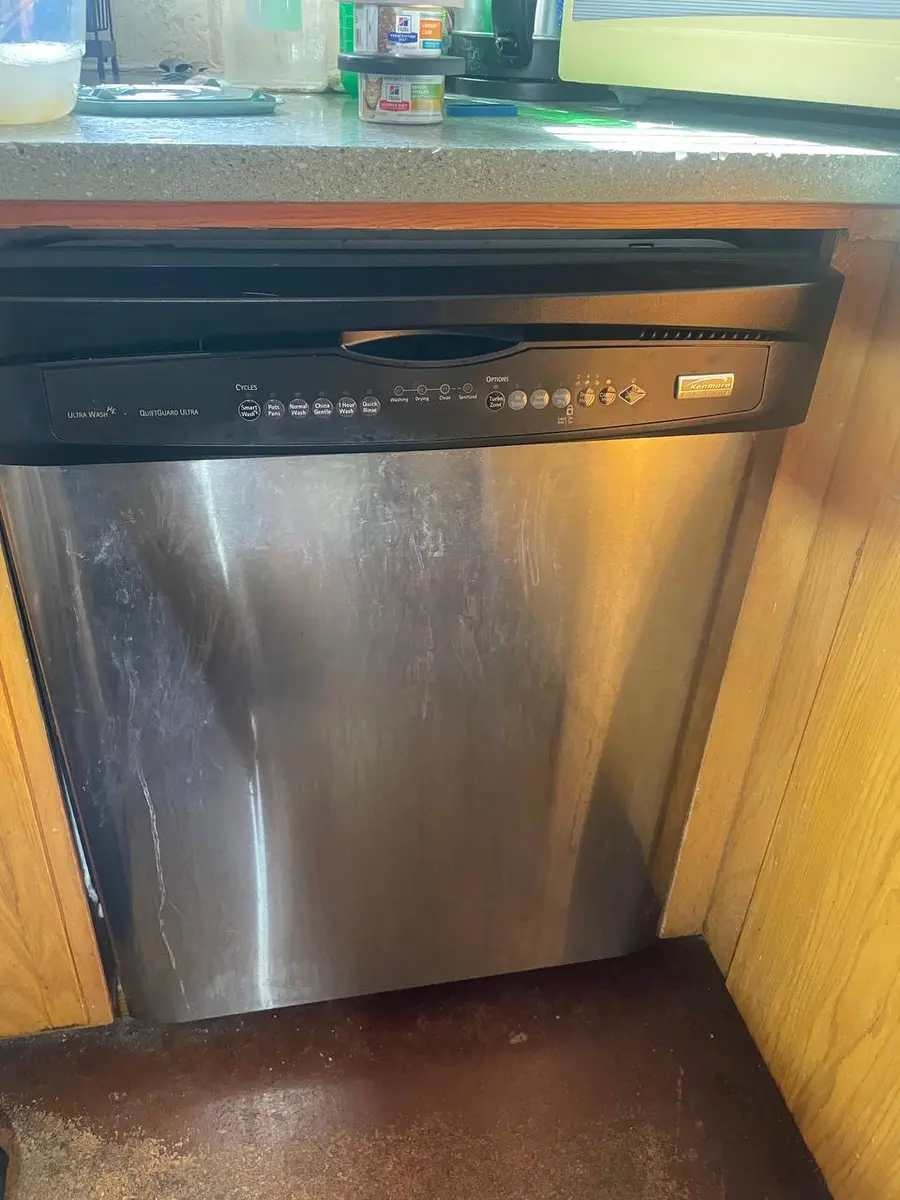
Kenmore Dishwasher Switch Replacement Guide
A Kenmore dishwasher relies on three separate switches — the door interlock, the float switch, and (on older timer machines) the cycle selector. The door interlock fails most often and is one of the simplest dishwasher parts to swap, usually 20–30 minutes with a Torx T20 driver and a multimeter.
Because "Kenmore" is a badge rather than a factory, the switch you actually need depends on which manufacturer built the machine. The first three digits of the model number settle it: 665 units are Whirlpool-built and use discrete W10-series microswitches, while 722 Kenmore Elite units are LG-built and fold most switching logic into the control board. A 587 prefix points to Frigidaire and 630 to Samsung. Identify the platform before you order anything — the label on the front tells you nothing about parts.
Which switch is failing?#
Each switch produces a distinct symptom, so you can usually narrow the culprit without opening the door:
| Switch | Job | Relative cost | DIY effort |
|---|---|---|---|
| Door interlock | Cuts all power unless the door is latched | Low — among the cheapest parts | Beginner, ~20–30 min |
| Float switch | Tells the inlet valve to stop filling | Low | Beginner, ~25–35 min |
| Cycle selector | Routes power on mechanical-timer models | Low–moderate | Moderate, ~45–60 min |
- Dead panel, no response to any button — a door interlock that failed open kills power to the whole control system. On Whirlpool platforms this often surfaces as an F5 door-switch fault.
- Overfilling, or water pooling on the floor — the float switch is stuck closed and never signals the F8 inlet valve to shut off.
- Runs one cycle regardless of the dial — the mechanical cycle selector's contacts are worn (older 665 timer models only), or the dial turns without engaging anything.
Do You Have the Right Tools?
Water pressure gauge ($60), spray arm tester, float switch multimeter ($85), and drain inspection camera. Our technician arrives with $3,000+ in professional tools — your diagnostic is free.
Licensed & Insured · 90-Day Warranty · Same-Day Service
Testing and replacing the door switch#
Cut power at the breaker first; a dishwasher door switch sits in a live circuit. Remove the inner door panel (Torx T20 on 665 builds), unplug the switch leads, and probe the switch with a multimeter set to continuity. A healthy switch reads closed when the plunger is pressed and open when released — no change in either position confirms it is dead. A single-pole switch has two wires; a dual-pole has four, so note which leads go where before you pull them. Snap the replacement into the same bracket, transfer the leads exactly, and reassemble.
The float switch follows the same logic from below: lift the dome-shaped float inside the tub, drop the lower kickplate, and swap the two-wire switch mounted beneath it. Confirm the float travels up and down freely before you close everything up, because trapped food debris can jam the float and imitate a dead switch. The cycle selector on old timer machines is a bigger job — it lives behind the control panel with multiple color-coded connections — so photograph every wire before disconnecting it.
Buy the OEM part, not the Kenmore label#
Once you know the builder, search the Whirlpool or LG part number directly instead of the Kenmore-branded equivalent. The identical component under the OEM name typically runs 30–40% less. Whirlpool door and float switches carry W10/WP numbers; if the same platform is also throwing an F9 drain fault, treat that as a separate sub-system rather than assuming one switch is behind everything. Entering the machine's diagnostic mode helps confirm the fault before you buy — on 665 units you press three pads in sequence within 5 seconds; a 722 Elite uses Power then Start within 3 seconds.
Safety First — Know the Risks
Live 120V wiring in a wet environment is one of the most dangerous DIY scenarios. Water + electricity = serious shock risk. Our techs are licensed and insured — let them handle the risk.
Licensed & Insured · 90-Day Warranty · Same-Day Service
Lifespan and prevention#
The door switch takes the most abuse — it actuates every time the door opens — and typically lasts 5 to 10 years. Float switches rarely trigger, so they run 8 to 15 years, and the rotary cycle selectors on old timer machines are robust enough to reach 10 to 20 years. To stretch that out: wipe mineral and detergent film from the door-switch area once a year, keep the float dome clear of food debris so it never sticks, and avoid slamming the door, which fatigues the interlock contacts over thousands of cycles.
Appliance Repair Technician · 8 years experience
Experienced technician with 8 years specializing in dishwasher repairs and European appliance brands including Bosch and Thermador.