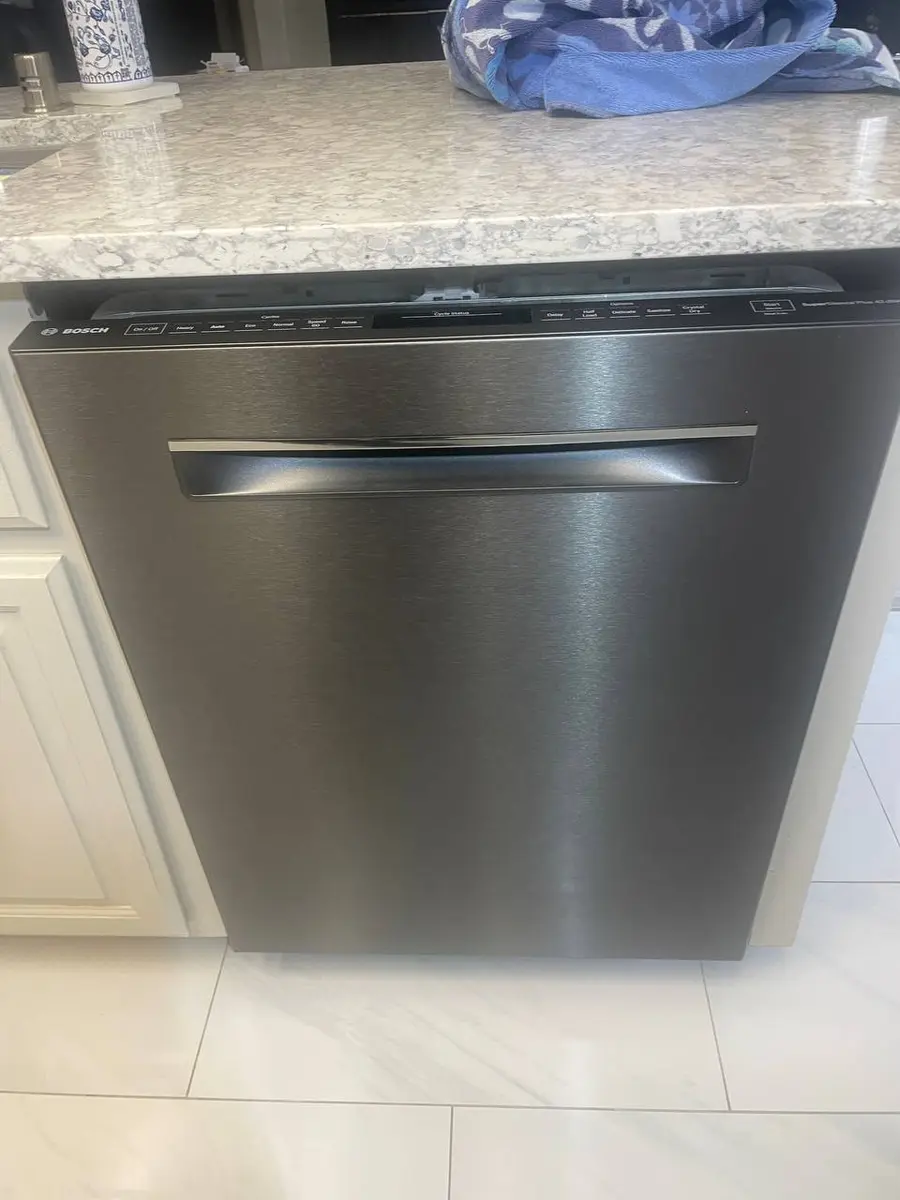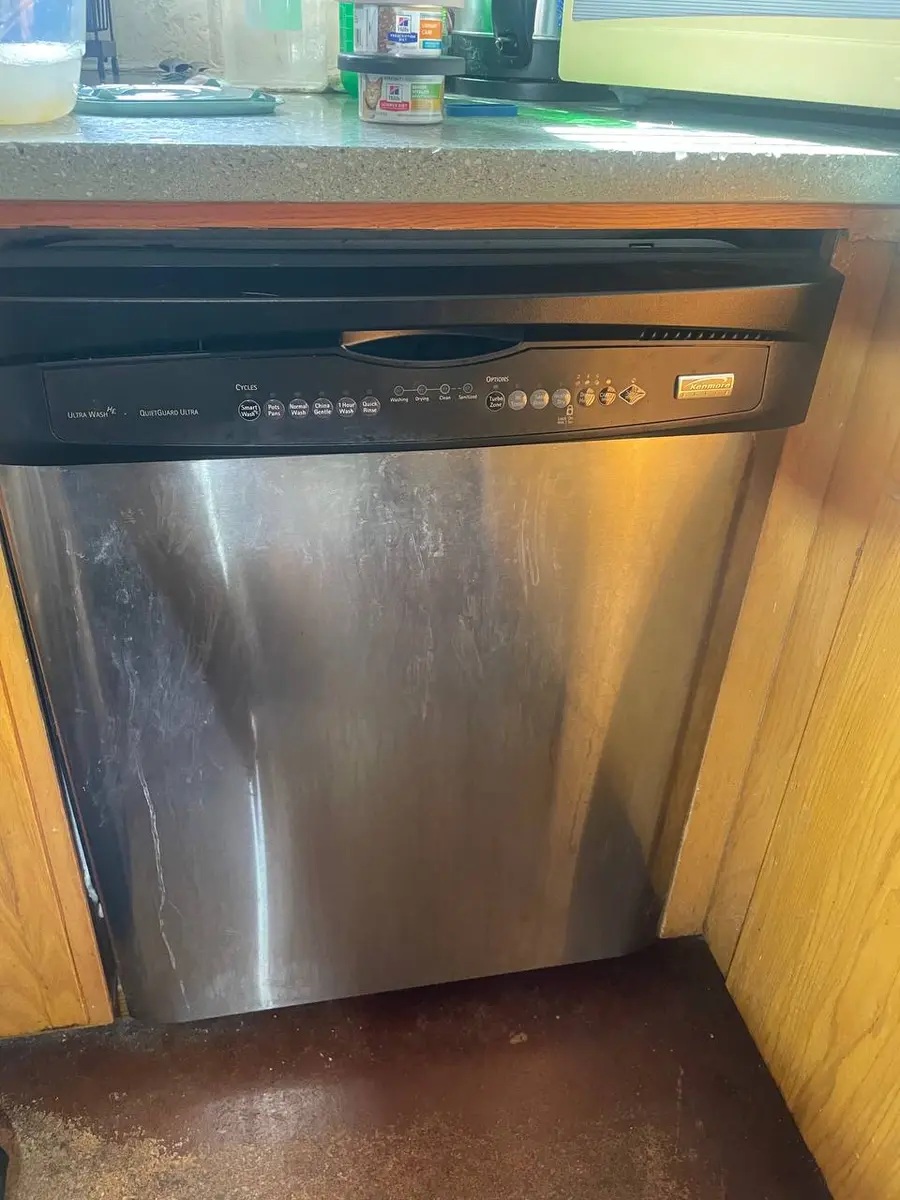
Kenmore dishwashers are one of the most confusing appliances to troubleshoot because Kenmore sources them from multiple manufacturers, each with its own error code system. A flashing clean light on one Kenmore means something completely different from an "i30" on another. This cross-manufacturer guide decodes both Kenmore dishwasher code formats.
Identify Your Kenmore Dishwasher's Code Format#
Find the model number on the sticker — usually on the door frame (visible when the door is open), on the left or right side of the tub opening. Your owner's manual or the tech sheet for that model confirms which code system it uses. The display itself is the quickest clue:
- Blinking lights or F-codes — an indicator light flashes a set number of times, or a digital display shows an F-code. See the blink-code section below.
- "i" + number codes (i10, i20, i30 and so on) — see the i-code section below.
Important: Many Kenmore dishwashers do not display alphanumeric codes. Instead, they use blinking light patterns — 1 blink, 2 blinks, etc. — where the number of blinks corresponds to the fault. This guide covers both formats.
Do You Have the Right Tools?
Water pressure gauge ($60), spray arm tester, float switch multimeter ($85), and drain inspection camera. Our technician arrives with $3,000+ in professional tools — your diagnostic is free.
Licensed & Insured · 90-Day Warranty · Same-Day Service
Kenmore Dishwashers With Blink Codes or F-Codes#
Newer models with digital displays show F-codes. Older models with button panels use flashing clean-light sequences.
F1 / 1 Blink — Water Temperature Sensor (Thermistor) Error#
The water temperature sensor is reading abnormally — either shorted or showing an open circuit.
Common causes:
- Failed thermistor
- Disconnected sensor wire in the tub sump area
- Sensor corroded from hard water deposits
How to fix:
- Switch off the dishwasher's breaker before you open the toe panel or touch the sensor wiring. The thermistor is typically mounted in the tub sump area near the heating element.
- Measure resistance and compare the reading with the value on your model's tech sheet.
- If the reading is 0 or infinite, replace the sensor.
- Also check the wire connector for corrosion — hard-water areas often see mineral buildup on sensor pins.
F2 / 2 Blinks — Stuck Key / Console Error#
The control is reading a stuck key on the console, or the touch panel membrane has failed.
Common causes:
- Button physically stuck from moisture or spilled detergent
- Touch panel membrane degraded
- Ribbon cable between panel and control board corroded
How to fix:
- Check each button on the panel — press firmly and release. If any feels sticky or does not spring back, clean around it with a slightly damp cloth.
- If no button is stuck, the touch panel membrane has likely degraded. Some models have a combined panel/board assembly; others have a separate overlay.
- Switch off the dishwasher's breaker before you open the door panel. Disconnect the ribbon cable from the control board, clean contacts with electronics cleaner, and reconnect firmly.
- If the overlay membrane is damaged, replace it.
F6 / 6 Blinks — Water Inlet / Flow Meter Error#
The dishwasher is not filling with water or not filling fast enough, or the flow meter (turbine sensor) on the inlet valve assembly is not detecting water flowing through.
Common causes:
- Water supply valve under the sink turned off or partially closed
- Kinked inlet hose
- Clogged inlet valve screen with mineral deposits
- Faulty water inlet valve
- Mineral buildup inside the flow meter housing blocking the turbine
How to fix:
- Check the shut-off valve under the sink — turn it fully counterclockwise to open.
- Inspect the inlet hose for kinks between the valve and the dishwasher.
- Switch off the breaker and turn off the water, then disconnect the inlet hose at the valve. Check the mesh screen filter for mineral buildup — clean with vinegar and a toothbrush.
- If the screen is clean and pressure is adequate, the inlet valve or the flow meter needs replacement — a technician can confirm which.
F7 / 7 Blinks — Circulation (Wash) Motor Error#
The circulation motor has stalled — sometimes because a glass shard is wedged in the impeller, sometimes because of a weak start capacitor.
How to fix:
- Switch off the dishwasher's breaker before you open the sump.
- Wearing gloves, remove the lower spray arm and the filter assembly and check the sump for broken glass or hard debris.
- If the sump is clear, the motor or its start capacitor needs testing — a technician job.
F8 / 8 Blinks — Drain Pump Error#
The drain pump is not clearing water from the tub — the pump itself has failed, or debris is reaching it.
Common causes:
- Clogged food filter at the tub bottom (the number one cause)
- Failed drain pump motor
How to fix:
- Remove the lower spray arm and the food filter assembly at the bottom of the tub. Clean thoroughly — food particles and grease accumulate here with every cycle.
- If the filter is clear, the drain pump may have failed. Listen carefully — no sound at all means the motor is dead; a humming sound with no water movement means a jammed impeller.
F9 / 9 Blinks — Drain Timeout#
The drain did not finish in time — usually a problem in the drain path rather than the pump itself.
Common causes:
- Blocked or kinked drain hose at the disposal or air gap connection
- Knockout plug still in garbage disposal (on new installations)
- A drain pump that has grown weak
How to fix:
- Check the drain hose connection at the garbage disposal or sink drain. If you recently installed a new disposal, verify the knockout plug was removed from the disposal's dishwasher port.
- Verify the drain hose has a high loop (or air gap) to prevent backflow from the sink, and that it is not kinked behind the dishwasher.
- If the drain path is clear, have the pump checked — a weak pump can time out without failing outright.
Kenmore Dishwashers With i-Codes#
These Kenmore dishwashers use an "i" + number code format.
i10 — Water Supply Error#
The dishwasher is not receiving water or filling too slowly.
Common causes:
- Water supply valve turned off
- Inlet hose kinked or crushed
- Inlet valve screen clogged with mineral deposits
How to fix:
- Check the hot water supply valve under the sink — open fully.
- Run hot water at the kitchen sink for 30 seconds before starting the dishwasher to prime the hot water line.
- Close the supply valve under the sink and switch off the dishwasher's breaker before you disconnect anything. Remove the inlet hose and clean the mesh screen filter at both ends.
- If the valve solenoid has failed, the inlet valve needs replacement.
i20 / i40 — Drain Error#
Water is not draining from the tub. i40 is the same fault code after a secondary timeout attempt.
Common causes:
- Clogged triple-filter assembly at the tub bottom
- Blocked drain hose at disposal or air gap
- Drain pump failure
How to fix:
- Remove and clean the triple-filter system at the tub bottom (fine filter, coarse filter, mesh screen).
- Check drain hose at the disposal — ensure the knockout plug was removed on new installations.
- Verify there is a high loop or air gap in the drain hose to prevent backflow.
- If the pump hums but water does not drain, the impeller is jammed. If silent, the motor has failed.
i30 — Leak / Overflow#
The float switch in the base pan detected water, indicating a leak inside the dishwasher.
Common causes:
- Door gasket failure
- Loose hose connections inside the tub
- Spray arm hitting a tall dish and redirecting water outside the tub
How to fix:
- Turn off power and water. Get a second person to help you carefully pull the dishwasher out from under the counter.
- Check the base pan for standing water and soak it up.
- Inspect the door gasket for tears, food debris, or compression loss along its length.
- If you cannot see where the water came from, push the dishwasher back into place, restore water and power, run a short cycle and then check for fresh water on the floor — never reach under a running dishwasher. A leak you cannot trace is a technician job.
- Replace a torn or flattened door gasket.
i50 — Drain Motor Error#
The drain pump motor has failed electrically — distinct from i20 which indicates a physical blockage.
Common causes:
- Drain pump motor windings burned
- Wiring harness fault between board and pump
- Control board relay failure
How to fix:
- Switch off the dishwasher's breaker, then, wearing gloves, check the drain pump impeller for foreign objects (glass shards, bones).
- With the power still off, measure pump motor resistance and compare it with the tech-sheet value.
- If the pump hums but does not turn, a foreign object is jamming the impeller. If it is completely silent, have a technician check whether the pump is getting power — testing a live connector is a technician job.
i60 — Heating Error#
The water is not reaching the target temperature for the selected wash cycle.
Common causes:
- Heating element failure
- NTC thermistor fault giving incorrect temperature readings
- Wiring issue between the control board and heating element
How to fix:
- Switch off the dishwasher's breaker, then test heating element resistance and compare it with the tech-sheet value.
- Check the NTC thermistor resistance against the tech-sheet value.
- Run hot water at the kitchen faucet before starting — if inlet water temperature is below 120°F, the element must work much harder and may exceed its timeout.
PF — Power Failure#
The dishwasher experienced a power interruption during a cycle.
How to fix:
- Press Start/Resume to continue the interrupted cycle.
- If PF appears without a known power outage, check the circuit breaker. Loose wiring in the junction box under the dishwasher is a job for a technician or electrician, with the breaker switched off first.
Safety First — Know the Risks
Live 120V wiring in a wet environment is one of the most dangerous DIY scenarios. Water + electricity = serious shock risk. Our techs are licensed and insured — let them handle the risk.
Licensed & Insured · 90-Day Warranty · Same-Day Service
Kenmore Dishwasher Diagnostic Mode#
Both code formats have a diagnostic (service) mode, and the button sequence that enters it differs by model — follow the diagnostic-mode procedure on your model's tech sheet.
Frequently Asked Questions#
Q: My Kenmore dishwasher's clean light blinks 7 times. What does that mean? A: On a Kenmore that uses blink codes, 7 blinks points to the circulation (wash) motor — it has stalled, sometimes because a glass shard is wedged in the impeller. Switch off the breaker, then check the sump for broken glass wearing gloves; if it is clear, have a technician test the motor and its start capacitor.
Q: Why does my Kenmore dishwasher smell bad even after cleaning? A: The most common source is the food filter at the tub bottom — most owners do not realize it needs regular cleaning. Remove the lower spray arm, pull out the filter assembly, and clean it thoroughly with dish soap and a brush. Also run an empty cycle with 1 cup of white vinegar placed upright in a glass on the top rack.
Q: Can I use regular dish soap in my Kenmore dishwasher? A: No. Regular hand dish soap creates massive suds that overflow the tub, trigger the leak float switch (i30 on i-code models), and can damage the pump seals. Use only automatic dishwasher detergent — pods, powder, or liquid specifically labeled for dishwashers.
Q: How do I reset my Kenmore dishwasher after an error? A: Turn off the circuit breaker for 60 seconds, then turn it back on. On some models you can also press and hold Start/Cancel for 3 seconds to drain and reset. The error code will clear once the underlying issue is resolved and a successful cycle completes.
Q: Why does my Kenmore dishwasher leave dishes dirty on the top rack? A: This usually indicates a diverter motor problem — the motor is not switching water to the upper spray arm. It can also be caused by a clogged upper spray arm (remove it and flush water through to clear blocked nozzles) or low water pressure that cannot reach the top rack effectively.
The Real Cost of DIY
Average DIY attempt: $150-400 in tools you may use once, plus the risk of further damage. Our diagnostic visit costs $0 — we find the problem and give you an honest quote.
Licensed & Insured · 90-Day Warranty · Same-Day Service
When to Call a Professional#
- Persistent leak (i30) — Internal leaks from the pump seal or tub require pulling the dishwasher out and accessing components underneath, which involves water line and electrical disconnection.
- Control board failure — Board replacement involves electrical connections in a wet environment and is best handled by a trained technician.
- Heating element replacement — Requires accessing the tub sump area and working with high-voltage connections.
- Installation issues — If your dishwasher was recently installed and shows drain or fill errors, the plumbing connections may need professional inspection and correction.
Kenmore dishwasher giving you trouble? EasyBear technicians are trained on major appliance brands, Kenmore included. We identify your manufacturer before arriving so we bring the right parts the first time. Free diagnostic visit, 90-day repair warranty. Schedule your free diagnosis today.