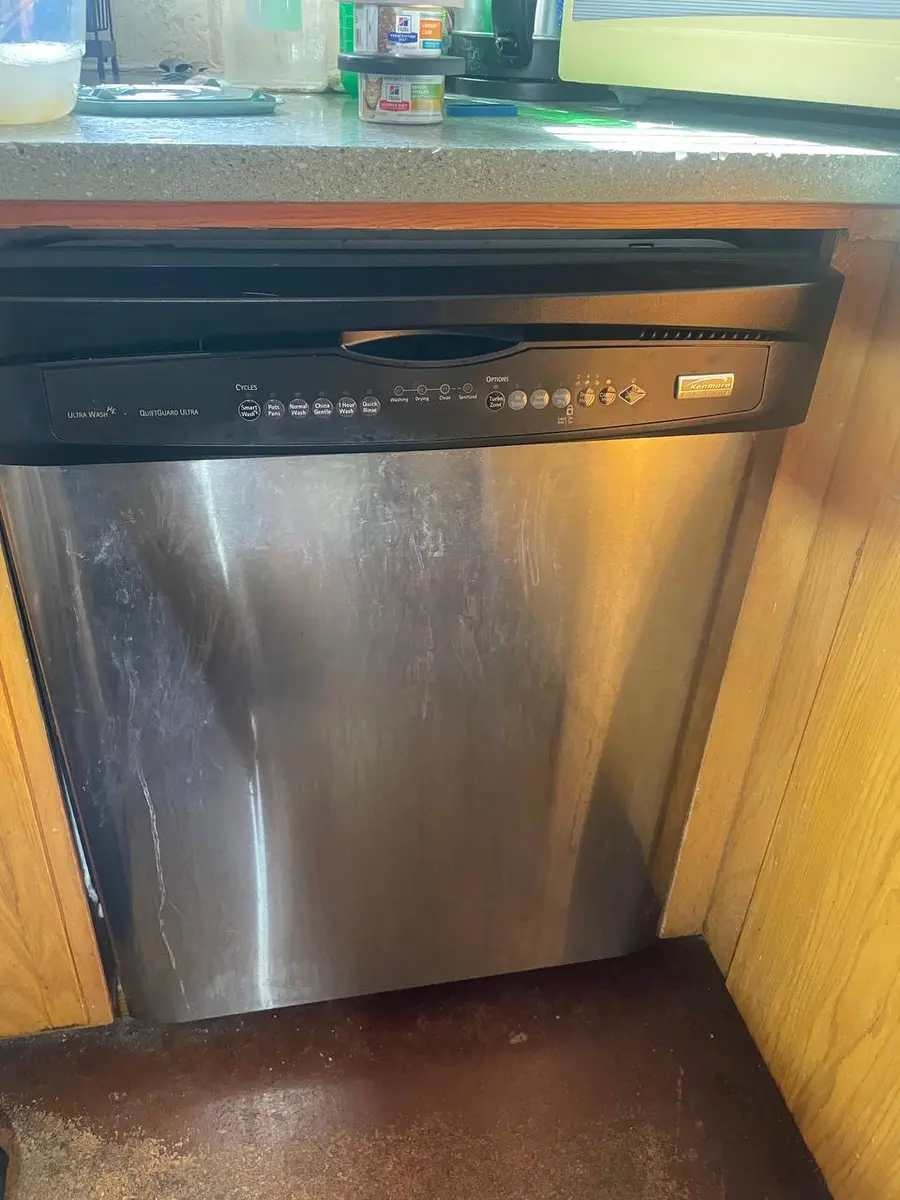
Kenmore Dishwasher Sanitize Light: What It Means
the Sani LED flashes on a Kenmore dishwasher when the machine did not detect the temperature that sanitization requires — and the first place to look is the hot water arriving at the house, not the dishwasher.
EasyBear is an independent appliance repair company. We are not affiliated with or authorized by Kenmore.
Start at the faucet, not the appliance#
The manufacturer's own first instruction for this indicator is telling: check the water temperature at the nearest faucet by running the hot water for about 30 seconds. That instruction points away from the dishwasher entirely, and there is a reason for it.
A dishwasher does not manufacture its heat budget from nothing. It draws whatever the household supplies and works from there. If the water reaching the machine starts cold — a long run from the tank, a tank set low, a nearby fixture that just drained the hot supply — the cycle begins in a hole it may never climb out of, and the LED reports the shortfall at the end.
Thirty seconds at the nearest faucet is a genuine test, not a formality. It tells you what the machine had to work with.
Do You Have the Right Tools?
Water pressure gauge ($60), spray arm tester, float switch multimeter ($85), and drain inspection camera. Our technician arrives with $3,000+ in professional tools — your diagnostic is free.
Licensed & Insured · 90-Day Warranty · Same-Day Service
The two ways a load misses the temperature#
| Where the heat was lost | What it looks like |
|---|---|
| The supply never delivered it | Water at the nearest faucet runs cool after 30 seconds of flow |
| The cycle lost it | The door was opened during the cycle, letting the heat escape before the Sanitize Cycle requirement was met |
Both end in the same flashing LED, and they are distinguished by a test rather than a guess. That is why the faucet check comes first: it separates a supply problem from a cycle problem before you touch the dishwasher at all.
The sequence to work through#
- Run the hot water at the nearest faucet for about 30 seconds and check the temperature of what comes out.
- Start the cycle once the hot supply has arrived, and leave the door shut for the whole run.
- If the LED still flashes, unplug the dishwasher for 30 seconds and then plug it back in.
- If it is hard wired, turn the breaker off at the home's electrical panel that powers the dishwasher for 30 seconds, then turn the breaker back on.
Working in that order matters. A power reset performed before the faucet test tells you nothing, because a control that reads its sensor perfectly will still flash when the water was never hot.
Safety First — Know the Risks
Live 120V wiring in a wet environment is one of the most dangerous DIY scenarios. Water + electricity = serious shock risk. Our techs are licensed and insured — let them handle the risk.
Licensed & Insured · 90-Day Warranty · Same-Day Service
Worth fixing, or worth living with?#
For most households this never becomes a repair. It becomes a habit: draw the hot water first, keep the door shut, and the indicator stops flashing. The cost of that is zero and the fix is permanent.
The case that earns a technician is narrow and specific — hot water confirmed at the tap, a cycle nobody opened, a control already power-cycled, and the LED still flashing. That combination points at the control panel, the part associated with this indicator, and testing it is the honest next step rather than swapping parts to see what sticks.
Have the control tested properly#
If your Kenmore dishwasher flashes the Sani LED with genuinely hot water at the tap and the door shut all cycle, book an EasyBear technician. We will measure what the machine is actually seeing and tell you whether the control panel is reporting the truth.
Appliance Repair Technician · 8 years experience
Experienced technician with 8 years specializing in dishwasher repairs and European appliance brands including Bosch and Thermador.