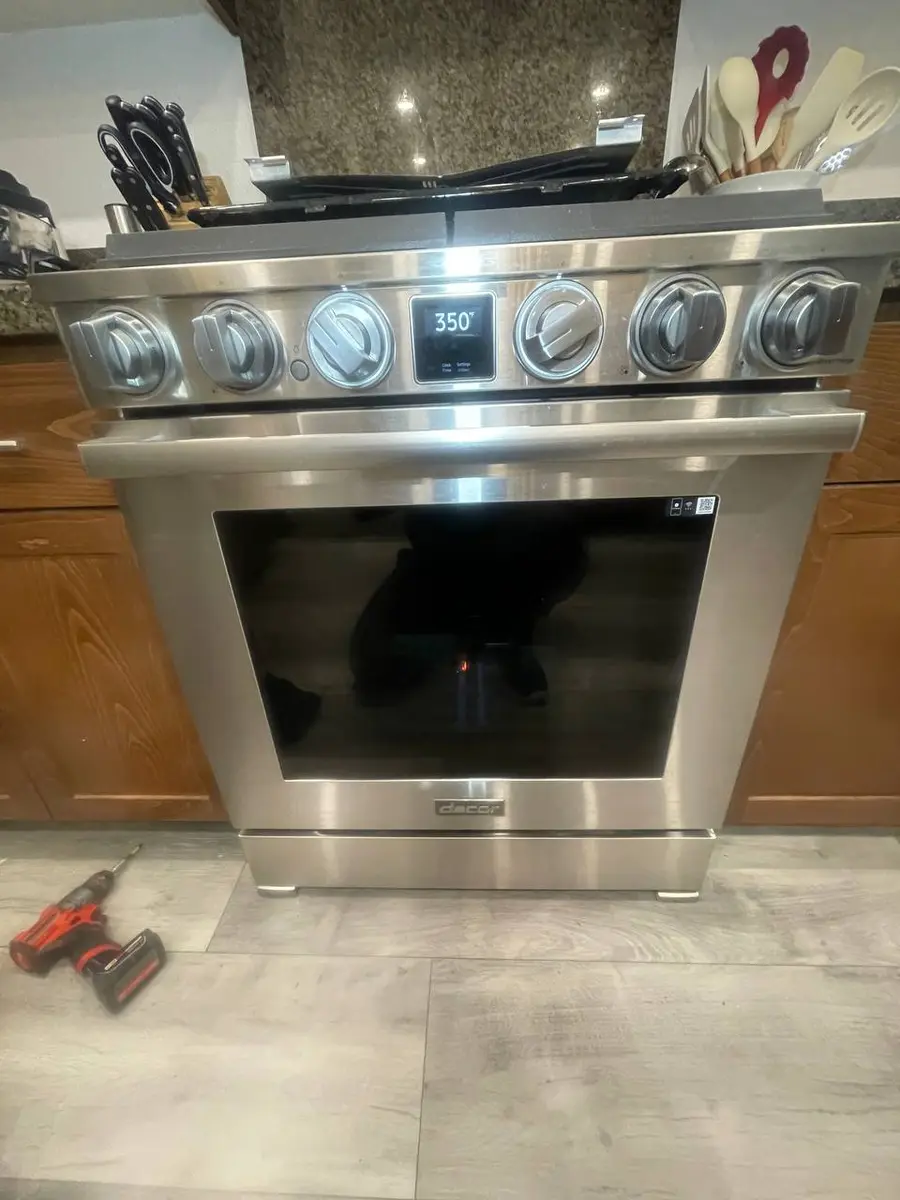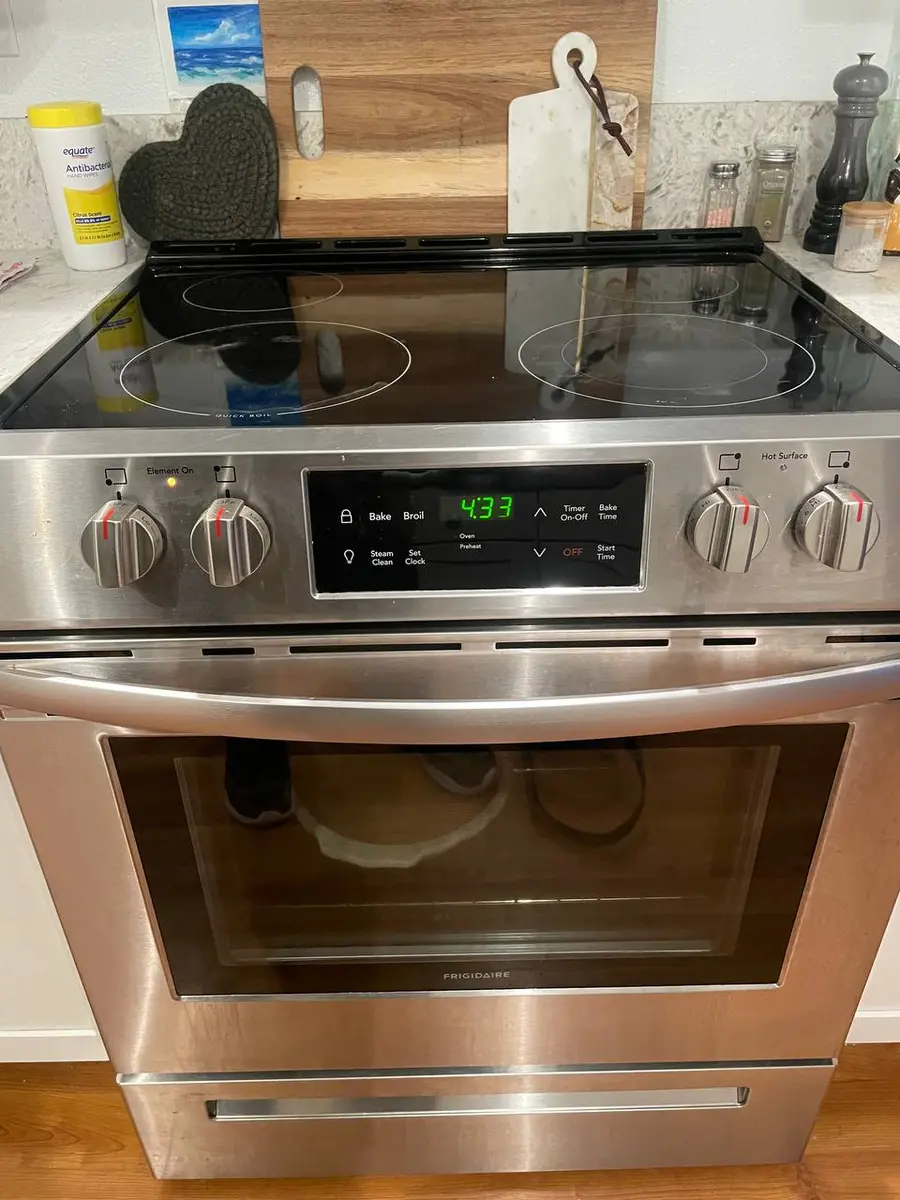
A Whirlpool oven that shuts itself off mid-cook is usually a temperature sensor cutting in and out, a safety device tripping on heat, or the control board losing its place — and its F#E# codes point almost straight at which. Pull the stored codes in diagnostic mode first, then use the timing of the shutoffs and whether the clock survives to name the part.
Start With the Stored Codes#
Whirlpool ovens keep a fault history, so the fastest first move is to read it. Enter diagnostic mode with the model-specific button sequence on the tech sheet (behind the rear panel or inside the console) and note any stored codes: F3E1 and F3E2 are the temperature sensor, F5E1 is the door lock, F1E0 through F1E2 are board-level faults, and F2E1 is a stuck key. On WFE and WFG ranges and WOS and WOD wall ovens, the AccuBake system leans on that sensor — about 1080 ohms at room temperature — to hold heat, and several of the shutdown causes announce themselves in the log before you touch a tool.
Do You Have the Right Tools?
Combustion analyzer ($300), igniter tester ($120), temperature calibrator ($150), and gas pressure manometer. Our technician arrives with $3,000+ in professional tools — your diagnostic is free.
Licensed & Insured · 90-Day Warranty · Same-Day Service
Two Free Observations That Narrow It#
Before opening anything, note two things at the moment of shutoff. First, the clock: if it resets to a flashing default, the board lost power entirely, which points at a supply interruption or a tripped safety; if the clock keeps running normally, the board stayed alive and the heat chain dropped out under it. Second, the pattern: a shutoff at random, works-then-quits intervals is the fingerprint of an intermittent sensor, while a steady interval — the oven runs a consistent stretch and then cuts — points at a heat-driven part like a relay or a thermal device warming to its trip point.
The Causes, Most Likely First#
Intermittent temperature sensor (about 25%)#
The most common cause of an oven that quits on its own. When the sensor's connection is failing — a wire cracked at the rear-wall pass-through, or corroded pins at the board — the board momentarily loses its temperature reference and shuts heating down to stay safe, throwing F3E1 (open) or F3E2 (short) if it catches the fault. The tell is the random, unpredictable timing. Meter the sensor across its leads for that 1080-ohm room-temperature value, and do the wiggle test: jiggle the connector while the oven runs, and if it cuts out, you've found an intermittent connection rather than a dead sensor.
Control-board relay or memory fault (about 15%)#
A relay on the board that opens when it heats up — from radiant warmth reaching the console after the oven has run a while — cuts the element yet leaves the display alive, which is why the clock keeps running through the shutoff. Separately, a power surge can corrupt the board's cycle memory so it simply loses track and stops. F1-series codes flag board faults, and if several unrelated functions misbehave together, the board is the common thread. A hard reset — breaker off for a few minutes — clears a corrupted-memory case, but a heat-sensitive relay will keep quitting until the board is replaced.
Thermal fuse or high-limit thermostat (about 5%)#
These safety devices cut power when they sense overheating, and one that trips — or a thermal fuse degrading toward its limit — will shut the oven down partway through and leave it dead until it cools. A steady runs-then-quits pattern with the clock resetting fits here. Test them for continuity, and crucially, find why they tripped, usually a real overheat from a stuck relay or blocked airflow, before simply replacing them.
Door switch or lock losing signal (about 10%)#
The oven wants confirmation the door is closed, and a door switch or self-clean lock that drops its signal mid-cycle can make the board halt as though the door opened. An F5E1 lock code, or a shutoff that coincides with the door being bumped, points here. Check the switch and lock harness for a signal that comes and goes.
Safety First — Know the Risks
Gas ovens involve live gas lines — a loose connection creates explosion and carbon monoxide risk. Electric ovens run on 240V circuits. Our techs are licensed and insured — let them handle the risk.
Licensed & Insured · 90-Day Warranty · Same-Day Service
Gas Ovens "Turn Off" Differently#
On a gas Whirlpool range, a self-shutoff often isn't the controls quitting at all — it's the flame going out. A hot-surface igniter that has weakened draws less current as it ages, and once it drifts below the roughly 3-amp threshold needed to hold the gas safety valve open, the valve closes and the burner dies even though the oven never commanded a shutoff. The classic signature is an oven that lights and heats fine at first, then loses heat ten or twenty minutes in as the igniter and valve warm — the igniter is right at the edge of its threshold when hot. Watch the igniter through the bottom vent: if it glows but the flame drops out, or it glows more than about ninety seconds without lighting, it has degraded and needs replacing. Handle the new igniter only by its metal bracket, since skin oil on the ceramic shortens its life. This is a genuinely different failure from the electric-side sensor and relay causes, so identify your fuel type before chasing parts.
A Clean Diagnostic Order#
Put it together so you test cheap and common before expensive and rare. Read the stored codes first — they may hand you the answer outright. Note the clock at shutoff and the interval between shutoffs to sort intermittent-sensor from heat-driven-relay from safety-trip. Meter the temperature sensor and wiggle-test its connector, since the sensor and its wiring top the list and cost the least. Try a hard reset to clear a corrupted board memory. Test the thermal fuse and high-limit for continuity if the clock resets and the pattern is a steady runs-then-quits. Check the door switch and lock harness for a dropping signal, especially with an F5E1 code. And on a gas oven, watch the igniter and flame directly. Working outside-in this way keeps you from replacing a control board for what was really a fifteen-dollar sensor or a loose connector.
The Real Cost of DIY
Average DIY attempt: $150-400 in tools you may use once, plus the risk of further damage. Our diagnostic visit costs $0 — we find the problem and give you an honest quote.
Licensed & Insured · 90-Day Warranty · Same-Day Service
Don't Forget the Simple Explanations#
Two non-faults masquerade as this symptom. Many Whirlpool ovens include an automatic shutoff after a long unattended run — a safety feature, not a defect — so an oven that quits at the same elapsed time on a marathon bake may simply be doing its job; check the manual for the setting. And a genuine power-supply interruption at the outlet, cord, or breaker resets the board, which the flashing clock reveals. Rule those out, then work the causes: read the codes, do the clock and timing checks, wiggle-test the sensor, and hard-reset for a memory fault before condemning a part. Because the sensor and its connection sit at the top of the list and are the cheapest to check, start there and you'll resolve most self-shutoff calls without touching the board.
Keep It From Recurring#
Once you've fixed the immediate cause, a few habits keep the oven from quitting again. The temperature sensor's connector is the recurring weak point, because every heat cycle expands and contracts the wire at the rear-wall pass-through, so checking that connection once a year for looseness or corrosion heads off the most common self-shutoff before it starts. Protect the control board with a surge protector rated for the oven's amperage, since surges are what both corrupt board memory and, over time, weaken the relays that quit when hot. Limit self-clean to a few times a year and clean spills by hand instead, because the extreme heat of that cycle is hard on the sensor, the lock, and the safety thermostats alike. And on a gas model, have the igniter tested during annual maintenance and replaced before it fully weakens, so a burner that's already hovering at its threshold doesn't strand you with a half-cooked dinner. None of these are expensive, and together they address the sensor, the board, the safety devices, and the igniter — the whole spread of causes behind an oven that turns itself off before any of them can strand a meal again.
Related reading: a Whirlpool oven element that won't heat and a Whirlpool oven that won't start.
Whirlpool [oven repair](/bay-area/services/oven-repair) across [Sacramento](/sacramento/sacramento) and the Bay Area — sensor, board, and safety-device diagnostics in one visit. Book a technician.
Lead Appliance Repair Technician · 12 years experience
Experienced technician with 12 years specializing in washing machine and dryer repairs across all major brands.