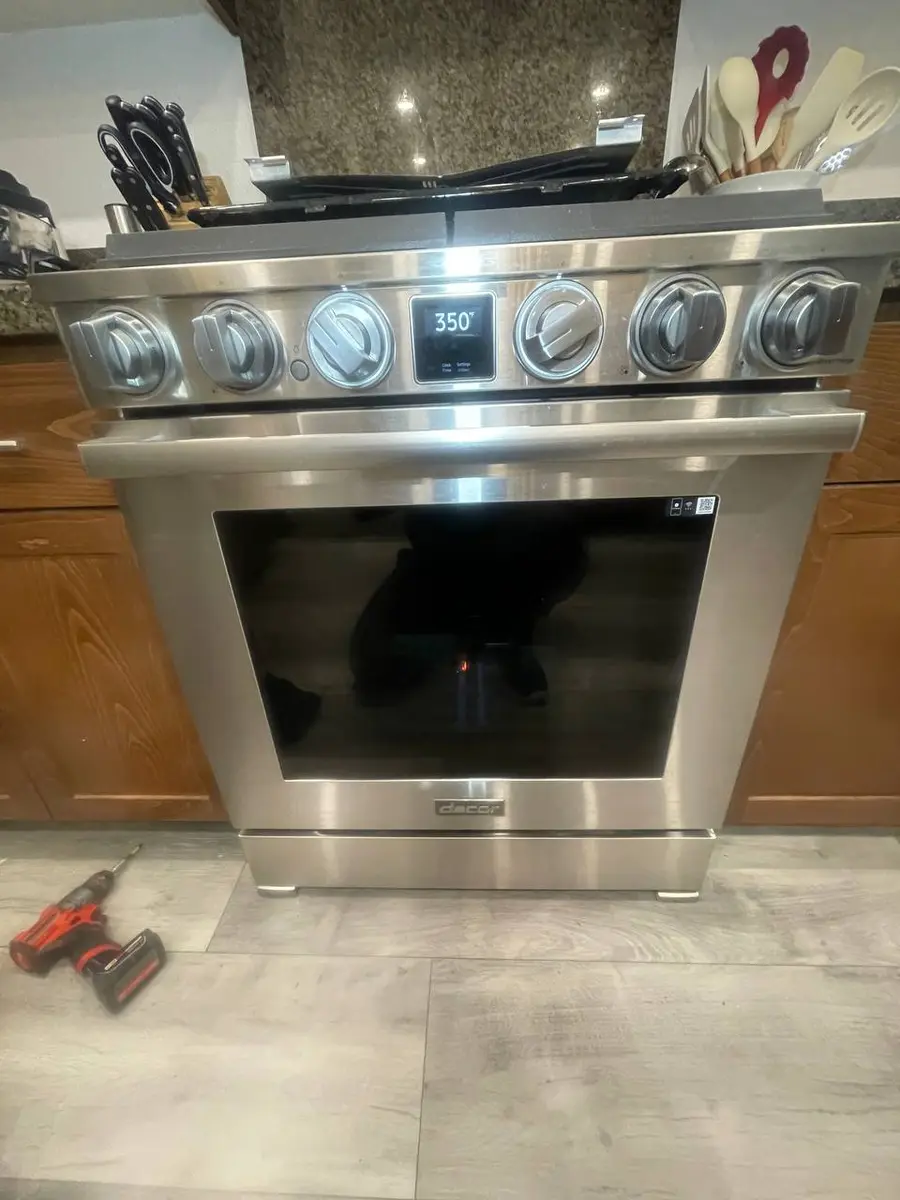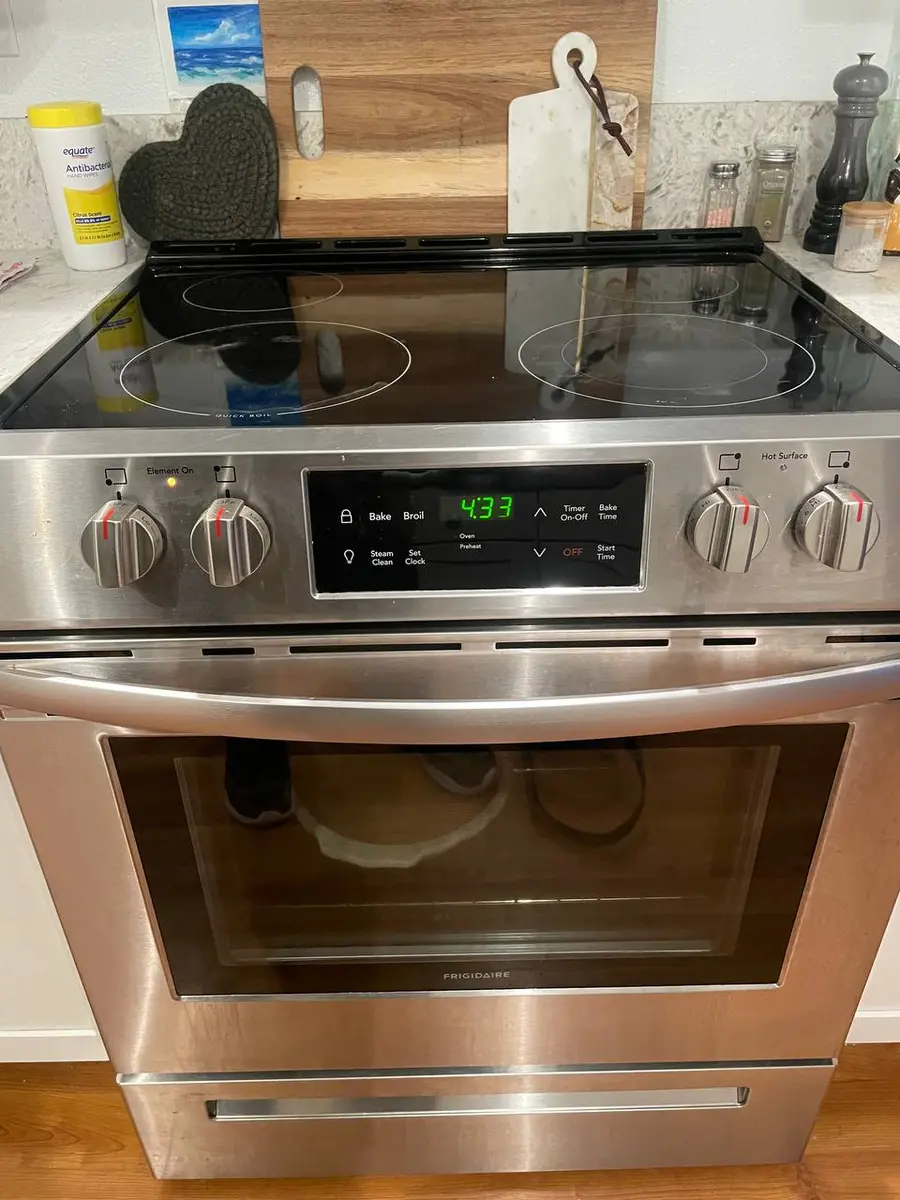
GE Monogram ovens and ranges represent professional-grade cooking in a residential setting — dual-fuel ranges (ZDP, ZGP series), gas rangetops, built-in wall ovens (ZET, ZEP, ZKD series), and the unique Advantium speedcook ovens. These units share GE's F-code diagnostic platform but feature more complex heating systems, multiple oven cavities, advanced convection, and professional-grade gas burner systems requiring specialized knowledge. With Monogram ranges running $5,000–significant cost, understanding error codes quickly matters.
How GE Monogram Oven Codes Display#
Monogram ovens use the Electronic Range Control (ERC) system common to all GE cooking products. Error codes display as "F" followed by a number on the LED or LCD panel. Key Monogram differences:
- Dual-cavity models — ZET and ZKD wall ovens have independent upper and lower ovens, each with their own ERC
- Dual-fuel complexity — ZDP ranges combine gas burners with electric ovens, meaning electrical failures affect only the oven while gas continues working
- Advantium technology — ZEP ovens use halogen bulbs, microwave, and convection in combination with unique codes beyond standard F-series
- Professional-grade gas — ZGP rangetops have electronic ignition modules separate from the ERC
To access code history on most Monogram wall ovens: press Bake + Broil simultaneously for 5 seconds. On ranges, hold Self-Clean + Delay Start for 5 seconds.
Do You Have the Right Tools?
Combustion analyzer ($300), igniter tester ($120), temperature calibrator ($150), and gas pressure manometer. Our technician arrives with $3,000+ in professional tools — your diagnostic is free.
Licensed & Insured · 90-Day Warranty · Same-Day Service
F0 — Stuck Keypanel#
The control board detects a key continuously pressed with no user interaction.
Why Monogram units are different: Monogram ranges and wall ovens feature glass-touch panels with capacitive sensing rather than membrane keypads. Grease film, moisture, and even certain cleaning products can cause phantom touches. The Monogram glass-touch interface is more sensitive than other GE variants.
Common causes:
- Grease or moisture film on glass-touch panel causing capacitive interference
- Control panel flex cable connection issue (common after cleaning behind the panel)
- ERC board capacitive sensing circuit failure
- Cleaning product residue (certain spray cleaners leave conductive film)
How to fix:
- Power off at the breaker — for Monogram built-in wall ovens, this is typically a dedicated 40A or 50A breaker.
- Clean the glass-touch panel with a microfiber cloth and a small amount of glass cleaner applied to the cloth (never sprayed directly on the panel).
- Wait 5 minutes after cleaning, then restore power.
- If F0 persists, the issue is internal. Access the flex cable connection — on Monogram wall ovens, the control board is behind the control panel.
- Reseat the flex cable. Check for corrosion on connector pins.
- If F0 still appears with the keypanel disconnected from the ERC, the ERC board itself has a fault.
Part cost: Glass-touch panel assembly for Monogram: varies by part. ERC board: varies by part. Professional repair: varies by part.
Prevention: Never spray cleaning products directly on the control panel. Use a damp (not wet) microfiber cloth only. Avoid abrasive cleaners that scratch the glass surface — micro-scratches allow moisture penetration.
F2 — Oven Over-Temperature#
The oven sensor detects temperature significantly above the set point. This is a safety-critical code — treat it as an emergency.
Why Monogram units are different: Monogram dual-fuel ranges and convection wall ovens have more powerful heating elements and faster preheat capabilities than standard GE. The over-temperature threshold activates sooner to protect sophisticated internal components. On dual-cavity models, F2 may appear in only one oven while the other operates normally.
Common causes:
- Oven temperature sensor (RTD) failure — reading lower than actual temp, causing ERC to keep heating
- Bake or broil relay stuck closed on the ERC board (welded contacts)
- Convection fan failure creating hot spots that trigger the safety sensor
- Sensor wiring short to ground (reads near-zero resistance, board interprets as extreme temp)
How to fix:
- Immediately cancel the cycle, open the oven door to ventilate, and power off at breaker.
- After cool-down (30+ minutes), test the oven sensor resistance at room temperature: expect approximately 1,080 ohms at 70F for Monogram models.
- Check sensor wiring for damage — on Monogram wall ovens, the sensor wire routes through the oven cavity wall and can degrade from repeated self-clean heat exposure.
- If the sensor reads correctly at room temp, the ERC's bake or broil relay is likely stuck closed. Confirmed if the heating element stays on even after reaching set temperature.
- For dual-cavity models: identify which cavity is showing F2 by entering diagnostic mode. Each cavity has its own RTD sensor and relay.
Part cost: Oven sensor: varies by part. ERC board for Monogram: varies by part. Professional repair: varies by part.
Safety warning: Do not continue using the oven if F2 appears. A stuck relay means uncontrolled heating — this is a fire hazard. Keep the breaker off until repair is complete.
Safety First — Know the Risks
Gas ovens involve live gas lines — a loose connection creates explosion and carbon monoxide risk. Electric ovens run on 240V circuits. Our techs are licensed and insured — let them handle the risk.
Licensed & Insured · 90-Day Warranty · Same-Day Service
F3 — Open Oven Sensor (RTD Open Circuit)#
The ERC detects infinite resistance on the oven sensor circuit — the sensor wire is broken or disconnected.
Why Monogram units are different: Monogram's self-clean cycle reaches higher temperatures (up to 950F) than standard GE models, accelerating sensor wire fatigue. Dual-cavity wall ovens have multiple sensors, and F3 may not clearly specify which sensor is open without entering diagnostic mode.
Common causes:
- Sensor element internal break (thermal fatigue from aggressive self-clean cycles)
- Disconnected sensor plug at the rear of the oven (vibration from convection fan over time)
- Broken wire in the harness where it passes through the oven cavity wall
- Corrosion at connector pins from ambient kitchen humidity
How to fix:
- Power off at breaker.
- Locate the oven sensor probe — a thin metal rod at the top-rear of the oven cavity, secured by one or two mounting screws.
- From behind the unit (pull out built-in wall ovens from cabinet to access), find the sensor connector.
- Measure resistance across the sensor terminals: expect ~1,080 ohms at room temperature. If infinite (OL on multimeter), the sensor or wire is broken.
- Disconnect the sensor connector and measure at the sensor end only — this isolates sensor from wiring to identify which has the break.
- For dual-cavity models: identify the correct sensor by tracing wires from the diagnostic mode indication.
Part cost: Oven sensor: varies by part. Wiring harness: varies by part. Professional repair: varies by part.
Self-clean advisory: On Monogram ovens over 5 years old, limit self-clean to 2–3 times per year and use the "light" setting when available. The thermal stress at 950F degrades sensor wiring insulation progressively.
F4 — Shorted Oven Sensor#
The ERC reads near-zero resistance from the sensor circuit — the opposite failure mode from F3.
Monogram-specific context: On Monogram wall ovens where the sensor wire routes through tight cabinet-space walls, insulation degradation from heat and physical contact with metal edges can create a ground short. This is more common in retrofit installations where Monogram units replaced older, differently-sized appliances.
How to fix:
- Power off at breaker.
- Disconnect the sensor at its connector. Measure resistance — a shorted sensor reads near 0 ohms (or well below 500 ohms at room temperature).
- If the sensor reads normally when disconnected from the harness, the wiring has a short to ground. Inspect where the wire passes through the oven cavity wall for insulation damage.
- On Monogram wall ovens, also check wire routing behind the unit — tight cabinet installations can pinch wiring against metal framing edges.
- Replace sensor if its element is shorted; repair wiring insulation if the harness contact is the cause.
Part cost: Same as F3 — sensor varies by part harness varies by part. Professional repair: varies by part.
The Real Cost of DIY
Average DIY attempt: $150-400 in tools you may use once, plus the risk of further damage. Our diagnostic visit costs $0 — we find the problem and give you an honest quote.
Licensed & Insured · 90-Day Warranty · Same-Day Service
F5 — ERC Board Internal Failure#
The ERC has detected its own internal component failure. This is a self-diagnostic code requiring board replacement.
Why Monogram units are different: Monogram ERC boards are model-specific with different firmware than standard GE or GE Profile versions. WiFi-enabled Monogram models use a different board revision than non-connected variants. On dual-fuel ranges, there may be separate control boards for the gas and electric systems.
Common causes:
- Internal relay failure (welded or burned contacts from years of cycling)
- Capacitor degradation (electrolytic capacitors dry out over 8–12 years)
- Power surge damage (Sacramento summer brownouts are a documented trigger)
- Solder joint failure from thermal cycling in the high-heat environment behind the panel
How to fix:
- Power off for 5 minutes, then restore. If F5 returns immediately on power-up, the board must be replaced.
- Inspect the ERC visually for obvious damage: swollen capacitors, burn marks, cracked solder joints.
- Order the exact replacement ERC by full model number — Monogram, GE Profile, and standard GE boards often look identical but have different firmware.
- On SmartHQ-connected models, the replacement board may require activation/pairing via the SmartHQ Pro technician app.
- Consider installing a surge protector on the oven circuit after repair to prevent recurrence.
Part cost: ERC board for Monogram: varies by part. Professional repair (with board sourcing): varies by part.
F7 — Stuck Function Key#
Similar to F0 but specifically identifies a function key (Bake, Broil, Convection, Self-Clean) stuck in the pressed state.
Monogram context: The glass-touch panels are divided into zones — F7 indicates a specific function zone is registering continuous contact. Often caused by grease migration into the panel's touch-sensor layer under the glass.
How to fix:
- Identify which function was last used — that zone of the touch panel is likely affected.
- Clean the specific panel area thoroughly with glass cleaner on a microfiber cloth.
- If cleaning doesn't resolve, the glass-touch panel assembly needs replacement. Unlike membrane keypads, glass-touch panels cannot be field-repaired or patched.
- On Monogram ranges with both physical knobs and touch panel, verify the issue is the panel (not a stuck knob microswitch) by disconnecting the touch panel and testing.
Part cost: Glass-touch panel: varies by part. Professional repair: varies by part.
Don't Void Your Warranty
Opening your appliance yourself may void the manufacturer warranty. Our repair comes with a 90-day guarantee, and we document everything for warranty compliance.
Licensed & Insured · 90-Day Warranty · Same-Day Service
F8 — ERC Non-Recoverable Fault#
Similar to F5 but indicates a more catastrophic internal failure. Often follows power surges or lightning events.
Common causes: Power surge/lightning damage, catastrophic relay failure, transformer overheating.
How to fix: Same procedure as F5 — board replacement is the only resolution. If both F5 and F8 are in code history, the ERC suffered cascading relay failures. Check for burning smell from the control panel area — disconnect power immediately if detected.
Part cost: Same as F5: ERC varies by part. Professional repair: varies by part.
F9 — Door Lock Circuit Error#
The oven door lock system (used during self-clean) is not responding correctly to ERC commands.
Why Monogram units are different: Monogram wall ovens use more robust door lock mechanisms rated for higher self-clean temperatures. The lock motor draws more current, making the lock relay on the ERC a failure point. Monogram slide-in ranges have a different lock mechanism design than freestanding models.
Common causes:
- Door lock motor failure (worn gears or burned motor windings)
- Lock switch out of adjustment
- ERC lock relay failure (burned contacts from high current draw)
- Wiring between lock and ERC damaged by self-clean heat
How to fix:
- If door is stuck locked: wait for full cool-down (1–2 hours). Power off. Access the lock mechanism from the top panel and manually release the lock lever.
- If door is unlocked but F9 appears: initiate a self-clean cycle and listen for the lock motor engaging. No sound = motor or wiring failure.
- Test the lock switch for continuity in both locked and unlocked positions.
- Test the lock motor by applying 120V directly with appropriate safety — if it doesn't engage, replace the lock assembly.
- On Monogram dual-cavity wall ovens, each oven has its own lock mechanism — verify which is affected.
Part cost: Door lock assembly: varies by part. ERC (if lock relay failed): varies by part. Professional repair: varies by part.
Is It Worth Your Time?
Oven temperature issues require systematic testing of the igniter, gas valve, thermostat, and calibration. Average DIY: 4-6 hours. Our technician diagnoses the issue in about 30 minutes — same-day appointments available.
Licensed & Insured · 90-Day Warranty · Same-Day Service
FD — Meat Probe Shorted#
The oven detects a completed (shorted) circuit on the meat probe jack when no probe should be connected, or the inserted probe reads abnormally.
Monogram context: Monogram ovens feature premium stainless-steel meat probes. The jack receptacle inside the oven cavity accumulates grease and food residue during roasting, causing false readings.
How to fix:
- Remove the meat probe from the oven jack.
- Clean the jack receptacle inside the oven with a dry cotton swab — grease buildup is the primary cause.
- Test the probe: at room temperature, resistance should be approximately 50,000 ohms. Near 0 = shorted (replace probe).
- If FD appears with no probe inserted, the jack has internal contamination. Clean with electrical contact cleaner.
- If cleaning doesn't resolve, replace the jack receptacle.
Part cost: Meat probe varies by part. Jack receptacle varies by part. Professional repair: varies by part.
Advantium-Specific Codes (ZEP Models)#
Monogram Advantium ovens combine halogen, microwave, and convection:
- F6 — Halogen lamp circuit open. A speedcook halogen bulb burned out or connector is loose.
- F76 — Magnetron fault. The microwave component failed — professional service required (high-voltage hazard).
- F97 — Cooling fan failure. Unit shuts down to prevent overheating. Check fan motor and connections.
The Risk of Getting It Wrong
A wrong diagnosis often turns a simple fix into a costly replacement. Without proper diagnostic tools, you might replace the wrong part — or cause additional damage. Our free diagnostic eliminates the guesswork.
Licensed & Insured · 90-Day Warranty · Same-Day Service
Frequently Asked Questions#
Q: My Monogram dual-fuel range shows F2 — can I still use the gas burners? A: Yes — on Monogram dual-fuel ranges (ZDP series), gas burners and electric oven have separate control systems. An oven F2 code does not affect gas rangetop operation. However, keep the oven breaker off until the oven is repaired.
Q: Can self-clean damage my Monogram oven's electronics? A: Self-clean generates extreme heat (900F+) that stresses sensors, wiring, and the lock mechanism. The most common post-self-clean failures are F3 (sensor wire fatigue) and F9 (lock mechanism wear). Limit self-clean to 2–3 times per year and use "light" self-clean when available.
Q: How do I tell which oven has the error on my dual-cavity model? A: Enter diagnostic mode (Bake + Broil held 5 seconds). The display shows "UP" or "LO" prefix before the code. If you can't access diagnostic mode, note which cavity was active when the error appeared — only the affected cavity halts.
Q: Is the Monogram ERC interchangeable with GE Profile? A: No. While they may physically fit, Monogram ERC boards have different firmware calibrated for higher-output heating elements and convection systems. Installing a wrong board can cause temperature inaccuracy or safety system failures.
Q: My Monogram Advantium shows F6 — can I still use conventional mode? A: F6 indicates a halogen lamp failure. The Advantium speedcook mode won't work correctly, but conventional bake, broil, and convection modes typically still function. Replace the halogen lamp to restore full functionality.
When to Call a Professional#
- F2 (over-temperature) — fire safety concern; do not use until repaired
- F5/F8 (ERC failure) — requires model-specific board sourcing and possible SmartHQ pairing
- Advantium F76 (magnetron) — high-voltage components carry lethal shock risk
- Any code on a unit under warranty — DIY voids Monogram coverage
- Dual-cavity issues affecting both ovens — shared wiring or power supply problem
Your Monogram cooking investment deserves expert service. EasyBear technicians are trained on the full Monogram range line — from Advantium speedcook ovens to professional dual-fuel ranges. We carry common Monogram ERC boards and sensors, understand built-in access requirements, and protect your custom installation. Free diagnostic visit, 90-day warranty. Schedule today.
Lead Appliance Repair Technician · 12 years experience
Experienced technician with 12 years specializing in washing machine and dryer repairs across all major brands.