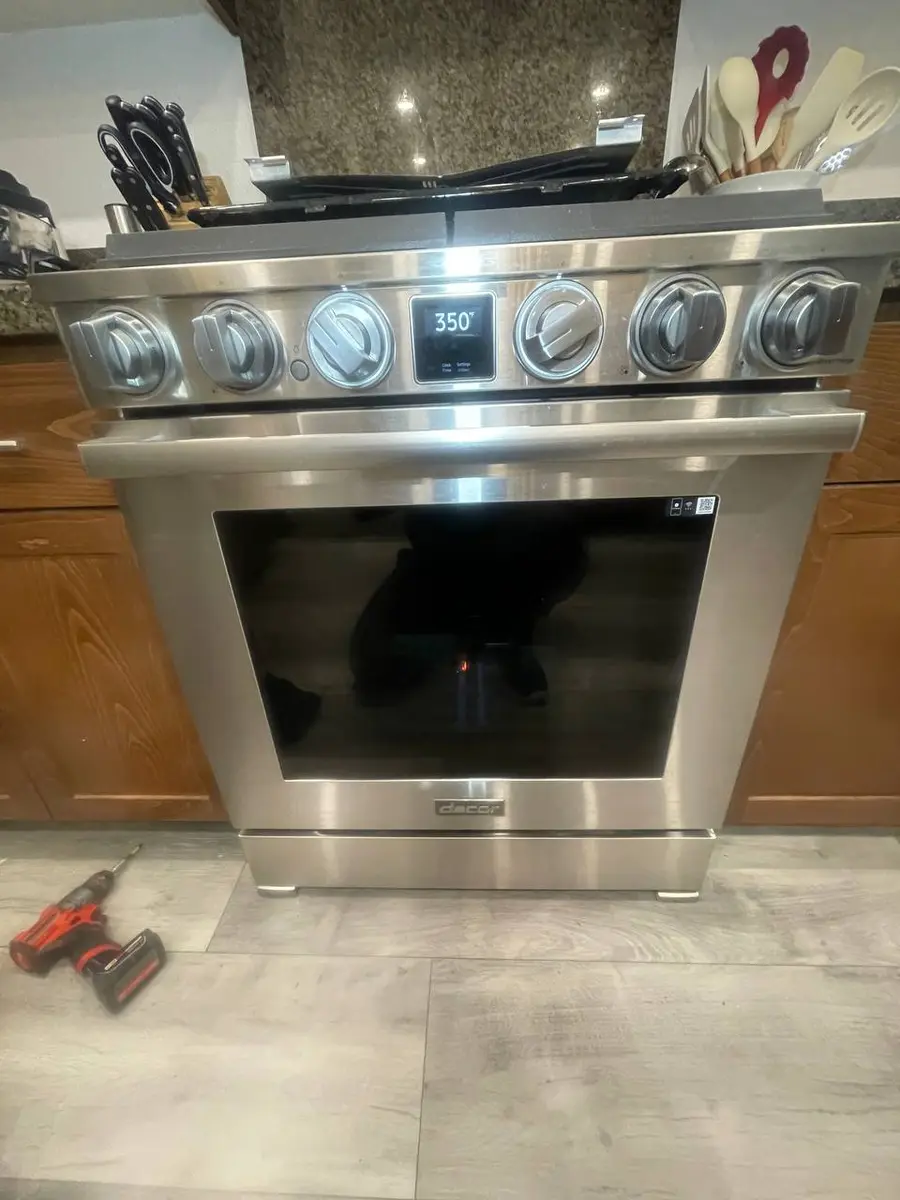
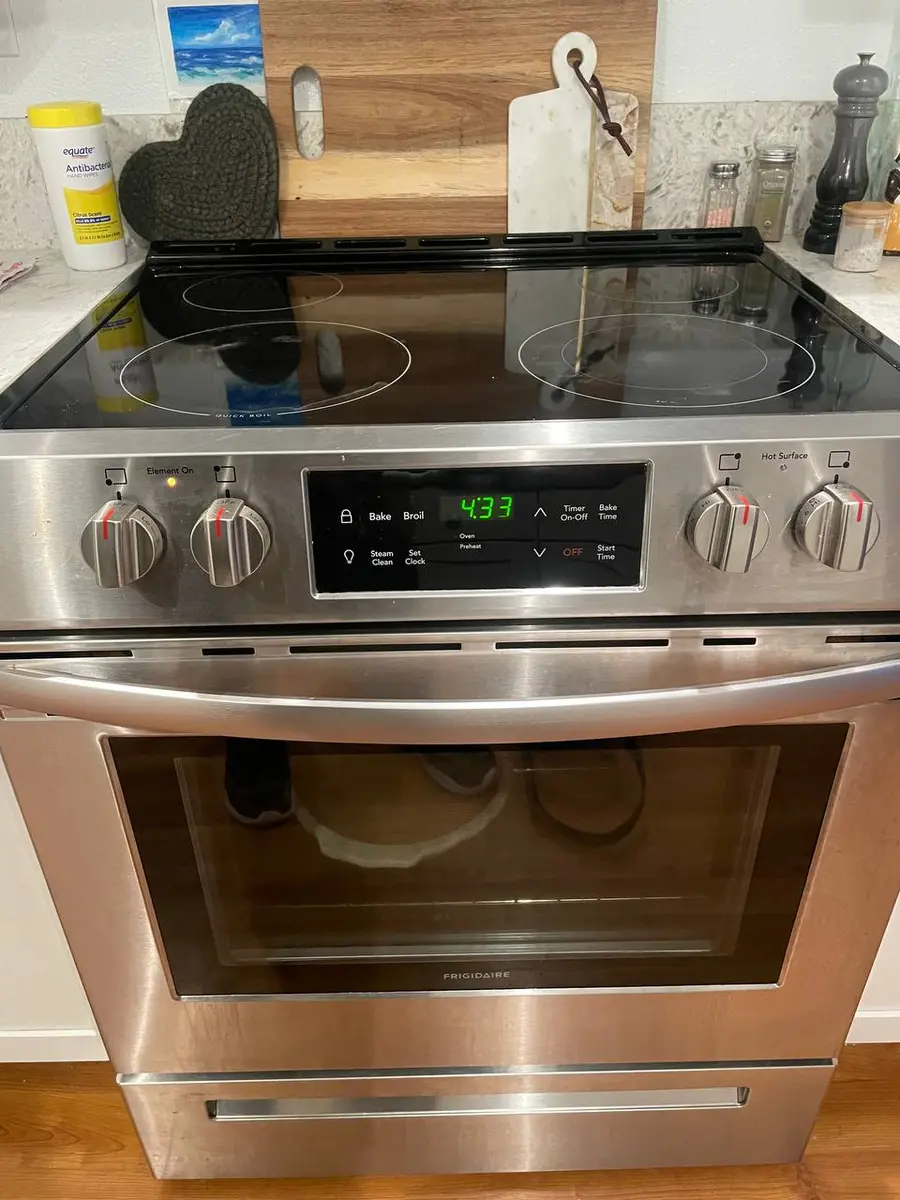
An oven is almost always worth repairing before about year twelve. It is the longest-lived appliance in your kitchen, so a single fix usually buys years of extra service instead of months. The two classic failures — a dead igniter or a burned-out bake element — are inexpensive parts. The one repair that gives pause is the control board. Here is how to decide.
The quick answer: repair or replace your oven?#
Repair if the oven is under about twelve years old and the fix costs less than half of a comparable new range. A gas range lasts roughly 15 years and an electric range about 13, so most ovens spend a long time in repair territory.
A new mid-range range runs $700-2,200, which puts the 50% line around $350-1,100 depending on what you would buy. That threshold is high enough that nearly every common oven repair clears it. Compared with a dishwasher or a microwave, the oven is the kitchen appliance the 50% rule most often tells you to fix.
Do You Have the Right Tools?
Combustion analyzer ($300), igniter tester ($120), temperature calibrator ($150), and gas pressure manometer. Our technician arrives with $3,000+ in professional tools — your diagnostic is free.
Licensed & Insured · 90-Day Warranty · Same-Day Service
Why ovens earn repairs longer than anything else in the kitchen#
The reason is simple: ovens outlive every other kitchen appliance. At 13-15 years of typical service (gas near 15, electric near 13), a repair at year ten still leaves years of cooking ahead.
That same repair on a ten-year-old dishwasher — which only lasts 9-12 years — would be throwing money at a machine near the end. The oven's long life is exactly why the verdict skews toward repair well into its second decade. When you weigh a fix, weigh it against how much life the appliance still has, not just against the price of the part.
Which group is your fault in#
The age table below decides the borderline cases. But most ovens do not need it, because most oven faults fall into a group whose answer does not depend on the year. Find your fault first.
| What the oven is doing | The fault and typical total | The group it is in |
|---|---|---|
| A gas burner clicks but will not light, or the oven takes forever to reach temperature | Gas igniter, $150-300 | Near-automatic repair. This is the classic cheap fix and it sits well under the 50% line at any mid-life age — the igniter is the signature failure of a gas range and it is not the whole range. |
| The bake element is visibly blistered, cracked or broken | Bake or broil element, $150-280 | Near-automatic repair. A visible part a technician swaps out, and the signature failure of an electric coil or element range. |
| The oven heats unevenly or not at all, with no visible element damage | Element or igniter, in the same $150-280 to $150-300 range | Near-automatic repair. Both classic failures present this way, and both are cheap enough that the diagnosis matters more than the verdict. |
| The display is dead, drops settings, or will not hold a mode | Control board, $300-600 | The only real judgment call. Under twelve years it still beats a $700-2,200 replacement; past fifteen the age tips it, because a board on a range that old is usually followed by the next failure. |
| The glass cooktop is cracked through | Structural | Not a repair question. On a budget range the job can approach the price of a new unit, and it is both cosmetic and functional — this is a replace signal. |
| Rust through the cavity or the frame | Structural | Not a repair. Structural damage does not repair, whatever the part costs, and a rusted-through oven is done. |
| The door is warped and no longer seals the heat in | Structural | Not a repair. A door that will not seal makes every other component work harder for the rest of the appliance life. |
| A persistent smell of gas | Stop | Not a cost decision at all. Shut off the range and call a professional now rather than weighing anything. |
Eight rows in three groups, because that is how oven faults actually distribute: three cheap fixes that clear the 50% line at any mid-life age, one control board that is the sole genuine judgment call, three structural findings that are not repairs, and one safety stop. The prices are this page own field figures for parts and labour together, and the $700-2,200 replacement range is what puts the 50% line at $350-1,100. Note the shape: the fault decides seven of the eight rows on its own, and the age table below is really only needed for the control board.
Safety First — Know the Risks
Gas ovens involve live gas lines — a loose connection creates explosion and carbon monoxide risk. Electric ovens run on 240V circuits. Our techs are licensed and insured — let them handle the risk.
Licensed & Insured · 90-Day Warranty · Same-Day Service
Verdict by age#
Line up your oven's age against its roughly 14-year lifespan, then look at whether you are facing a cheap fix or the control board.
| Oven age | Share of ~14-yr life | Cheap fix (under $300) | Control board ($300-600) |
|---|---|---|---|
| Under 8 yr | Under 50% | Repair | Repair |
| 8-12 yr | 55-85% | Repair | Evaluate vs a $700-2,200 replacement |
| Over 15 yr | Over 100% | Evaluate | Replace-leaning |
For a closer look at your exact age, see whether it is worth repairing a 5-year-old, 7-year-old, 10-year-old, 12-year-old, or 15-year-old oven.
What oven repairs cost#
The two most common oven failures are also the cheapest, which is why so many ovens are worth fixing. Here is what the typical repairs run, parts and labor together.
| Repair | Typical total | Usual verdict |
|---|---|---|
| Gas igniter | $150-300 | Repair — the classic cheap fix |
| Bake or broil element | $150-280 | Repair |
| Control board | $300-600 | Evaluate by age |
An igniter or an element sits well under the 50% line at any mid-life age, so those are near-automatic repairs. The control board is the only fault that ever puts a mid-life oven in doubt, and even then a $300-600 board usually beats a $700-2,200 replacement until the range is past fifteen years.
The Real Cost of DIY
Average DIY attempt: $150-400 in tools you may use once, plus the risk of further damage. Our diagnostic visit costs $0 — we find the problem and give you an honest quote.
Licensed & Insured · 90-Day Warranty · Same-Day Service
Gas, electric, or glass-top: how the fix changes#
The kind of range you own shapes the failure you will see and the call you will make.
Gas ranges last longest, near fifteen years, and the igniter is their signature fix at $150-300. A burner that clicks but will not light, or an oven that takes forever to heat, is usually the igniter — not the whole range. Electric coil and element ranges, closer to thirteen years, tend to fail at the bake or broil element ($150-280), a visible part a technician can swap out. Glass-top smooth ranges cook fine for years, but a shattered ceramic top is a pricier job that is both cosmetic and functional; if the surface is cracked through on a budget range, the repair can approach the price of a new unit, and that is a replace signal.
Two worked examples#
Two cases show the rule in action for an appliance built to last.
A 9-year-old gas range with a slow-to-light igniter. The igniter is a $150-300 fix, and at nine years the range is only about two-thirds through its 15-year life. That is far under 50% of a $700-2,200 replacement and well inside the age window — an easy repair that should buy several more years of cooking.
A 16-year-old range that needs a control board. The board runs $300-600, but the range is already past its expected lifespan. Even though $300-600 is under half of a new unit on price alone, the age tips the call: a board on a sixteen-year-old range is likely to be followed by the next failure, so replacement is the sounder spend.
Don't Void Your Warranty
Opening your appliance yourself may void the manufacturer warranty. Our repair comes with a 90-day guarantee, and we document everything for warranty compliance.
Licensed & Insured · 90-Day Warranty · Same-Day Service
Signs the whole range is done#
Some oven problems are not a part failure at all — they are the end of the appliance. Rust through the cavity or the frame, a warped door that no longer seals heat in, or a shattered glass cooktop are structural, and structural damage does not repair. If a technician finds any of those, the fix is a new range, not a new part. A persistent smell of gas is a different kind of stop sign — shut off the range and call a professional right away rather than weighing costs. The good news is that these cases are rare; the far more common igniter and element failures are exactly the cheap, worth-it repairs the table points to.
What we see in the field#
Igniters and elements are our bread-and-butter oven calls in California, and both are quick jobs. Our labor on an oven visit usually falls in the $150-350 range, and most repairs come in between $200 and $600 all-in — comfortably under half the cost of a new range.
Control boards are rarer, and we see them mostly on higher-feature ranges with more electronics to fail. The ovens we tell people to replace are almost always the oldest ones: a range past fifteen years that needs a board, or one where the cavity or frame has rusted or warped. Structural damage does not repair, and a rusted-through oven is done regardless of what the part costs.
Is It Worth Your Time?
Oven temperature issues require systematic testing of the igniter, gas valve, thermostat, and calibration. Average DIY: 4-6 hours. Our technician diagnoses the issue in about 30 minutes — same-day appointments available.
Licensed & Insured · 90-Day Warranty · Same-Day Service
Tariffs and right to repair in 2026#
The 2025-26 shift makes repairing an existing range look smarter. After the 2025 tariffs, new ranges ($700-2,200) got more expensive faster than repairs did — appliance prices rose about 4.3% month over month and parts roughly 5-20% — so the replacement side of the equation grew.
California's SB-244 right-to-repair law reinforces the case. In force since July 2024, it requires makers of appliances costing at least $100 to keep parts, tools, and documentation available for at least seven years after the last unit is built. Given how long ovens last, that seven-year floor matters: a 2017-or-newer range is well covered for the igniter, element, or board it may eventually need.
Frequently Asked Questions#
Is it worth repairing a 10-year-old oven? Usually yes. A gas range lasts about 15 years and an electric one about 13, so a 10-year-old oven still has real life left. A $150-300 igniter or a $150-280 element is an easy call; pause only on a $300-600 control board.
What is the average lifespan of an oven or range? Gas ranges average about 15 years and electric ranges about 13 — the longest-lived kitchen appliance. That long life is why an oven earns repairs longer than a dishwasher or a microwave.
How much does an oven repair cost? The two most common fixes are cheap: a gas igniter runs $150-300 and a bake or broil element $150-280. A control board is the big one at $300-600.
When should I replace my oven instead of fixing it? When it is past about fifteen years, when the repair tops 50% of a $700-2,200 replacement, or when the cavity or frame is rusted or warped, or a glass top is shattered — those are not repairable.
Does the 50% rule apply to ovens? Yes, but the high replacement price ($700-2,200) sets the threshold high, so most single repairs clear it easily. The oven is the kitchen appliance the 50% rule most often says to repair.
Are oven parts more expensive after the tariffs? Parts rose roughly 5-20% and ranges about 4.3% month over month after the 2025 tariffs. California's SB-244 keeps parts available for at least seven years on 2017-and-newer ranges.
Q: Does my oven age or my oven fault decide this? A: The fault, for seven of the eight common cases. An igniter at $150-300 or an element at $150-280 clears the 50% line at any mid-life age, and rust, a warped door or a cracked-through cooktop are structural findings that no age makes repairable. The control board at $300-600 is the one fault where the year genuinely decides — under twelve it beats a $700-2,200 replacement, past fifteen it usually does not.
Senior Gas Appliance Specialist · 18 years experience
AGA-certified gas appliance specialist with 18 years of experience in residential and commercial oven, range, and cooktop repairs.