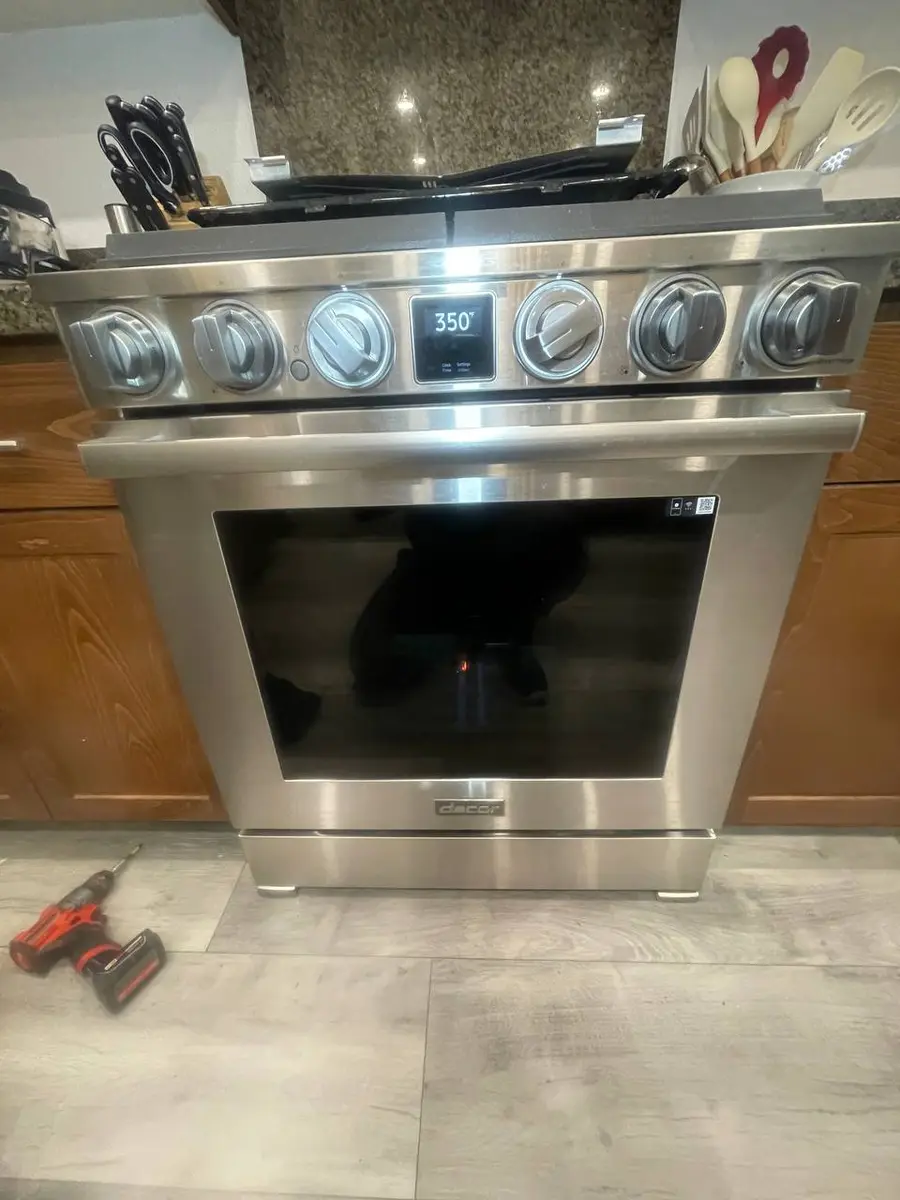
Bertazzoni ranges and wall ovens — from the flagship Professional PROF366DFSXT (36" dual-fuel) to the Master MAS365DFMXE and Heritage HER366DFSXELP — are Italian-engineered luxury cooking appliances priced between $3,500 and $10,000. These units combine gas cooktops with electric convection ovens, using electronic control boards that display error codes when something goes wrong. Understanding Bertazzoni oven error codes is essential when repair costs typically run varies by model and region for these premium appliances. This guide covers every error code across all Bertazzoni oven product lines.
How Bertazzoni Oven Error Codes Work#
Bertazzoni ovens display error codes on the oven's digital display panel (LCD or LED depending on the series). The format is "E" followed by a single digit (E1–E9) or occasionally a two-character code. The control board monitors oven cavity temperature sensors (typically 2 NTC thermistors), heating elements (bake, broil, convection ring), convection fan, door lock mechanism, and on gas models, ignition and flame detection.
Important distinction: Bertazzoni dual-fuel ranges have electric ovens but gas cooktops. The cooktop section uses mechanical flame failure devices (thermocouples) and does not generate digital error codes. All E-codes relate to the electric oven section.
To reset most Bertazzoni oven error codes:
- Turn the oven off using the control panel.
- Switch off the circuit breaker (dedicated 40A or 50A circuit for ranges).
- Wait 120 seconds.
- Restore power and attempt a basic bake at 350F.
If the error returns, the underlying issue requires attention.
Do You Have the Right Tools?
Combustion analyzer ($300), igniter tester ($120), temperature calibrator ($150), and gas pressure manometer. Our technician arrives with $3,000+ in professional tools — your diagnostic is free.
Licensed & Insured · 90-Day Warranty · Same-Day Service
E1 — Oven Temperature Sensor 1 Error#
The primary oven cavity NTC temperature sensor is reading out of range — either open circuit, shorted, or reporting values that don't correlate with actual temperature.
Common causes:
- NTC sensor failure from heat cycling (these sensors endure temperatures up to 500F continuously and 900F during self-clean — they degrade over time)
- Sensor wire insulation damage from heat exposure
- Connector corrosion at the control board connection point
- Sensor physically displaced from its mounting bracket (reads air instead of wall temperature)
How to fix:
- Turn off power at the circuit breaker. Bertazzoni ranges operate on 240V — lethal voltage at element terminals.
- Locate the sensor: The primary temperature sensor is a small probe inserted into the oven cavity through the rear wall, typically at the upper-left or upper-right corner. It has a visible metal tip inside the oven and wires running through the cavity wall to the control board.
- Measure resistance: Disconnect the sensor leads at the control board connection (access board by removing the rear panel or top back-guard). At room temperature (72F), expect 1,000–1,100 ohms for Bertazzoni NTC sensors. At 350F, expect approximately 100–200 ohms (resistance decreases with temperature). Open circuit or zero ohms = sensor failure.
- Inspect wiring: The sensor wire runs from inside the oven cavity to the back panel. Check for heat damage to insulation, particularly where the wire passes through the cavity wall.
- Check sensor mounting: The probe must be seated in its mounting bracket with the tip extending into the cavity. A dislodged probe reads inaccurately.
Part cost: Oven temperature sensor varies by part. Professional repair varies by part.
E2 — Oven Temperature Sensor 2 Error (Redundant Sensor)#
The secondary cavity temperature sensor is reporting abnormal readings. Professional and Heritage series Bertazzoni ovens use dual sensors for safety — both must agree within a defined tolerance.
Common causes:
- Same failure modes as E1 (NTC degradation, wire damage, connector issue)
- Sensor calibration drift — readings within range but diverging from the primary sensor
- Only the secondary sensor has failed (primary still working — oven may still heat but with reduced precision)
How to fix:
- The secondary sensor is typically on the opposite side of the oven cavity from the primary (if primary is upper-left, secondary is upper-right or lower-rear).
- Measure resistance using the same spec as E1: 1,000–1,100 ohms at room temperature.
- Compare readings between both sensors — they should be within 50 ohms of each other at the same temperature. If one reads significantly different, that's the failed sensor.
Part cost: Temperature sensor varies by part. Professional repair varies by part.
Safety First — Know the Risks
Gas ovens involve live gas lines — a loose connection creates explosion and carbon monoxide risk. Electric ovens run on 240V circuits. Our techs are licensed and insured — let them handle the risk.
Licensed & Insured · 90-Day Warranty · Same-Day Service
E3 — Bake Element Failure#
The lower (bake) heating element is not drawing current or not producing the expected temperature rise in the allotted time.
Common causes:
- Bake element burned out — often visible as a break, blister, or bright spot on the element surface
- Element terminal connection failed (corroded or melted spade connectors)
- Control board bake relay failure (not switching 240V to the element)
- Thermal fuse in the bake circuit has blown
How to fix:
- Visual inspection: Open the oven door and look at the bake element (the coil at the bottom of the oven cavity — remove the floor panel if it covers the element). Look for visible breaks, holes, blistered spots, or sections that glow brighter than others (hot spots preceding failure).
- Measure element resistance: With power disconnected, access the element terminals at the rear of the oven. Disconnect one lead and measure across the element — expect 20–50 ohms for a 240V bake element. Open circuit = burned out.
- Check for ground fault: Measure between element terminal and oven chassis — should be open/infinite. Continuity indicates the element insulation has failed.
- Inspect connections: Look at the spade connectors at the element terminals. Heat and age cause these to oxidize and create resistance, leading to overheating at the connection point. Burned or melted connectors should be replaced along with the element.
Part cost: Bake element varies by part. Terminal connectors varies by part. Professional repair varies by part.
E4 — Broil Element Failure#
The upper (broil) heating element is not functioning. This element provides top-down heat for broiling, finishing, and contributes to preheating.
Common causes:
- Broil element burned out (same failure as bake element — heat cycling causes wire fatigue)
- Broil element relay failure on control board
- Wiring issue between board and broil element
- Thermal fuse protecting the broil circuit has blown
How to fix:
- Visually inspect the broil element at the top of the oven cavity. Look for breaks, sags, or discoloration.
- Measure resistance — expect 15–40 ohms for a 240V broil element. Open = failed.
- Ground fault test: element terminal to chassis should read open.
- If element tests good, check the board's broil relay. During preheat (when both elements should be on), measure voltage at the broil element terminals — should see 240V. No voltage = board relay failure.
Part cost: Broil element varies by part. Professional repair varies by part.
The Real Cost of DIY
Average DIY attempt: $150-400 in tools you may use once, plus the risk of further damage. Our diagnostic visit costs $0 — we find the problem and give you an honest quote.
Licensed & Insured · 90-Day Warranty · Same-Day Service
E5 — Convection Fan Motor Error#
The convection fan is not running or is drawing abnormal current during convection cooking modes.
Common causes:
- Fan motor bearing failure (common after 5–8 years of regular use)
- Fan blade obstruction (baking pan or foil touching the rear wall)
- Motor winding failure
- Control board fan circuit failure
- Thermal overload on motor tripped (motor overheating from restricted airflow)
How to fix:
- Open the oven and check the rear panel. The convection fan is behind the round cover plate on the back wall. Remove the cover (center screw or quarter-turn) and spin the fan by hand. It should rotate freely and smoothly. Any grinding, scraping, or stiffness indicates bearing failure.
- Check for obstructions: Ensure no baking sheets, foil, or food debris can contact the fan blade during operation.
- Test the motor: Access from behind the oven (remove rear panel). Measure motor winding resistance — expect 10–30 ohms. Check for ground fault to chassis.
- Reset thermal overload: Some Bertazzoni convection motors have a thermal overload button. If the motor is accessible from behind, look for a small red or black button that can be pressed to reset.
Part cost: Convection fan motor varies by part. Professional repair varies by part.
E6 — Door Lock Error#
The oven door lock mechanism is not engaging or disengaging properly. This error primarily appears when attempting self-clean mode (pyrolytic cleaning requires door lock engagement before reaching 900F+).
Common causes:
- Door lock motor failure (small gear motor that drives the latch)
- Lock position switch not detecting correct state
- Door hinge misalignment preventing full closure for lock engagement
- Control board lock circuit failure
- Lock mechanism jammed (food residue in the latch area)
How to fix:
- If the door is locked and won't open: Wait 60 minutes for the oven to cool below the lock release temperature (typically 550F). The lock is temperature-interlocked for safety. Never force the door open.
- If E6 appears when trying to start self-clean: Verify the door closes completely flush. Check that nothing is preventing full closure (racks positioned incorrectly, food spillage on the gasket surface).
- Clean the latch mechanism: The lock latch at the top of the door opening can accumulate food residue. Clean with a damp cloth — never use spray cleaners that could drip into the mechanism.
- Listen for the lock motor: When self-clean is selected, listen for the lock motor attempting to engage. Clicking/grinding = motor jammed. Nothing = no power to motor (board issue).
Part cost: Door lock assembly varies by part. Professional repair varies by part.
Don't Void Your Warranty
Opening your appliance yourself may void the manufacturer warranty. Our repair comes with a 90-day guarantee, and we document everything for warranty compliance.
Licensed & Insured · 90-Day Warranty · Same-Day Service
E7 — Oven Over-Temperature#
The oven has exceeded the maximum safe operating temperature. This is a critical safety code — the control board detected temperature significantly above the set point.
Common causes:
- Temperature sensor failure (reading low, causing the board to keep heating past actual temperature)
- Control board relay stuck closed (continuously energizing heating element regardless of temperature feedback)
- Calibration error after a control board replacement
- Self-clean malfunction (element did not shut off at target temperature)
How to fix:
- Turn off the oven immediately at the circuit breaker. Over-temperature is a fire hazard.
- Do not ignore this code. If the oven is overheating because a relay is stuck, the element will remain energized as long as power is applied — regardless of the control panel setting.
- Check sensor first: If the sensor reads low (making the board think the oven is cold when it's actually hot), the board keeps heating. Test sensor resistance as described in E1.
- If the sensor is good: The control board's heating relay has likely welded shut (contacts fused due to arcing). This requires professional board replacement.
Part cost: Temperature sensor varies by part. Control board varies by part. Professional repair varies by part. This is a priority repair — do not use the oven until resolved.
E8 — Ignition/Flame Failure (Gas Oven Models)#
On Bertazzoni gas oven models, E8 indicates the gas burner failed to ignite within the safety timeout or the flame was detected as lost during operation.
Common causes:
- Gas supply not reaching the oven burner (supply valve off, flex line kinked)
- Igniter failure — Bertazzoni gas ovens use hot surface igniters (HSI) that glow white-hot to ignite gas
- Igniter weak but not dead — draws insufficient current to open the gas safety valve
- Gas valve solenoid failure
- Flame sensor (thermocouple or flame rod) dirty or failed
- Gas orifice clogged
How to fix:
- Check gas supply: Verify the gas shutoff valve behind the range is fully open. If you recently had service on gas lines, the valve may have been left partially closed.
- Observe the igniter: Remove oven racks and the oven floor panel. When you turn on the oven, the igniter (a flat silicon carbide bar or round silicon nitride element at the back of the burner) should glow bright orange/white within 30–60 seconds. If it glows dimly (orange but not white), it's weak and not drawing enough current (minimum 3.2A required to open the safety valve on most models). If it doesn't glow at all, it's failed.
- Measure igniter current: With the oven calling for heat, use a clamp ammeter on the igniter wire. Should read 3.2–3.6A for the gas valve to open. Below 3.2A = weak igniter. Replace it even though it still glows — it's not hot enough.
- Check flame sensor/rod: If the burner lights but shuts off after 30–90 seconds, the flame sensor is not detecting the flame. Clean the sensor rod with fine sandpaper (emery cloth). On some models, it's a thermocouple that needs replacement if cleaning doesn't help.
Part cost: Hot surface igniter varies by part. Gas valve varies by part. Flame sensor varies by part. Professional repair varies by part.
Is It Worth Your Time?
Oven temperature issues require systematic testing of the igniter, gas valve, thermostat, and calibration. Average DIY: 4-6 hours. Our technician diagnoses the issue in about 30 minutes — same-day appointments available.
Licensed & Insured · 90-Day Warranty · Same-Day Service
E9 — Control Board / Communication Error#
A general fault code indicating the main control board has detected an internal error — EEPROM failure, communication bus fault, or power supply instability.
Common causes:
- Power surge damage to board components
- Capacitor aging on the control board (electrolytic capacitors dry out over time)
- Communication failure between the board and display module
- Firmware corruption in the EEPROM
- Moisture damage to board (steam or cleaning solution penetration)
How to fix:
- Extended power cycle: Disconnect from power for 15 minutes (longer than standard reset). This allows full capacitor discharge and can clear transient errors.
- Check for moisture: Access the control board (behind the back panel or under the console top). Look for any signs of moisture, condensation, or corrosion on the board or connectors.
- Inspect capacitors visually: Look for swollen (bulging top) or leaking electrolytic capacitors on the board. These are cylindrical components — the top should be flat. Bulging or oozing brown liquid = failed capacitor.
- If persistent: The board needs professional replacement. Bertazzoni control boards are model-specific — the part number varies between Professional, Heritage, and Master series even for similar-looking ranges.
Part cost: Control board varies by part. Professional repair varies by part.
Additional Error Codes Quick Reference#
- EL — Door lock timeout. Lock motor ran for longer than expected without achieving locked position. Lock mechanism jammed or motor failing.
- EE — EEPROM data error. Subset of E9 — specifically the non-volatile memory chip. Board replacement required.
- EF — Cooling fan error. The electronics cooling fan at the top/rear of the oven is not running. Required for safe operation — oven will not heat without fan confirmation.
- EC — Communication bus error. Similar to E9 but specifically the serial communication between boards.
The Risk of Getting It Wrong
A wrong diagnosis often turns a simple fix into a costly replacement. Without proper diagnostic tools, you might replace the wrong part — or cause additional damage. Our free diagnostic eliminates the guesswork.
Licensed & Insured · 90-Day Warranty · Same-Day Service
Bertazzoni Oven Diagnostic Mode#
Bertazzoni Professional and Heritage ovens have a service test mode:
- Enter diagnostic mode: With the oven off, press and hold the Temperature Up and Temperature Down buttons simultaneously for 7 seconds. Display flashes to confirm entry.
- Sensor readings: The display shows current NTC sensor values (ohms and calculated temperature) for both sensors.
- Element test: The board sequentially energizes bake, broil, and convection elements for 10 seconds each while showing amperage draw.
- Fan test: Convection fan runs at full speed for verification.
- Lock test: Door lock engages and disengages.
- Error log: Shows last 5 stored error codes.
- Exit: Hold both buttons again for 3 seconds.
Bertazzoni Gas Cooktop Troubleshooting (No Error Codes)#
The gas cooktop section on Bertazzoni ranges does not display digital error codes. Common issues:
- Burner won't stay lit: Thermocouple dirty or misaligned. Clean the thermocouple tip with fine emery cloth. Ensure it's positioned in the flame path (the tip must be in direct contact with the flame). If cleaning doesn't help after holding the knob for 20+ seconds, replace the thermocouple (varies by model and region).
- Igniter clicks but no flame: Gas not reaching burner. Check that the burner cap is seated correctly (brass cap must be centered on the burner base). Clean burner ports with a pin. Verify gas supply.
- Continuous clicking even when burner is lit: The spark module is not detecting flame or has a grounding issue. Check that burner cap and electrode are dry (moisture causes continuous sparking). If problem persists after drying, the spark module may need replacement.
- Uneven or yellow flame: Air shutter adjustment needed, or burner ports partially clogged. Yellow flames indicate incomplete combustion — produces carbon monoxide. Do not use until corrected.
Free Diagnostic Visit — Zero Risk
Our certified technician comes to your home, diagnoses the problem with professional tools, and gives you an honest quote — all at zero cost. No parts markup, no hidden fees. If you decide not to proceed, you pay nothing.
Licensed & Insured · 90-Day Warranty · Same-Day Service
Frequently Asked Questions#
Q: My Bertazzoni range shows E3 but the oven still heats. Should I worry? A: E3 indicates the heating system is underperforming — it's reaching temperature but taking too long. This usually means the element is partially failed (still conducting but at reduced wattage) or hard water scale is insulating it. The oven works but is stressing the remaining capacity. Schedule service within 1–2 weeks — the element will fully fail soon.
Q: Are Bertazzoni parts hard to find? A: Core components (elements, sensors, igniters) use standard specifications and are readily available. Bertazzoni-specific items (control boards, custom gaskets, decorative trim, knobs) may have 2–3 week lead times from Bertazzoni's parts distribution center. For urgent repairs, an experienced technician can often source compatible components from industrial suppliers.
Q: How much does Bertazzoni oven repair cost? A: Bertazzoni oven repairs range from $250 for sensor replacements to significant cost for control board or gas valve work. Element replacements typically run varies by model and region. The Italian-sourced control boards are the most expensive individual component. EasyBear offers free diagnostics to identify the issue before any parts are ordered.
Q: Can I use self-clean on my Bertazzoni oven? A: Bertazzoni Professional and Heritage ovens include pyrolytic self-clean. However, many luxury appliance technicians recommend avoiding self-clean — the extreme temperatures (900F+) stress every component and are the most common trigger for element, lock, and sensor failures. Manual cleaning with oven cleaner and a non-abrasive pad is gentler on components and equally effective.
Q: My Bertazzoni oven temperature is off by 25-50 degrees. Is this an error? A: Temperature inaccuracy without an error code is usually sensor calibration drift — the sensor works but reads slightly off. Most Bertazzoni ovens have a temperature calibration adjustment in the settings menu (hold Temperature button for 5 seconds to access calibration mode, then adjust +/- up to 35F). If calibration doesn't help or the offset exceeds 50F, the sensor is degrading and should be replaced before it triggers E1/E2.
When to Call a Professional#
Bertazzoni ranges operate on 240V circuits and contain gas components. Professional service is recommended for:
- E7 over-temperature — fire hazard. Do not use the oven until the stuck relay or failed sensor is resolved.
- E8 gas ignition issues — gas leak potential. If you smell gas, turn off supply and ventilate before any diagnosis.
- E3/E4 element replacement on 240V ranges — lethal current at element terminals. Always confirm power is off at the breaker.
- E9 control board replacement — boards are model-specific and may require configuration.
- Any gas valve or regulator work — requires licensed technician with gas certification.
Bertazzoni oven showing an error code? EasyBear's technicians are experienced with Italian luxury ranges including Bertazzoni, Ilve, andDERA. We offer free diagnostic visits — our tech identifies the exact fault, explains repair options, and completes the work with quality parts. Every repair includes our 90-day parts and labor warranty. Schedule your free diagnosis today.
Lead Appliance Repair Technician · 12 years experience
Experienced technician with 12 years specializing in washing machine and dryer repairs across all major brands.