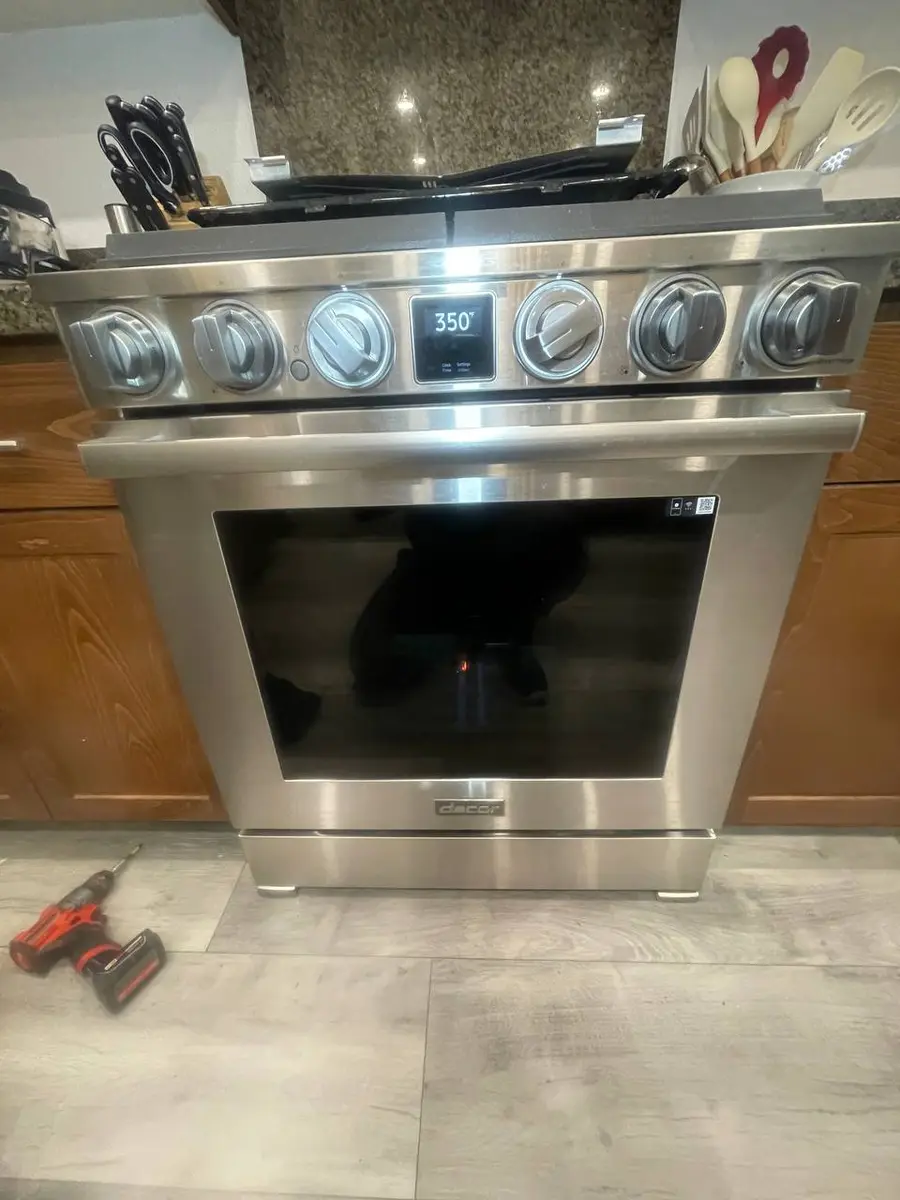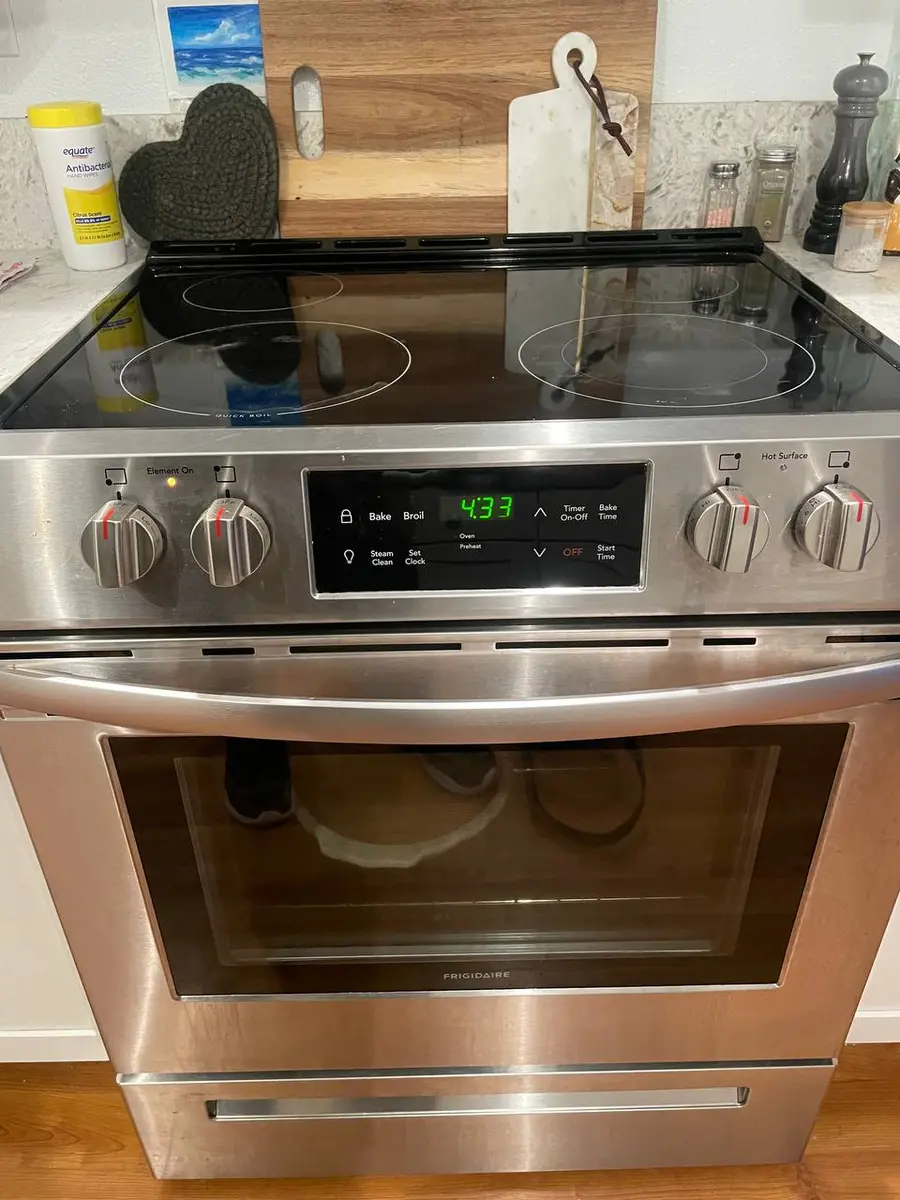
A Whirlpool oven that runs hotter than its setpoint almost always comes down to three things: the AccuBake temperature sensor reading low, a control-board relay welded closed, or a calibration offset dialed the wrong way. The sensor is the key, because AccuBake trusts it completely — when it reports a cooler cavity than reality, the board just keeps heating. Whirlpool's F-code diagnostic mode is the fastest way to sort a sensor fault from a board fault.
Safety First#
- Disconnect power at the breaker — electric ovens run on lethal 240V.
- On gas models, if you smell gas strongly, leave and call the gas company before any diagnosis.
- Let the oven cool fully; surfaces stay above safe-to-touch for well over half an hour after shutdown.
- Never bypass the door-lock safety system — it guards against self-clean temperatures.
- Never probe oven wiring with the power on.
Do You Have the Right Tools?
Combustion analyzer ($300), igniter tester ($120), temperature calibrator ($150), and gas pressure manometer. Our technician arrives with $3,000+ in professional tools — your diagnostic is free.
Licensed & Insured · 90-Day Warranty · Same-Day Service
How AccuBake Holds Temperature#
Whirlpool's AccuBake system uses a dedicated oven temperature sensor that reads about 1080 ohms at room temperature, rising predictably as the cavity heats. The control board reads that resistance, compares it to your setpoint, and cycles the element or modulates the gas valve to hold target. Faults are reported in Whirlpool's standard F#E# code format shared across the brand's appliances. The whole design leans on the sensor being accurate, so when the sensor drifts low, the entire loop overheats — which is why "too hot" is usually a sensor story.
Usually, but not always, and the exception is the reason to read the next section before the ranked list. One of the causes below is an oven that has lost the ability to stop heating at all, and it is not safe to keep using while you work through a diagnosis. Every other cause on this page produces an oven that runs hot and still obeys you. Telling those two apart takes one press of a button, and it is the first thing to establish.
First question: does it stop heating when you tell it to?#
Set the oven going, let it get hot, then press Cancel and watch. Whether the heat actually stops is what separates the one dangerous cause on this page from the six that are merely annoying.
| What the oven does | What it points at | What to do about it now |
|---|---|---|
| Keeps heating after Cancel, or after the timer expires, and climbs on its own | The element relay has welded closed — the board can no longer switch the heat off | Kill the breaker. This one is a safety issue and the oven is not usable until it is fixed |
| Stops obediently, but everything cooks hot by roughly the same amount every time | The sensor reading low, or a calibration offset set the wrong way | Zero the calibration offset first — it is free — then measure with an independent thermometer |
| Stops obediently; one part of the cavity is far hotter than the rest | Heat pooling rather than overheating — a convection fan that is not circulating | Start a convection cycle and listen at the rear: silence is a dead motor, grinding is bearings |
| Stops obediently, but the door exterior and the surrounding cabinetry run hot too | The door gasket has hardened and is no longer sealing the cavity | Press the gasket with a finger — one that does not spring back is done |
| Heats, then cuts out entirely and will not restart until it has cooled | A safety device has tripped — which is the opposite complaint, and a symptom of something else overheating | Find what overheated it before replacing it, or the replacement trips too |
| Behaves erratically: hot some days, correct others, no pattern | Heat-damaged terminals or connections on the high-current wiring | Inspect the element terminals and board connections for discoloration or melting, power off |
Row one is the only one that needs action before diagnosis. Row two covers the two cheapest causes on the page, and the calibration offset costs nothing at all to rule out — which is a good reason to zero it before ordering a sensor.
Where these rows come from: the seven causes ranked below — sensor reading low, welded element relay, calibration offset, door gasket, convection distribution, high-limit or thermal device, and wiring — re-keyed on what the oven does when it is told to stop, because that is the question with a safety consequence and it is answerable in one press. The page's own warning that a welded relay means killing the breaker is what row one restates. The percentages beside those causes rank them against one another and name no sample they were drawn from, so no share is repeated here.
Safety First — Know the Risks
Gas ovens involve live gas lines — a loose connection creates explosion and carbon monoxide risk. Electric ovens run on 240V circuits. Our techs are licensed and insured — let them handle the risk.
Licensed & Insured · 90-Day Warranty · Same-Day Service
The Causes, By Frequency#
1. Temperature Sensor Reading Low (25% of cases)#
A sensor whose resistance has drifted below spec tells the board the cavity is cooler than it is, so AccuBake keeps the element energized past the true setpoint and the oven overheats. Unlike an open sensor, which throws F3E1 and usually stops the oven, or a shorted sensor at F3E2, a merely drifted-low sensor often throws no code — the oven just runs consistently hot. To test it, cut power, reach the sensor at the back wall of the cavity, disconnect it at the board, and measure across the leads: about 1080 ohms near room temperature is healthy, while a clearly low reading (or infinite, or zero) confirms failure. Replace the sensor and verify calibration against an oven thermometer at several temperatures.
2. Welded Element Relay (22% of cases)#
The board switches the element through a relay, and when its contacts weld shut the element stays powered continuously regardless of temperature, so the oven climbs without limit. This is the dangerous cause — the tell is an oven that keeps heating even after you press Cancel, and it can drive an over-temperature condition. Because the relay lives on the board on the live 240V side, and a welded relay is a safety issue, confirming and replacing it belongs to a technician. If the oven is overheating on its own right now, kill the breaker.
3. Calibration Offset Wrong (20% of cases)#
Whirlpool ovens allow a temperature calibration offset, and if a previous user or technician set it the wrong way, the oven runs hot by exactly that amount with no fault at all. This is the cheapest thing to rule out: reset the offset toward zero through the control panel, then confirm the real temperature with an independent thermometer set to 350°F. If it now reads accurately, calibration was the whole problem; if it still runs hot at a zeroed offset, move on to the sensor.
4. Door Gasket Leaking (15% of cases)#
The fiberglass door gasket seals the cavity, and years of thermal cycling harden it until it no longer compresses. Heat then escapes, and the oven overshoots because the loss triggers longer element runs to hold temperature, while the exterior of the door and nearby cabinetry run hotter than they should. If the gasket is stiff, cracked, or no longer springs back — especially if it has failed worse on the side near the sensor, which artificially cools the sensor and compounds the overheating — replace it.
5. Convection Distribution Fault (10% of cases)#
On True Convection models a rear fan and dedicated element circulate heat evenly, and if that fan fails the heat pools instead of spreading, so one part of the cavity reads far hotter than the rest even when the average is fine — a "too hot" complaint that is really uneven distribution. Start a convection cycle and listen at the rear for the fan within about thirty seconds; silence means a dead motor, and grinding means worn bearings.
6. High-Limit or Thermal Device (5% of cases)#
Safety devices cut power when they sense overheating, and while a blown thermal fuse or tripped high-limit usually stops heating entirely, a marginal or miswired one can behave erratically around an overheating cavity. Test these for continuity, and critically, if one has tripped, find out what overheated it — a stuck relay or a leaking gasket — rather than just replacing the device and inviting a repeat.
7. Wiring or Connection (3% of cases)#
High-current element wiring can develop heat damage at its terminals over years, and burned or corroded connections create resistance that can distort heating behavior. Inspect the element terminals and the board connections for discoloration, melting, or corrosion, and replace any damaged terminals with high-temperature parts rated for oven use.
Use Whirlpool's F-Code Diagnostic Mode#
Before tearing anything down, read the stored codes. Enter diagnostic mode with the model-specific button sequence on the tech sheet behind the rear panel or inside the console, and the panel shows stored codes and offers individual component tests. The ones that matter here are F3E1 (sensor open) and F3E2 (sensor shorted) for the sensor, F2E1 (stuck key) if a jammed button is forcing a heat command, F5E1 for the door lock, and the F1-series (F1E0, F1E1, F1E2) for board-level faults. If several unrelated functions misbehave together, the board is the common point — and the F-codes save you from replacing a good sensor to chase a board fault, or the reverse.
The Real Cost of DIY
Average DIY attempt: $150-400 in tools you may use once, plus the risk of further damage. Our diagnostic visit costs $0 — we find the problem and give you an honest quote.
Licensed & Insured · 90-Day Warranty · Same-Day Service
Why "Too Hot" Is Usually a Sensor Story#
It is worth understanding why the sensor dominates this symptom, because it shapes the whole diagnosis. AccuBake has no independent way to know the cavity temperature — it knows only what the sensor's resistance tells it. So if the sensor reads low, the board is not malfunctioning at all; it is faithfully doing what it was told, heating toward a target it believes it has not reached. That is why a drifted-low sensor overheats an oven silently, with no error code, while the board's own logic stays healthy. The practical consequence is that you should almost always trust a resistance test over a code: an oven that runs hot with no F-code is far more likely a low-reading sensor than a board fault, and replacing the sensor is both cheaper and more often correct than replacing the board. The one exception is the runaway case — an oven that ignores Cancel and climbs without limit — where the sensor is beside the point because a welded relay has taken heat control out of the board's hands entirely. Matching the pattern to the mechanism keeps you from swapping the expensive part first.
How to Prevent It#
- Use a surge protector rated for the oven's amperage to protect the control board and its relays.
- Run self-clean no more than three to four times a year, since the extreme heat stresses every component that overheating traces back to.
- Clean spills promptly rather than relying on self-clean for heavy buildup.
- Check the temperature sensor connection yearly to make sure thermal cycling has not loosened it.
- Inspect the door gasket periodically and replace it once it stiffens, before heat loss drives overshoot.
Don't Void Your Warranty
Opening your appliance yourself may void the manufacturer warranty. Our repair comes with a 90-day guarantee, and we document everything for warranty compliance.
Licensed & Insured · 90-Day Warranty · Same-Day Service
When to Call a Professional#
Resetting the calibration and swapping the sensor are reasonable DIY jobs, but a welded relay, any control-board work on a live 240V circuit, and gas valve service belong to a technician. Call immediately if the oven overheats with no input, keeps heating after you press Cancel, or if you see arcing or smell overheated insulation — a stuck relay is a fire risk, not a nuisance. On models where the door lock is implicated by an F5E1, leave the lock system alone and let a professional handle it, since it protects against self-clean heat.
Whirlpool oven acting up? Our technicians diagnose and repair same-day across [Sacramento](/sacramento/sacramento) and the Bay Area. Book your repair
Can you keep using it while you wait for a repair?#
The answer splits the same way the first table does, and it is worth being direct about.If the oven keeps heating after you press Cancel: no. Not for one more meal. The control has lost the ability to switch the element off, which means nothing on the front panel limits the temperature the cavity reaches. Cut the breaker and leave it off until the relay has been dealt with. This is the only cause on this page that behaves like this and the only one where waiting is genuinely unsafe.
If it stops obediently and simply runs hot: yes, with a thermometer. An oven that overshoots by a consistent amount is a controlled oven with a wrong number in it, and an independent thermometer on the middle shelf turns it back into a usable one — set the dial low enough that the thermometer reads what you actually want. Roasting tolerates this easily; baking that depends on a precise temperature does not, and that is a judgement about what you are cooking rather than about the oven.
If the heat is uneven rather than excessive: yes, with a caveat. A convection fan that has stopped circulating leaves hot and cold regions rather than a hot oven, so rotating trays part way through does most of what the fan was doing.
If a safety device has already tripped once: treat that as the warning it is. Something overheated far enough to open a protective device, and continuing to run the oven while that cause is unaddressed is how the next thing to fail becomes more expensive than the first.
Is It Worth Your Time?
Oven temperature issues require systematic testing of the igniter, gas valve, thermostat, and calibration. Average DIY: 4-6 hours. Our technician diagnoses the issue in about 30 minutes — same-day appointments available.
Licensed & Insured · 90-Day Warranty · Same-Day Service
What an accurate measurement actually looks like#
Most of what sends people to this page is a judgement about food rather than a measurement, and the gap between the two matters, because a technician cannot act on "everything burns."Use a standalone oven thermometer, on the middle shelf, in the centre. Not hanging from a rack edge, not near the door, and not near the rear wall where a convection element sits — all three read the local condition rather than the cavity.
Give it time. An oven does not settle at its setpoint the moment the preheat tone sounds; it overshoots, comes back, and then cycles around the target. A reading taken at the tone tells you about the preheat, not about the oven. Half an hour at temperature gives you the range it is actually holding.
Read it more than once. What you want is not a number but a pattern: a stable offset in one direction is one finding, a wide swing either side of the target is another, and a temperature that simply keeps climbing is the urgent one.
Repeat at a second temperature. A sensor that has drifted rarely drifts by the same amount everywhere, so an oven that is close at a moderate setting and badly out at a high one tells you more than either reading alone.
That handful of numbers is worth an hour of anyone's diagnosis, and it costs a thermometer and an afternoon of not cooking.
Why an overheating oven is worth chasing rather than working around#
It is tempting to treat a hot oven as a quirk and simply set it lower, and for one of the causes on this page that is a perfectly reasonable interim. For the others it is not, and the reasons are worth stating.
Because two of the causes get worse rather than staying put. A gasket that has begun to harden keeps hardening, and a sensor that has drifted keeps drifting — so an offset you calibrate around today is wrong again in a few months, and the compensation you learned stops matching the oven.
Because the cabinetry pays for it. An oven leaking heat through a failed door seal is heating the units around it as well as the food, and the surfaces immediately above and beside a wall oven are not designed for sustained temperature. That is a slow, quiet cost that never presents as an oven fault at all.
Because a safety device that trips has already told you something. A high-limit or thermal cut-out only opens after a genuine over-temperature event, so treating it as the fault and replacing it puts a fresh device in front of the same condition. It will do the same job again, and the second time it may not be the cheapest thing that fails.
And because one of them does not wait. A welded relay is not a degrading condition, it is a control that has already lost authority over the element. That is the one row on this page where working around the problem is not an option and the breaker is the correct response.
The Risk of Getting It Wrong
A wrong diagnosis often turns a simple fix into a costly replacement. Without proper diagnostic tools, you might replace the wrong part — or cause additional damage. Our free diagnostic eliminates the guesswork.
Licensed & Insured · 90-Day Warranty · Same-Day Service
The order to spend money in#
Ranked by cost rather than by likelihood, this page reorders itself considerably — and the cheapest thing on it is also one of the more common.
Free, and first: the calibration offset. It is a number in the control panel, it can be put back toward zero in under a minute, and if it was set the wrong way by a previous owner or a previous visit, the oven has been running hot with nothing whatever wrong inside it. Nobody should buy a sensor before zeroing this.
Free, and second: the gasket, by hand. Press the seal around the door with a finger. One that has hardened does not spring back, and you can feel the difference between that and a live one without any tools. It is not a free repair, but it is a free finding.
Cheap, and third: the temperature sensor. A modest part with a definite test behind it — a resistance reading taken cold that either sits near where it should or clearly does not.
Then the fan, on a convection model. A listening test decides whether it runs at all, and a dead motor is a defined replacement rather than a diagnosis.
Last, and only on evidence: the board. It is the expensive end of this page and the one that should never be reached by elimination alone. The exception is the welded relay, which is not a cost decision at all — an oven that will not stop heating is a safety problem and it jumps the queue regardless of what it costs.
Lead Appliance Repair Technician · 12 years experience
Experienced technician with 12 years specializing in washing machine and dryer repairs across all major brands.