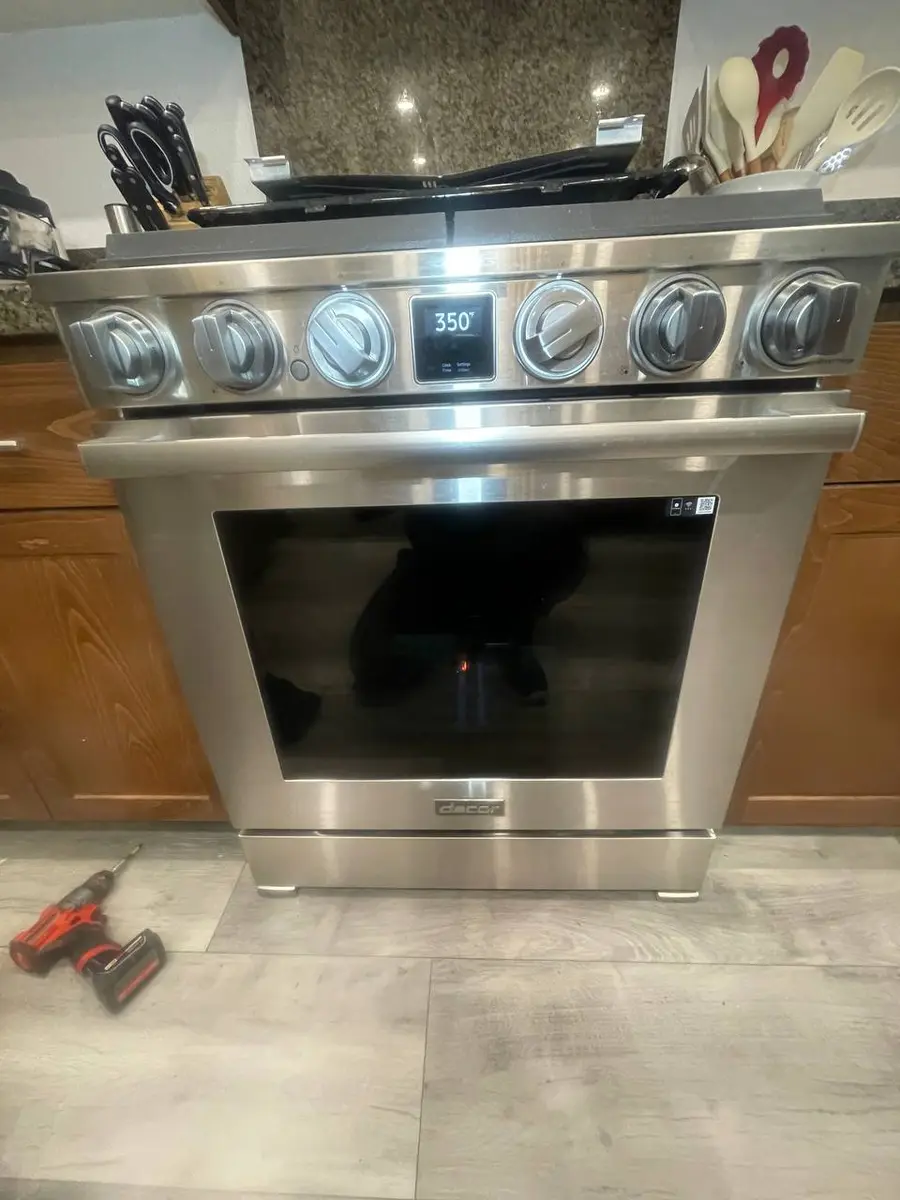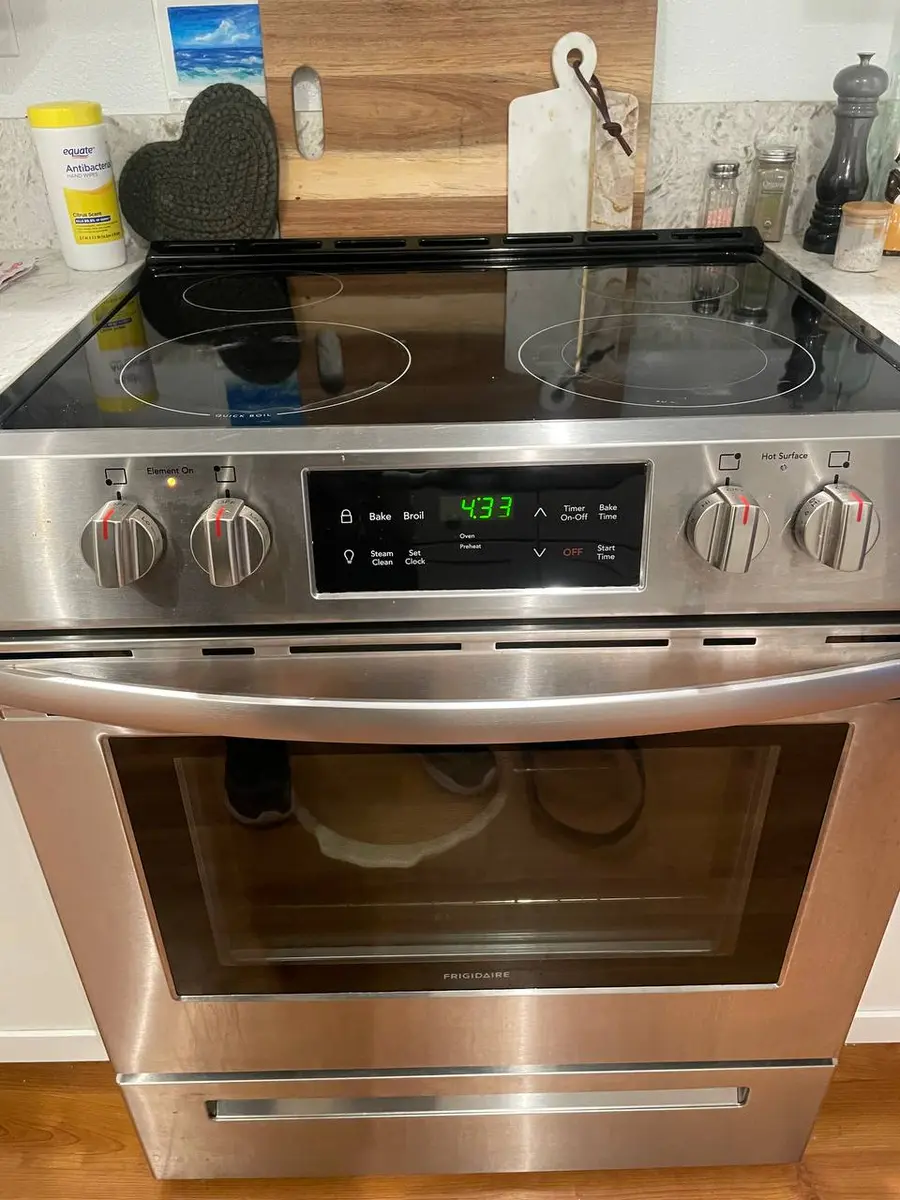
Whirlpool ovens and ranges use a simpler error code system than their washers and dryers. Most codes are a single "F" followed by a number (F1, F2, F3, etc.), and they relate directly to the Electronic Range Control (ERC) — the brain of the oven. This system is shared across Whirlpool (WFE, WFG, WOS), Maytag (MER, MGR), KitchenAid (KOSE, KFEG), Jenn-Air, and Amana ranges. Some newer models add an "E" suffix (F3E0, F3E2) for more specific diagnosis. This guide covers every code for freestanding ranges, slide-in ranges, wall ovens, and double oven models.
How Whirlpool Oven Error Codes Work#
The ERC (Electronic Range Control) monitors all oven functions: temperature sensing, element/burner control, door latch operation, and user input. When a fault is detected, the ERC displays an F-code and sounds a continuous beep. On most models, pressing Cancel/Off silences the alarm but does not clear the underlying fault.
Important safety note: Oven error codes involving temperature or the door latch can indicate fire hazards. If the oven is overheating, turn off the circuit breaker before troubleshooting. If you smell gas, leave the home right away: do not operate switches, light a flame or use a phone inside, and call your gas utility from outside.
Basic reset: Turn off the oven at the circuit breaker for 5 minutes. Restore power. If the code returns when you turn on the oven, the fault requires repair.
Do You Have the Right Tools?
Combustion analyzer ($300), igniter tester ($120), temperature calibrator ($150), and gas pressure manometer. Our technician arrives with $3,000+ in professional tools — your diagnostic is free.
Licensed & Insured · 90-Day Warranty · Same-Day Service
Stuck Function Key#
A function key on the control panel can stick, or the ERC can generate a false key-press signal.
Common causes:
- Self-clean cycle heat (900+ degrees F) warping the control panel overlay membrane
- Grease and cooking splatter seeping behind buttons
- Failed ERC with a stuck input
- Moisture intrusion behind the control panel from steam during cooking
How to fix:
- Turn off the breaker for 3 minutes, then restore power.
- Press each function key firmly to free any physically stuck button.
- Clean around all buttons with a damp cloth. On ranges positioned near dishwashers, steam migration causes button adhesion.
- If the problem only appears during or immediately after self-clean, the control panel overlay is delaminating from heat exposure. Replace the overlay before condemning the ERC — the overlay is the cheaper part.
- If the problem persists after cleaning and overlay inspection, replace the ERC.
F1 — Touch Pad / Clock / ERC Internal Error#
The most common Whirlpool oven error code. The ERC's internal clock circuit or touch pad interface has failed.
Common causes:
- ERC internal component failure (the most frequent oven board failure)
- Touch pad membrane deterioration from heat and age
- Ribbon cable connection between touch pad and ERC loosened by heat cycling
- Power surge damage
How to fix:
- Turn off the breaker for 5 minutes. If F1 returns immediately on power-up, the ERC itself is faulty.
- If F1 only appears when specific keys are pressed, the touch pad membrane is the problem, not the ERC.
- Isolation test: On models where the touch pad and ERC are separate parts, switch off the breaker, disconnect the ribbon cable from the touch pad to the ERC, then restore power and watch the display. If the error clears with the touch pad disconnected, the touch pad is faulty. If the error persists, the ERC is faulty. Switch the breaker off again before you reconnect the cable.
- Important model difference: On KitchenAid KOSE and Jenn-Air ranges, the ERC and touch pad are integrated as a single assembly. On Whirlpool WFE and Maytag MER models, they are separate parts. Always check the model-specific parts diagram before ordering.
Safety First — Know the Risks
Gas ovens involve live gas lines — a loose connection creates explosion and carbon monoxide risk. Electric ovens run on 240V circuits. Our techs are licensed and insured — let them handle the risk.
Licensed & Insured · 90-Day Warranty · Same-Day Service
F2 — Oven Over-Temperature (Safety Critical)#
The oven exceeded its programmed temperature limit. This is a safety-critical code — the ERC has detected a temperature above its safety limit.
Common causes:
- Welded bake or broil relay on the ERC (stuck in the ON position — keeps the element powered continuously)
- Failed oven temperature sensor reading artificially low (ERC adds more heat)
- Shorted sensor wiring touching the oven cavity wall
- Failed cooling fan (on convection models) allowing heat buildup in the control area
How to fix:
- Turn off the circuit breaker immediately. Allow the oven to cool completely (1–2 hours) before any diagnosis.
- With the breaker still off, test the oven temperature sensor resistance and compare it with the tech sheet value for room temperature — resistance rises with temperature. A reading significantly below spec means the sensor is faulty, causing the ERC to think the oven is cooler than it actually is.
- Check the sensor wire harness for shorts to the oven cavity wall — insulation can melt during self-clean cycles.
- If the sensor tests correctly but the oven still overheated, the bake relay on the ERC board is likely welded closed. Confirming it means checking for voltage at the bake element connector with the power on — a live test for a technician, who then replaces the ERC.
Warning: An over-temperature oven is a fire hazard. Do not use the oven until repaired. Keep the circuit breaker off.
F3 — Oven Control Error#
F3 points to the oven control or its wiring.
What to do:
- Run the basic reset above once.
- If F3 returns, keep the breaker off and book a technician to check the oven control and its wiring.
The Real Cost of DIY
Average DIY attempt: $150-400 in tools you may use once, plus the risk of further damage. Our diagnostic visit costs $0 — we find the problem and give you an honest quote.
Licensed & Insured · 90-Day Warranty · Same-Day Service
Shorted Temperature Sensor#
A shorted oven temperature sensor reads abnormally low resistance, indicating a short circuit in the sensor or its wiring.
Common causes:
- Sensor wire insulation melted where it contacts the hot oven cavity wall (common after self-clean)
- Short circuit inside the sensor probe
- Moisture in the sensor connector
How to fix:
- Switch off the breaker first. Access the temperature sensor — it enters the oven cavity through the rear wall, secured by one or two mounting screws. You can access it from inside the oven without pulling the unit out.
- Disconnect the sensor connector (usually behind the range or inside the wall oven frame). Measure resistance and compare it with the tech sheet value for room temperature.
- A reading far below the tech sheet value confirms a short. Replace the sensor.
- Before installing the new sensor, inspect the wire harness inside the oven cavity for insulation damage. On self-cleaning ovens, the extreme heat (900+ degrees F) degrades wire insulation over time. Secure the wire away from the oven walls with high-temperature clips.
A sensor replacement is one of the least expensive oven repairs.
Diagnostic tip: Oven temperature sensors are RTD (Resistance Temperature Detector) type — resistance rises with temperature, so compare a reading with the tech sheet value for the temperature the sensor is at. A shorted sensor (low resistance) and an open one (infinite resistance) are opposite failures of the same sensor.
F4 — Oven Control Error#
F4 points to the oven control (the oven cavity control on wall ovens) or its wiring.
What to do:
- Run the basic reset above once.
- If F4 returns, keep the breaker off and book a technician to check the oven control and its wiring.
Don't Void Your Warranty
Opening your appliance yourself may void the manufacturer warranty. Our repair comes with a 90-day guarantee, and we document everything for warranty compliance.
Licensed & Insured · 90-Day Warranty · Same-Day Service
Open Temperature Sensor#
An open sensor circuit reads infinite resistance, meaning a broken wire or disconnected sensor.
Common causes:
- Disconnected sensor connector (vibration from the oven fan or door closing can loosen the plug)
- Broken conductor inside the sensor wire at a stress point
- Corroded connector pins from heat exposure
- Fractured sensor element inside the probe
How to fix:
- Switch off the breaker first, then check that the sensor connector is firmly plugged in. On many Whirlpool ranges, the connector is behind the unit and can vibrate loose.
- Disconnect and measure resistance — an infinite/OL reading at room temperature confirms an open circuit.
- Before replacing the sensor, check the wire harness for breaks, especially where it enters the oven cavity through the rear wall. A wire repair can save a sensor replacement.
- Check connector pins for heat damage or corrosion. Clean with electrical contact cleaner.
- Replace the sensor if it reads open.
F5 — Door Latch Assembly or Latch Switch Error#
F5 points to the oven door latch assembly, the door latch switches or their wiring.
What to do:
- Make sure nothing keeps the oven door from closing fully, then run the basic reset above once.
- If F5 returns, book a technician to test the door latch assembly, the latch switches and their wiring.
Is It Worth Your Time?
Oven temperature issues require systematic testing of the igniter, gas valve, thermostat, and calibration. Average DIY: 4-6 hours. Our technician diagnoses the issue in about 30 minutes — same-day appointments available.
Licensed & Insured · 90-Day Warranty · Same-Day Service
F9 — Door Latch Error#
The oven door latch mechanism cannot lock or unlock properly. Most commonly occurs during or after the self-clean cycle.
Common causes:
- Stripped plastic gears inside the latch motor assembly (wear from age)
- Latch motor seized or burned out
- Latch position switches out of calibration
- Door stuck locked after self-clean because the bi-metal lock hasn't cooled enough
How to fix:
- If the door is stuck locked after self-clean: Turn off the breaker and wait 30 minutes. The bi-metal lock releases as the oven cools below 550 degrees F. Never force the door open — forcing breaks the latch mechanism.
- If the door won't lock for self-clean: check the latch motor by entering diagnostic mode and running the door latch test. You should hear the motor run and see the latch extend.
- Switch off the breaker, then inspect the latch assembly for broken or stripped gears — visible through the top vent or by removing the top panel.
- Running the latch motor on line voltage is a live test for a technician — never apply power to it with improvised leads.
- With the breaker still off, check the latch position switches for proper continuity at each position (locked, unlocked, mid-travel).
- Replace the latch assembly if the motor or gears are failed.
F8 — Control Board Configuration Error#
The ERC's configuration memory does not match the appliance model. This typically appears after a board replacement with an improperly configured replacement part.
How to fix:
- Verify the replacement ERC part number matches the original exactly — even within the same model series, different build dates may use different ERC versions.
- Some replacement ERCs require programming/configuration after installation. Consult the installation instructions included with the new board.
- If this appears on an oven that has not had a board replacement, the ERC's configuration EEPROM has become corrupted. Replace the ERC.
The Risk of Getting It Wrong
A wrong diagnosis often turns a simple fix into a costly replacement. Without proper diagnostic tools, you might replace the wrong part — or cause additional damage. Our free diagnostic eliminates the guesswork.
Licensed & Insured · 90-Day Warranty · Same-Day Service
Gas Range Ignition Problems#
Oven Igniter Issues#
On gas ranges, the control may try to light the oven burner while the flame sensor does not detect ignition within the safety timeout period.
How to fix:
- Check the igniter: a weak igniter glows but doesn't generate enough heat to open the gas valve. Measuring its current draw is a live test for a technician.
- With the breaker off and the oven cool, check the flame sensor (a small metal rod near the burner) for carbon buildup. Clean with fine steel wool.
- Verify gas supply — ensure the gas shutoff valve behind the range is fully open.
A weak igniter is one of the most common gas oven repairs.
Gas Safety Notes#
If you smell gas, leave the home right away: do not operate switches, light a flame or use a phone inside, and call your gas utility from outside.
Whirlpool Oven Diagnostic Mode#
Standard entry method (most Whirlpool/Maytag ranges):
- Press and hold Bake for 3 seconds. On some models, press Cancel first, then Bake within 5 seconds.
- The display shows the current temperature sensor reading (should be near room temperature if oven is cold).
- Arrow keys (temperature up/down) scroll through diagnostic functions.
- Stored error codes display as the last 3 faults recorded.
Self-clean models — testing the door latch:
- Enter diagnostic mode using the method above.
- Scroll to the door latch test.
- The display shows "LOC" when the latch engages and "UNL" when it releases.
- If the latch does not respond, the latch motor or gears have failed.
Free Diagnostic Visit — Zero Risk
Our certified technician comes to your home, diagnoses the problem with professional tools, and gives you an honest quote — all at zero cost. No parts markup, no hidden fees. If you decide not to proceed, you pay nothing.
Licensed & Insured · 90-Day Warranty · Same-Day Service
Frequently Asked Questions#
Q: My Whirlpool oven shows F1 and beeps constantly. How do I stop the beeping? A: Press Cancel/Off to silence the alarm. Then turn off the breaker for 5 minutes to reset. If F1 returns when you restore power, the ERC has failed and needs replacement. If F1 only appears when you press certain buttons, the touch pad membrane is faulty — a less expensive repair than the full ERC.
Q: Can I still use the stovetop burners if the oven shows an error code? A: On most Whirlpool ranges, yes. The cooktop burners operate independently of the ERC on gas models. On electric ranges with a shared control board, some F-codes may disable the entire appliance. If the cooktop burners still light/heat normally, they are safe to use while you schedule the oven repair.
Q: Why does my Whirlpool oven show F2 during self-clean? A: Self-clean raises the oven temperature to approximately 900 degrees F to incinerate food residue. If the temperature sensor or its wiring has degraded, the oven may exceed the safety threshold, triggering F2. This is common on ovens that have been self-cleaned many times — the extreme heat degrades the sensor and wire insulation over time. Replace the sensor and inspect the wiring before running self-clean again.
Q: How much does it cost to replace a Whirlpool oven control board (ERC)? A: The cost depends on the ERC your model needs — on KitchenAid and Jenn-Air ranges the touch pad is integrated with the ERC, so the combined assembly is replaced — and on the installation labor. For ovens over 10 years old, compare the total repair cost against a new oven — if repair exceeds 50% of replacement cost, consider replacing.
Q: My Whirlpool oven temperature is off by 25–50 degrees but shows no error code. What should I check? A: Minor temperature calibration drift is normal. Most Whirlpool ovens have a calibration offset accessible through the settings menu: hold Bake for 5 seconds, then use the temperature arrows to adjust in 5 degree F increments (up to +/- 35 degrees F). If the offset is larger than 35 degrees F, the temperature sensor is likely degrading — replace it proactively before it fails.
When to Call a Professional#
Professional repair is recommended for:
- F2 (over-temperature) — A welded relay poses a fire risk and requires board-level diagnosis to confirm.
- F9 with the door locked — Forcing a locked oven door breaks the latch mechanism and can shatter the glass on some models. A technician can safely release the latch.
- Gas oven ignition failures — Gas system diagnosis requires proper tools and safety training.
- F3 or F4 that returns after a reset — The oven control or its wiring needs board-level diagnosis.
- Repeated sensor faults after sensor replacement — May indicate a wiring harness short inside the oven cavity that needs to be traced and repaired.
- Any burning smell or visible sparking — Turn off the breaker immediately and do not use the oven until inspected.
Whirlpool oven showing an error code? EasyBear's certified technicians specialize in Whirlpool oven and range repair for freestanding, slide-in, and wall oven models. We carry temperature sensors, igniters, latch assemblies, and control boards in stock. Free diagnostic visit, same-day repair in most cases, backed by our 90-day parts and labor warranty. Schedule your free diagnosis today.