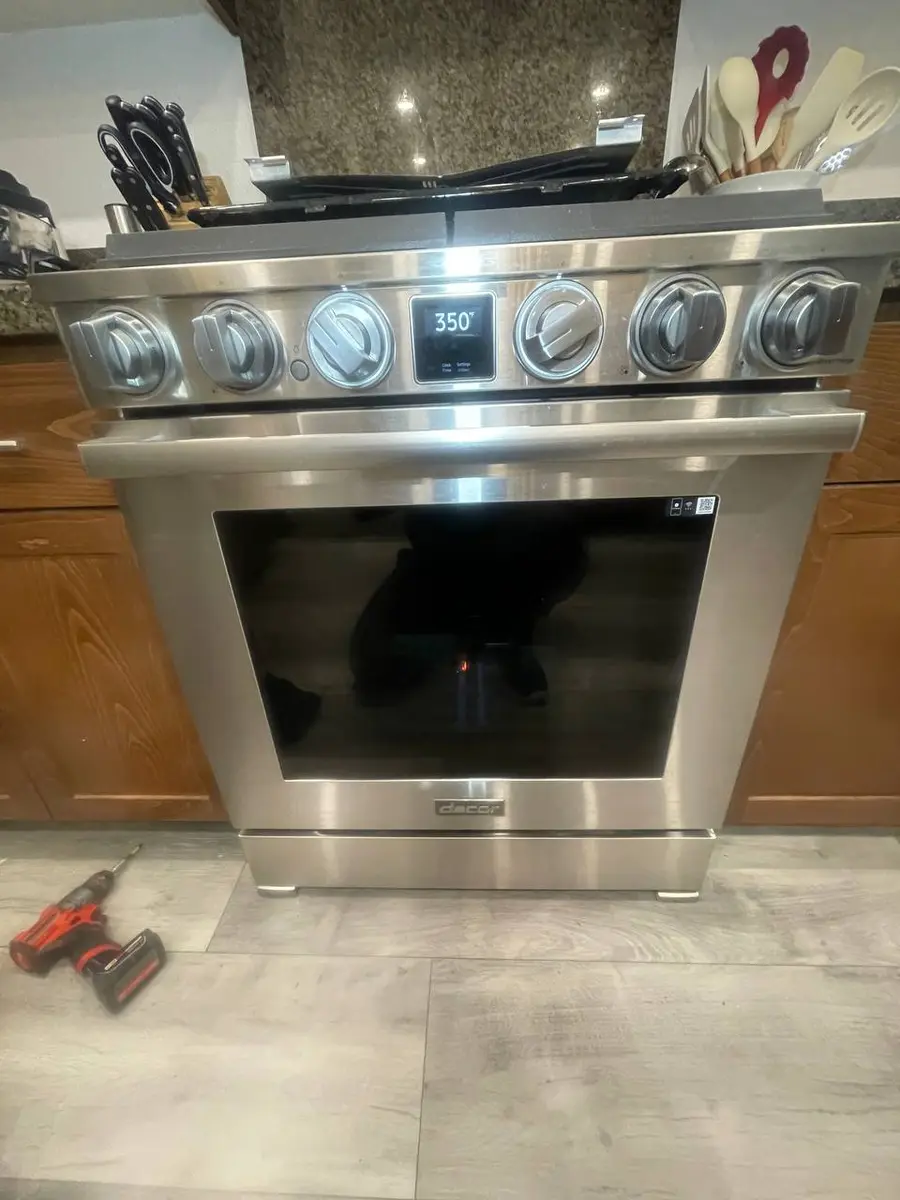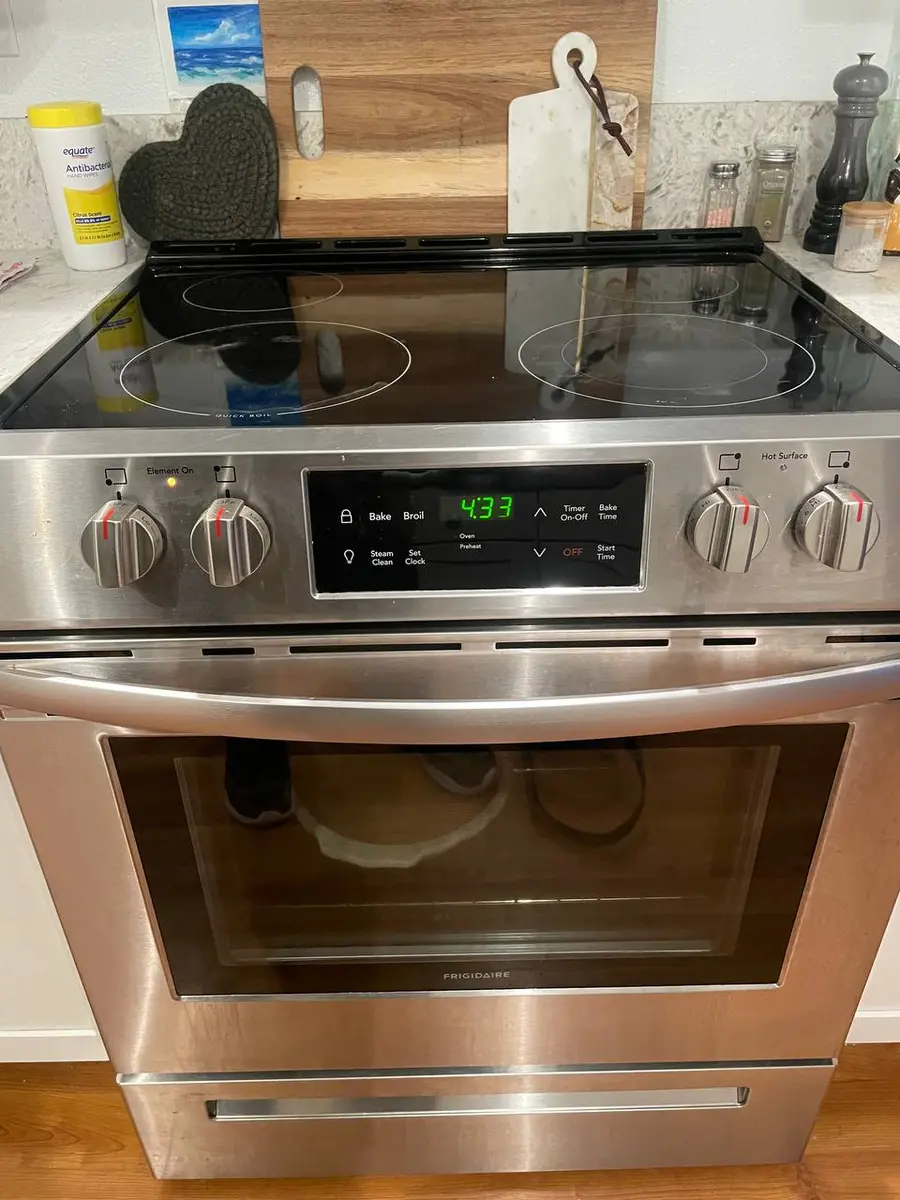
Whirlpool oven codes use a two-part F#E# format that groups by subsystem: F3-codes are the temperature sensor, F5E1 is the door lock, F2E1 is a stuck key, and F1-codes are the control board itself. Read the pair, match it to its family, and you've localized the fault before opening a panel. A hard reset clears the transient ones; a code that returns needs the specific repair.
How to Read the F#E# Format#
Every Whirlpool Corporation appliance, ovens included, reports faults in the same F#E# style — the F-number names the fault category and the E-number the specific condition within it. That consistency is what makes the codes so useful: once you know which family a code belongs to, you know which part to check. To pull stored codes and run component tests, enter diagnostic mode with the model-specific button sequence printed on the tech sheet behind the rear panel or inside the console. Before any of that, respect the safety basics: cut power at the breaker, since 240V oven wiring is lethal, and let the oven cool fully before reaching inside.
Do You Have the Right Tools?
Combustion analyzer ($300), igniter tester ($120), temperature calibrator ($150), and gas pressure manometer. Our technician arrives with $3,000+ in professional tools — your diagnostic is free.
Licensed & Insured · 90-Day Warranty · Same-Day Service
The Codes, by Family#
Temperature sensor — F3E1 and F3E2 (about 25% of faults)#
The most common family. The oven's control reads a temperature sensor — about 1080 ohms at room temperature — to hold heat, and when that reading goes bad it posts an F3-series code: F3E1 for an open circuit, F3E2 for a short. Diagnose by cutting power, finding the thin sensor rod at the back cavity wall, disconnecting it at the board, and metering across its leads for that 1080-ohm value at room temperature; an infinite or zero reading confirms the sensor. It mounts with a screw or two and swaps out quickly, after which you verify calibration against an oven thermometer.
Door lock — F5E1 (about 10% of faults)#
F5E1 is the self-clean door lock. The lock motor must engage at the start of self-clean and release once the oven cools below about 550°F, and a failed motor, a stripped lock gear, or a fault in the board's lock circuit throws F5E1 — either refusing to start self-clean or leaving the door locked afterward. Start self-clean and listen for the lock motor within about thirty seconds; silence means testing for voltage at the lock connector. Sometimes only the gears have stripped, visible through the top panel, and can be replaced without the whole motor.
Stuck key — F2E1#
F2E1 means the board sees a keypad button held continuously — a stuck key or a moisture-infiltrated membrane behind the touch panel. Steam from cooktop cooking drifting onto the console is a common source. Disconnect power for several minutes to let the contacts dry, and if F2E1 returns, the membrane overlay needs replacing. Until it's cleared, the phantom key press can block other commands.
Control board — F1E0, F1E1, F1E2 (about 15% of faults)#
The F1-series family points at the board itself, so no external part will fix them. Power surges are the usual origin, and the giveaway beyond the code is several unrelated functions misbehaving at once — display, timer, and heat all off together. The board lives behind the rear panel or in the console, and a code that persists after a hard reset means it's replaced rather than reset.
Steady, Flashing, or Intermittent#
How a code presents itself adds useful information beyond which code it is. A code showing solid and refusing to clear is an active, present fault — the condition exists right now, so the oven won't operate normally until it's addressed. A code that appears only under specific conditions, such as when a particular mode energizes or the oven reaches a certain temperature, points to a fault that's developing rather than constant, like a sensor connection that opens only when hot. And a code that flashes up briefly and vanishes on its own often traces to a momentary electrical event rather than a failed part. Noting whether the code is tied to a specific action — starting self-clean brings F5E1, high-temperature baking brings an F3-series code, a humid cooktop session brings F2E1 — turns the log from a list of symptoms into a map of what to test, because the trigger is as telling as the code itself.
Safety First — Know the Risks
Gas ovens involve live gas lines — a loose connection creates explosion and carbon monoxide risk. Electric ovens run on 240V circuits. Our techs are licensed and insured — let them handle the risk.
Licensed & Insured · 90-Day Warranty · Same-Day Service
Which Codes You Can Handle Yourself#
The families sort neatly into DIY and professional territory. An F2E1 stuck key is usually the most homeowner-friendly — often just drying out a steam-fogged membrane restores it, no tools needed. An F3-series sensor code is a moderate job for anyone comfortable pulling the rear panel and metering: the sensor is inexpensive, mounts with a screw or two, and swaps out cleanly. An F5E1 lock is also moderate, especially if only the gears have stripped rather than the motor. The F1-series board codes are the ones to be cautious with — a board is the priciest oven part and the easiest to misdiagnose, since a sensor or lock fault can masquerade as board trouble, so confirm with diagnostic mode and rule out the cheaper causes before ordering one. And through all of it, remember the voltage: a 240V electric oven can deliver fatal current, so every internal check happens with the breaker off, and if metering a live-adjacent circuit isn't in your comfort zone, a technician is the right call.
Clearing Codes and What Each One Blocks#
To clear a code, cut power at the breaker for a few minutes and restore it. A transient code from a surge or a one-time glitch won't return, and you're done. A code that comes back the moment the oven resumes normal use is a live fault needing its specific repair. It also helps to know what each family stops you from doing: an F3-series sensor fault leaves the oven unable to regulate heat, so don't rely on it for cooking; an F5E1 lock fault mainly blocks self-clean and can trap the door; an F2E1 stuck key can lock out the controls but usually leaves heating intact once you dry it out; and an F1-series board fault is unpredictable and warrants a professional look before you trust the oven again. When in doubt, treat any code touching temperature or the board as a reason to pause rather than push through.
The Real Cost of DIY
Average DIY attempt: $150-400 in tools you may use once, plus the risk of further damage. Our diagnostic visit costs $0 — we find the problem and give you an honest quote.
Licensed & Insured · 90-Day Warranty · Same-Day Service
Note the Codes You Won't See Here#
Two things worth knowing round out the picture. First, the heating element and, on gas models, the igniter are among the most common oven repairs — an element degrades with thermal cycling and a hot-surface igniter weakens until it glows without lighting — yet a failed element or igniter often produces no code at all, just no heat, because there's no dedicated sensor watching them. So a no-heat oven with a blank code log still points at the element or igniter. Second, prevention keeps the code log short: a surge protector rated for the oven's amperage guards the board, limiting self-clean to a few times a year spares the sensor and lock the extreme 800-to-900-degree stress, and checking the sensor connector once a year for thermal loosening heads off the most common F3-series code before it appears.
Is It Worth Fixing?#
For a Whirlpool oven under roughly eight to ten years old, a single error code almost always points to one component — a sensor, a lock, a membrane, or at worst a board — rather than a failing appliance, and these ovens are built to outlast a single part. The three most common families are also the least expensive: an F2E1 stuck key is often a free dry-out, and an F3-series sensor is a cheap part and a quick swap. Even an F5E1 lock is a modest repair, particularly when only the gears have stripped. It's really only the F1-series board that rises to a larger expense worth weighing against replacement, and even then only when the cheaper causes have been ruled out. So a lone code is a repair decision, not a reason to shop for a new range, and reading the family correctly is what keeps a cheap fix from being mistaken for an expensive one. A quick professional diagnosis confirms which side of that line you're on when a code is ambiguous or keeps returning.
Related reading: a Whirlpool oven that won't self-clean and a Whirlpool oven with a dark display.
Whirlpool [oven repair](/bay-area/services/oven-repair) across [Sacramento](/sacramento/sacramento) and the Bay Area — sensor, lock, and control-board diagnostics in one visit. Book a technician.
Lead Appliance Repair Technician · 12 years experience
Experienced technician with 12 years specializing in washing machine and dryer repairs across all major brands.