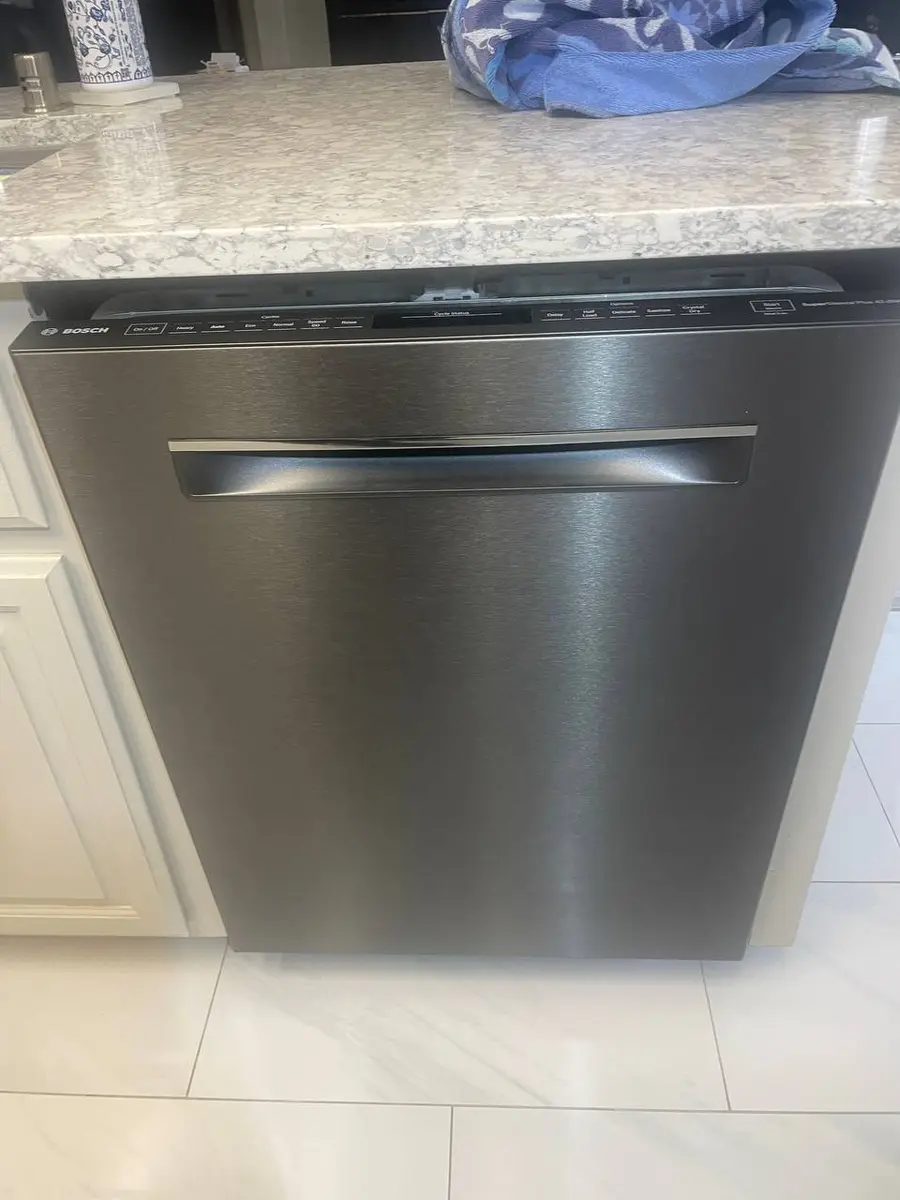
What is the Samsung Dishwasher HE error?#
An HE code means the heating system in your Samsung dishwasher has failed — the element that heats water for washing and drying is not doing its job. The tell-tales are dishes that come out cold and wet, a sanitize cycle that never reaches its target temperature, and water spots or film left behind because the rinse never got hot. There is no home hazard; the dishwasher still runs, it just cannot heat. Because heating is central to cleaning and drying, it is worth addressing rather than living with cold, spotty results. A power cycle is worth one try to rule out a transient fault.
HE on a Samsung Dishwasher: likely causes and repair cost#
On a Samsung Dishwasher, the HE code signals: heater error.
| Likely cause | Typical likelihood |
|---|---|
| Heating element failure | Most common |
| Thermostat issue | Common |
Typical professional repair: $175–$375 · Difficulty: hard · usually a technician job
Symptoms that often accompany HE: Dishes not drying properly; Cycle completes but dishes are cold; Sanitize cycle does not reach target temperature; Water spots or film on glassware (no hot rinse)
Technician diagnostic sequence for HE:
- Run a normal cycle and check if the water is hot during the wash phase — open the door mid-cycle (carefully) and feel the water temperature. It should be 120-140 °F during the main wash
- Access the heating element from below the tub by removing the lower access panel. Test the heater for continuity — it should read 15-30 ohms. An open reading means the element has burned out
- Check the heater wiring for damage or disconnection at the control board end. Samsung dishwasher heater wires run through a tight space near the sump and can chafe on sharp edges
- Test the thermistor (temperature sensor) near the sump — it should read approximately 10-15 k-ohm at room temperature. A failed thermistor can prevent the board from activating the heater
Parts a technician may check or replace: Samsung DD81-02132A; Samsung DD32-00010A; model-specific
Field note: Samsung dishwasher heater elements tend to fail with a visible crack or blister near the center of the loop. Before testing electrically, visually inspect the element through the bottom of the tub with a flashlight — a physical crack is definitive diagnosis.
Do You Have the Right Tools?
Water pressure gauge ($60), spray arm tester, float switch multimeter ($85), and drain inspection camera. Our technician arrives with $3,000+ in professional tools — your diagnostic is free.
Licensed & Insured · 90-Day Warranty · Same-Day Service
How to troubleshoot the HE error yourself#
HE leaves modest room for owner troubleshooting because it is an electrical heating fault. Power-cycle the dishwasher and run a hot cycle to confirm the fault is real. Make sure your home's hot water is reaching the machine — running the kitchen tap hot before starting a cycle gives the dishwasher a warmer starting point and can mask a marginal element. Beyond that, the causes in the table above — a failed heating element or thermostat — are a "hard" repair. The element sits under the tub and testing it means a meter and disassembly. That is where I hand off to a technician, both to confirm which part failed and to reinstall the element with a proper seal.
Is the Samsung Dishwasher HE error worth fixing?#
HE is generally worth fixing on a dishwasher with life left. The table above lists $175 to $375 to replace the heating element or thermostat and restore proper washing and drying — a mid-range repair. Against a new machine that is a modest share, so I fix it in most cases. Replacement only enters the picture on an old unit already stacking failures; a lone HE on a sound dishwasher is comfortably worth the $175 to $375 to get hot, spotless results back.
Safety First — Know the Risks
Live 120V wiring in a wet environment is one of the most dangerous DIY scenarios. Water + electricity = serious shock risk. Our techs are licensed and insured — let them handle the risk.
Licensed & Insured · 90-Day Warranty · Same-Day Service
Samsung Dishwasher HE: frequently asked questions#
What does the HE error mean on a Samsung Dishwasher?#
It indicates a heating fault: the element is not heating water, so dishes come out cold and wet and the sanitize cycle cannot reach temperature.
Is it safe to keep using a Samsung Dishwasher that shows the HE error?#
There is no hazard, but cleaning and drying will be poor and sanitizing will not work. It is fine to run while you arrange a repair.
Can I clear the HE error myself, or do I need a technician?#
A power cycle and running your hot tap first are worth trying. A genuinely failed heating element or thermostat needs a technician to test and replace.
How much does it cost to repair the HE error on a Samsung Dishwasher?#
The table above lists $175 to $375 for diagnosis and replacement of the heating element or thermostat.
Which parts usually fail when a dishwasher throws the HE code?#
The heating element or its thermostat, per the table above, with the element the leading failure.
Why does a heating element failure trigger the HE error?#
When the element cannot heat the water, the dishwasher never reaches its target temperature within the expected time, so it flags HE rather than run a cold, ineffective cycle.
Appliance Repair Technician & Diagnostics Specialist · 10 years experience
Electronics and diagnostics specialist with 10 years of experience in modern smart appliance repair, specializing in LG and Samsung.