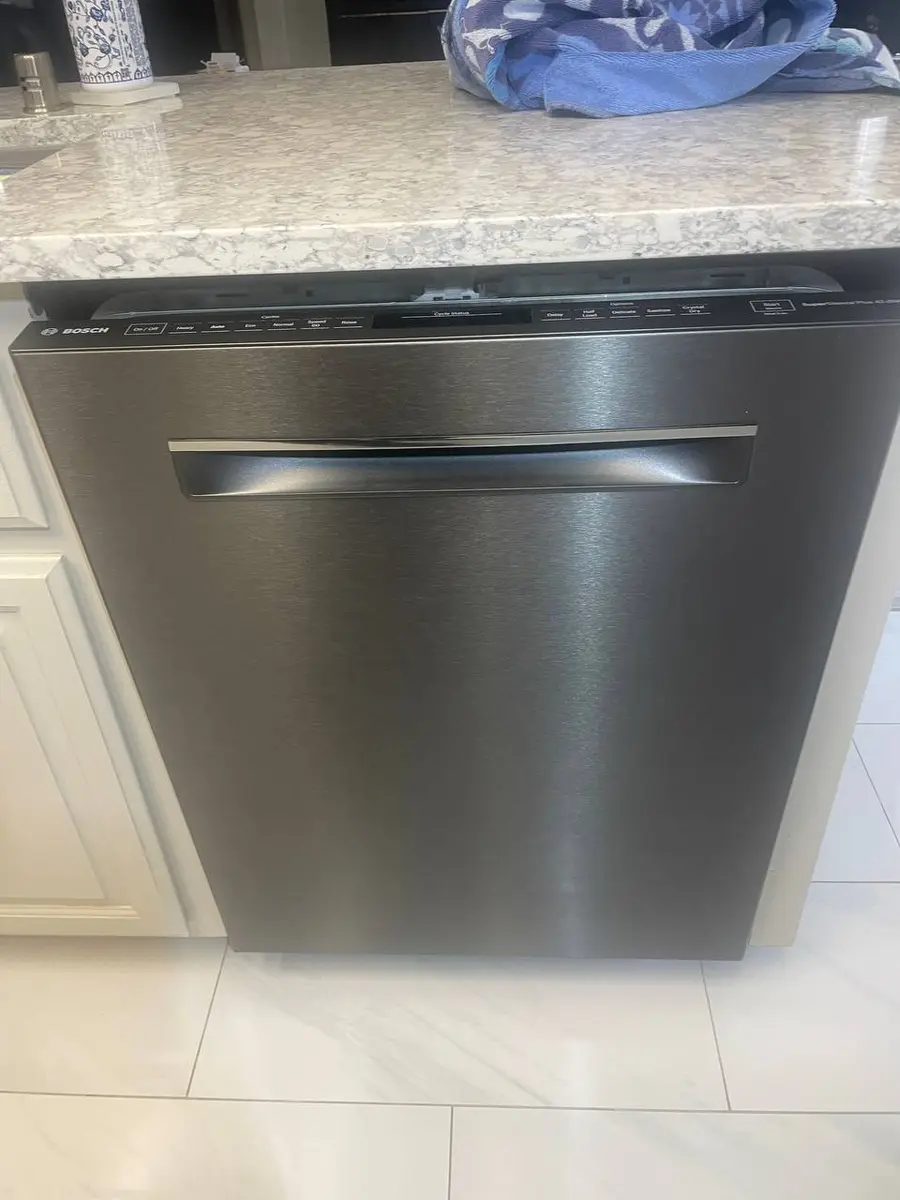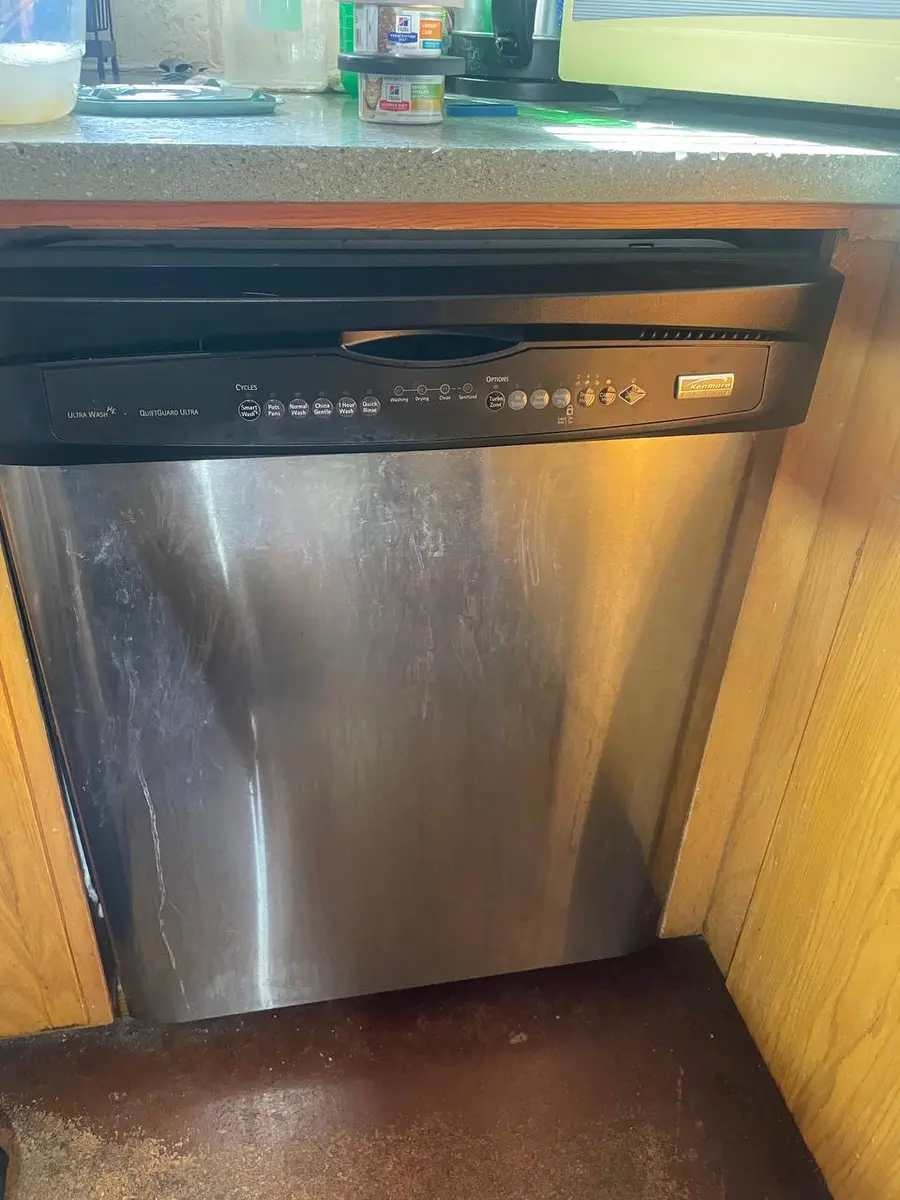
Most Likely Cause#
Flashing lights on a Kenmore [dishwasher](/blog/repair-or-replace-dishwasher) aren't a random glitch — on models without a digital display they are the error-code system, with the control board counting out fault codes in LED flash sequences. The catch is that the same flash pattern means different things on different machines, because Kenmore is a badge over several manufacturers. Seven flashes of the Clean light on a Whirlpool-built 665 is a completely different fault than seven flashes on a Frigidaire-built 587. So the first step is never counting flashes — it's identifying the platform from your model prefix.
That said, one scenario dominates: after a power interruption, many Kenmore dishwashers flash all their LEDs at once, and that's not a fault at all — just an interrupted-cycle flag that a single reset clears.
Find Your Platform First#
Because a flash pattern is meaningless without the manufacturer, start at the model plate on the inner door edge and read the first three digits: 665 is Whirlpool, 630 is LG, 587 is Frigidaire. Write that number down before you count a single flash — it's the difference between correctly reading a Whirlpool's seven Clean-light flashes as a turbidity fault and misreading the same count on a Frigidaire, whose scheme is completely different. This one habit separates a right diagnosis from an afternoon spent chasing the wrong component, and it's why a technician who knows Kenmore asks for the model number before anything else.
Do You Have the Right Tools?
Water pressure gauge ($60), spray arm tester, float switch multimeter ($85), and drain inspection camera. Our technician arrives with $3,000+ in professional tools — your diagnostic is free.
Licensed & Insured · 90-Day Warranty · Same-Day Service
Whirlpool 665 Platform — Clean-Light Flash Codes#
Whirlpool-built Kenmores (prefix 665) flash the Clean light in counted sequences that pause and repeat. Count the flashes in one sequence:
| Flashes | Code | Meaning |
|---|---|---|
| 1 | F1 | Control-board processor fault |
| 2 | F2 | User-interface communication error |
| 3 | F3 | Thermistor open or shorted |
| 4 | F4 | Drain exceeded time (couldn't drain in 120 seconds) |
| 5 | F5 | Door-latch fault — microswitch not confirming closed |
| 6 | F6 | Water-inlet fault — tub didn't fill in time |
| 7 | F7 | Flow/turbidity fault — motor running, no flow detected |
| 8 | F8 | Overflow — float switch triggered |
On newer 665 units with a display, these same faults appear as letter-number codes such as F1E1 or F2E1; the meaning is identical to the flash count.
LG 630 and Frigidaire 587 Platforms#
LG 630 models flash a row of program LEDs together rather than counting one light. All LEDs flashing at once is a power interruption — cut power for ten minutes and restore. Rinse and Dry alternating is a drain-motor fault (the display-model OE), Wash and Rinse alternating is an inlet fault (IE), and only the Start LED blinking means the door switch isn't engaged. LG-platform units also support Smart Diagnosis: hold Temp while on the phone with LG support and the machine transmits diagnostic tones the system decodes.
Frigidaire 587 models flash one indicator a counted number of times: two flashes is a drain fault, three is overfill or flood detection, five is a circulation-pump fault, and six is a heater fault — the same faults Frigidaire posts as i20, i30, i50, and i60 on display models.
Safety First — Know the Risks
Live 120V wiring in a wet environment is one of the most dangerous DIY scenarios. Water + electricity = serious shock risk. Our techs are licensed and insured — let them handle the risk.
Licensed & Insured · 90-Day Warranty · Same-Day Service
The Everyday Scenarios#
All lights flash after an outage. This is the interrupted-cycle flag, not a fault. Press Cancel (hold it three seconds on a 665, or press Power Off then On on a 630) to clear it. If it persists, kill the breaker for five minutes for a full board reset.
Start LED blinks but nothing runs. Across every platform this almost always means the door isn't fully latched — the board accepted the cycle but the door-switch circuit is open. Close the door firmly until it clicks; if it's clearly shut already, the latch microswitch (665) or reed switch (630) has failed.
Lights flash mid-cycle, then it stops. A fault that develops during operation, most often drainage: on a 665 that's four flashes from food debris at the drain-pump impeller — cancel, pull the filter, clear the sump, and restart; on a 630 it's Rinse and Dry alternating from a loosened drain pump or a kinked hose.
How to Reset#
- Quick reset: hold Cancel (or Start/Cancel) three seconds, wait for the lights to go out, then select a cycle and press Start.
- Hard reset: switch off the dishwasher's breaker, wait five minutes (ten for LG-platform boards, which hold a charge longer), and restore power — it should boot to idle.
- Diagnostic mode: on a 665, press Heated Dry, Normal, Heated Dry, Normal within four seconds to step through each component and see which phase triggers the fault; on a 630, hold Delay Start + Dual Zone for three seconds to read the stored code.
The Real Cost of DIY
Average DIY attempt: $150-400 in tools you may use once, plus the risk of further damage. Our diagnostic visit costs $0 — we find the problem and give you an honest quote.
Licensed & Insured · 90-Day Warranty · Same-Day Service
Resolving the Most Common Codes#
Once you've counted the flashes and named the platform, most codes have a first fix you can try yourself. A drain code — F4 on a 665, or Rinse-and-Dry alternating on a 630 — usually means debris reached the drain pump: cancel the cycle, pull the filter, clear the sump of glass and food, and confirm the drain hose didn't kink when the machine shifted. A fill or inlet code — F6 on a 665, or Wash-and-Rinse alternating on a 630 — points at the water supply: check that the household shutoff under the sink is fully open and the inlet screen isn't scaled shut. A door or latch code — F5 on a 665, or a lone Start blink on any platform — often just needs the door closed harder until it clicks, or a failed latch switch replaced. Only the board, thermistor, and turbidity faults (F1, F3, F7 on a 665) typically call for a part rather than a five-minute fix.
When It's Serious#
- Continuous rapid flashing with no pause can be a board short — cut power immediately.
- A burning smell alongside any flash code is an active electrical failure, not a mere sensor error.
- A code that clears but returns within the first 30 seconds of every cycle is reproducible and won't self-resolve.
Don't Void Your Warranty
Opening your appliance yourself may void the manufacturer warranty. Our repair comes with a 90-day guarantee, and we document everything for warranty compliance.
Licensed & Insured · 90-Day Warranty · Same-Day Service
Cost and Repair-or-Replace#
Most flash codes are cheap or free to resolve — a reset clears the interrupted-cycle flag, a firm door close fixes a Start blink, and clearing the sump handles a mid-cycle drain code. The parts behind persistent codes (a latch switch, a thermistor, a drain pump) are inexpensive, and only a control-board fault pushes the cost up. Because the machine underneath is a Whirlpool, LG, or Frigidaire, a persistent code after a hard reset is worth repairing rather than replacing — and a technician who knows Kenmore's multi-OEM structure can read the flash pattern on arrival and know immediately which system they're on. If the code won't clear, request a technician.
Appliance Repair Technician · 11 years experience
Experienced technician with 11 years specializing in Frigidaire and Electrolux refrigerator and dryer repair with a focus on safety.