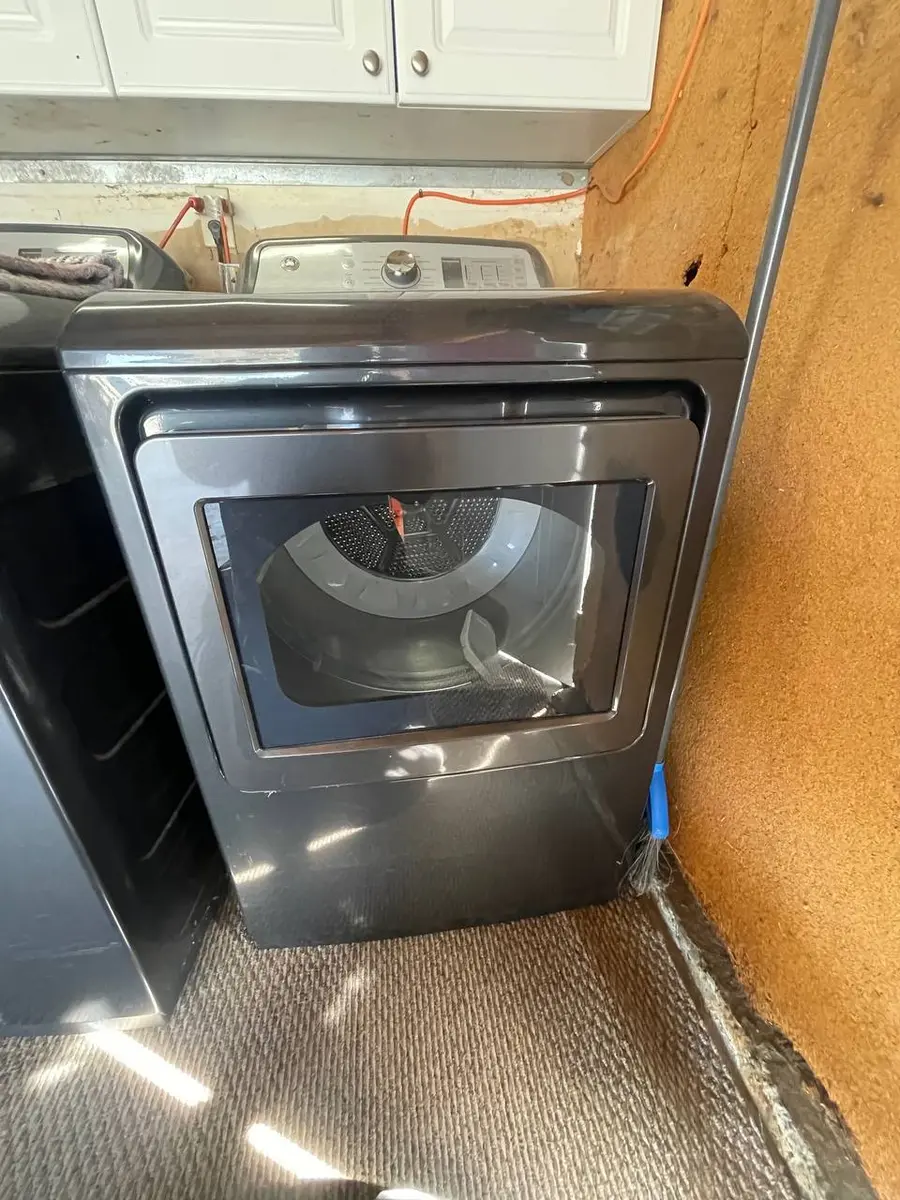
On a GE dryer the door switch is the start permission — the motor won't run until the switch confirms the door is shut, so a failed switch or latch leaves you pressing Start with nothing happening. The diagnostic clue is error E3, a door-switch fault. The fix is usually the door switch (part WE4M415), and GE's reversible-door design is part of why it wears.
What the Door Switch Actually Controls#
A GE dryer's door switch isn't just a courtesy light control — it's a safety interlock wired ahead of the motor circuit. When the door closes, the switch must physically actuate and signal the board that it's secured; only then will the board let the drive motor start. If the switch fails to make that contact — a broken actuator, worn contacts, or a latch that no longer depresses the plunger — the dryer behaves as though the door is open and simply refuses to start, even though everything else is fine. This is true on both GE lines: the GFD electric models and the GTD gas models share the same door switch (WE4M415) and the same start-permission logic, differing only in how they make heat.
Do You Have the Right Tools?
Gas leak detector ($130), thermal fuse tester ($95), belt tension gauge, and vent inspection camera ($180). Our technician arrives with $3,000+ in professional tools — your diagnostic is free.
Licensed & Insured · 90-Day Warranty · Same-Day Service
Read the Symptom and the Code#
The failure has a clean signature. Press Start and get no response at all — no motor, no tumble — with the door apparently closed, and the door switch tops the suspect list. GE's diagnostic mode confirms it: with the dryer in standby, hold Delay Start and My Cycle together for three seconds until the display shows "88" and then "t1," and among the codes it can report, E3 is specifically a door-switch fault (alongside E1 for an open thermistor, E2 for a shorted one, and E5 for high exhaust temperature). An E3, or a start command that does nothing with the door shut, points you straight at the switch rather than the motor or board.
Why GE Door Switches Wear#
Every GE dryer supports a reversible door — four screws swap the hinges and latch to change the swing — and that same mechanism means the latch and switch see a lot of duty in a tight laundry room where the door is opened and closed at an awkward angle. Over years, the plunger the door presses wears, or the latch drifts so it no longer fully depresses the switch, and the contact becomes intermittent before it fails outright. Reversing the door to open toward more clearance can actually spare the switch, since a door that closes squarely presses the plunger cleanly every time instead of glancing off it.
Safety First — Know the Risks
Gas dryers carry carbon monoxide and explosion risk. Even electric dryers involve 240V circuits that can deliver a fatal shock. Our techs are licensed and insured — let them handle the risk.
Licensed & Insured · 90-Day Warranty · Same-Day Service
Test and Replace the Switch#
Work it safely first: on an electric GFD, unplug from the 240V outlet, which is a lethal voltage; on a gas GTD, shut the gas valve and unplug the 120V cord. Then find the door switch at the front bulkhead where the door meets it, and meter it — it should show continuity when the plunger is depressed (door closed) and open when released. A switch that never changes state, or that reads intermittently when you wiggle it, is done. The WE4M415 switch is an inexpensive part and a moderate job: disconnect the harness, release the switch from its mount, fit the new one, and confirm continuity before reassembling. While you're in there, check that the latch and strike align so the new switch gets pressed fully.
Electric and Gas Are the Same Here#
One thing that simplifies the door-switch diagnosis: it's identical across GE's electric and gas dryers. A GFD electric model runs its heat from a 240V element and a GTD gas model from an igniter and gas valve, but both use the same door switch, the same start-permission interlock, and the same diagnostic sequence, so nothing about the door problem changes with the heat source. That means you don't need to know your heat type to chase a no-start — the WE4M415 switch, the E3 code, and the continuity test apply either way. It also means the switch is one of the higher-mileage parts on any GE dryer, since every single cycle depends on it closing cleanly, which is exactly why it's the first thing to check when a dryer goes dead on Start.
The Real Cost of DIY
Average DIY attempt: $150-400 in tools you may use once, plus the risk of further damage. Our diagnostic visit costs $0 — we find the problem and give you an honest quote.
Licensed & Insured · 90-Day Warranty · Same-Day Service
Don't Overlook the Simple Checks#
Before condemning the switch, rule out the trivial: confirm the door is genuinely latching and not held ajar by a lint-packed strike or a warped bulkhead gasket, and make sure a child lock or control lock isn't holding the panel. If diagnostic mode shows no E3 and the switch tests good but the dryer still won't start, the fault moves upstream to the start switch, the wiring harness, or the board — but on a GE dryer the door switch is the first and most common stop on a no-start call, and it's the cheapest to rule in or out. Keeping the latch area clean and reversing the door for a square close are the two habits that make the switch last. It's also worth checking the switch's wiring where it flexes each time the door opens, since a conductor that has fatigued and cracked inside its insulation reads like a dead switch even when the switch itself is fine — meter continuity right at the harness connector to tell the two apart before you buy the part.
Related reading: a GE dryer that won't start and a GE dryer drum that won't turn.
GE [dryer repair](/bay-area/services/dryer-repair) across [Sacramento](/sacramento/sacramento) and the Bay Area — door switch, latch, and control diagnostics in one visit. Book a technician.
Senior Gas Appliance Specialist · 18 years experience
AGA-certified gas appliance specialist with 18 years of experience in residential and commercial oven, range, and cooktop repairs.