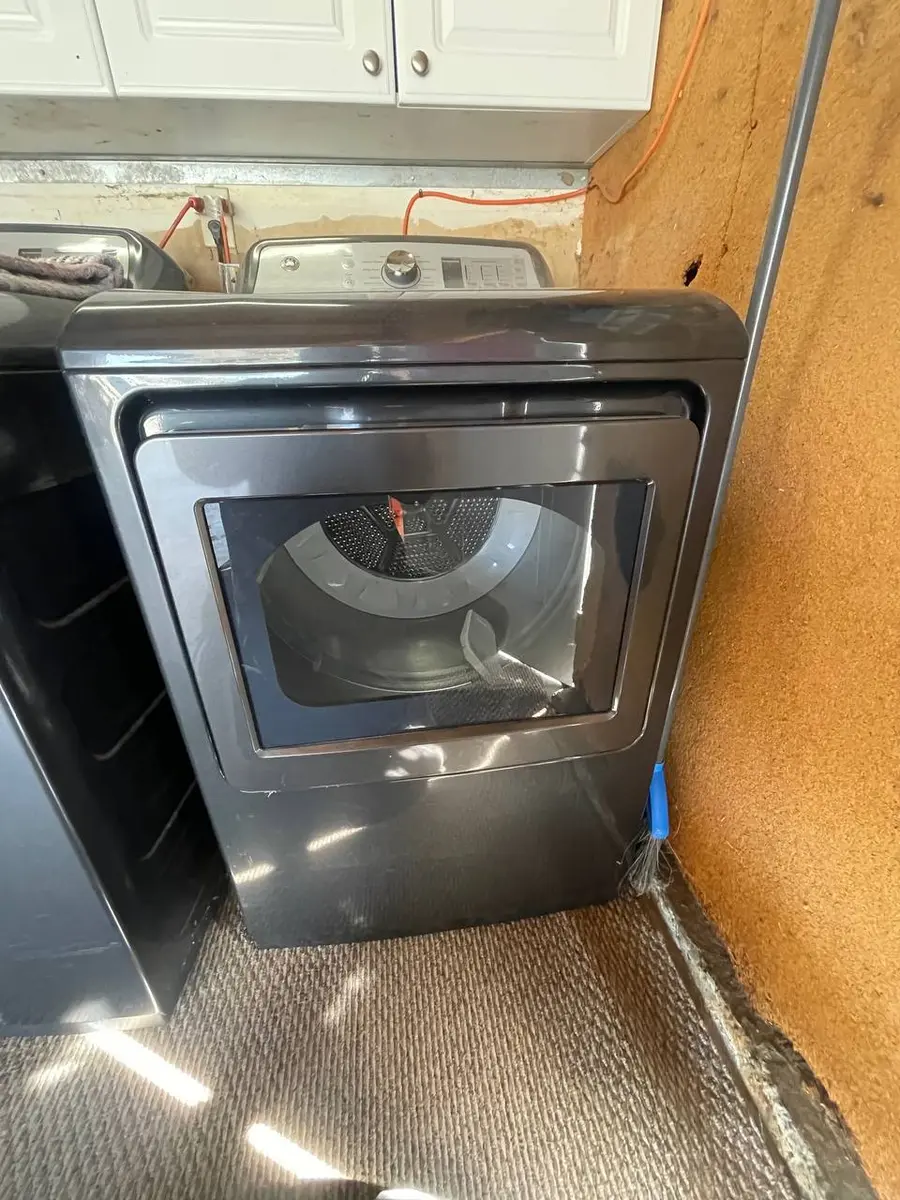
GE Profile dryers offer advanced features including heat pump technology (ventless operation), SmartHQ Wi-Fi connectivity, Sanitize cycles, steam refresh, and sensor-based auto-dry that adjusts time based on actual moisture content. Models like the PFD87ESP (heat pump), PFD95ESP, and PTD90EB varies and include some of the most energy-efficient drying technology available for California homes where energy costs are among the highest in the nation.
Profile dryers use the GE error code system (E-codes and status codes) while adding Profile-specific codes related to the heat pump system, advanced moisture sensors, and SmartHQ connected diagnostics.
How GE Profile Dryer Error Codes Work#
Profile dryers display error codes on the LED or LCD panel. Connected models push error notifications to SmartHQ with suggested troubleshooting. The control board monitors exhaust temperature, drum motor current, moisture sensor readings, and on heat pump models, the refrigerant circuit pressures and evaporator/condenser temperatures.
To reset most error codes: Press Power to turn off, unplug for 60 seconds, plug back in, and run a Timed Dry cycle on Air Fluff (no heat) to test basic operation. If the error returns, the fault persists.
Do You Have the Right Tools?
Gas leak detector ($130), thermal fuse tester ($95), belt tension gauge, and vent inspection camera ($180). Our technician arrives with $3,000+ in professional tools — your diagnostic is free.
Licensed & Insured · 90-Day Warranty · Same-Day Service
E1 — Thermistor / Temperature Sensor Error#
E1 indicates the exhaust temperature sensor (thermistor) is reading outside its expected range — either shorted, open, or disconnected.
Common causes:
- Thermistor element failure (open or shorted internally)
- Disconnected wiring at the thermistor connector
- Corroded connector pins from lint and moisture exposure
- Control board analog input circuit fault
How to fix:
- Locate the exhaust thermistor — on GE Profile dryers, it is mounted in the exhaust duct housing behind the drum, accessible from the rear panel.
- Disconnect the thermistor leads and measure resistance: approximately 10,000 ohms (10k) at room temperature (77 degrees F). The resistance should decrease as temperature rises. An open reading (infinite) or near-zero reading confirms failure.
- Check the wiring connector for lint buildup, corrosion, or loose pins. Clean and reseat.
- Replace the thermistor if readings are outside specification (varies by model and region for the part).
Profile-specific note: GE Profile heat pump dryers (PFD87ESP and similar) have multiple temperature sensors — one on the exhaust, one on the heat pump condenser, and one on the evaporator. E1 may refer to any of these depending on which circuit the board detects as faulted. In diagnostic mode, the specific sensor is identified by test number. Heat pump sensor replacement requires accessing the sealed heat pump compartment — professional service recommended.
Part cost: Thermistor varies by part (standard). Heat pump sensors varies by part. Professional repair: varies by part.
E2 — Heating System Error#
E2 means the dryer is not generating heat or not reaching the target temperature within the expected timeframe.
Common causes (electric models):
- Heating element burned out (open circuit) — part WE11X10007 or model-specific equivalent
- High-limit thermostat tripped (safety device that cuts heater power if exhaust exceeds 250 degrees F)
- Thermal fuse blown (one-time safety device that does not reset — common after vent blockage events)
- Broken or loose heater wire connection
Common causes (gas models):
- Gas valve solenoid failure (coils burn out after 5–7 years)
- Igniter failure (glows but does not reach ignition temperature)
- Flame sensor fault (cannot detect flame, so gas valve shuts off)
Common causes (heat pump models):
- Compressor not running (inverter or compressor fault)
- Refrigerant charge low (sealed system leak)
- Condenser or evaporator airflow blocked by lint
How to fix (electric):
- Test the heating element for continuity — disconnect power, access the heater housing (rear panel), and measure across the element terminals. Open = element burned out.
- Test the high-limit thermostat and thermal fuse for continuity. Both should read near 0 ohms (closed). Open = tripped or blown.
- If the thermal fuse is blown, replace it AND clean the entire exhaust vent system — a blown fuse indicates dangerous heat buildup from restricted airflow.
- Inspect heater wire connections for signs of arcing or loose spade terminals.
How to fix (heat pump):
- Check that the lint filter is clean and that the heat pump condenser fins (accessible behind the lint filter compartment on some models) are clear of lint accumulation.
- Listen for the compressor — it should start within 30 seconds of cycle start. No compressor operation = inverter or compressor fault (professional diagnosis needed).
- If the compressor runs but air is not warm, the refrigerant charge may be low from a leak. This is sealed system work requiring a certified technician.
Profile-specific note: GE Profile heat pump dryers operate at lower temperatures (approximately 120–140 degrees F vs 135–175 degrees F for conventional dryers). E2 on a heat pump model may trigger even when the unit is technically producing some heat — but not enough to satisfy the cycle's temperature target. Lint on the heat pump condenser fins is the most common cause of reduced heat output in Sacramento (where lint accumulates faster due to the combination of hard water mineral residue on clothing and pet hair). Clean the condenser fins monthly with the included brush tool or a vacuum with brush attachment.
Part cost: Heating element varies by part. Thermal fuse varies by part. High-limit thermostat varies by part. Heat pump compressor: varies by part (sealed system). Professional repair: varies by part.
Safety First — Know the Risks
Gas dryers carry carbon monoxide and explosion risk. Even electric dryers involve 240V circuits that can deliver a fatal shock. Our techs are licensed and insured — let them handle the risk.
Licensed & Insured · 90-Day Warranty · Same-Day Service
E3 — Motor Error#
E3 indicates the drum motor is drawing excessive current, stalled, or not responding to the control board drive signal.
Common causes:
- Drum bearing seizure (the felt drum seal wears out, causing metal-to-metal contact)
- Foreign object lodged between the drum and housing (coins, bra underwire)
- Motor windings failed (open or shorted)
- Drive belt jammed or broken (motor spins but drum does not rotate)
- Motor capacitor failure (motor hums but cannot start rotation)
How to fix:
- Try to rotate the drum by hand through the open door. It should turn freely with smooth resistance. If stiff, grinding, or completely locked, something is preventing rotation.
- If the drum does not rotate, check the belt — if broken, the drum spins freely (too freely). Replace belt and inspect for cause of breakage.
- If the drum is mechanically locked, check for objects between the drum and housing. Access requires removing the front or top panel depending on model.
- Test motor windings for continuity. Motor replacement is varies by model and region for the part.
Profile-specific note: GE Profile dryers with the reversible tumble feature (alternating drum direction for reduced tangling) put additional stress on the motor and belt system compared to standard unidirectional dryers. If E3 occurs specifically during direction-change moments, the motor relay or the direction-switching relay on the control board may be faulty rather than the motor itself.
Part cost: Belt varies by part. Motor varies by part. Drum bearing kit varies by part. Professional repair: varies by part.
E4 — Airflow Restriction Detected#
E4 is a Profile-specific code indicating the exhaust airflow sensor has detected restricted airflow below the minimum threshold for safe operation. This is a fire safety warning.
Common causes:
- Clogged lint filter (always check first)
- Blocked exhaust vent (lint accumulation in the duct run from dryer to exterior)
- Crushed or kinked flexible exhaust duct
- Bird nest or debris in the exterior vent termination
- Excessive duct length or too many elbows (GE maximum: 60 equivalent feet)
How to fix:
- Clean the lint filter — even a partially clogged filter can trigger E4 on Profile models with sensitive airflow sensors.
- Disconnect the exhaust duct from the back of the dryer. Run a Timed Dry cycle with the duct disconnected. If E4 clears, the restriction is in the duct system, not the dryer.
- Clean the entire exhaust duct from dryer connection to exterior termination. A dryer vent cleaning kit with a rotating brush (available at hardware stores, varies by model and region) handles most residential duct runs.
- Check the exterior vent flap — it should swing open freely when air flows. Sacramento Valley cottonwood seeds and leaves frequently block exterior vents in spring.
- Verify duct specifications: maximum 60 equivalent feet (each 90-degree elbow = 5 feet, each 45-degree elbow = 2.5 feet). Use rigid metal duct, not flexible vinyl (which is a fire hazard and code violation in California).
Profile-specific note: GE Profile heat pump dryers that are ventless (PFD87ESP) do not have an exhaust duct — but they still have E4 capability related to the internal condenser airflow. On ventless models, E4 means the condenser fins are so clogged with lint that internal air cannot circulate properly. Clean the condenser with the included brush tool and vacuum the lint accumulation from the lower compartment.
Part cost: $0 in most cases (cleaning resolves it). Duct replacement: $50–$150 for materials + installation. Professional vent cleaning: $100–$200.
The Real Cost of DIY
Average DIY attempt: $150-400 in tools you may use once, plus the risk of further damage. Our diagnostic visit costs $0 — we find the problem and give you an honest quote.
Licensed & Insured · 90-Day Warranty · Same-Day Service
E5 — Moisture Sensor Error#
E5 indicates the moisture sensor bars (metal strips inside the drum that detect fabric dampness) are not providing a valid signal.
Common causes:
- Dryer sheet residue coating the sensor bars (creates an insulating film)
- Sensor bar corroded or pitted
- Wiring fault between sensor and control board
- Control board analog input failure
How to fix:
- Locate the moisture sensor bars — on GE Profile front-load dryers, they are two or three metal strips on the inner front of the drum opening, near the lint filter area.
- Clean the sensor bars with rubbing alcohol and a soft cloth. Fabric softener sheets leave a waxy residue that insulates the bars from fabric contact, causing inaccurate readings.
- Check for visible corrosion or pitting on the bar surfaces. Light sanding with fine sandpaper (400 grit) removes surface oxidation.
- If cleaning does not resolve E5, check the wire connection from the sensor bars to the control board. Lint accumulation around the connector can cause intermittent contact.
Profile-specific note: GE Profile models with the Sensor Dry and Optimized Dry features rely more heavily on moisture sensor accuracy than standard GE dryers. An inaccurate sensor on a Profile unit causes the auto-dry cycle to either over-dry (damaging fabrics and wasting energy) or under-dry (leaving damp clothes). If your Profile consistently over-dries or under-dries on auto cycles without an E5 code, the sensors may be contaminated below the error threshold — clean them as a maintenance step.
Part cost: Sensor bars varies by part. Professional repair: varies by part.
dE — Door Switch Error#
The dE code means the control board cannot detect that the door is closed and latched.
Common causes:
- Door not fully closed (lint buildup on the door seal prevents full closure)
- Failed door switch (the mechanical switch that detects door position)
- Broken door catch or latch mechanism
- Wiring fault at the door switch connector
How to fix:
- Clean the door seal and latch area — lint buildup prevents the door from closing completely.
- Close the door firmly and listen for a positive click.
- Test the door switch: press it manually while the dryer is powered on. The drum light should turn off and the dryer should start if you press Start. If no response, the switch has failed.
- Measure switch continuity with a multimeter — should be closed (near 0 ohms) when pressed, open when released.
Part cost: Door switch varies by part. Door latch varies by part. Professional repair: varies by part.
Don't Void Your Warranty
Opening your appliance yourself may void the manufacturer warranty. Our repair comes with a 90-day guarantee, and we document everything for warranty compliance.
Licensed & Insured · 90-Day Warranty · Same-Day Service
Additional GE Profile Dryer Codes#
- E6 — Drive motor tachometer error. The board is not receiving speed feedback. Check tach sensor and motor connections.
- E8 — Drum light circuit error. LED drum light has a short or the circuit is overloaded. Usually resolved by replacing the LED module.
- PF — Power failure. Dryer lost power during a cycle. Press Start to resume or start a new cycle.
- LOC — Control lock active. Press and hold Lock for 3 seconds to deactivate.
- dC — Lint filter compartment not fully closed. Ensure the lint filter is seated completely and the compartment door is latched.
GE Profile Dryer SmartHQ Diagnostics#
Connected Profile dryers provide:
- Cycle history — water removal rate, time to dry, average exhaust temperature, energy usage per load.
- Vent health monitor — tracks drying time trends. Gradually increasing dry times indicate developing vent restriction before E4 triggers.
- Error log — last 30 events with cycle phase context.
- Remote start — begin a cycle remotely (clothes must already be loaded and door closed).
- Energy reporting — monthly energy usage statistics, particularly valuable for California's tiered electricity pricing.
Is It Worth Your Time?
A dryer not heating could be the element, thermal fuse, gas valve, igniter, or timer. Average DIY diagnosis: 3-4 hours with no guarantee of finding the issue. Our technician diagnoses the issue in about 30 minutes — same-day appointments available.
Licensed & Insured · 90-Day Warranty · Same-Day Service
GE Profile Dryer Diagnostic Mode#
Enter diagnostic mode: with the dryer off, press and hold the Signal + Wrinkle Care buttons, then press Power within 3 seconds. Tests cycle through: door switch (t1), heater/heat pump (t2), motor forward (t3), motor reverse (t4), moisture sensors (t5), thermistors (t6). Each test runs 30–60 seconds.
Frequently Asked Questions#
Q: Are GE Profile dryer codes different from standard GE dryer codes? A: Core codes (E1, E2, E3, dE) are shared. Profile adds E4 (airflow restriction with dedicated sensor), heat pump-specific codes, UltraFresh-related codes, and more granular motor diagnostics (reversible tumble). Parts differ — heat pump components are Profile-exclusive and significantly more expensive.
Q: My Profile heat pump dryer takes longer than my old dryer. Is something wrong? A: No. Heat pump dryers intentionally operate at lower temperatures (120–140 degrees F vs 150+ degrees F for conventional). This extends drying time by 15–30 minutes but uses 50–60% less energy and is gentler on fabrics. If drying time has increased beyond the normal baseline for your unit, clean the condenser fins and check for E4 codes.
Q: How often should I clean the heat pump condenser on my Profile dryer? A: Monthly in typical use. Sacramento homes with pets or hard water mineral residue in fabrics should clean every 2–3 weeks. The condenser fins trap fine lint that bypasses the main filter. Neglected condensers cause E2 (insufficient heat) and E4 (airflow restriction) and reduce efficiency.
Q: Is the thermal fuse on a GE Profile dryer resettable? A: No. Thermal fuses are one-time safety devices. Once blown, they must be replaced (varies by model and region for the part). More importantly, a blown fuse means the dryer exhaust reached dangerous temperatures — the vent system MUST be cleaned before using the dryer again. Running a dryer with a new fuse and a blocked vent will blow the new fuse and risks a house fire.
Q: Can I vent my GE Profile dryer into the attic or garage? A: No. California building code (and GE's installation requirements) mandate that dryer exhaust vent to the exterior of the building. Venting into an attic or garage creates moisture damage and fire hazards. If your laundry room lacks an exterior vent path, the GE Profile heat pump dryer (PFD87ESP) is the solution — it is ventless and condenses moisture internally.
The Risk of Getting It Wrong
A wrong diagnosis often turns a simple fix into a costly replacement. Without proper diagnostic tools, you might replace the wrong part — or cause additional damage. Our free diagnostic eliminates the guesswork.
Licensed & Insured · 90-Day Warranty · Same-Day Service
Professional GE Profile Dryer Service#
GE Profile dryers include heat pump technology, advanced moisture sensing, SmartHQ connectivity, and reversible tumble systems that require Profile-specific diagnostic knowledge. EasyBear technicians understand these systems — including the critical difference between conventional heating element failures and heat pump refrigerant circuit issues that require different repair approaches. We provide free diagnostic visits and carry common Profile dryer parts for same-visit repair. Every repair is backed by our 90-day parts and labor warranty. Schedule your free diagnosis today.
Lead Appliance Repair Technician · 12 years experience
Experienced technician with 12 years specializing in washing machine and dryer repairs across all major brands.