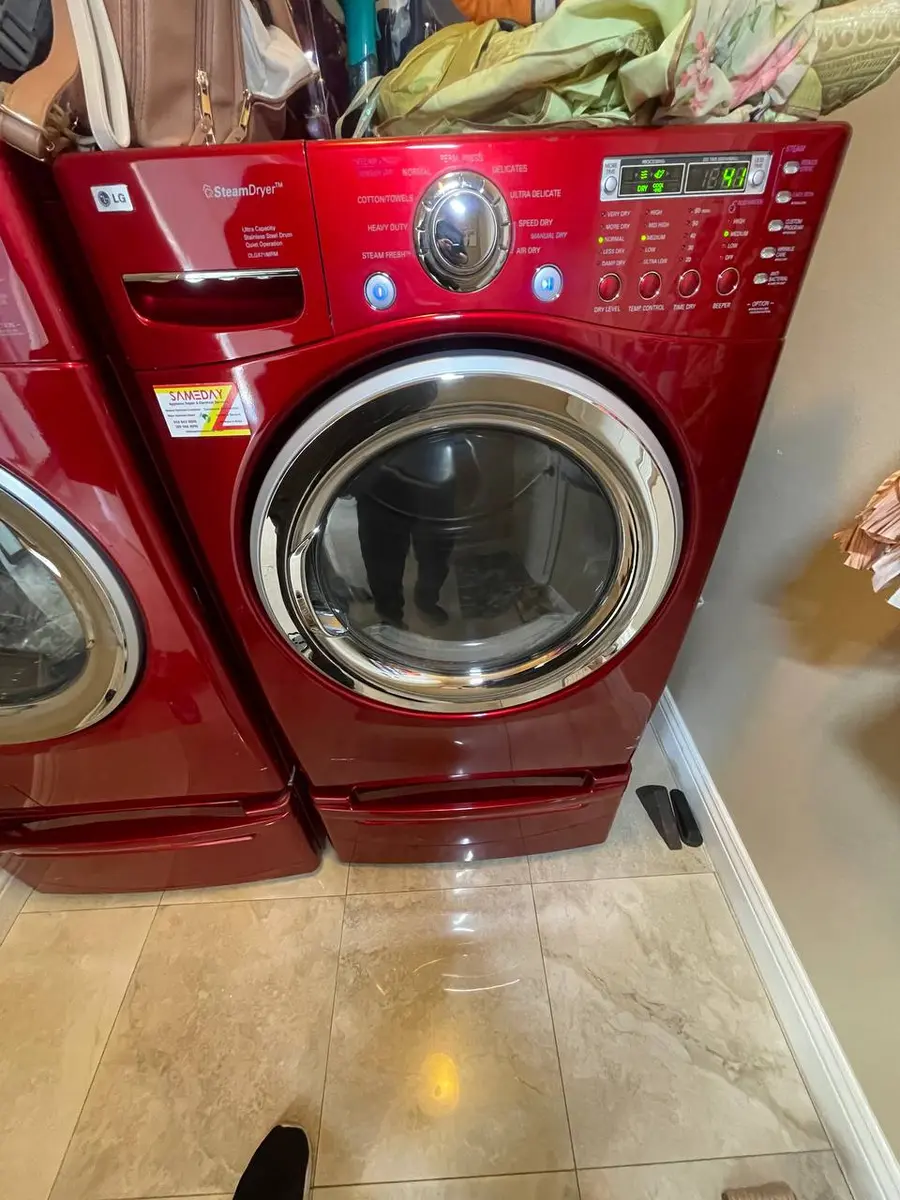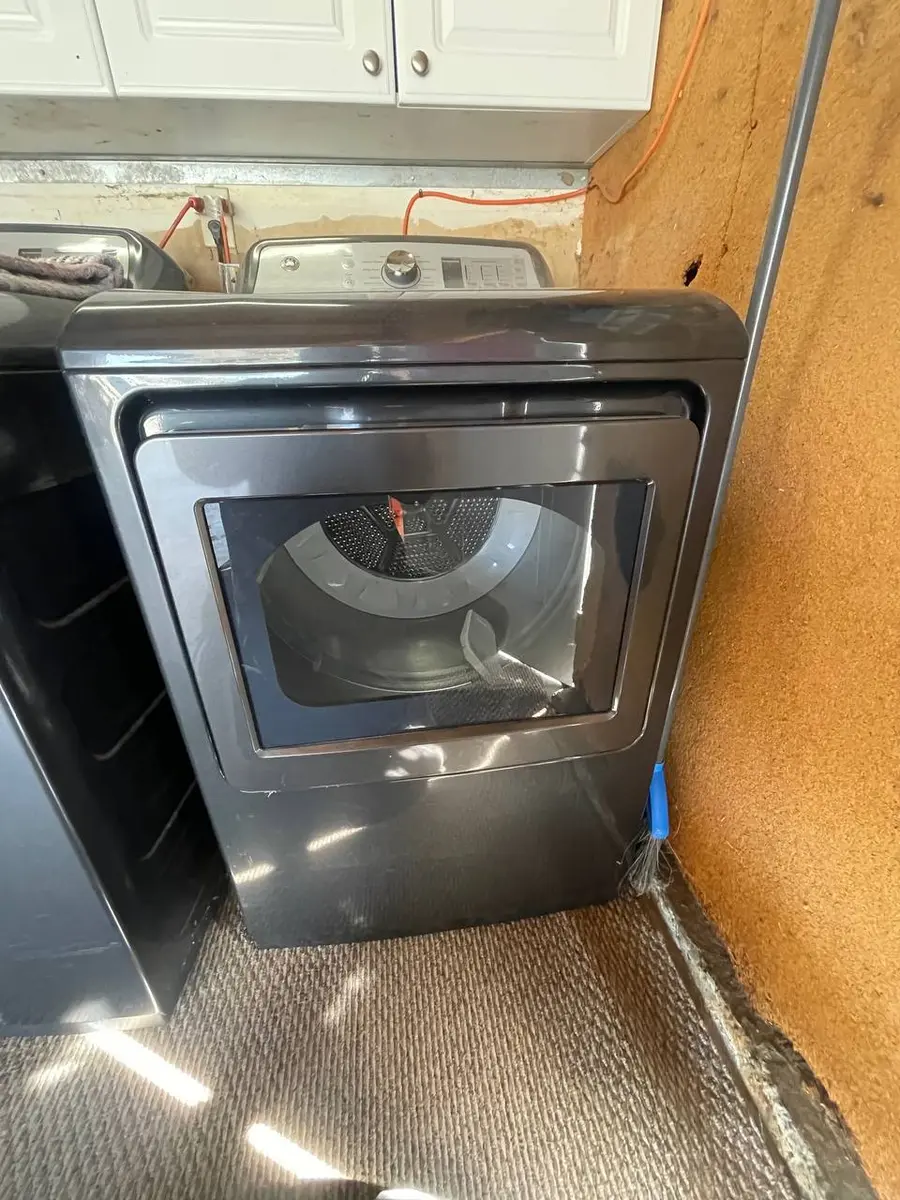
GE dryers — both gas and electric — use an electronic control system that monitors temperature, moisture, airflow, and motor operation throughout every cycle. When the control board detects a sensor reading outside normal parameters or a component failure, it halts the cycle and displays an error code on the front panel. This guide covers every GE dryer error code, explains the root cause, and provides step-by-step repair instructions with real GE part numbers.
How GE Dryer Error Codes Work#
GE dryers have two control boards: the main electronic control board (mounted behind the rear panel or under the top panel) and the user interface board (behind the front control panel). The main board collects data from the thermistor, moisture sensor bars, door switch, and motor circuit. When a fault is detected, it sends a code to the UI board for display.
SmartHQ diagnostics (WiFi models): GE dryers with WiFi Connect (GFD55, GFD65, GFD85 series and newer) send error codes and cycle data to the GE SmartHQ app. Open the app, select your dryer, and tap "Appliance Health" for real-time diagnostics and stored fault history.
Service Mode entry: Press and hold the Wrinkle Care and Signal buttons simultaneously for 3 seconds. On knob-selector models, use the same rotation sequence as GE washers: 12 o'clock, 1 counterclockwise, 3 clockwise, 1 counterclockwise, 1 clockwise. The display shows stored error codes and allows you to run component tests.
Basic reset for most GE dryer error codes:
- Press Power to turn off the dryer.
- Unplug from the outlet (or flip the breaker) for 60 seconds.
- Plug back in and run a Timed Dry cycle for 5 minutes to test.
Do You Have the Right Tools?
Gas leak detector ($130), thermal fuse tester ($95), belt tension gauge, and vent inspection camera ($180). Our technician arrives with $3,000+ in professional tools — your diagnostic is free.
Licensed & Insured · 90-Day Warranty · Same-Day Service
E1 — Thermistor Open / Temperature Sensor Failure#
The E1 code means the dryer's temperature sensor (thermistor) is reading an open circuit — the control board receives no temperature data and cannot regulate heating safely.
Common causes:
- Failed thermistor element (part WE04X25996) — the resistive element inside the sensor has broken
- Disconnected wiring harness between thermistor and main control board
- Corroded connector pins at the thermistor plug
- Main board thermistor input circuit failure (rare)
How to fix:
- Locate the thermistor: On most GE dryers, the thermistor is mounted on the blower housing or the exhaust duct inside the cabinet. Unplug the dryer (and turn off the gas valve on gas models) and remove the rear panel or lower front panel depending on the model.
- Test resistance: Disconnect the thermistor plug and measure resistance with a multimeter. At room temperature (77 degrees F), a healthy GE dryer thermistor reads approximately 10,000–12,000 ohms (10k–12k). An open reading (OL/infinite) confirms the thermistor has failed.
- Check wiring: If the thermistor reads normal, trace the wiring harness from the thermistor to the main board connector. Look for breaks, burns, or chafed insulation where wires route near the heating element or exhaust duct.
- Replace the thermistor (WE04X25996, varies by model and region) if it reads open. It is a 15-minute repair requiring only a Phillips screwdriver.
Part cost: Thermistor (WE04X25996) varies by model and repair complexity. Professional repair varies by model and repair complexity.
E2 — Thermistor Shorted#
The E2 code indicates the thermistor is reading a very low resistance (near zero), meaning the sensor element is internally shorted or the wiring has a short to ground.
Common causes:
- Thermistor element failure (shorted internally)
- Wiring insulation melted from proximity to the heating element, causing wire-to-wire or wire-to-ground contact
- Moisture intrusion into the thermistor connector (can happen after vent cleaning if moisture enters the cabinet)
How to fix:
- Unplug the dryer and locate the thermistor (same location as E1 — blower housing or exhaust duct area).
- Disconnect the thermistor plug and measure resistance. A shorted sensor reads near 0 ohms or very low (under 1,000 ohms at room temperature).
- If the thermistor reads normal when disconnected from the harness but E2 persists, the wiring between the thermistor and control board has a short. Inspect the harness for melted insulation, especially where it routes near the heater box.
- Replace the thermistor or repair the wiring as needed.
Part cost: Thermistor (WE04X25996) varies by model and repair complexity. Wiring harness repair is typically varies by part in labor. Professional repair varies by model and repair complexity.
Safety First — Know the Risks
Gas dryers carry carbon monoxide and explosion risk. Even electric dryers involve 240V circuits that can deliver a fatal shock. Our techs are licensed and insured — let them handle the risk.
Licensed & Insured · 90-Day Warranty · Same-Day Service
E3 — Exhaust High Limit / Overheating#
The E3 code is a critical safety alert — the dryer's exhaust temperature has exceeded the high-limit threshold, indicating a potential fire hazard from restricted airflow.
Common causes:
- Clogged lint filter — the number one cause of dryer overheating and house fires nationwide
- Clogged or kinked exhaust vent duct (from the dryer to the exterior wall)
- Crushed flexible duct behind the dryer (common when the dryer is pushed too close to the wall)
- Failed high-limit thermostat (part WE04X25996) — the safety switch that cuts power to the heating element at excessive temperatures
- Blocked exterior vent hood (birds' nests, lint accumulation, stuck damper)
How to fix:
- Clean the lint filter completely. Remove all lint from the filter screen and the filter housing cavity. Use a long brush to clean lint from the duct inside the dryer below the filter.
- Inspect the exhaust vent: Disconnect the vent duct from the back of the dryer. Use a dryer vent cleaning kit (long flexible brush) to clean the full length of the duct to the exterior. Check the exterior vent hood — the damper flap should open freely.
- Check the high-limit thermostat: This safety device is mounted on the heater housing or exhaust duct. Test continuity with a multimeter — it should read 0 ohms (closed) at room temperature. If it reads open, it has tripped. Some are resettable (press the reset button); others are one-time fuses that must be replaced.
- Measure vent duct length and turns: GE dryers require a maximum equivalent vent length of 60 feet. Each 90-degree turn reduces the maximum by 5 feet. If your vent run exceeds specifications, airflow restriction is inevitable.
Part cost: High-limit thermostat (WE04X25996) varies by model and repair complexity. Professional vent cleaning varies by model and repair complexity. Professional repair varies by model and repair complexity.
Warning: Dryer vent fires cause an estimated 2,900 house fires annually in the U.S. If E3 appears, do not continue using the dryer until the vent system is fully inspected and cleaned.
E4 — Heater Relay Stuck / Heating Circuit Failure#
The E4 code indicates the control board has detected that the heating element relay is stuck closed (heating continues when it should not) or the heating circuit has an electrical fault.
Common causes:
- Relay on the main control board stuck in the closed position (the board continues to energize the heater even when the cycle does not call for heat)
- Heating element grounded to the cabinet (part WE11M10002 for electric, WE14X215 igniter for gas)
- Cycling thermostat failure
- Wiring issue in the heater circuit
How to fix:
- Safety first: If the dryer continues to heat after the cycle ends, unplug it immediately. A stuck heater relay is a fire hazard.
- Test the heating element (electric dryers): Unplug the dryer, access the heater box (behind the rear panel on most GE models), and measure the heating element resistance: expect 8–15 ohms across the element terminals. Also test from each terminal to the cabinet ground — any continuity to ground means the element is shorted and must be replaced.
- Test the gas valve coils (gas dryers): Measure resistance across each gas valve solenoid coil — expect 300–2,000 ohms each. Open reading means a coil has failed.
- Test the relay on the main board: This requires an advanced multimeter test. With the dryer running on a no-heat cycle (air fluff), measure voltage at the heater circuit output on the main board. If 240V (electric) or 120V (gas igniter) is present during a no-heat cycle, the relay is stuck and the board must be replaced.
Part cost: Heating element (WE11M10002) varies by model and repair complexity. Gas igniter (WE14X215) varies by model and repair complexity. Main control board varies by model and repair complexity. Professional repair varies by model and repair complexity.
The Real Cost of DIY
Average DIY attempt: $150-400 in tools you may use once, plus the risk of further damage. Our diagnostic visit costs $0 — we find the problem and give you an honest quote.
Licensed & Insured · 90-Day Warranty · Same-Day Service
E5 — Motor Circuit Error#
The dryer motor has failed to start or the control board detects an overcurrent condition from the motor.
Common causes:
- Seized drum bearings preventing motor rotation
- Failed motor start capacitor
- Motor winding failure
- Broken or slipped drum belt (the motor runs but the drum does not turn)
- Foreign object jammed between the drum and front or rear bulkhead
How to fix:
- Check belt and drum rotation: Open the dryer door and try to turn the drum by hand. It should rotate smoothly with moderate resistance (from the belt). If the drum does not turn at all, the belt may be broken, or a foreign object is jamming the drum.
- Inspect the belt: Remove the top panel and front panel to access the belt. A broken belt will be sitting at the bottom of the cabinet. Replace with the correct GE belt (WE12M29 for most models).
- Test the motor: If the belt is intact and the drum turns freely by hand but E5 persists, the motor or its start capacitor has failed. Measure motor winding resistance — expect 2–6 ohms. Check the start capacitor if equipped.
- Listen for hum: A motor that hums but does not spin indicates either a failed start capacitor or seized bearings. A motor that does nothing at all (no sound) indicates a winding failure or no power reaching the motor.
Part cost: Drum belt (WE12M29) varies by model and repair complexity. Motor assembly (WE17X10010) varies by model and repair complexity. Professional repair varies by model and repair complexity.
E6 — Door Switch Error#
The dryer cannot confirm the door is closed. The motor will not start.
Common causes:
- Door not fully latched — lint buildup in the door catch area
- Faulty door switch (part WE04X23662)
- Broken door latch or strike
- Wiring issue between door switch and control board
How to fix:
- Clean the door catch and strike area. Lint accumulates in the latch mechanism over time and prevents full engagement.
- Close the door firmly and listen for a positive click. If the latch feels loose or does not click, inspect the door catch and strike for broken plastic tabs.
- Test the door switch: Access the switch behind the front panel (remove the top panel and front panel). Press the switch plunger manually — you should hear a distinct click. Test continuity with a multimeter: closed when pressed, open when released. If no click or no continuity change, replace the switch.
Part cost: Door switch (WE04X23662) varies by model and repair complexity. Door latch kit varies by model and repair complexity. Professional repair varies by model and repair complexity.
Don't Void Your Warranty
Opening your appliance yourself may void the manufacturer warranty. Our repair comes with a 90-day guarantee, and we document everything for warranty compliance.
Licensed & Insured · 90-Day Warranty · Same-Day Service
Additional GE Dryer Error Codes Quick Reference#
- E7 — Moisture sensor error. The moisture sensor bars inside the drum are not reading correctly. Clean the bars with rubbing alcohol and a soft cloth — fabric softener residue coats the bars and reduces sensitivity. If cleaning does not help, replace the sensor (WE14X26218, varies by model and region).
- E8 — Motor speed sensor error. The tachometer on the motor is not sending a speed signal. Check the sensor and wiring connector. Costs varies by model and region.
- PF — Power failure. The dryer lost power during a cycle. Press Start to resume or select a new cycle. If PF recurs without actual outages, check the outlet and breaker connections.
- dE — Door error (alternate format). Same as E6 — check door switch and latch.
- HE — Heater error. The heating element or gas igniter did not raise the temperature within the expected time. Check the heater element, igniter, gas valve coils, and incoming gas supply (gas models).
- LF — Lint filter alert. Not an error — a maintenance reminder to clean the lint filter. Press any button to clear.
Dryer Vent Safety and E3 Prevention#
GE dryer error code E3 (exhaust overheating) is entirely preventable with proper vent maintenance:
- Clean the lint filter before every load. This is the single most important dryer maintenance task.
- Have the vent duct professionally cleaned annually. Sacramento and Bay Area homes with longer vent runs (second-floor laundry, interior venting) should clean every 6 months.
- Use rigid or semi-rigid metal vent duct — never flexible vinyl or foil duct, which collects lint and restricts airflow.
- Keep the vent run as short and straight as possible. Each 90-degree turn is equivalent to 5 feet of straight duct.
- Check the exterior vent hood seasonally. Ensure the damper flap opens freely and is not blocked by debris, leaves, or bird nests.
Is It Worth Your Time?
A dryer not heating could be the element, thermal fuse, gas valve, igniter, or timer. Average DIY diagnosis: 3-4 hours with no guarantee of finding the issue. Our technician diagnoses the issue in about 30 minutes — same-day appointments available.
Licensed & Insured · 90-Day Warranty · Same-Day Service
Frequently Asked Questions#
Q: How do I reset my GE dryer after an error code? A: Unplug the dryer for 60 seconds, then plug it back in and run a short Timed Dry cycle. Most error codes clear once the underlying issue is resolved and a successful cycle completes. For persistent codes, enter service mode to read the full error history and run diagnostic tests.
Q: Why does my GE dryer take two cycles to dry clothes? A: Slow drying is almost always caused by restricted airflow — not a dryer malfunction. Check the lint filter, clean the exhaust vent duct, and verify the exterior vent hood opens freely. A dryer that takes two cycles to dry a normal load has approximately 50 percent airflow restriction. Ignoring this leads to the E3 overheating code and potential fire hazard.
Q: My GE gas dryer shows E1 but the electric igniter glows. Is it the thermistor? A: Yes. The igniter glowing means the gas ignition circuit is working, but E1 specifically indicates the temperature-sensing thermistor has failed. The dryer cannot regulate temperature without the thermistor, so it shuts down as a safety measure even though the heating system itself is functional. Replace the thermistor (WE04X25996).
Q: Are GE dryer parts covered by warranty? A: GE provides a 1-year full parts and labor warranty. The stainless steel drum (on applicable models) has a limited lifetime warranty against rust-through. No extended warranties apply to electronics, heating elements, or mechanical components beyond year 1 unless you have a GE Protection Plan.
Q: Can I stack my GE washer and dryer? Does it affect error codes? A: Yes, GE offers stacking kits for compatible front-load pairs. Stacking does not cause error codes, but it can make the E4 (unbalanced) code more frequent on the washer if the stacking kit is not properly installed — the dryer's weight must be evenly distributed and all four bolts fully tightened.
When to Call a Professional#
Some GE dryer error codes require specialized tools or expertise:
- E3 with clean vent — If the overheating code persists after thorough vent cleaning, the high-limit thermostat, cycling thermostat, or heating element may need replacement. On gas models, the gas valve or burner assembly may need service.
- E4 with continued heating after cycle end — A stuck heater relay is a fire hazard. Disconnect power immediately and have the main board replaced.
- E5 with a seized drum — Drum bearing or roller replacement requires significant disassembly.
- Any gas-related repair — Gas valve, burner assembly, and igniter work should be done by a qualified technician. Gas leaks are extremely dangerous.
- Multiple simultaneous error codes — Indicates a likely main control board failure.
- Any burning smell — Unplug immediately and do not use the dryer until professionally inspected.
Tired of dealing with GE dryer error codes? EasyBear's certified technicians specialize in GE dryer repair — both gas and electric models. We arrive with common GE parts in stock, including thermistors, heating elements, drum belts, and door switches. We offer free diagnostic visits — our tech will identify the exact cause, explain your options, and complete the repair on the spot in most cases. Every repair is backed by our 90-day parts and labor warranty. Schedule your free diagnosis today.
Lead Appliance Repair Technician · 12 years experience
Experienced technician with 12 years specializing in washing machine and dryer repairs across all major brands.