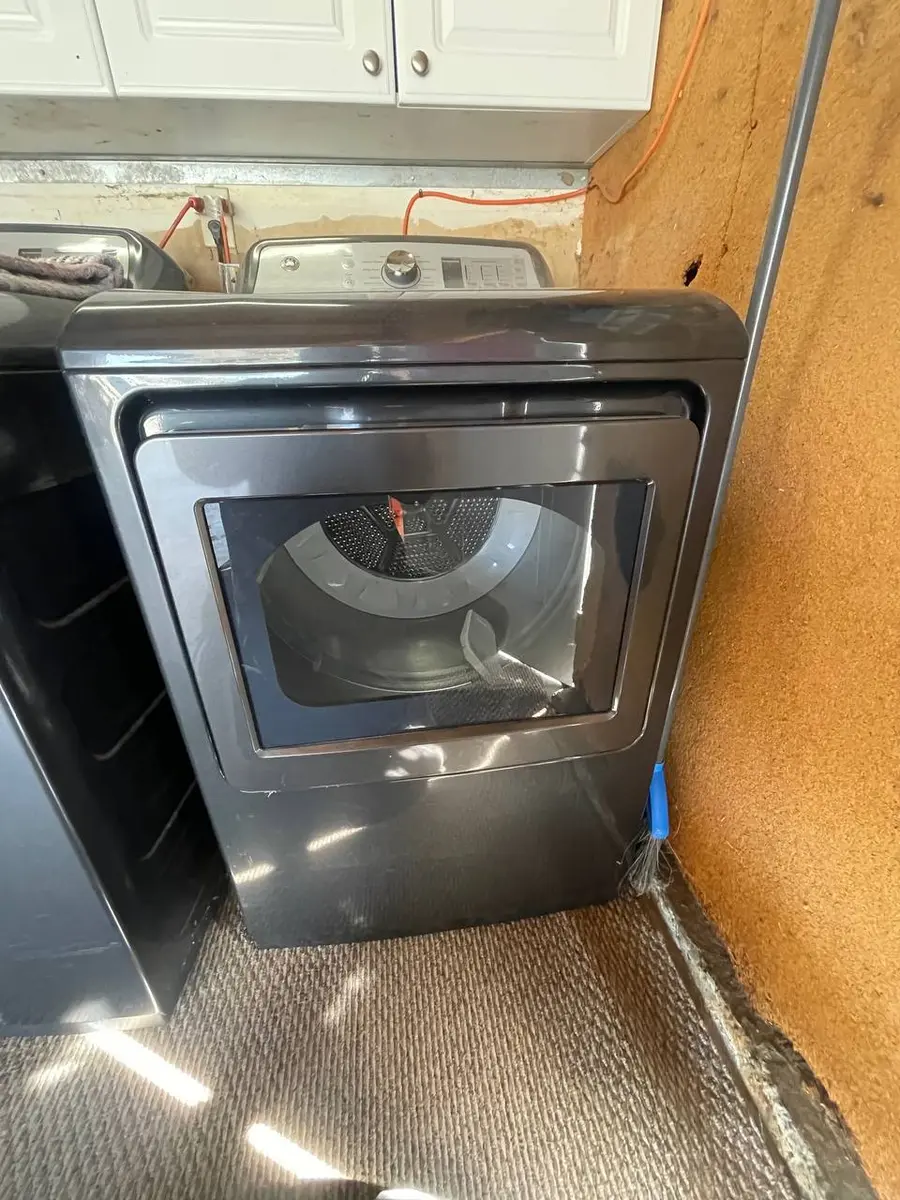
When a GE dryer will not start, the first question is whether the problem is mechanical, electrical, or a safety device doing its job. GE dryers — electric GFD and gas GTD alike — share the same drum-drive system, and they will not run unless the door switch confirms the door is shut and the safety devices in the circuit are intact. Most no-start calls come down to a worn door switch or a blown thermal fuse, both inexpensive parts, so those are where to look before suspecting the board.
Safety precautions#
For an electric GFD model, unplug it from the 240-volt outlet — that is a lethal voltage. For a gas GTD model, turn off the gas supply valve and unplug the dryer. In both cases, remember that dryer lint is highly flammable, so clean the lint screen and inspect the vent before running the machine again.
Do You Have the Right Tools?
Gas leak detector ($130), thermal fuse tester ($95), belt tension gauge, and vent inspection camera ($180). Our technician arrives with $3,000+ in professional tools — your diagnostic is free.
Licensed & Insured · 90-Day Warranty · Same-Day Service
Quick Answer#
Quick answer: Most likely the door switch (part WE4M415) is no longer confirming the door is closed, so the motor never gets its start signal — test it first. A blown thermal fuse (part WE04X10120), often triggered by a restricted vent, is the next most common reason a GE dryer goes completely dead.
Most Likely Causes, Ranked#
| Cause | What you'll notice | How likely |
|---|---|---|
| Door switch not engaging (WE4M415) | No response when you press start | 30% |
| Thermal fuse blown (WE04X10120) | Dryer completely dead, no tumble/heat | 25% |
| No power to the dryer | Dead or partial function | 15% |
| Start switch failure | Click but no start | 12% |
| Motor thermal protector tripped | Won't start until the motor cools | 10% |
| Control board failure | Flicker or error codes, no start | 5% |
| Broken belt with belt switch | Completely dead on some models | 3% |
Safety First — Know the Risks
Gas dryers carry carbon monoxide and explosion risk. Even electric dryers involve 240V circuits that can deliver a fatal shock. Our techs are licensed and insured — let them handle the risk.
Licensed & Insured · 90-Day Warranty · Same-Day Service
Door switch and thermal fuse#
The door switch must confirm the door is closed before the motor will start, and GE's mechanical snap-action switches (part WE4M415) wear out after many tens of thousands of open-close cycles — when the switch fails, pressing start does nothing. On many GE models the thermal fuse (part WE04X10120) is wired in series with the motor, so when it blows from vent-restriction overheating, the entire dryer goes dead: no tumble, no heat, and on some models no display. Critically, a thermal fuse blows for a reason, so clear the vent restriction that overheated it before replacing the fuse.
Power, start switch, and motor protector#
Before condemning a part, confirm the dryer is getting full power: an electric GFD needs both legs of its 240-volt supply from a 30-amp circuit, and losing one leg (one half of the double breaker) can leave it partly functional but unable to start. The push-to-start switch can fail mechanically, giving a click with no start. And if the motor overheated from restricted airflow or a seized roller, its internal thermal protector opens and the dryer will not start until the motor cools — typically 30 to 60 minutes — after which it may run again if the underlying restriction is cleared.
The Real Cost of DIY
Average DIY attempt: $150-400 in tools you may use once, plus the risk of further damage. Our diagnostic visit costs $0 — we find the problem and give you an honest quote.
Licensed & Insured · 90-Day Warranty · Same-Day Service
Control board and belt switch#
Least common are a control-board fault, where a failed relay withholds the motor start signal (look for display flicker or error codes such as E1, E2, E3, or E5), and, on some older models, a belt switch that opens when the drive belt breaks — an intentional design that stops the motor running without belt tension, which makes the dryer appear completely dead. Both are diagnoses of exclusion after the door switch, fuse, power, and start switch check out.
How to check it yourself#
- Disconnect power (and gas, on GTD) before testing anything.
- Confirm full power — both halves of the 240-volt breaker are on.
- Test the door switch for continuity when the door is closed.
- Check the thermal fuse and clear the vent restriction that blew it.
- Let a hot motor cool 30 to 60 minutes and retry to catch a tripped protector.
Don't Void Your Warranty
Opening your appliance yourself may void the manufacturer warranty. Our repair comes with a 90-day guarantee, and we document everything for warranty compliance.
Licensed & Insured · 90-Day Warranty · Same-Day Service
DIY or call a pro?#
Checking power, testing the door switch, and replacing a thermal fuse (after clearing the vent) are approachable owner tasks that fix most no-start cases. A failed start switch integrated into the timer, a control board, or a motor that trips its protector repeatedly is a technician repair around the dryer's high voltage. If the dryer stays dead after the door switch and fuse checks, book a diagnostic and we will confirm the failed part before ordering it.
Senior Gas Appliance Specialist · 18 years experience
AGA-certified gas appliance specialist with 18 years of experience in residential and commercial oven, range, and cooktop repairs.