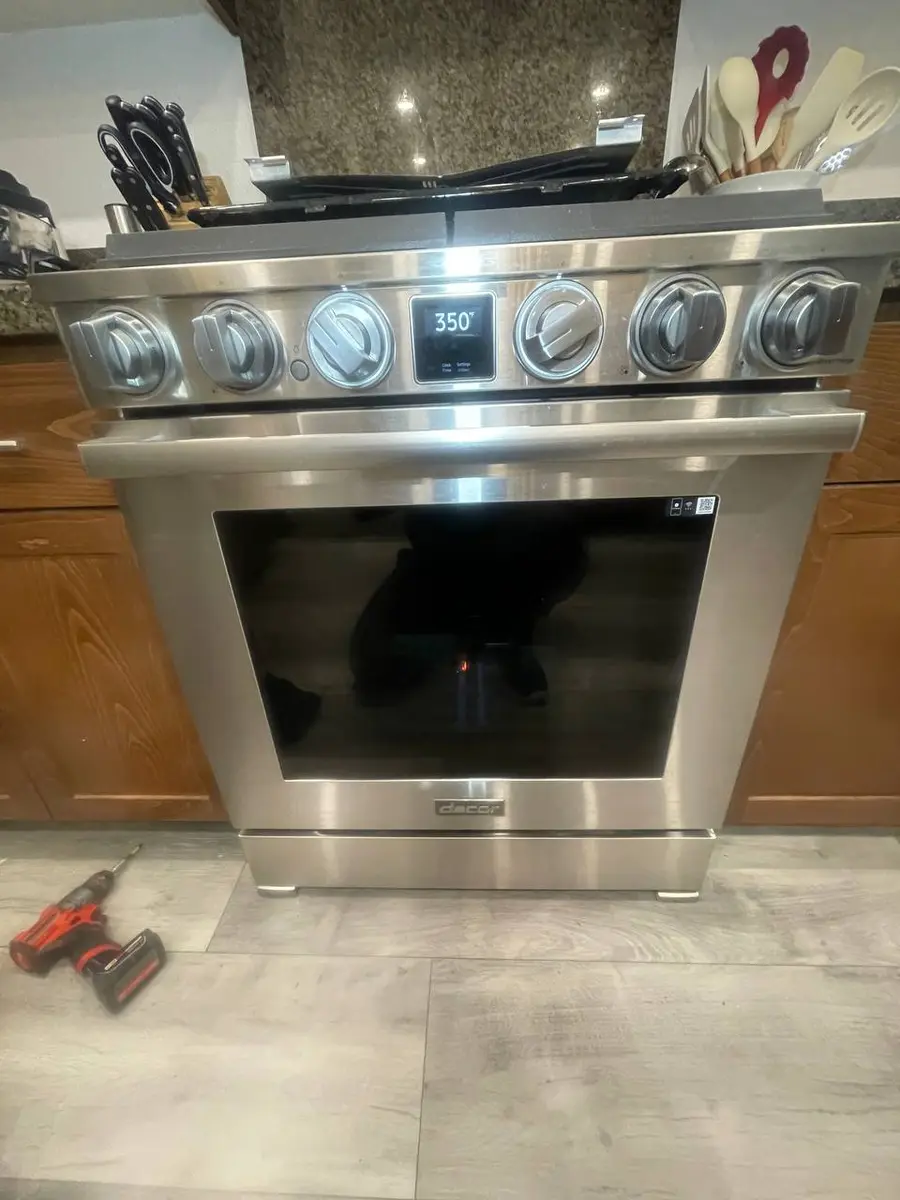
Quick Answer: Why Your Dacor Oven Temperature Is Wrong#
Most likely: the oven temperature sensor (an RTD probe) has drifted, throwing an F3 or F4 code and making the oven overshoot or undershoot the set temperature. Next in line are a control-board calibration offset, a slow or seized convection fan leaving one side hot and the other cool, a hardened door gasket bleeding heat, and — on dual-fuel ranges — a partially failed electric bake or convection element. Dacor Modernist models use Samsung-derived electronics, which are easier to source than older Heritage parts. Before ordering, confirm the model from the plate.
Likely Causes at a Glance#
| Cause | Likelihood | What to check |
|---|---|---|
| RTD temperature sensor drift | Most likely | an F3 or F4 code; sensor resistance out of range |
| Control-board calibration offset | Common | oven is off by a fixed amount across settings |
| Convection fan slow or seized | Common | silence or grinding; one side hot, the other cool |
| Door gasket hardened | Occasional | heat bleeding from the door; failed paper test |
| Dual-fuel element partial failure | Occasional | oven heats but unevenly or not to full temperature |
Do You Have the Right Tools?
Combustion analyzer ($300), igniter tester ($120), temperature calibrator ($150), and gas pressure manometer. Our technician arrives with $3,000+ in professional tools — your diagnostic is free.
Licensed & Insured · 90-Day Warranty · Same-Day Service
Walking Through the Diagnosis#
These are premium ovens with proprietary calibration, so keep DIY to testing and swap-in parts, and note that gas and high-voltage work belongs to a professional. Record the model and serial first, and read any code on the panel — a Dacor F3 or F4 points straight at the temperature sensor.
Start with that sensor. It is an NTC probe in the cavity whose resistance falls as temperature rises, and with the oven cold it should read in the low four figures of ohms — an open circuit, a near-zero reading, or a value well outside that range confirms it has failed. A drifted sensor is exactly what makes the oven overshoot or undershoot its setpoint, sometimes by dozens of degrees, and an F3 code means the reading is out of range while F4 flags a value so high it points to a short. Replace the sensor rather than chasing the symptom.
If the sensor is good, the fault is usually calibration or airflow. Many Dacor ovens allow a temperature offset of up to plus or minus 35°F in the control panel — if the oven is off by a consistent amount everywhere, adjust the offset, and if the needed correction exceeds that range the sensor, not the board, is the real problem. For UNEVEN heat, look at the convection fan: it circulates cavity air, and a motor that has seized or burned out leaves the area by the element hot and the far side cool. Listen at startup for silence or a grind, and note that dual-convection models have two motors, so one can fail while the other runs. On a dual-fuel range, a partially failed electric bake or convection element produces the same uneven, never-quite-hot-enough result, and each heating circuit has to be tested on its own because the oven still heats.
Last, a hardened door gasket bleeds heat and drops the true cavity temperature below setpoint. Run the paper test around the door and replace the gasket where it no longer grips.
Repair or Replace? The Short Version#
Rule of thumb: if the repair comes in under about half the price of a comparable new oven and yours is under eight to ten years old, repair it — an RTD sensor or a gasket is a modest part, and even a convection motor is a targeted fix. Sourcing is the main variable: Modernist-era Samsung-derived parts are widely available, while older Heritage components can be harder to find, so confirm the exact part against your model. Our technicians service Dacor ovens and handle the parts sourcing — book a repair.
Safety First — Know the Risks
Gas ovens involve live gas lines — a loose connection creates explosion and carbon monoxide risk. Electric ovens run on 240V circuits. Our techs are licensed and insured — let them handle the risk.
Licensed & Insured · 90-Day Warranty · Same-Day Service
Frequently Asked Questions#
What do the Dacor F3 and F4 codes mean?#
Both point to the oven temperature sensor. F3 means its reading is outside the expected range (open or shorted), and F4 flags a value so high it suggests a short. Both call for replacing the sensor.
Can I just recalibrate the oven instead of replacing parts?#
If it is off by a consistent amount, yes — many Dacor ovens allow a temperature offset of up to plus or minus 35°F in the control panel. But if the correction you need exceeds that range, the sensor has drifted and must be replaced.
One side of my Dacor oven is hot and the other is cool — why?#
That is the convection fan. A motor that has seized or burned out stops circulating cavity air, so heat pools near the element. Listen for silence or grinding at startup; dual-convection models have two motors, and one can fail alone.
Are Dacor parts hard to get?#
It depends on the era. Modernist models use Samsung-derived electronics that are widely available, while older Heritage parts can be harder to source, so confirm the exact part against your model and serial first.
Appliance Repair Technician & Diagnostics Specialist · 10 years experience
Electronics and diagnostics specialist with 10 years of experience in modern smart appliance repair, specializing in LG and Samsung.