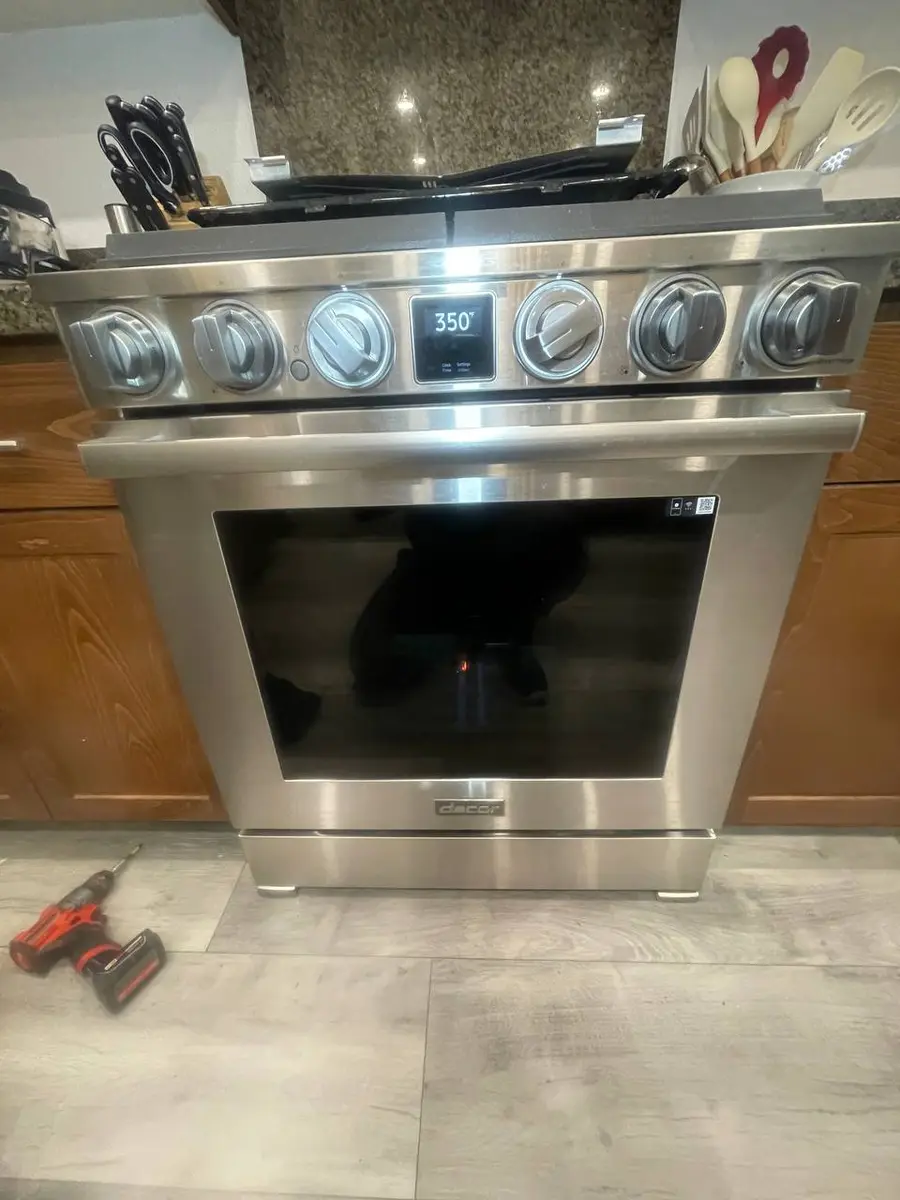
Dacor wall ovens and ranges represent serious culinary investment — the Modernist line starts at $4,500 for a single wall oven and reaches significant cost for double-oven configurations, while Heritage pro-style ranges varies. These units use Samsung-derived control electronics with Dacor's proprietary high-heat engineering, and their F-code error system provides precise diagnostic information when something goes wrong.
Whether you own a Modernist 30" or 36" wall oven with its stunning LCD touchscreen, or a Heritage 48" dual-fuel range, this guide covers every error code your Dacor oven can display.
How Dacor Oven Error Codes Work#
Dacor ovens use an F-code format inherited from the Samsung control platform but modified for Dacor's higher-performance specifications. Error codes appear on the LCD panel (Modernist) or LED display (Heritage) and are stored in the error history memory. Some codes trigger an automatic oven shutdown for safety.
Basic reset procedure:
- Press Cancel/Off to clear the active alarm.
- If the code remains, turn off the circuit breaker (240V for electric, 120V+gas for dual-fuel) for 5 minutes.
- Restore power and attempt to set a bake cycle at 350°F. If the code returns within 10 minutes, the fault is confirmed and requires repair.
Important safety note: Dacor ovens operate at 240V (electric) with internal temperatures exceeding 500°F in normal operation and 900°F+ during self-clean. Never attempt repairs with power connected. Always verify zero voltage with a meter before touching internal components.
Do You Have the Right Tools?
Combustion analyzer ($300), igniter tester ($120), temperature calibrator ($150), and gas pressure manometer. Our technician arrives with $3,000+ in professional tools — your diagnostic is free.
Licensed & Insured · 90-Day Warranty · Same-Day Service
F1 — Oven Temperature Sensor Open Circuit#
The F1 code indicates the RTD (Resistance Temperature Detector) sensor has an open circuit — the control board cannot read oven cavity temperature.
Common causes:
- Temperature sensor probe failure (platinum element broken)
- Wiring harness damage from repeated thermal cycling
- Connector oxidation at the board or sensor end
- Physical damage from oven rack contact
How to fix:
- Access the temperature sensor probe inside the oven cavity — it's typically mounted at the top-rear, secured with one or two screws.
- Disconnect the sensor at its plug (inside the oven or at the rear access panel). Measure resistance: Dacor RTD sensors should read approximately 1,080–1,100 ohms at room temperature (77°F).
- If the sensor reads infinite (open circuit), it's failed. Check the wiring harness from sensor to board for continuity before ordering a new sensor — a broken wire is cheaper to fix.
- Replacement temperature sensor (Dacor part DG32-00002A equivalent) cost varies by model and region.
- If the sensor and wiring are good, the control board analog input has failed.
Professional repair cost: varies by model and region.
F2 — Oven Overtemperature Condition#
F2 is a critical safety code — the oven exceeded maximum safe temperature (typically 650°F in bake mode or 1,000°F+ in self-clean). The oven immediately cuts power to all heating elements.
Common causes:
- Bake or broil relay contacts welded closed (element stays on regardless of thermostat signal)
- Temperature sensor drifted low (board thinks oven is cooler than reality)
- Control board output stuck high
- Improper voltage supply (over 250V can cause runaway heating)
How to fix:
- Turn off the circuit breaker immediately. F2 indicates the oven reached dangerous temperatures.
- Wait for complete cool-down (at least 1 hour).
- The most common cause is a welded relay on the control board. Inspect the relay contacts — if they're fused together, the element receives continuous power. You can sometimes hear a relay buzzing or see scorch marks on the board.
- Test the temperature sensor: if it reads significantly below 1,080 ohms at room temperature, it's drifted and gives the board false "still cold" readings.
- Control board replacement cost varies by model and region. This is not a DIY repair for most homeowners due to the 240V circuits involved.
Professional repair cost: varies by model and region. Do not operate the oven until this is repaired — fire hazard.
Safety First — Know the Risks
Gas ovens involve live gas lines — a loose connection creates explosion and carbon monoxide risk. Electric ovens run on 240V circuits. Our techs are licensed and insured — let them handle the risk.
Licensed & Insured · 90-Day Warranty · Same-Day Service
F3 — Oven Temperature Sensor Shorted#
The F3 code means the temperature sensor reads near-zero resistance (shorted) instead of the normal ~1,100 ohms. The board interprets this as an impossibly high temperature and prevents heating.
Common causes:
- Sensor probe insulation breakdown (moisture ingress or physical damage)
- Wiring short from pinched harness (common after oven installation)
- Connector contamination creating a low-resistance path
- Sensor probe contact with grounded oven chassis
How to fix:
- Measure sensor resistance at the board connector: near-zero confirms the short.
- Disconnect the sensor at the cavity end and re-measure at the board connector. If the harness now reads open, the sensor itself is shorted.
- If the harness still reads low with the sensor disconnected, the wiring has a short — inspect for pinch points, especially where wires pass through the oven cavity wall.
- Check for moisture on the sensor connector. Steam from cooking can condense on cooler components. Let it dry completely and retest.
- Sensor replacement cost varies by model and region.
Professional repair cost: varies by model and region.
F4 — Humidity Sensor Error#
The F4 code on Dacor Modernist ovens with Steam Assist indicates the humidity sensor is malfunctioning. Heritage models without steam features won't display this code.
Common causes:
- Humidity sensor element contaminated (cooking grease coating)
- Sensor wiring corrosion from steam exposure
- Control board input failure
- Sensor end-of-life (steam sensors degrade faster than temperature sensors)
How to fix:
- The humidity sensor is located in the oven cavity near the vent. On Modernist models, it's behind a small perforated cover at the top-rear.
- Carefully clean the sensor with isopropyl alcohol — do not use water or abrasive materials. Cooking grease coats the sensor element and causes drift.
- If cleaning doesn't resolve F4, measure the sensor output: it should produce a variable voltage (0.5–4.5V) that changes with humidity level.
- Humidity sensor replacement cost varies by model and region.
Professional repair cost: varies by model and region.
The Real Cost of DIY
Average DIY attempt: $150-400 in tools you may use once, plus the risk of further damage. Our diagnostic visit costs $0 — we find the problem and give you an honest quote.
Licensed & Insured · 90-Day Warranty · Same-Day Service
F5 — Door Latch/Lock Error#
The F5 code indicates the door lock mechanism cannot reach its commanded position — either failing to lock for self-clean or failing to unlock after.
Common causes:
- Door lock motor failure (gear mechanism stripped or motor burned out)
- Latch mechanism physically jammed (grease/food residue)
- Lock position switch failure (board can't confirm lock state)
- Warped door from high-heat self-clean cycle
How to fix:
- If the door is stuck locked: disconnect power for 30 minutes. The lock motor has a thermal release that disengages when power is removed and the motor cools.
- If the door is unlocked but F5 appears when starting self-clean: inspect the latch mechanism at the top of the door opening for debris or bent components.
- Test the lock motor: remove the access panel and apply 120V directly to the motor leads (disconnect from board first). The motor should drive the latch to the locked position.
- Check the lock position microswitch with a multimeter — should have continuity when the latch is fully engaged.
- Door lock motor assembly cost varies by model and region.
Professional repair cost: varies by model and region.
F6 — Convection Fan Error#
The F6 code indicates the convection fan motor is not operating at expected speed or has failed completely. Dacor's True Convection system relies on the fan for even heat distribution.
Common causes:
- Convection fan motor winding failure
- Fan blade loose on motor shaft (spins but at reduced effectiveness)
- Motor thermal fuse blown from overheating
- Control board TRIAC failure for fan circuit
- Bearing seizure (common after 8–10 years)
How to fix:
- Turn the oven on to convection bake and listen for the fan behind the rear panel. Complete silence indicates motor failure. A grinding noise indicates bearing wear.
- Access the fan motor from behind the oven (rear panel removal required). Check that the blade spins freely by hand — if there's resistance, the bearing is failing.
- Test motor resistance: should read 15–30 ohms across windings.
- Check the motor thermal fuse (if equipped) for continuity.
- Convection fan motor cost varies by model and region.
Professional repair cost: varies by model and region.
Don't Void Your Warranty
Opening your appliance yourself may void the manufacturer warranty. Our repair comes with a 90-day guarantee, and we document everything for warranty compliance.
Licensed & Insured · 90-Day Warranty · Same-Day Service
F7 — Bake Element Open Circuit#
The F7 code means the hidden bake element (bottom heating element) has an open circuit and cannot heat.
Common causes:
- Bake element burned through (visible break in the element coil)
- Terminal connection failure at the element-to-harness junction
- Relay failure on the control board (not sending voltage)
- Wiring damage between board and element
How to fix:
- On Dacor wall ovens, the bake element is concealed beneath the oven floor for a clean aesthetic. You cannot visually inspect it without removing the oven floor panel.
- Access the element terminals from behind the oven. Measure resistance: a functioning bake element reads 20–40 ohms. Infinite means it's burned out.
- Check voltage at the element terminals during a bake cycle (carefully — 240V present): no voltage means the board or relay is the issue, not the element.
- Bake element replacement cost varies by model and region. On concealed-element Dacor models, access is more complex than standard ovens.
Professional repair cost: varies by model and region.
F8 — Broil Element Open Circuit#
The F8 code indicates the broil element (top heating element) has failed open. Similar to F7 but for the upper element.
Common causes:
- Broil element burned through from grease splatter corrosion
- Terminal connector failure
- Board relay for broil circuit failed
- Wiring harness damage
How to fix:
- The broil element is visible at the top of the oven cavity. Look for a visible break, blister, or dark spot on the element.
- Measure resistance at the element terminals: should read 15–30 ohms (broil elements are slightly lower resistance than bake elements due to higher wattage).
- If element tests good, verify 240V is present at terminals during a broil cycle.
- Broil element replacement cost varies by model and region.
Professional repair cost: varies by model and region.
Is It Worth Your Time?
Oven temperature issues require systematic testing of the igniter, gas valve, thermostat, and calibration. Average DIY: 4-6 hours. Our technician diagnoses the issue in about 30 minutes — same-day appointments available.
Licensed & Insured · 90-Day Warranty · Same-Day Service
F9 — Door Switch Error#
The F9 code indicates the door position switch cannot determine whether the door is open or closed. This prevents heating operation for safety.
Common causes:
- Door switch contacts worn or corroded
- Door misalignment preventing switch engagement
- Wiring issue at switch connection
- Door hinge failure causing sag
How to fix:
- Open and close the door, checking for smooth operation. Dacor oven doors are heavy (25–50 lbs with triple-pane glass) and hinge wear causes gradual sag.
- Inspect the door switch plunger — it should depress fully when the door closes. Clean any debris around the switch area.
- Test the switch with a multimeter: should have continuity when depressed (door closed).
- Check door hinges for wear — if the door has dropped even 2–3mm, the switch may not engage.
- Door switch cost varies by model and region. Hinge assembly cost varies by model and region per side.
Professional repair cost: varies by model and region.
F0 — Communication Error#
The F0 code indicates the main control board and the user interface/display board have lost communication.
Common causes:
- Ribbon cable connection failure between boards
- Power surge damage to communication interface
- Board-level component failure (communication IC)
- Connector oxidation
How to fix:
- Power cycle completely — unplug for 10 minutes. Software-level communication faults often clear on full reset.
- Access the control board area and verify all ribbon/flat cables are securely seated. Reseat each connector firmly.
- Inspect both boards for physical damage: swollen capacitors, darkened areas, or corrosion.
- If F0 persists after reseating cables, one of the boards has failed. The main control board is the more common failure.
- Main control board cost varies by model and region. Display/UI board cost varies by model and region.
Professional repair cost: varies by model and region.
The Risk of Getting It Wrong
A wrong diagnosis often turns a simple fix into a costly replacement. Without proper diagnostic tools, you might replace the wrong part — or cause additional damage. Our free diagnostic eliminates the guesswork.
Licensed & Insured · 90-Day Warranty · Same-Day Service
Dacor Oven Diagnostic Mode#
Access the diagnostic mode for detailed troubleshooting:
Modernist wall ovens (DOB/DOC Series):
- On the LCD touchscreen, tap the settings gear icon, then hold the Dacor logo area for 10 seconds.
- Enter the service code (default: 0000 on most units).
- The screen displays real-time sensor readings, element status, and error history.
Heritage ranges (ER/DYRP Series):
- Turn the oven function knob to Off. Press and hold Bake + Broil buttons simultaneously for 5 seconds.
- The display shows "SP" followed by the first stored error.
- Press the temperature up button to scroll through error history.
Frequently Asked Questions#
Q: My Dacor oven won't heat but shows no error code — what's wrong? A: Most common causes with no displayed error: (1) the oven is in Demo/Showroom mode (check settings — common after power outages that reset defaults), (2) the child lock is engaged, (3) a sabbath/Shabbat mode is active, (4) the oven relay has failed silently (board thinks it's sending power but relay contacts are open). If none of these, the control board's power output section may have failed without triggering a self-diagnostic code.
Q: Are Dacor oven control boards repairable or must they be replaced? A: Dacor control boards can often be repaired by a board-level repair service at 40–60% the cost of a new board. Common repairs include relay replacement, capacitor replacement, and connector resoldering. However, boards with failed microprocessors or ASICs require full replacement. Board repair takes 5–10 business days plus shipping, so many homeowners opt for replacement for faster resolution.
Q: How hot does a Dacor self-clean cycle get? A: Dacor self-clean cycles reach approximately 880°F–930°F, converting food residue to ash. This extreme temperature stresses the door lock, gasket, temperature sensor, and control board cooling system. Many technicians recommend limiting self-clean to 2–3 times per year and using the Steam Clean option (on equipped models) for light maintenance. Most oven failures occur shortly after a self-clean cycle.
Q: Can I use my Dacor oven with an error code displayed? A: It depends on the code. Safety codes (F2, F5) completely disable the oven — do not attempt to bypass. Sensor codes (F1, F3, F4) prevent the oven from regulating temperature accurately — using the oven risks under/over-cooking or overheating. Fan codes (F6) mean uneven heating. Only the F0 communication error might be temporarily resolved with a power cycle, allowing limited use until repair.
Q: What is the lifespan of a Dacor wall oven? A: With proper maintenance, Dacor wall ovens last 15–20 years — significantly longer than mass-market brands. Control boards typically last 8–12 years, heating elements 10–15 years, and the oven cavity/structural components 20+ years. Annual professional inspection and limiting self-clean cycles are the best investments for longevity.
Free Diagnostic Visit — Zero Risk
Our certified technician comes to your home, diagnoses the problem with professional tools, and gives you an honest quote — all at zero cost. No parts markup, no hidden fees. If you decide not to proceed, you pay nothing.
Licensed & Insured · 90-Day Warranty · Same-Day Service
When to Call a Professional#
Dacor oven repairs involve 240V circuits and extreme temperatures. Call a luxury appliance specialist for:
- F2 (overtemperature) — Fire hazard. Do not operate until repaired.
- Any code returning after reset — Confirms active fault requiring component replacement.
- Control board failures (F0) — Requires Dacor service tools for board programming.
- Built-in wall oven models — Limited access space and 240V hardwiring require electrician-level skill.
- Heritage range gas components — Gas valve or igniter issues require gas-certified technicians.
Your Dacor oven is the heart of a luxury kitchen. EasyBear's technicians are certified for Dacor and Samsung-platform luxury appliances. We understand that a non-functioning varies by model and region oven isn't just an inconvenience — it's a disruption to your daily life. Our free diagnostic identifies the exact fault, and we carry common Dacor-compatible control boards and sensors in stock. Every repair backed by our 90-day warranty. Schedule your free diagnosis today.
Lead Appliance Repair Technician · 12 years experience
Experienced technician with 12 years specializing in washing machine and dryer repairs across all major brands.