Miele Oven Sensor Replacement Guide
Replacing the cavity NTC temperature sensor on a Miele oven is a moderate DIY job — disconnect power, unplug the sensor at the rear, swap the probe, and confirm accuracy with an oven thermometer. The wireless meat probe, by contrast, is fully user-replaceable.
A Miele oven relies on more than one sensor. The primary cavity NTC probe reads air temperature and reports it to the ELP control board, which cycles the heating elements to hold the setpoint. A secondary sensor near the door compensates for the heat lost every time the door is opened, and models with the Wireless Food Probe add a receiver circuit that tracks internal food temperature during cooking. Because Miele holds cavity temperature within about 5°F of the target, a sensor whose resistance curve has drifted quietly ruins baking results even while the display still shows the correct number.
An NTC sensor is a resistor whose resistance falls as it warms. The board converts that resistance into a temperature reading, so any drift in the resistance curve shifts every reading the board sees. Years of high-heat cycling — and the extreme pyrolytic self-clean environment near 900°F — slowly change that curve, which is why an old sensor reads plausibly but wrongly rather than failing outright.
Which sensor is failing?#
- Baked goods come out under- or over-done even though the set temperature is right — the classic sign of a drifted NTC.
- A temperature-fault code appears because the board sees a reading outside the valid range.
- The oven overheats when the sensor reads low and the board runs the elements too long.
- Elements pulse on and off rapidly from an unstable, jittery reading.
- The meat probe shows nothing — either the probe or its receiver has failed.
Do You Have the Right Tools?
Combustion analyzer ($300), igniter tester ($120), temperature calibrator ($150), and gas pressure manometer. Our technician arrives with $3,000+ in professional tools — your diagnostic is free.
Licensed & Insured · 90-Day Warranty · Same-Day Service
Sensor guide: part, job, and who should do it#
| Sensor | What it does | DIY vs Pro |
|---|---|---|
| Cavity NTC probe | Reports air temperature to the ELP board for element cycling | Moderate DIY — rear access needed |
| Door-area sensor | Compensates for heat loss when the door opens | Moderate DIY |
| Wireless food probe | Reads internal food temperature during cooking | User-replaceable, no tools |
Miele uses an OEM-only parts policy and its own Torx Plus security fasteners, so a standard Torx driver will not seat properly — use a Torx Plus driver to avoid stripping heads on the high-temperature fasteners around a cavity that endures roughly 900°F during pyrolytic self-clean. That OEM policy also means the replacement carries the correct resistance calibration; a cheaper generic probe with a slightly different curve simply moves the inaccuracy rather than curing it.
Replacing the cavity NTC sensor#
- Switch the oven off at the breaker, not just the front control.
- Find the NTC probe inside the cavity — usually a slim metal rod at the top rear.
- From the back of the oven, unplug the sensor's wire connector; you may need to pull the oven forward or drop the rear panel for access.
- Remove the single mounting screw that holds the probe inside the cavity.
- Feed the new sensor through, seat it in the same position, and reconnect the harness.
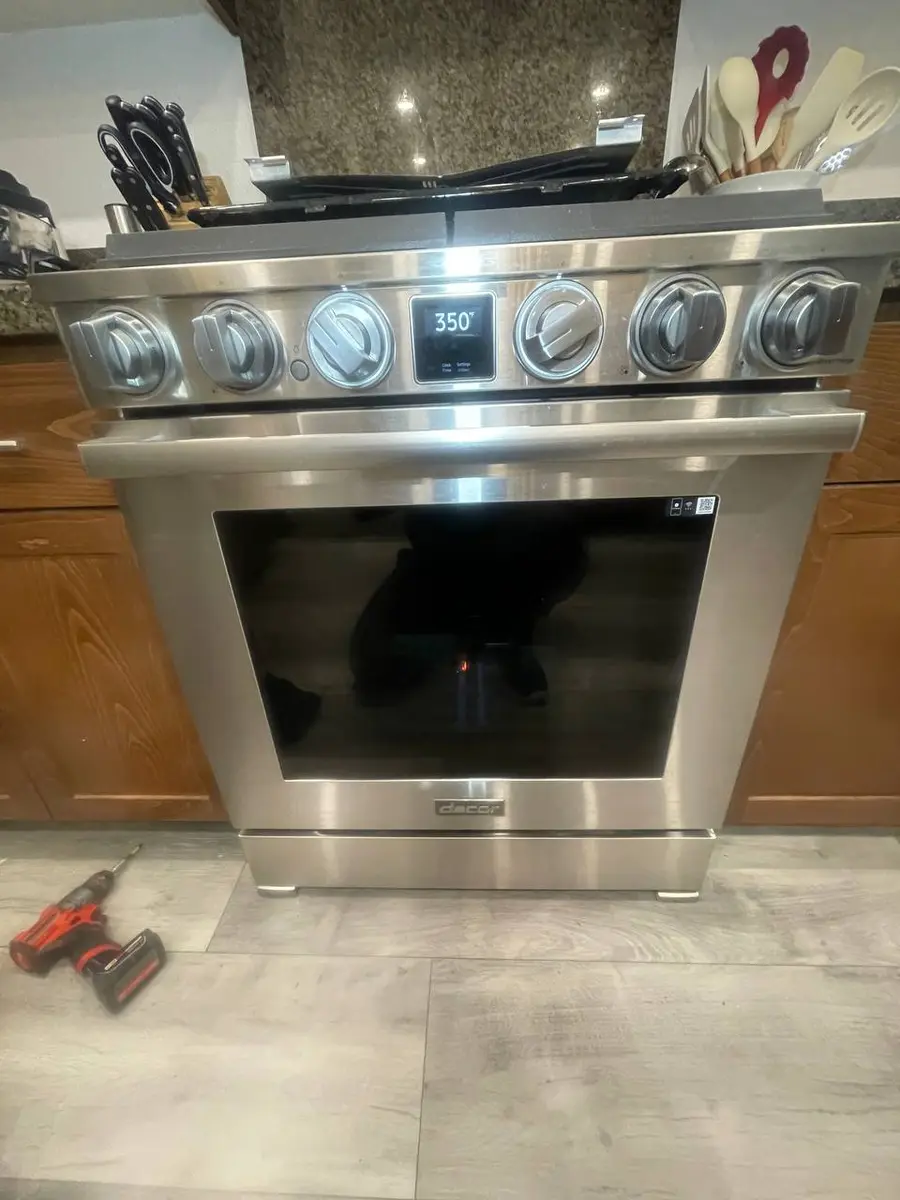
- Restore power, preheat to 350°F, and check against an independent oven thermometer once the cavity settles.
Wall ovens with tight rear clearance are the main case for calling a technician; a freestanding range usually gives enough room to reach the connector without pulling the whole unit out of the cabinet.
Safety First — Know the Risks
Gas ovens involve live gas lines — a loose connection creates explosion and carbon monoxide risk. Electric ovens run on 240V circuits. Our techs are licensed and insured — let them handle the risk.
Licensed & Insured · 90-Day Warranty · Same-Day Service
How long the sensors last#
A cavity NTC probe typically runs 15 to 20 years before the high-temperature environment shifts its resistance enough to matter. The wireless meat probe is the shorter-lived piece at roughly 5 to 10 years, since it is handled, washed, and stored between uses. If your oven bakes unevenly but the displayed and thermometer temperatures agree, suspect an element or the convection fan instead of the sensor before ordering a probe.
Miele oven baking off? EasyBear technicians diagnose and repair across Sacramento and the Bay Area — book online.
Appliance Repair Technician · 8 years experience
Experienced technician with 8 years specializing in dishwasher repairs and European appliance brands including Bosch and Thermador.