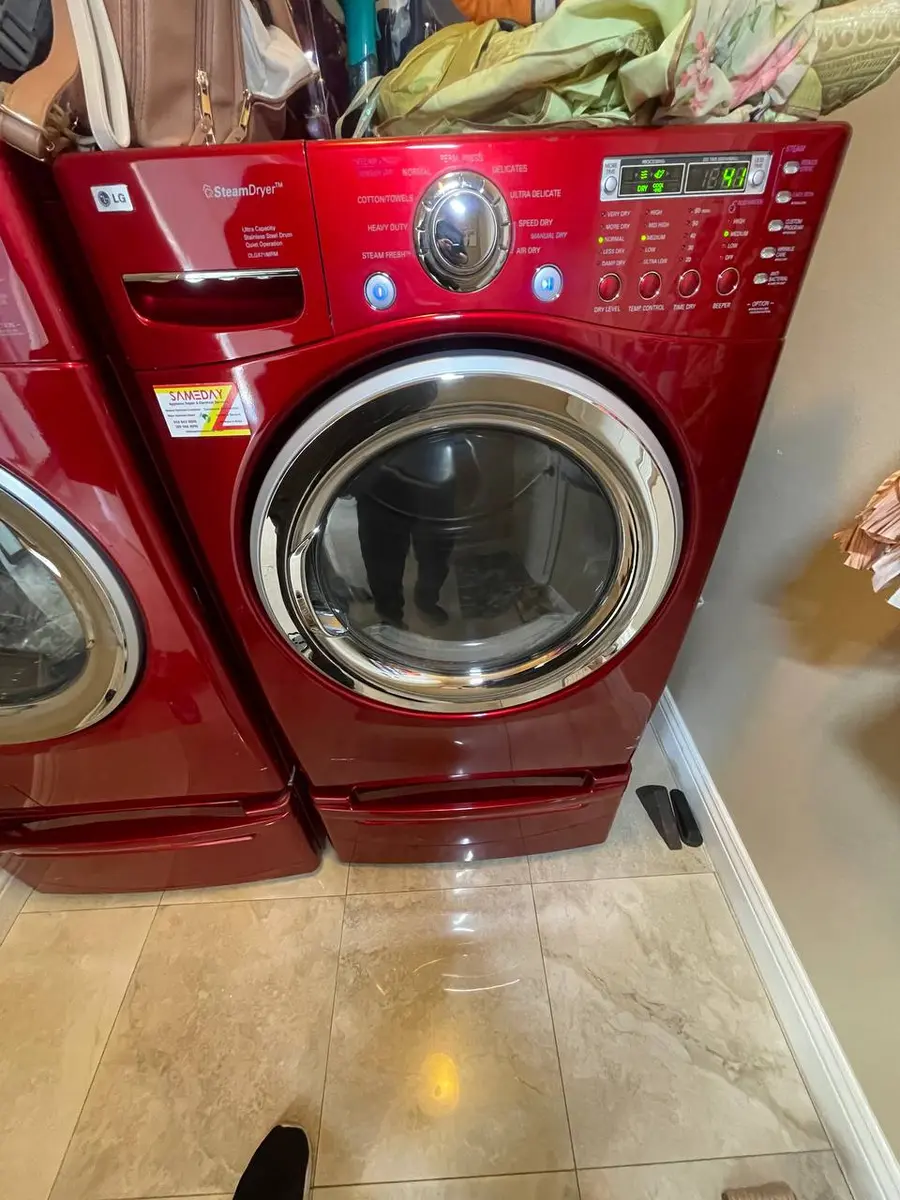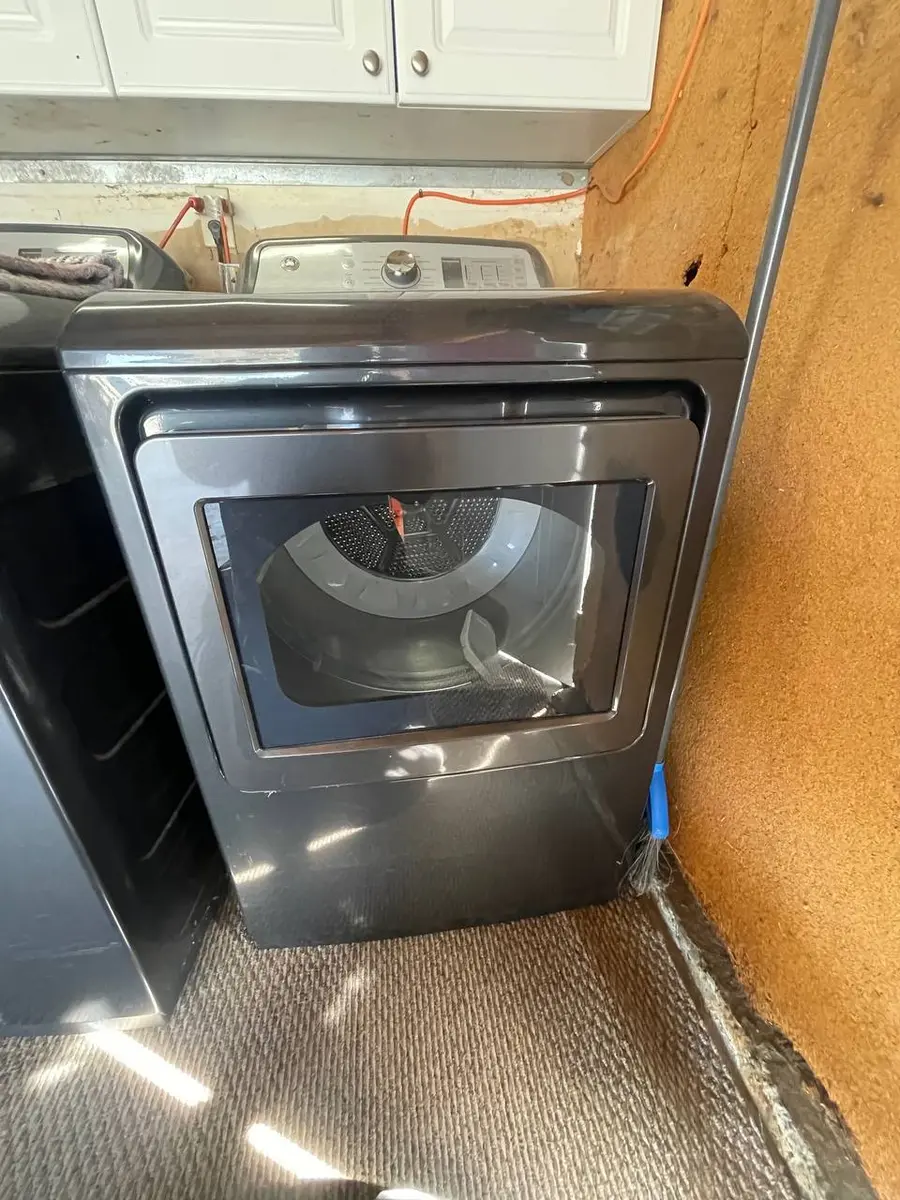
The dryer is still running but d80 appeared — 80% exhaust restriction detected. Your clothes will take significantly longer to dry because moisture-laden air cannot escape the drum efficiently.
What the FlowSense System Measured
LG's FlowSense measures pressure differential between the exhaust path and drum interior. d80 means only 20% of normal airflow passes through your vent system. The dryer continues but efficiency drops dramatically.
Signs you probably noticed before d80:
- Cycles taking 20-40 minutes longer
- Clothes still damp after a full cycle
- Dryer exterior hotter than usual
- Laundry room feels humid during drying
Do You Have the Right Tools?
Gas leak detector ($130), thermal fuse tester ($95), belt tension gauge, and vent inspection camera ($180). Our technician arrives with $15K+ in professional tools — your diagnostic is free.
Licensed & Insured · 90-Day Warranty · Same-Day Service
The Problem Is Almost Never the Dryer (95%+)
d80 reports that your home's vent ducting is restricted:
Lint in the duct (70%): Every load pushes lint past the screen. It accumulates at elbows, flex sections, and the wall exit point over months and years.
Crushed flex duct (15%): The transition duct behind the dryer gets crushed against the wall when you push the machine back.
External flap stuck (10%): Lint, ice (winter), or a bird nest blocks the exterior exit.
Duct too long (5%): Total equivalent length exceeds capacity (45-60 feet; each 90° elbow adds 5 equivalent feet).
Confirming the Problem
- Go to exterior vent exit. Run dryer on air-dry. Strong airstream? If weak/absent, duct is blocked.
- Disconnect vent from dryer exhaust port. Run dryer with nothing connected. d80 clears? Duct is confirmed as the problem.
Safety First — Know the Risks
Gas dryers carry carbon monoxide and explosion risk. Even electric dryers involve 240V circuits that can deliver a fatal shock. Our techs are licensed and insured — let them handle the risk.
Licensed & Insured · 90-Day Warranty · Same-Day Service
Cleaning Options
| Method | Cost | Best For |
|---|---|---|
| DIY rotary brush kit (drill attachment) | $25-40 | Straight/short runs |
| Professional vent cleaning | $80-150 | Long runs, roof exits, multiple elbows |
| Complete duct replacement | $30-60 materials | Vinyl/foil ducts (fire hazard anyway) |
Critical: Duct Material
If your duct is white vinyl or thin foil flex — replace it regardless. These materials catch lint in ridges, are combustible, crush permanently, and violate current building codes. Replace with smooth rigid or semi-rigid aluminum.
The Real Cost of DIY
Average DIY attempt: $150-400 in tools you may use once, plus the risk of further damage. Our diagnostic visit costs $0 — we find the problem and give you an honest quote.
Licensed & Insured · 90-Day Warranty · Same-Day Service
Fire Risk Context
2,900 dryer vent fires annually (US). Lint ignites at 240°F. d80 is a legitimate safety warning — not a nuisance code. Ignoring it risks lint auto-ignition inside the duct.
d80 → d90 → d95 Progression
These are severity levels of the same issue. d80 is the early warning. If ignored, restriction worsens to d90 (stop using dryer soon) then d95 (stop immediately, fire hazard).
Cannot access your vent (roof exit, multi-story run)? Our service includes professional rotary brush cleaning up to 30 feet and FlowSense verification. Book vent service →
Don't Void Your Warranty
Opening your appliance yourself may void the manufacturer warranty. Our repair comes with a 90-day guarantee, and we document everything for warranty compliance.
Licensed & Insured · 90-Day Warranty · Same-Day Service
FlowSense Sensor Technology
LG's FlowSense is a differential pressure sensor mounted in the dryer's exhaust duct housing. It measures the pressure difference between:
- Inside the drum (where heated air pushes through clothes)
- The exhaust duct (where air exits toward the wall vent)
A clear vent: low pressure differential (air flows freely) A blocked vent: high pressure differential (air backs up against restriction)
The sensor continuously monitors this differential during operation. The d80/d90/d95 thresholds represent specific pressure differential ranges corresponding to approximate percent-blockage of the vent system.
FlowSense cannot tell you WHERE the blockage is — only that it exists. It could be at the dryer connection, mid-duct, at an elbow, at the wall penetration, or at the exterior exit. Locating the blockage requires physical inspection.
Vent Cleaning: DIY Detailed Procedure
Tools needed:
- Rotary dryer vent brush kit ($25-40 — includes flexible rods and a brush head)
- Cordless drill to spin the brush
- Vacuum with hose attachment
- Screwdriver for hose clamp
- Flashlight
Step-by-step:
- Unplug dryer completely (gas: also shut gas valve)
- Pull dryer forward from wall (note: gas dryers have limited hose length — do not over-pull)
- Loosen the hose clamp on the vent duct at the dryer exhaust port. Remove duct from dryer
- Look into the duct with flashlight — note lint accumulation
- Attach the first brush rod section to your drill
- Insert brush into the duct opening. Set drill to low/medium speed forward
- Push brush in slowly while spinning. Attach additional rod sections as needed to reach deeper
- Pull back while spinning — lint wraps around the brush
- Repeat 3-4 times until the brush comes out clean
- Go to the exterior vent exit. Remove the damper flap or cover if possible
- Brush from this end as well (lint compresses at the exit point)
- Vacuum any loose lint from both ends and from behind the dryer
- Reconnect duct to dryer using a proper hose clamp (not duct tape — tape degrades from heat)
- Push dryer back — ensure minimum 4 inches clearance behind (do not crush the duct)
- Run dryer on air-dry for 10 minutes. Go outside and verify strong, steady airflow at exit
Same-Day Appliance Repair
Fixed or It's Free
$89 → $0 Service Call & Diagnosis — offer ends May 25
Is It Worth Your Time?
A dryer not heating could be the element, thermal fuse, gas valve, igniter, or timer. Average DIY diagnosis: 3-4 hours with no guarantee of finding the issue. Our technician diagnoses the issue in about 30 minutes — same-day appointments available.
Licensed & Insured · 90-Day Warranty · Same-Day Service
When Professional Cleaning Is Required
| Situation | Why DIY Is Insufficient |
|---|---|
| Vent exits through roof | You need roof access and cannot safely brush from below through vertical rise + cap |
| Vent run exceeds 25 feet | DIY brush kits max at 12-15 feet; professional equipment reaches 30+ feet |
| Multiple 90-degree elbows | Brush cannot navigate tight turns effectively — compresses rather than clears |
| Vent runs through inaccessible wall/ceiling cavity | Cannot visually confirm clearance without borescope |
| Duct is disconnected somewhere in the wall | Only discoverable by professional inspection with airflow measurement |
Professional vent cleaning services typically include:
- Full-length rotary brush treatment
- Airflow measurement (CFM or velocity) before and after
- Exterior damper inspection and cleaning
- Borescope inspection for disconnections or damage (some providers)
- Written report of findings
Dryer Vent Length Calculation
Calculate your total equivalent length:
- Measure total duct length in feet (straight runs only)
- Add 5 feet for each 90-degree elbow
- Add 2.5 feet for each 45-degree elbow
- Add 5 feet for the exterior damper/cap
Example: 15 feet straight + two 90° elbows + exterior cap = 15 + 10 + 5 = 30 equivalent feet
LG maximum: 60 equivalent feet. Above this, consider a booster fan or duct redesign.
The Risk of Getting It Wrong
A wrong diagnosis often turns a simple fix into a costly replacement. Without proper diagnostic tools, you might replace the wrong part — or cause additional damage. Our free diagnostic eliminates the guesswork.
Licensed & Insured · 90-Day Warranty · Same-Day Service
Seasonal Factors
Winter: Exterior damper flaps can freeze shut from condensation. The warm moist exhaust air condenses on the cold metal flap, freezes, and gradually seals it. Check exterior flaps after freezing weather.
Spring: Birds build nests in exposed vent terminations. A nest directly behind the damper creates instant near-100% blockage.
Fall: Leaf debris can blow against the exterior vent, partially blocking it. Ensure clear area around the vent exit.
Long-Term Vent Health
After cleaning, consider these upgrades:
- Replace foil flex duct with rigid or semi-rigid aluminum (reduces lint catch, cannot crush)
- Install a magnetic dryer vent cover on the exterior (prevents animal/insect entry when dryer is off)
- Add a lint trap to the duct transition behind the dryer (catches lint before it enters the long run)
- Schedule annual professional cleaning (set a calendar reminder)
Free Diagnostic Visit — Zero Risk
Our certified technician comes to your home, diagnoses the problem with professional tools, and gives you an honest quote — all at zero cost. No parts markup, no hidden fees. If you decide not to proceed, you pay nothing.
Licensed & Insured · 90-Day Warranty · Same-Day Service
Electrical Testing for d80 Diagnosis
Before replacing any component, verify with measurements. Lg dryers operate on 240V split-phase power, meaning both legs must be tested independently:
Power supply verification:
- L1 to Neutral: 120VAC (+/- 5%)
- L2 to Neutral: 120VAC (+/- 5%)
- L1 to L2: 240VAC (+/- 5%)
Component-specific measurements:
- Heating element: 8-15 ohms (varies by wattage — lower ohms = higher wattage)
- Thermal fuse: 0 ohms (continuity) when good, OL when blown
- High-limit thermostat: 0 ohms at room temp, OL if tripped
- Drive motor windings: start 2-5 ohms, run 1-3 ohms
- Any reading to chassis ground should be OL (infinity) — any measurable resistance indicates insulation breakdown
Testing procedure: Always unplug the dryer and discharge any capacitors (wait 5 minutes) before measuring resistance. Voltage measurements require the unit to be powered — use extreme caution with 240V. A non-contact voltage tester confirms power presence without probe contact.
Which Lg Models Are Most Affected
While error d80 can appear on any Lg dryer with electronic controls, certain model years and configurations show higher failure rates for the specific component involved:
Higher incidence factors:
- First production year of any new model (revision A components, sometimes changed in year 2)
- Models installed in high-humidity environments (laundry closets, bathrooms, coastal homes)
- Units on shared electrical circuits (voltage fluctuations stress electronic components)
- High-use units (commercial or large-family use accelerates wear on mechanical components)
Identifying your production date: The serial number encodes manufacturing date — first two characters typically represent year and month. Check the manufacturer's website or data plate (inside door, rear panel, or control panel edge) for your specific production date when researching known issues for your exact unit.
Parts compatibility notes: When ordering replacement parts, always cross-reference your complete model AND serial number. Lg occasionally changes component suppliers mid-production-run, meaning two identical-looking units may require different part numbers for the same component.