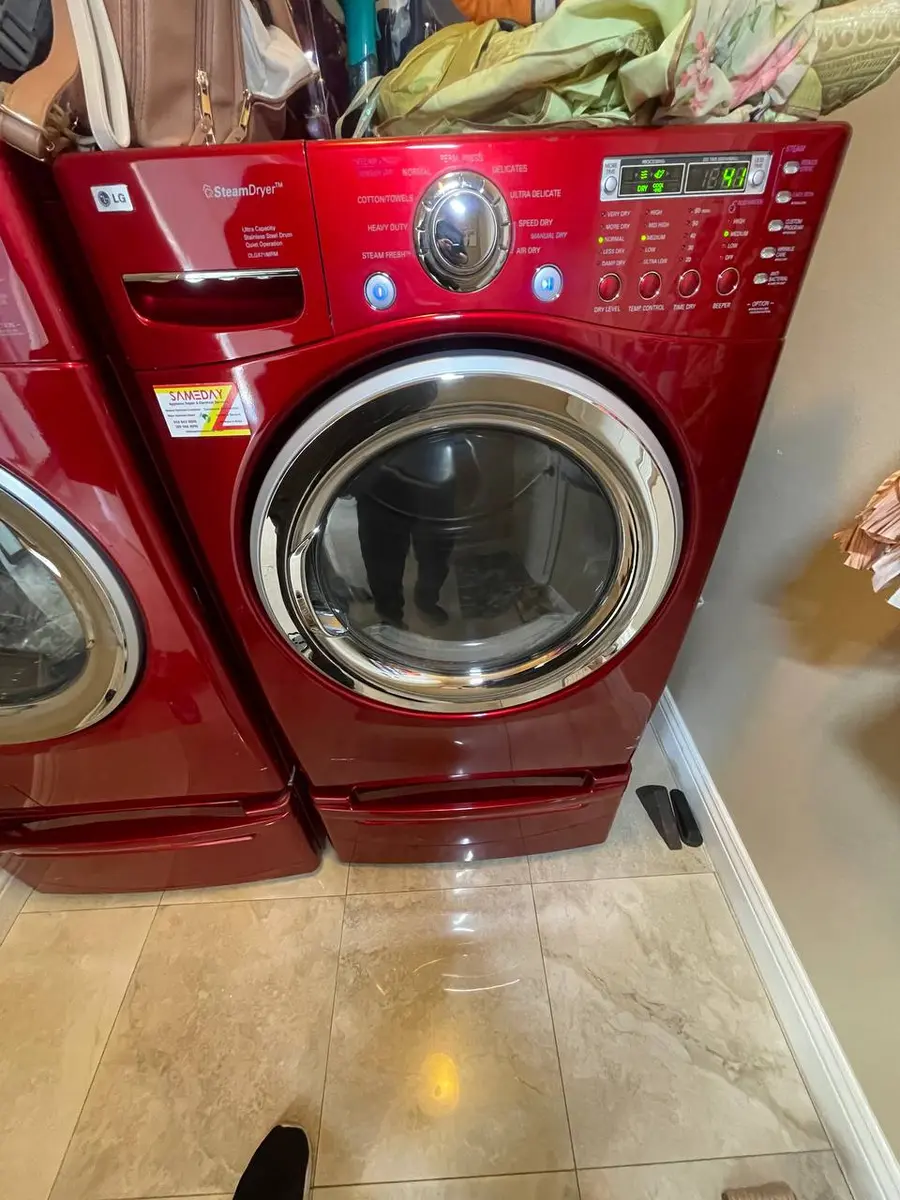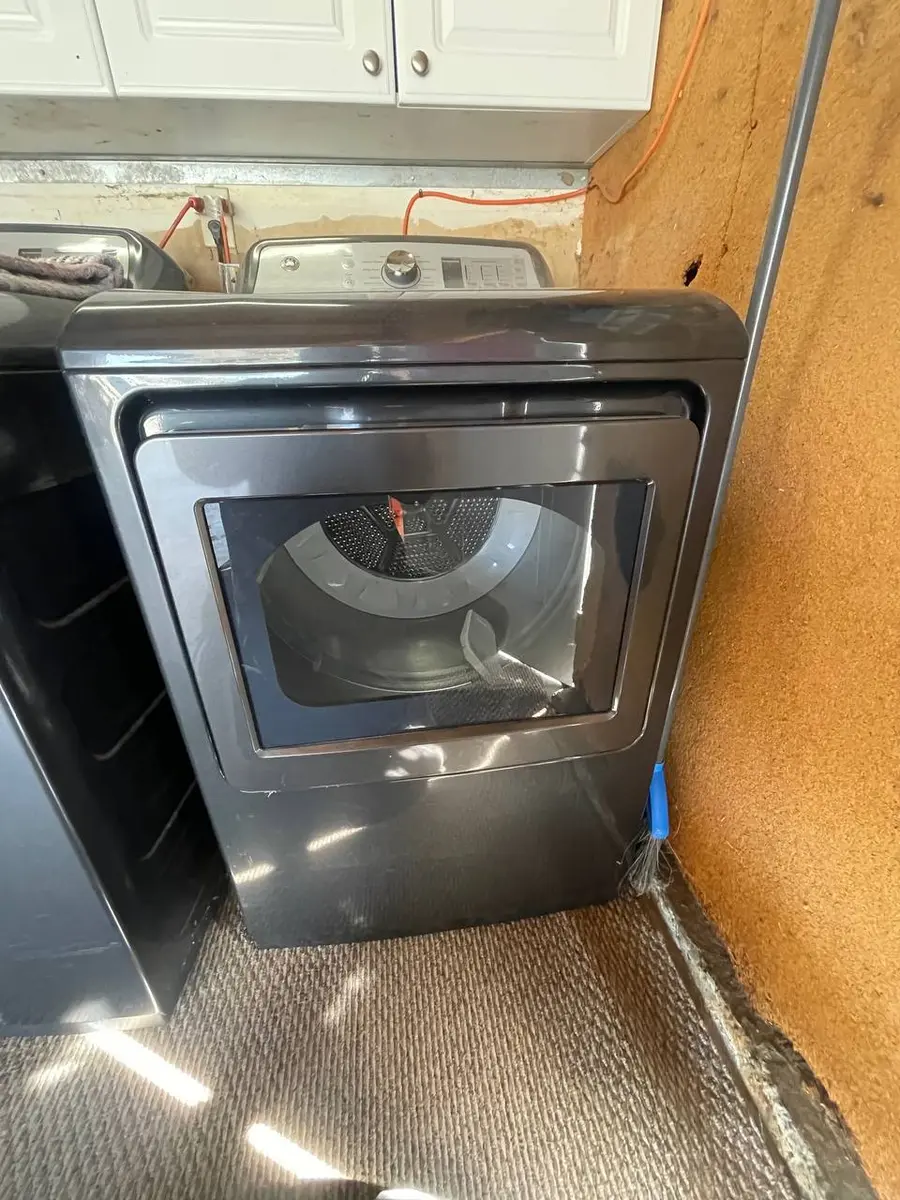
Midea dryers are growing rapidly in the US market, particularly in the compact ventless heat pump category where they offer apartment-friendly drying at significantly lower prices than European brands. Whether you have a traditional vented Midea dryer, a ventless heat pump model, or a Comfee-branded unit (same machine, different label), this guide covers every error code and provides actionable repair steps.
Midea dryers use the E##/F## error code format on the digital display. Heat pump models have additional codes specific to the refrigerant circuit. Understanding these codes is important because finding a local tech familiar with Midea heat pump dryers can be challenging — many issues have DIY fixes that save a service call.
How Midea Dryer Error Codes Work#
Midea dryers display error codes on the LED/LCD panel as alphanumeric codes (E01, E02, F01, etc.). The dryer stops, the drum may stop or continue tumbling without heat, and the code appears.
To reset a Midea dryer error code:
- Press Power to turn off the dryer.
- Unplug for 60 seconds.
- Plug back in and start a new cycle.
- If the code returns within 5 minutes of operation, the fault needs repair.
Heat pump models: Some heat pump specific codes require 15 minutes unplugged because the heat pump compressor needs to equalize pressure before restarting.
Do You Have the Right Tools?
Gas leak detector ($130), thermal fuse tester ($95), belt tension gauge, and vent inspection camera ($180). Our technician arrives with $3,000+ in professional tools — your diagnostic is free.
Licensed & Insured · 90-Day Warranty · Same-Day Service
E01 — Thermistor / Temperature Sensor Error#
The control board cannot read the exhaust or drum temperature sensor correctly. The sensor circuit is open, shorted, or reading values outside the measurable range.
Common causes:
- Failed thermistor (most common — inexpensive component that degrades from thermal cycling)
- Disconnected sensor connector (vibration loosens spade connectors)
- Corroded connector pins
- Wire harness damage (often from lint buildup causing heat damage)
How to fix:
- Midea dryers typically have 2–3 temperature sensors: exhaust thermistor (on the blower housing or exhaust duct), drum thermistor (inside the drum cavity), and on heat pump models, an evaporator thermistor.
- Unplug the dryer (or switch off its breaker) before you remove any panel. Access the sensors by removing the back panel (vented models) or the side/bottom panels (heat pump models).
- Check each sensor connector — reseat firmly. Look for discoloration on wires near the sensors, which indicates heat damage.
- Test each thermistor (an NTC type) with a multimeter and compare the room-temperature reading with the value on your model's tech sheet. If a sensor reads 0 (shorted) or infinite (open), replace it.
- If multiple sensors test bad simultaneously, check the shared ground wire — a broken ground causes all sensors on that circuit to read as open.
E02 — Heating Element Open Circuit (Vented Models)#
The control board detected that the heating element is not conducting electricity. The dryer tumbles but produces no heat.
Common causes:
- Heating element coil broken (single break makes the entire element non-functional)
- High-limit thermostat tripped and did not reset (some are one-time fuses)
- Thermal fuse blown (one-time safety device)
- Loose wire connection at the heating element terminals
- Heater relay on the control board failed open
How to fix:
- Unplug the dryer and access the heating element — on Midea vented dryers, it is typically in a housing at the rear of the drum.
- Test the thermal fuse first (located on the blower housing or heater housing). It should show continuity. If open, it has blown. Important: a blown fuse always means an airflow restriction existed — clean the vent system before replacing the fuse.
- Test the high-limit thermostat — should show continuity at room temperature.
- Test the heating element by measuring resistance across its terminals and compare the reading with the value on your model's tech sheet. If infinite (open), the element has a break and needs replacement.
- Visually inspect the element coils for a visible break — often you can see where the coil has separated.
Safety First — Know the Risks
Gas dryers carry carbon monoxide and explosion risk. Even electric dryers involve 240V circuits that can deliver a fatal shock. Our techs are licensed and insured — let them handle the risk.
Licensed & Insured · 90-Day Warranty · Same-Day Service
E03 — Motor Speed Error#
The control board cannot detect the drum motor reaching expected speed, or the motor is not rotating at all.
Common causes:
- Broken or worn drum belt (if belt-drive model)
- Motor shaft jammed (lint buildup around motor bearings)
- Failed motor start capacitor
- Motor winding failure
- Drum bearing seized (prevents rotation)
- Motor control board fault
How to fix:
- Try to rotate the drum by hand through the door opening. It should spin smoothly with some resistance from the belt and bearings. If it does not rotate, something is mechanically jammed.
- Check the belt — on Midea dryers, the belt wraps around the drum and threads through a tensioner pulley. If the belt is broken, the drum will spin too freely (no resistance). Unplug the dryer before you remove the top and front panels; the belt is visible with them off.
- If the belt is intact and the drum rotates freely by hand, the motor may have failed. With the panels back on and the dryer plugged in, listen for a humming sound when you start a cycle — hum without rotation indicates a seized motor or failed start capacitor.
- Unplug the dryer again before you open the panels. Clean around the motor area — lint accumulation can overheat the motor and cause bearing seizure. Vacuum thoroughly with the panels removed.
- Test the motor start capacitor with a capacitance meter if the motor hums but does not turn — with the dryer unplugged and only after the capacitor is discharged, because it can hold a charge; otherwise leave this test to a technician.
E04 — Humidity Sensor Error (Auto-Dry Cycles)#
The moisture/humidity sensor is reading abnormally or not responding. Auto-dry cycles rely on this sensor to determine when clothes are dry — without it, the dryer cannot auto-terminate the cycle.
Common causes:
- Dryer sheet residue coating the sensor bars (most common — not a part failure)
- Failed moisture sensor element
- Disconnected sensor wiring
- Lint buildup on sensor surface
How to fix:
- Locate the moisture sensor — two metal strips (bars) inside the drum, typically near the lint screen housing or just inside the door opening on the front bulkhead.
- Clean the sensor bars with fine sandpaper (220-grit) or a cotton ball soaked in rubbing alcohol. Dryer sheet residue creates an invisible coating that insulates the sensors from detecting moisture in the clothing. This is a common fix for E04.
- If cleaning does not resolve E04, unplug the dryer (or switch off its breaker) first, then check the wire connector on the back of the sensor bars. Follow the wires to the control board connection and reseat.
- Test the sensor by starting an auto-dry cycle with a single damp towel touching the sensor bars. If the display shows "Dry" or "Cool Down" immediately without actually drying, the sensor is detecting a false "dry" condition and needs replacement.
- As a workaround, you can use timed-dry cycles (which do not rely on the moisture sensor) until the sensor is repaired.
The Real Cost of DIY
Average DIY attempt: $150-400 in tools you may use once, plus the risk of further damage. Our diagnostic visit costs $0 — we find the problem and give you an honest quote.
Licensed & Insured · 90-Day Warranty · Same-Day Service
E05 — Door Switch Error#
The dryer cannot confirm the door is closed. The drum will not start.
Common causes:
- Door not fully latched
- Failed door switch
- Worn door strike or latch
- Wiring issue between switch and control board
- Broken door hinge preventing full closure
How to fix:
- Close the door firmly — you should hear a solid click from the latch mechanism.
- Check the door gasket/felt seal for items preventing full closure.
- Unplug the dryer before you remove the top panel to reach the switch (step 4). Test the door switch with a multimeter: with the door closed (switch actuated), it should show continuity. With the door open, it should show open circuit.
- The switch is typically accessible by removing the top panel and looking at the door frame area. It is a small mechanical switch actuated by the door latch.
- If the switch tests good, check the wiring from the switch to the control board. A single broken wire prevents the control board from detecting door closure.
E06 — Airflow Restriction (Vented Models)#
The exhaust temperature or pressure sensor has detected restricted airflow through the dryer. This is a safety-related code that protects against overheating and fire.
Common causes:
- Clogged lint screen (clean before every load)
- Blocked exhaust vent duct
- Crushed flexible transition hose
- Bird nest or debris in exterior vent hood
- Lint buildup inside the dryer cabinet
- Exhaust duct too long (check the maximum equivalent duct length in your model's installation instructions)
How to fix:
- Clean the lint screen completely. Wash monthly with soap and water to remove dryer sheet residue that clogs mesh pores.
- Disconnect the exhaust duct from the back of the dryer and run the dryer briefly. If E06 clears, the blockage is in the ductwork.
- Clean the entire vent run from dryer to exterior hood. Use a vent brush or leaf blower. Sacramento homes with long vent runs through attics are especially prone to lint buildup.
- Check the exterior vent hood flapper — it should swing open freely when air flows. Replace if stuck or damaged.
- Midea compact dryers have smaller blower wheels than full-size dryers, making them more sensitive to airflow restriction. Keep vent runs as short as possible and use rigid metal duct.
This airflow restriction is usually a maintenance issue.
Don't Void Your Warranty
Opening your appliance yourself may void the manufacturer warranty. Our repair comes with a 90-day guarantee, and we document everything for warranty compliance.
Licensed & Insured · 90-Day Warranty · Same-Day Service
E07 — Heat Pump Compressor Error (Ventless Models Only)#
The heat pump compressor is not operating correctly — it may not start, may shut down prematurely, or may be drawing abnormal current.
Common causes:
- Compressor overheated (ambient temperature too high — check the ambient range in your model's installation instructions)
- Refrigerant leak (reduced charge causes compressor to overheat)
- Failed compressor start relay
- Clogged condenser (lint coating the heat exchanger)
- Failed compressor motor (rare, usually preceded by months of reduced performance)
How to fix:
- Check the ambient temperature — Midea heat pump dryers are designed for indoor installation in climate-controlled spaces. If installed in a hot garage or laundry room without AC during Sacramento summers, the compressor will overheat.
- Clean the condenser and evaporator coils. Midea heat pump dryers have a removable lint filter for the heat exchanger (in addition to the regular lint screen). Access it per your model's manual — typically behind a panel at the bottom front. Clean this filter as often as your model's manual directs.
- Unplug the dryer for 15 minutes (allow refrigerant pressure to equalize) and retry. If E07 clears temporarily but returns after 30–60 minutes of operation, the condenser is dirty or ambient temp is too high.
- If E07 persists immediately upon starting, the compressor starting components or the compressor itself has failed. This requires professional repair — heat pump refrigerant circuits are sealed systems.
Note: Heat pump refrigerant work requires EPA Section 608 certification.
E08 — Condensate Pump Error (Ventless Models Only)#
The condensate pump (which removes water extracted from clothes) is not functioning. Water may pool in the base of the dryer or the condensate tank may not be filling.
Common causes:
- Condensate tank full (if manually drained model — empty the tank)
- Failed condensate pump motor
- Clogged condensate drain line or filter
- Float switch stuck (tank-full sensor reading incorrectly)
- Pump impeller jammed with lint or debris
How to fix:
- If your model has a removable condensate tank, pull it out and empty it. On some models, a full tank triggers E08 rather than a separate "tank full" indicator.
- If the tank is not full, check the condensate drain path for blockage. A small filter or screen near the pump intake can clog with lint.
- Unplug the dryer before you reach into the pump area. Clean the pump intake — remove any accessible lint or debris.
- If the unit is connected to a permanent drain hose (rather than using the tank), check that the drain hose is not kinked and the elevation does not exceed the pump's capability (check the maximum drain height in your model's installation instructions).
- Test the pump by pouring water directly into the pump sump (if accessible) — only with the cabinet closed, any spilled water dried up and the dryer plugged back in. If the pump does not activate, the motor or float switch has failed.
Is It Worth Your Time?
A dryer not heating could be the element, thermal fuse, gas valve, igniter, or timer. Average DIY diagnosis: 3-4 hours with no guarantee of finding the issue. Our technician diagnoses the issue in about 30 minutes — same-day appointments available.
Licensed & Insured · 90-Day Warranty · Same-Day Service
Additional Codes Quick Reference#
- F01 — Control board internal fault. Power cycle for 5 minutes. If persistent, board replacement required.
- F02 — Fan motor error (not rotating). Check for lint blockage around the fan. If fan is clean and still not spinning, fan motor needs replacement.
- F03 — Inverter board overtemperature. Ensure adequate ventilation around the dryer. Let cool for 30 minutes before restarting.
Heat Pump vs. Vented: Which Codes Apply#
| Code | Vented | Heat Pump |
|---|---|---|
| E01 | Yes | Yes |
| E02 | Yes | No (no heating element) |
| E03 | Yes | Yes |
| E04 | Yes | Yes |
| E05 | Yes | Yes |
| E06 | Yes | No (no exhaust vent) |
| E07 | No | Yes |
| E08 | No | Yes |
The Risk of Getting It Wrong
A wrong diagnosis often turns a simple fix into a costly replacement. Without proper diagnostic tools, you might replace the wrong part — or cause additional damage. Our free diagnostic eliminates the guesswork.
Licensed & Insured · 90-Day Warranty · Same-Day Service
Frequently Asked Questions#
Q: Are Midea and Comfee dryers the same? A: Yes. Comfee is Midea's US consumer sub-brand. Components, control boards, and error codes are identical. Parts are interchangeable — use the Midea part number for better sourcing options.
Q: My Midea heat pump dryer takes longer to dry than my old vented dryer. Is it broken? A: No — this is normal. Heat pump dryers operate at lower temperatures than vented dryers to be gentler on clothes and more energy-efficient. Cycle times are typically 30–60 minutes longer than vented dryers for the same load. If cycle times have increased compared to when the unit was new, clean the heat exchanger filter and check for lint buildup on the evaporator/condenser coils.
Q: Can I install a Midea heat pump dryer in my garage? A: Not recommended for unheated/uncooled spaces. Midea heat pump dryers need an ambient temperature inside the range their installation instructions give. A garage in a hot summer climate can run well above it, which will cause E07 compressor overheating errors. Indoor, climate-controlled installation is required.
Q: Why does my Midea dryer produce a puddle of water on the floor? A: For ventless heat pump models, this indicates a condensate system problem (E08). Check the condensate tank, pump, and drain connections. For vented models, water on the floor suggests the exhaust vent has a low spot where condensation accumulates and drips back through the vent connection at the dryer. Ensure the exhaust duct slopes downward toward the exterior with no sags.
Q: How often should I clean the heat pump filter? A: Clean the heat pump filter (the secondary filter that catches lint before it reaches the heat exchanger) as often as your model's manual directs. This is separate from the standard lint screen (clean every load). Neglecting the heat pump filter is the leading cause of reduced performance and E07 errors on these models.
When to Call a Professional#
Many Midea dryer issues have DIY solutions, but some require professional service:
- E07 persistent after cleaning — Likely a refrigerant issue requiring sealed system work with EPA 608 certification.
- E02 with burning smell — A broken heating element can arc, which is a fire hazard. Disconnect power immediately and get professional diagnosis.
- E03 with grinding noise — Indicates bearing failure or motor damage that requires disassembly.
- Any gas smell — Midea does not currently sell gas dryers in the US, but if you have a gas model from another brand with similar codes, gas leaks require immediate professional attention.
- Repeated E01 after sensor replacement — May indicate a control board fault rather than a sensor issue.
Having trouble with your Midea dryer error code? EasyBear technicians have experience with Midea's product line including their increasingly popular heat pump ventless models. Free diagnostic visit — we identify the problem, explain your options, and repair on the spot when parts are available. Every repair includes our 90-day parts and labor warranty. Schedule your free diagnosis today.