Most Likely Cause#
When a Kenmore oven bakes hotter or cooler than the set temperature, the two most common causes are a temperature sensor that has drifted out of calibration and a calibration offset that simply needs adjusting. On convection models, a failed convection fan can also make heat uneven enough to feel like the wrong temperature.
The sensor tells the control board the cavity temperature, and the board fires the element to match. If the sensor reads high, the oven runs cool; if it reads low, the oven runs hot. Before assuming a part has failed, it is worth confirming the real temperature and checking the calibration, because Kenmore ovens allow a built-in adjustment.
Why a Kenmore Oven Runs Off-Temperature#
| Symptom | Cause | How likely |
|---|---|---|
| Consistently hot or cold across the range | Temperature sensor drift | Most likely |
| Slightly off, steady in one direction | Calibration offset from the factory | Most likely |
| Uneven results in convection mode | Convection fan not spinning | Occasional |
Do You Have the Right Tools?
Combustion analyzer ($300), igniter tester ($120), temperature calibrator ($150), and gas pressure manometer. Our technician arrives with $3,000+ in professional tools — your diagnostic is free.
Licensed & Insured · 90-Day Warranty · Same-Day Service
How a Kenmore Oven Holds Temperature#
The oven regulates heat with a resistance-based temperature sensor that reads about 1080 ohms at room temperature; the control board watches that value and cycles the bake element to hold the setpoint. As the sensor ages it drifts, and even a small offset produces a noticeable temperature error — a drift can push the oven roughly 20-50°F off target. Kenmore also allows a calibration adjustment of up to plus or minus 35°F through the settings, which covers normal factory variation between units. On convection models a non-spinning fan leaves hot and cold zones that read as a wrong temperature even when the sensor is fine. Confirming the actual cavity temperature with a thermometer separates a calibration tweak from a failed part.
Check It Yourself First#
Before troubleshooting your Kenmore oven, disconnect power at the circuit breaker or unplug the unit when working on the sensor.
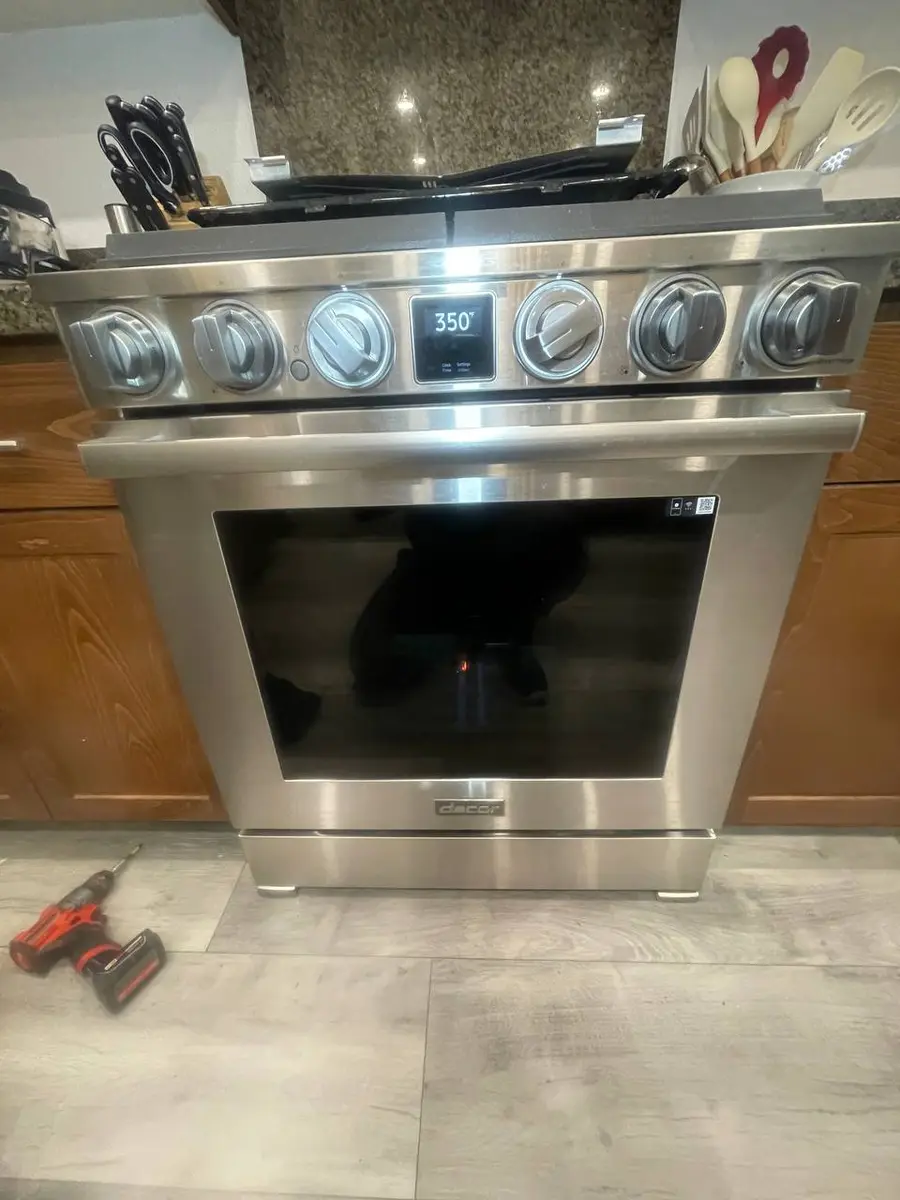
- Verify with a thermometer. Hang an oven thermometer at the center, set the oven to 350°F, and let it fully preheat. Compare the reading to the setting to measure the actual offset.
- Calibrate the oven. If the oven is off by a modest, steady amount, use the built-in calibration to adjust in 5°F increments, up to plus or minus 35°F. The exact steps vary by platform behind the Kenmore badge.
- Test the sensor. Measure the temperature sensor's resistance; it should read near 1080 ohms at room temperature. A reading well off that value means it has drifted and should be replaced (sensor part WPW10181986 on many models).
- Check the convection fan. For uneven convection results, confirm the rear fan spins freely when the mode is selected; a stalled fan leaves the heat unevenly distributed.
- Re-verify after any change. Always confirm with the thermometer at 350°F again after calibrating or replacing the sensor, so you know the fix landed.
Safety First — Know the Risks
Gas ovens involve live gas lines — a loose connection creates explosion and carbon monoxide risk. Electric ovens run on 240V circuits. Our techs are licensed and insured — let them handle the risk.
Licensed & Insured · 90-Day Warranty · Same-Day Service
Repair or Replace?#
Calibration is free, and a temperature sensor is an inexpensive part. A convection fan motor is moderate. On a Kenmore oven under about a decade old, all of these are well worth repairing against the cost of a new range — get a quote only if multiple systems are failing.
When to Call a Pro#
Call for service if the sensor tests good and calibration does not hold, if the convection fan needs replacing, or if you are not comfortable measuring the sensor's resistance. Sensor and fan work benefits from the correct service values.
The Real Cost of DIY
Average DIY attempt: $150-400 in tools you may use once, plus the risk of further damage. Our diagnostic visit costs $0 — we find the problem and give you an honest quote.
Licensed & Insured · 90-Day Warranty · Same-Day Service
Keep Your Kenmore Oven Accurate#
A little verification keeps baking results reliable. Check the oven against a separate oven thermometer at 350°F once or twice a year, since sensors drift slowly and you may not notice until a recipe fails. Do not rely on the preheat beep alone as proof the cavity is at temperature — give the oven a few extra minutes to fully stabilize before loading. Keep the sensor probe at the rear wall clear of foil and spills that can insulate it and skew its reading. If baking suddenly goes off after years of accuracy, verify the temperature before assuming your recipe or pans changed.
Kenmore oven baking hot or cold? Book an EasyBear technician — we test oven sensors and calibrate temperature on Kenmore ranges.
Appliance Repair Technician · 11 years experience
Experienced technician with 11 years specializing in Frigidaire and Electrolux refrigerator and dryer repair with a focus on safety.