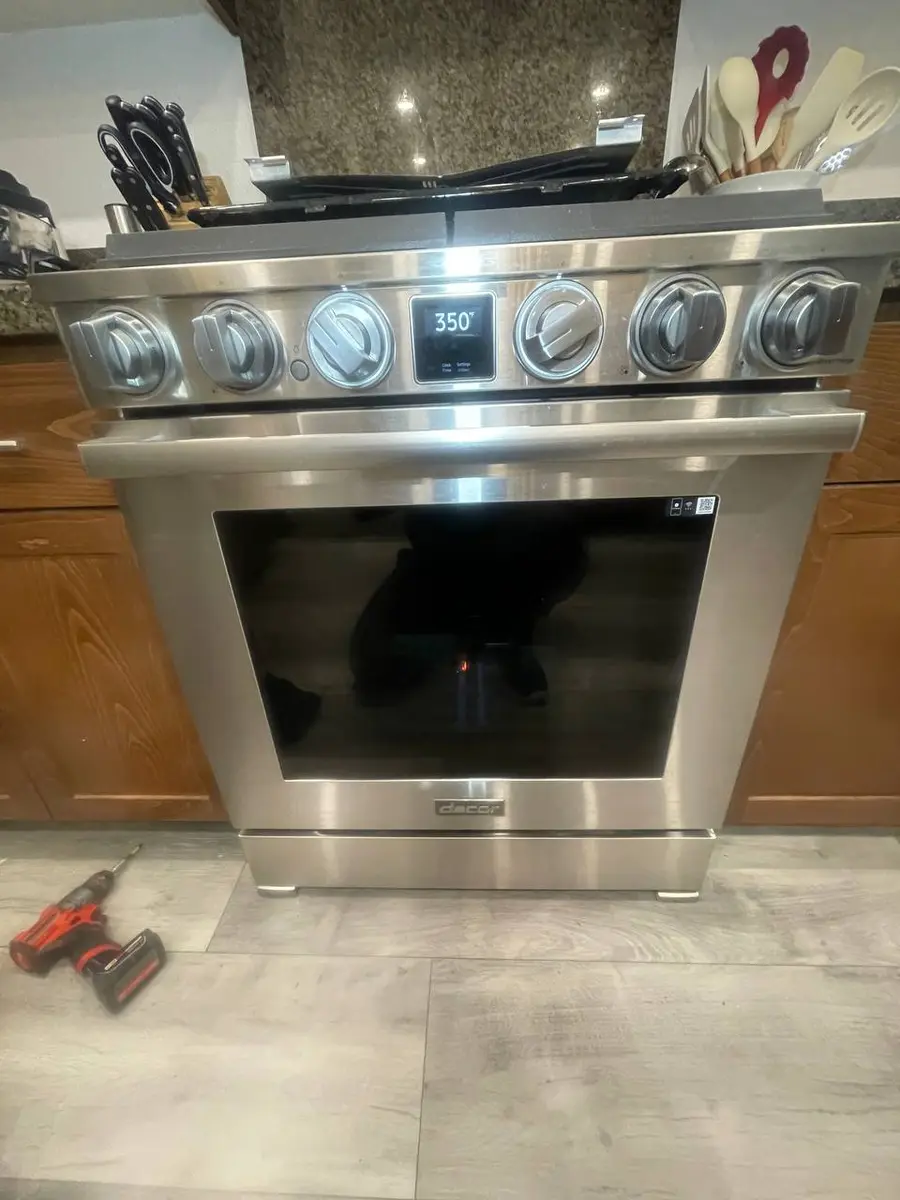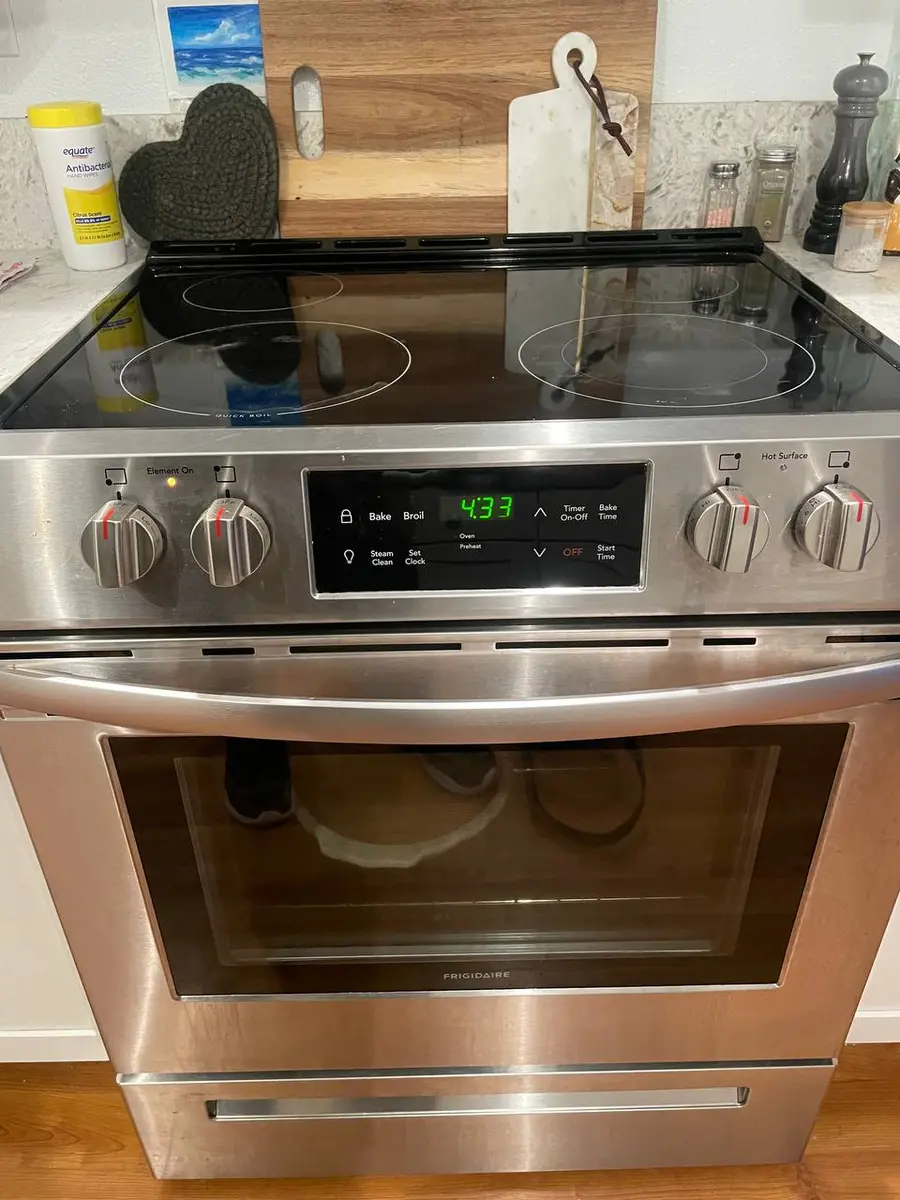
Kenmore ovens and ranges are built by multiple manufacturers — primarily Whirlpool and Frigidaire/Electrolux. The error code that appears on your Kenmore oven depends entirely on who manufactured it, and using the wrong troubleshooting guide can waste hours or lead you to order incorrect parts. This cross-manufacturer reference covers every Kenmore oven error code platform.
Identify Your Kenmore Oven's Manufacturer#
Find the model number on the sticker — usually inside the oven door frame, on the back panel, or behind the storage drawer at the bottom. The first three digits reveal the manufacturer:
- 790.xxxxx — Built by Frigidaire/Electrolux (the most common Kenmore ovens and ranges)
- 911.xxxxx — Built by Whirlpool (wall ovens and some slide-in ranges)
- 665.xxxxx — Built by Whirlpool (older freestanding ranges)
- 362.xxxxx — Built by GE (select older models)
Important safety note: Oven errors involving gas valves, igniters, or overheating are safety-critical. If you smell gas, turn off the gas supply immediately, ventilate the area, and call your gas utility. Do not attempt DIY repair on gas valve components.
Do You Have the Right Tools?
Combustion analyzer ($300), igniter tester ($120), temperature calibrator ($150), and gas pressure manometer. Our technician arrives with $3,000+ in professional tools — your diagnostic is free.
Licensed & Insured · 90-Day Warranty · Same-Day Service
Frigidaire/Electrolux-Built Kenmore Ovens (790.xxxxx)#
The vast majority of Kenmore ovens and ranges are Frigidaire-built. These use the "F" + number error code format, sometimes with an "E" suffix for sub-codes.
F10 — Runaway Temperature / Sensor Shorted#
The oven temperature has exceeded safe limits or the temperature sensor is reporting an abnormally high reading. This is a safety-critical code — the oven will shut down and the door may lock.
Common causes:
- Oven temperature sensor (RTD probe) shorted (part 316490000)
- Relay on the control board stuck closed, sending continuous power to the heating element
- Actual runaway heating from a welded relay
How to fix:
- Disconnect power immediately. If the oven door locked during this error, do NOT force it open — wait for the oven to cool completely (may take 1–2 hours).
- Once cooled, locate the oven temperature sensor — a metal probe extending into the oven cavity from the back wall, held by two screws.
- Measure sensor resistance at the connector end. At room temperature (77°F), it should read approximately 1,080–1,100 ohms. A reading near 0 ohms confirms a short.
- If the sensor reads correctly, the control board relay is likely stuck. The control board (part 316462800) needs replacement. This is a safety issue — do not continue using the oven.
Part cost: Temperature sensor 316490000 is varies by part. Control board 316462800 is varies by part.
F11 — Sensor Shorted (Element Circuit)#
The bake or broil element circuit is detecting a short to ground. Similar to F10 but specifically in the element wiring rather than the sensor.
Common causes:
- Bake element grounded (visible burn-through spot on element)
- Broil element wiring touching oven chassis
- Element terminal block corroded
How to fix:
- Visually inspect the bake element at the bottom of the oven cavity. Look for blistering, holes, or bright spots — these indicate a short to ground.
- Check the broil element at the top of the cavity similarly.
- Disconnect power and measure element resistance — bake element should read 15–50 ohms. Infinite = open (dead element). Near 0 = shorted.
- Replace any element showing visible damage. Bake element 316075103 cost varies by model and region.
Part cost: Bake element 316075103 is varies by part. Broil element 316203300 is varies by part.
F30 / F31 — Open or Shorted Sensor Circuit#
F30 means the oven temperature sensor has an open circuit (disconnected or broken). F31 means the sensor is shorted.
Common causes:
- Sensor wire harness disconnected at the back of the oven
- Sensor probe element failed (open or short internally)
- Corroded connector pins at the control board end
How to fix:
- Access the sensor connector behind the oven (usually requires pulling the range away from the wall).
- Measure sensor resistance — should be 1,080–1,100 ohms at room temperature. Infinite (OL) = open circuit (F30). Near 0 ohms = short (F31).
- If the sensor reads correctly at the sensor end but the error persists, check the harness and connector at the board end — a damaged wire or corroded pin between sensor and board causes F30.
- Sensor replacement 316490000 cost varies by model and region and takes about 10 minutes.
F1 — Oven Temperature Sensor Open (at Power-On)#
The control board cannot read the temperature sensor when the oven first powers on. Similar to F30 but detected during the initial self-test.
Common causes:
- Sensor wire disconnected (often after a self-clean cycle that loosened the connector)
- Sensor element failed
- Control board sensor input circuit damaged
How to fix:
- Check the sensor connector — self-clean cycles generate extreme heat that can warp connectors and loosen pins.
- Measure sensor resistance (1,080–1,100 ohms at room temperature).
- If the sensor and wiring test good, the control board may have a damaged input circuit.
F3 — Oven Temperature Sensor Open (During Operation)#
Same as F1 but the sensor connection was lost while the oven was actively running. The oven shuts down as a safety measure.
Common causes:
- Intermittent connection at the sensor connector (heat expansion breaks contact)
- Wire harness damaged by heat near the oven cavity
- Sensor probe cracked from thermal cycling
How to fix:
- This code suggests an intermittent problem — the sensor was working at startup but lost connection during heating.
- Check the connector for signs of heat damage (discoloration, melted plastic).
- Inspect the wire harness where it passes near the oven cavity for heat damage.
- Replace the sensor if the probe shows cracks or discoloration.
F9 — Door Lock Error#
The oven door lock mechanism failed to engage or disengage properly. This commonly occurs when entering or exiting self-clean mode.
Common causes:
- Door lock motor/solenoid failure (part 316464300)
- Lock switch not confirming locked position
- Door latch bent or misaligned
- Control board lock circuit failure
How to fix:
- If the oven door is locked and the oven is cool, try a power reset — unplug for 5 minutes, plug back in, and see if the lock resets.
- If the door remains locked, access the lock mechanism from behind the control panel. Manually disengage the lock lever (consult your service manual for the exact mechanism).
- Test the lock motor with a multimeter — it should draw power when activated.
- If the lock motor is dead, replacement 316464300 cost varies by model and region.
F90 — Door Lock During Clean Cycle#
The door lock failed specifically during a self-clean cycle. The oven may remain locked until it cools below 550°F.
How to fix:
- Wait for the oven to cool completely — this can take 1–2 hours.
- Once cool, attempt a power reset (unplug for 5 minutes).
- If the door remains locked after cooling and reset, the lock mechanism needs manual release and replacement.
Whirlpool-Built Kenmore Ovens (911.xxxxx, 665.xxxxx)#
Whirlpool-built Kenmore ovens use a different F-code set than Frigidaire. They may display as "F#" followed by "E#" for more specific sub-codes.
F1 E0 — EEPROM Communication Error#
The control board's internal memory has failed or become corrupted.
Common causes:
- Power surge corrupted the EEPROM chip
- Control board component failure
- Faulty board-to-board connection (on models with separate boards)
How to fix:
- Unplug the oven for 5 minutes and restart. EEPROM errors sometimes clear after a power reset.
- If the error returns, the control board needs replacement. Part WPW10340935 cost varies by model and region.
- There is no DIY fix for a corrupted EEPROM — the chip is soldered to the board.
F2 E0 — Oven Temperature Too High#
The oven exceeded the maximum allowable temperature during a bake or broil cycle.
Common causes:
- Temperature sensor failure reporting incorrect readings
- Control board relay stuck, sending continuous power to the element
- Poor ventilation around the oven
How to fix:
- Disconnect power and let the oven cool completely.
- Test the temperature sensor — should read 1,080–1,100 ohms at room temperature.
- If the sensor is good, the control board relay is likely stuck. The board needs replacement.
- Ensure the oven vent (usually at the back of the cooktop) is not blocked by cookware or foil.
F3 E0 / F3 E1 / F3 E2 — Sensor Open or Shorted#
F3 E0 = oven sensor open. F3 E1 = oven sensor shorted. F3 E2 = meat probe sensor error.
Common causes:
- Temperature sensor disconnected or failed
- Meat probe left in the jack without a probe attached (triggers E2)
- Corroded sensor connector
How to fix:
- For E0/E1: measure sensor resistance (1,080–1,100 ohms at room temp). Replace if out of range.
- For E2: check if anything is inserted into the meat probe jack. Remove the meat probe or clean the jack contacts.
- Sensor parts for Whirlpool-built models vary — use the full model number to find the correct replacement.
F5 E0 — Door Lock Error#
The door lock failed to engage or disengage.
How to fix:
- Same approach as Frigidaire F9 — wait for cooling, power reset, then check the lock motor.
- On Whirlpool-built models, the lock motor is usually accessible from behind the bottom front panel or behind the control console.
F9 E0 — Oven Door Lock During Clean#
Self-clean lock failure — identical in concept to Frigidaire's F90.
How to fix:
- Allow the oven to cool completely.
- Power reset (unplug 5 minutes).
- If the lock mechanism is jammed, access it from behind the control panel for manual release.
Safety First — Know the Risks
Gas ovens involve live gas lines — a loose connection creates explosion and carbon monoxide risk. Electric ovens run on 240V circuits. Our techs are licensed and insured — let them handle the risk.
Licensed & Insured · 90-Day Warranty · Same-Day Service
Kenmore Oven Diagnostic Mode#
- Frigidaire-built (790): Press and hold Bake for 6 seconds, then press the clock/timer button. The display enters service test mode and cycles through each component (relay, sensor, lock motor).
- Whirlpool-built (911): Enter by pressing and holding two specific buttons (varies by model — commonly Bake + Broil or Clock + Clean) for 3 seconds until "tSt" or "diag" appears. Press Start to advance through test stages.
Frequently Asked Questions#
Q: My Kenmore oven shows F10 and the door locked itself. How do I open it? A: F10 is a runaway temperature error — the oven locked the door as a safety measure because the temperature exceeded safe limits. Do NOT force the door. Unplug the oven and wait 1–2 hours for it to cool completely. Once cool, the lock should release. If it does not release after cooling, manually disengage the lock from behind the control panel.
Q: Can I still use my Kenmore oven if it shows F30 intermittently? A: No. F30 means the temperature sensor connection is intermittent, which means the oven cannot accurately regulate temperature. It may overheat without the sensor providing feedback to the control board. Replace the sensor before using the oven again — it is a varies by model and region part that takes 10 minutes to install.
Q: My Kenmore oven is off by 25 degrees. Is that an error code issue? A: Not necessarily. A 25-degree offset is within the normal calibration range and can be adjusted through the oven settings (usually accessible through the Options or Settings menu — consult your manual for the specific button sequence). If the offset is greater than 35 degrees, the temperature sensor may be drifting and should be tested.
Q: Why does my Kenmore oven beep and show an error during self-clean? A: Self-clean reaches 850–900°F, which stresses every component. Common self-clean failures include the door lock motor jamming (F9/F90), the temperature sensor reading out of range at extreme temperatures (F30/F31), and thermal fuse blowing from sustained heat. If errors only appear during self-clean, you can avoid the cycle and manually clean the oven instead.
Q: Is it safe to repair a gas Kenmore oven myself? A: You can safely replace the temperature sensor, control board, and door lock mechanism on gas ovens — these are electrical components that do not require disconnecting the gas line. However, any repair involving the gas valve, gas igniter connections, or gas supply line should be performed by a licensed professional. If you smell gas at any point, stop immediately and call your gas utility.
The Real Cost of DIY
Average DIY attempt: $150-400 in tools you may use once, plus the risk of further damage. Our diagnostic visit costs $0 — we find the problem and give you an honest quote.
Licensed & Insured · 90-Day Warranty · Same-Day Service
When to Call a Professional#
- F10 with suspected stuck relay — If the oven continues heating after being turned off (the element glows even with all controls at off), unplug it immediately. A stuck relay is a fire hazard that requires professional board replacement.
- Gas igniter or gas valve issues — Requires licensed gas work and proper leak testing after repair.
- Self-clean door lock jammed — While you can wait for cooling and attempt a power reset, a mechanically jammed lock that won't release may require partial oven disassembly.
- Repeated sensor errors after replacement — If a new sensor still triggers F30/F31, the control board's sensor input circuit may be damaged.
- Any burning smell or visible arcing — Disconnect power immediately and do not attempt DIY repair.
Kenmore oven showing an error code? EasyBear technicians are trained on both Frigidaire and Whirlpool Kenmore oven platforms. We identify the manufacturer from your model number, diagnose the issue, and carry common oven parts on every truck. Free diagnostic visit, 90-day repair warranty. Schedule your free diagnosis today.
Senior Gas Appliance Specialist · 18 years experience
AGA-certified gas appliance specialist with 18 years of experience in residential and commercial oven, range, and cooktop repairs.