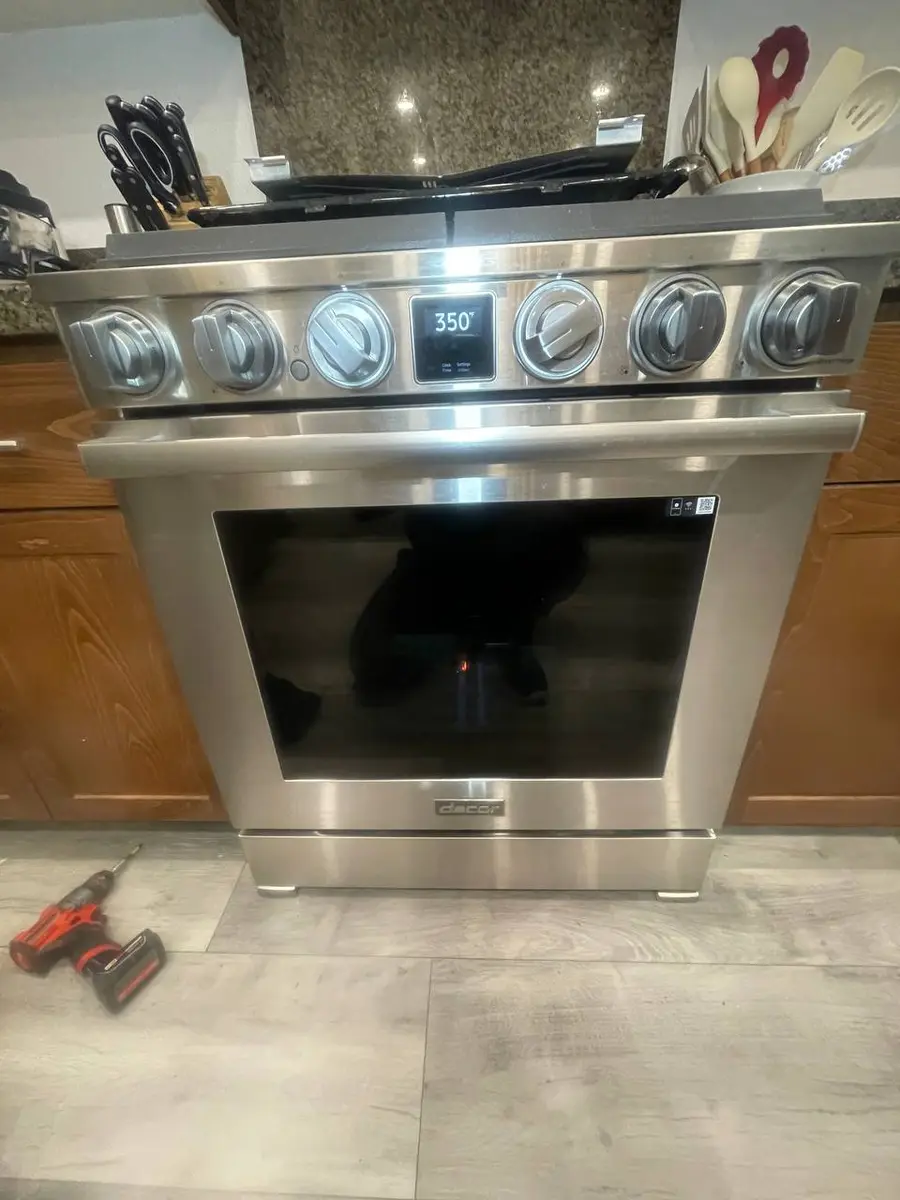
Short answer: a Viking oven typically lasts 13 to 20 years with proper maintenance — squarely on the 13-20 year industry range. The rating is average overall, but the story is uneven: the commercial-grade build is a strength, while the igniter is the part that fails soonest and most often. That unevenness is the useful part, because a Viking does not fail at random — it fails in a fixed order the high-BTU burners set. The table below matches what your range just did to the age it is, and names the one habit that moves every date on the list.
The rating rests on service-call frequency data from industry sources, including Yale Appliance 33,190 service-call dataset, Consumer Reports surveys, and aggregated repair-shop records, where a lower service rate signals higher reliability. One caveat the numbers make plain: Viking professional ranges carry a notably higher service rate than Sub-Zero, Wolf, or Thermador at similar prices — and the four failures below are where that difference is spent.
What it just did, at the age it is#
Find the behaviour, check it against the age band it belongs to, and the third column is your decision. Where the age does not match the symptom, that mismatch is itself the diagnosis.
| What the range just did | Expected age for it | The decision |
|---|---|---|
| A burner lights slowly, or will not light at all | 2-4 years | Igniter, and on a Viking this arrives earlier and more often than on rival luxury ranges — the price of high-BTU burners heat-stressing what sits near them. Repair; caught at the slow-light stage it is a routine part swap rather than an emergency. |
| The oven runs hot, cold, or uneven against a thermometer | 3-6 years | The RTD temperature sensor, the other regular visitor. Repair — it is a probe, it is affordable, and an uncalibrated oven quietly wastes years of good cooking. |
| Displays garbage, drops settings, or will not hold a mode | 5-8 years | Control board, the priciest part on the range and the second thing that concentrated heat wears. Repair if the range is under about 9 years; past that this is the failure that tips a Viking toward replacement. |
| The door will not latch, or the lock cycles on its own | 8-14 years | Door latch, the last common fault, and it is nearly always a slam-and-wear problem rather than an age one. Repair — and start closing the heavy door gently, because the hinge wear behind it is cumulative. |
| An igniter has failed twice inside a few years | Any age | Not a part problem. Something is running hotter or dirtier than it should — check for baked-on spills creating hot spots and a worn door gasket making the burners work harder to hold temperature. |
| A board failed and you use the self-clean cycle | Any age | These are connected. Self-clean drives the cavity past 900 degrees, which is punishing on a high-BTU range specifically, and skipping it directly extends control-board life. Clean manually from here. |
| Nothing yet, and it is 4 to 9 years old | 4-9 years | The band where single-part faults under 50% of a comparable new Viking are clearly worth fixing. Book the annual igniter inspection now — it is the single most valuable habit on this brand, given how early that part wears. |
Seven rows: the four failures this range own failure-by-age table lists — igniter, RTD sensor, control board, door latch — plus the two symptom patterns that mean a cause rather than a part, plus the decision band the repair-or-replace guidance below already draws. Every age here is Viking own, not a luxury-range average: the igniter at 2-4 years is specifically earlier than Sub-Zero, Wolf or Thermador, and that earliness is the brand signature rather than a rounding of the category.
Do You Have the Right Tools?
Combustion analyzer ($300), igniter tester ($120), temperature calibrator ($150), and gas pressure manometer. Our technician arrives with $3,000+ in professional tools — your diagnostic is free.
Licensed & Insured · 90-Day Warranty · Same-Day Service
Viking against its peers#
| Measure | Viking oven | Notes |
|---|---|---|
| Expected lifespan | 13-20 years | Matches the 13-20 year industry range |
| Reliability rating | Average | Higher service rate than Sub-Zero, Wolf, or Thermador |
| First common failure | Igniter, at 2-4 years | Very common — earlier than most brands |
| Cooking performance | Strong | High-BTU commercial-style burners |
Viking oven failures by age#
| Age range | Common failure | Frequency |
|---|---|---|
| 2-4 years | Igniter | Very common |
| 3-6 years | Temperature sensor (RTD) | Common |
| 5-8 years | Control board | Common |
| 8-14 years | Door latch / lock | Occasional |
The igniter is the headline. It fails as early as 2-4 years and does so more often than on rival luxury ranges — the price of those high-BTU burners, which put more heat stress on nearby components. An igniter that lights slowly or not at all is your signal; caught early, it is a routine part swap rather than an emergency.
Safety First — Know the Risks
Gas ovens involve live gas lines — a loose connection creates explosion and carbon monoxide risk. Electric ovens run on 240V circuits. Our techs are licensed and insured — let them handle the risk.
Licensed & Insured · 90-Day Warranty · Same-Day Service
Why the pro-style build cuts both ways#
Viking's commercial styling and high-output burners are the reason people buy the range and the reason it needs more attention. That concentrated heat is hardest on the igniter and, over time, the control board — the two parts that dominate a Viking's repair history. The temperature sensor, an RTD probe, is the other regular visitor at 3-6 years, usually showing up as uneven or wrong oven temperatures.
What shortens a Viking oven's life#
- Self-clean cycles: the extreme heat (past 900 degrees) is especially punishing on a high-BTU range. Skip self-clean on a Viking and clean manually — it directly extends control-board life.
- Baked-on spills: residue on the floor and elements creates hot spots that shorten element life.
- A worn door gasket: a leaky seal makes the burners work harder to hold temperature.
- Door slamming: it loosens hinges and, eventually, the latch that fails around 8-14 years.
- Power surges: the control board is the priciest part, so a surge protector is cheap insurance.
The Real Cost of DIY
Average DIY attempt: $150-400 in tools you may use once, plus the risk of further damage. Our diagnostic visit costs $0 — we find the problem and give you an honest quote.
Licensed & Insured · 90-Day Warranty · Same-Day Service
Keeping a Viking on the road#
Annual igniter inspection is the single most valuable habit for a Viking, given how early that part wears. Beyond it, wipe warm spills, clean racks and check elements monthly, inspect the gasket every few months, verify temperature accuracy twice a year, and book a yearly professional check of gas connections, the control board, and calibration. That routine can add roughly 20-30% to service life, and on a Viking it also delays the igniter and board failures that drive most of the repair spend. The door latch, the last common fault at 8-14 years, is usually a slam-and-wear problem, so closing the heavy Viking door gently is a small habit that pays off late in the range's life.
Repair or replace a Viking oven?#
Through the first four years, repair. From 4 to 9, fix single-part faults under 50% of a comparable new Viking. From 9 to 15, keep to simple, in-budget jobs. Past 15, or once a repair tops 50%, replacement is usually the better call — and a newer range's efficiency helps. Because the igniter and sensor faults are early and affordable, most Viking repairs in the single-digit years are clearly worth it; it is the later control-board failures that tip toward replacement. Book a service visit if yours is due.
Appliance Repair Technician · 11 years experience
Experienced technician with 11 years specializing in Frigidaire and Electrolux refrigerator and dryer repair with a focus on safety.