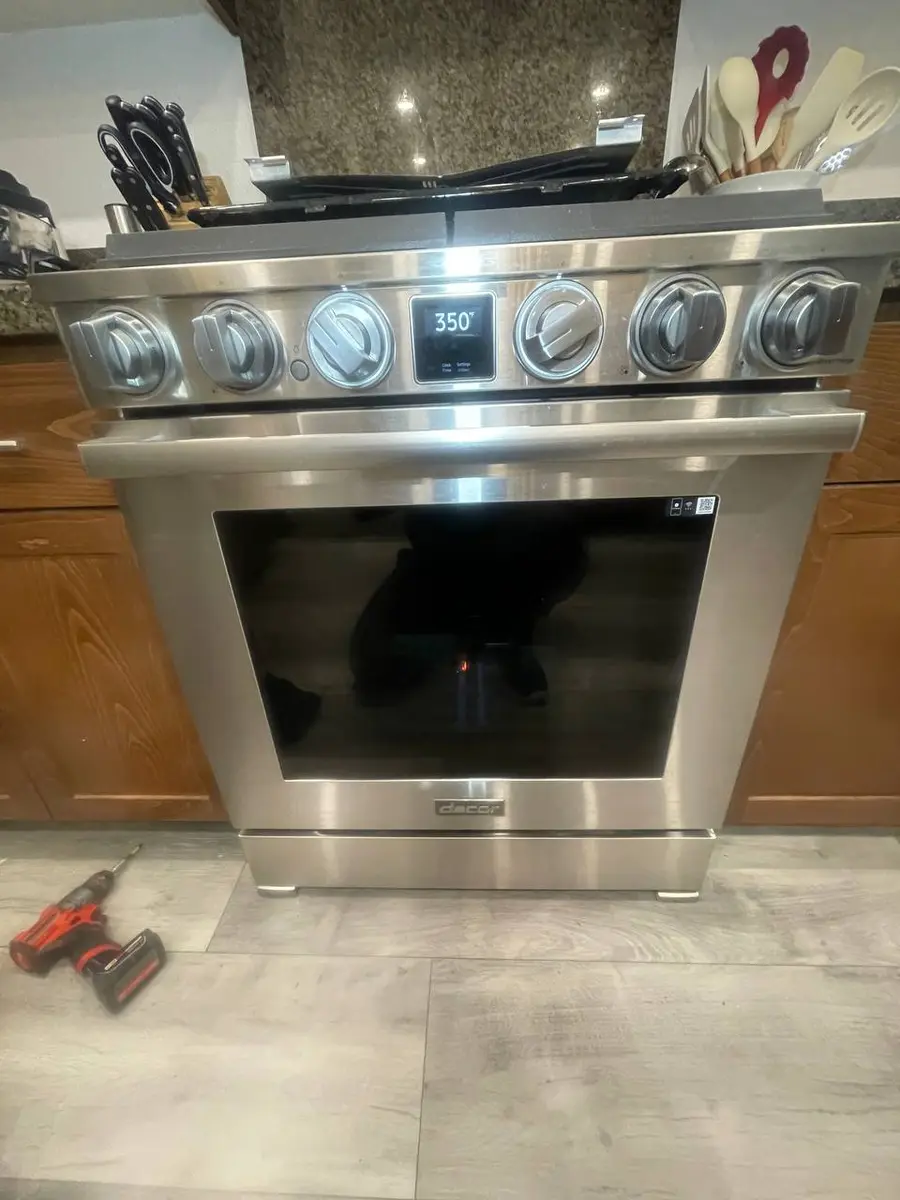
Thermador ovens are the cornerstone of luxury kitchens — from the Professional series dual-fuel ranges to the Masterpiece wall ovens and the specialty steam convection units. Built on BSH engineering with Thermador-exclusive features like the third element convection, SoftClose doors, and Home Connect integration, these ovens represent a $3,000–significant cost investment. When an error code appears, understanding its meaning helps you protect both your appliance and your dinner.
Thermador oven error codes use the BSH E-code system, displayed on the TFT touch screen (newer models) or the segmented LCD panel (earlier models). Some codes are safety-critical and will lock out the oven until resolved.
How Thermador Oven Error Codes Work#
Thermador ovens continuously monitor multiple systems: cavity temperature sensors, door lock mechanisms, cooling fans, and the control board's internal diagnostics. When a parameter falls outside acceptable range, the oven halts operation and displays an E-code.
Important safety note: Thermador ovens operate at extreme temperatures — up to 500F in standard bake, 550F in broil, and 900F+ during self-clean. Never ignore error codes, particularly those related to temperature control or door locking.
To access service diagnostic mode: The entry sequence varies by model. On most Professional series wall ovens, simultaneously press the "+" and "-" temperature buttons while holding the mode selector for 5 seconds. The display will show "d0" indicating diagnostic mode.
Basic reset: Turn off the oven at the circuit breaker for 5 minutes. Restore power and check if the error clears. Codes related to overheating require the oven to cool completely (1–2 hours) before resetting.
Do You Have the Right Tools?
Combustion analyzer ($300), igniter tester ($120), temperature calibrator ($150), and gas pressure manometer. Our technician arrives with $3,000+ in professional tools — your diagnostic is free.
Licensed & Insured · 90-Day Warranty · Same-Day Service
E011 — Temperature Sensor Short Circuit (Cavity 1)#
The main oven cavity temperature sensor (RTD probe) is reading abnormally low resistance, indicating a short circuit.
Common causes:
- Failed RTD temperature probe (BSH part 00658543)
- Sensor wiring insulation melted from proximity to the oven cavity wall
- Moisture intrusion into the sensor connector from steam cooking operations
- Control board analog input circuit failure
Troubleshooting steps:
- Access the RTD sensor — it enters the oven cavity through the rear wall, held by one or two Torx screws.
- Disconnect the sensor at its harness connector (behind the oven, accessible from the rear or by pulling the unit from the cabinet).
- Measure resistance: at room temperature (77F/25C), a BSH oven RTD should read approximately 1,080 ohms. A short circuit reads significantly below 500 ohms.
- Inspect the wiring path inside the cavity — the wire insulation degrades from thermal cycling, especially on units that use self-clean frequently.
- Check the harness connector for signs of moisture (greenish corrosion) if the oven is a steam convection model.
Repair cost: varies by part for sensor replacement. Wire harness repair adds varies by part for labor. Control board failure: varies by part.
E012 — Temperature Sensor Open Circuit (Cavity 1)#
The opposite of E011 — the sensor reads infinite resistance (open circuit), meaning the control board cannot detect temperature at all.
Common causes:
- Broken RTD wire inside the probe (thermal fatigue)
- Disconnected harness connector (vibration from door closures)
- Wire break at the cavity wall entry point (thermal stress concentration)
- Corroded connector pins preventing electrical contact
Troubleshooting steps:
- First check the most common cause: the harness connector behind the oven may have vibrated loose. Reseat it firmly.
- Measure sensor resistance at the connector — if infinite/OL, the sensor wire is broken and the probe must be replaced.
- If the sensor reads correctly at the connector but the board still shows E012, wiggle the wire harness while measuring to check for an intermittent break.
- On Professional series ranges with dual ovens, confirm which cavity sensor is triggering the error — E011/E012 for cavity 1, E013/E014 for cavity 2.
Repair cost: varies by part. The RTD probe (00658543) is a relatively affordable BSH part, and replacement takes 30–45 minutes.
Safety First — Know the Risks
Gas ovens involve live gas lines — a loose connection creates explosion and carbon monoxide risk. Electric ovens run on 240V circuits. Our techs are licensed and insured — let them handle the risk.
Licensed & Insured · 90-Day Warranty · Same-Day Service
E025 — Oven Overtemperature Protection Activated#
The oven exceeded its maximum safe temperature and the overtemperature protection system shut down heating elements. This is a safety-critical code.
Common causes:
- Relay on the control board stuck closed (welded contacts), keeping the bake or broil element permanently energized
- Convection fan failure causing localized hotspots near the sensor
- Temperature sensor drifted out of calibration, causing the control board to overrun heating
- Blocked cooling vents (items placed on top of a wall oven or against rear vents)
Troubleshooting steps:
- Turn off the oven at the breaker immediately. Allow 2+ hours for complete cooling.
- After cooling, remove the oven racks and inspect the bake and broil elements for visible damage (warping, holes, discoloration).
- Check the cooling vents above and behind the oven — blocked airflow causes the control board and exterior surfaces to overheat, but can also affect cavity temperature management.
- The most dangerous cause: a welded relay on the control board keeps an element on continuously. If the oven heats uncontrollably (will not respond to temperature reduction), the relay is failed and the board must be replaced immediately.
- Test the cavity sensor resistance to ensure it has not drifted. Compare reading to the expected 1,080 ohms at room temp.
Repair cost: varies by part. A welded relay means full control board replacement on Thermador — these are expensive, precision-calibrated assemblies. Do not attempt to repair individual relay components on the board.
E030 — Door Lock Failure#
The oven door lock mechanism failed to engage or disengage properly. This code appears during self-clean cycle initiation, during self-clean operation, or when attempting to unlock after self-clean completes.
Common causes:
- Door lock motor stripped gears (plastic gear set wears from repeated self-clean cycles)
- Lock switch not detecting the locked position (microswitch failure)
- Wiring harness to the lock assembly damaged by heat migration from self-clean temperatures
- Door latch misaligned (hinge wear on Professional series heavy doors)
Troubleshooting steps:
- If the door is stuck locked after self-clean: disconnect power and wait 30 minutes. The thermal lock (bi-metal strip) may release as it cools below its trip temperature.
- If still locked, access the lock mechanism from the top (remove the trim panel above the door on wall ovens) and manually release the latch.
- Inspect the lock motor and gear assembly — look for stripped or cracked plastic gears. This is the most common failure mode on Thermador ovens with more than 5 years of self-clean usage.
- Test the lock microswitches with a multimeter for proper continuity in each position (locked/unlocked).
- On Professional series ranges with SoftClose doors, check the door hinge springs — a weakened hinge can prevent the door from fully engaging the latch.
Repair cost: varies by part. Lock motor assemblies are moderately priced, but labor can be significant on built-in wall ovens where access is limited.
The Real Cost of DIY
Average DIY attempt: $150-400 in tools you may use once, plus the risk of further damage. Our diagnostic visit costs $0 — we find the problem and give you an honest quote.
Licensed & Insured · 90-Day Warranty · Same-Day Service
E042 — Convection Fan Motor Error#
The convection fan is not operating at the expected speed or has failed entirely. On Thermador's third-element convection system, this significantly impacts cooking performance.
Common causes:
- Fan motor bearing failure (overheating from extended high-temperature use)
- Fan blade striking the rear panel (warped blade from thermal expansion)
- Motor winding failure (open or shorted coil)
- Control board not sending the correct speed signal to the fan motor
- Excessive grease buildup on the fan blade causing imbalance
Troubleshooting steps:
- With the oven completely cool and power disconnected, open the door and locate the convection fan behind the rear panel of the oven cavity.
- Attempt to spin the fan by hand through the vent openings. It should rotate freely and smoothly. Grinding, wobbling, or resistance indicates bearing failure.
- Listen during operation: a failing fan motor produces grinding, squealing, or a rhythmic ticking sound as the blade contacts the housing.
- On models with variable-speed fans (Professional series True Convection), the motor is a DC brushless type. Test the motor connector for proper voltage during operation (requires diagnostic mode).
- Inspect for grease accumulation — particularly on models used frequently for roasting. Heavy grease on the fan blade causes vibration that accelerates bearing wear.
Repair cost: varies by part. Convection fan motors for Thermador are premium components, and replacement on wall ovens requires removing the rear panel from inside the cavity — a labor-intensive process.
E050 — Meat Probe Error#
The internal meat probe thermocouple is reading outside expected parameters or has a communication error with the control board.
Common causes:
- Meat probe not fully inserted into the jack (partial contact)
- Failed meat probe (thermocouple broken internally) — BSH part 00612830
- Moisture in the probe jack from steam cooking
- Probe jack wiring connection to the control board damaged
Troubleshooting steps:
- Remove and reinsert the meat probe firmly into the jack. Ensure the connector is fully seated with a slight click.
- Inspect the probe tip and connector for visible damage, bent pins, or corrosion.
- Test the probe: at room temperature, measure resistance between the probe tip and the connector ground — for BSH Type K thermocouples, expect a very low reading (near 0 ohms for the thermocouple, approximately 50kΩ for NTC types depending on model).
- With the probe disconnected, check if E050 clears. If it does, the probe is faulty. If it persists, the jack or wiring is the issue.
- Clean the probe jack with compressed air — moisture from steam oven operation is a frequent culprit.
Repair cost: varies by part. Replacement probes are available directly from BSH. Jack/wiring repairs are more involved: varies by part.
Don't Void Your Warranty
Opening your appliance yourself may void the manufacturer warranty. Our repair comes with a 90-day guarantee, and we document everything for warranty compliance.
Licensed & Insured · 90-Day Warranty · Same-Day Service
E305 — Steam System Error (Steam Convection Models)#
Exclusive to Thermador steam convection ovens, E305 indicates the steam generation system has malfunctioned.
Common causes:
- Water reservoir empty or not properly seated
- Scale buildup in the steam boiler from hard water (extremely common in Sacramento/Bay Area)
- Steam boiler heating element failure
- Water pump not delivering water to the boiler
- Steam temperature sensor malfunction
Troubleshooting steps:
- Check the water reservoir — remove, refill with fresh water, and reseat firmly. Ensure the reservoir contacts are clean and dry.
- Run the descaling cycle (consult your model's manual). Hard water in the Sacramento Valley and Bay Area causes rapid scale accumulation that restricts steam flow. Thermador recommends descaling every 20 steam cooking cycles.
- If descaling does not resolve E305, the boiler heater or pump may have failed. These components require service access from the rear of the unit.
- For persistent E305, check the steam temperature sensor — mineral deposits can coat the sensor and give false readings.
Repair cost: varies by part. Descaling is a basic maintenance item (varies by part service call). Boiler replacement is a major repair requiring BSH-specific parts.
Home Connect Oven Diagnostics#
Home Connect integration provides these oven-specific advantages:
Remote monitoring: Receive push notifications when a cooking program completes or when an error occurs — critical for unattended roasting.
Temperature curves: The app logs the actual vs. target temperature throughout cooking, helping technicians identify thermal drift or sensor calibration issues.
Firmware updates: BSH periodically releases firmware patches that resolve specific error code false-triggers. Check the Home Connect app for available updates before scheduling service.
Cooking programs: Downloaded cooking programs from the Home Connect library set precise temperature and timing parameters, reducing operator error that can trigger E025 overtemperature.
Is It Worth Your Time?
Oven temperature issues require systematic testing of the igniter, gas valve, thermostat, and calibration. Average DIY: 4-6 hours. Our technician diagnoses the issue in about 30 minutes — same-day appointments available.
Licensed & Insured · 90-Day Warranty · Same-Day Service
Frequently Asked Questions#
Q: My Thermador oven shows E025 during self-clean. Is this normal? A: No. While self-clean operates at 900F+, the oven is designed to handle this temperature without triggering overtemperature protection. E025 during self-clean indicates either a failing sensor (reading higher than actual temperature) or a genuine overheating condition from blocked vents. Have the cooling fans and vent pathways inspected before running self-clean again.
Q: How often should I descale my Thermador steam oven? A: In the Sacramento and Bay Area areas with hard water, descale every 15–20 steam cooking uses. Use only BSH-approved descaling solution — vinegar and generic descalers can damage the boiler's internal seals. The Home Connect app tracks steam usage and sends reminders.
Q: Can I replace the oven temperature sensor myself? A: On most Thermador wall ovens, the sensor is accessible from inside the cavity (1–2 Torx screws) with the connector reachable behind the unit. If you can pull the oven from the cabinet and have a Torx set, it is a feasible DIY repair. However, Professional series ranges may require removing the rangetop to access the connector, which is better left to a technician.
Q: Why does my Thermador oven run hot compared to my old oven? A: Thermador ovens are precisely calibrated at the factory, but calibration can drift over time as the RTD sensor ages. You can recalibrate the offset through the settings menu (typically +/- 35F adjustment). If the offset needed exceeds 35F, the sensor should be replaced. Do not rely on offset adjustment to compensate for a failing sensor.
Q: Is it worth repairing a $10,000 Thermador wall oven or should I replace it? A: Thermador wall ovens are designed for 15–20+ year lifespans. At the varies by model and region replacement cost (plus installation and cabinet modifications), repairs up to $1,200 are almost always justified. The control board is the most expensive single component (varies by model and region), and even that is a fraction of replacement cost. Only consider replacement if multiple major systems have failed simultaneously.
Thermador Oven Repair by EasyBear#
Professional and Masterpiece series ovens require technicians with BSH certification and experience with these high-performance cooking systems. EasyBear's specialists service all Thermador oven configurations — dual-fuel ranges, single and double wall ovens, speed ovens, and steam convection units. Our free diagnostic visit includes BSH diagnostic software access to read error history, test component-level functionality, and provide accurate repair quotes. Every repair is backed by our 90-day parts and labor warranty, ensuring your premium cooking investment performs as designed.
Lead Appliance Repair Technician · 12 years experience
Experienced technician with 12 years specializing in washing machine and dryer repairs across all major brands.