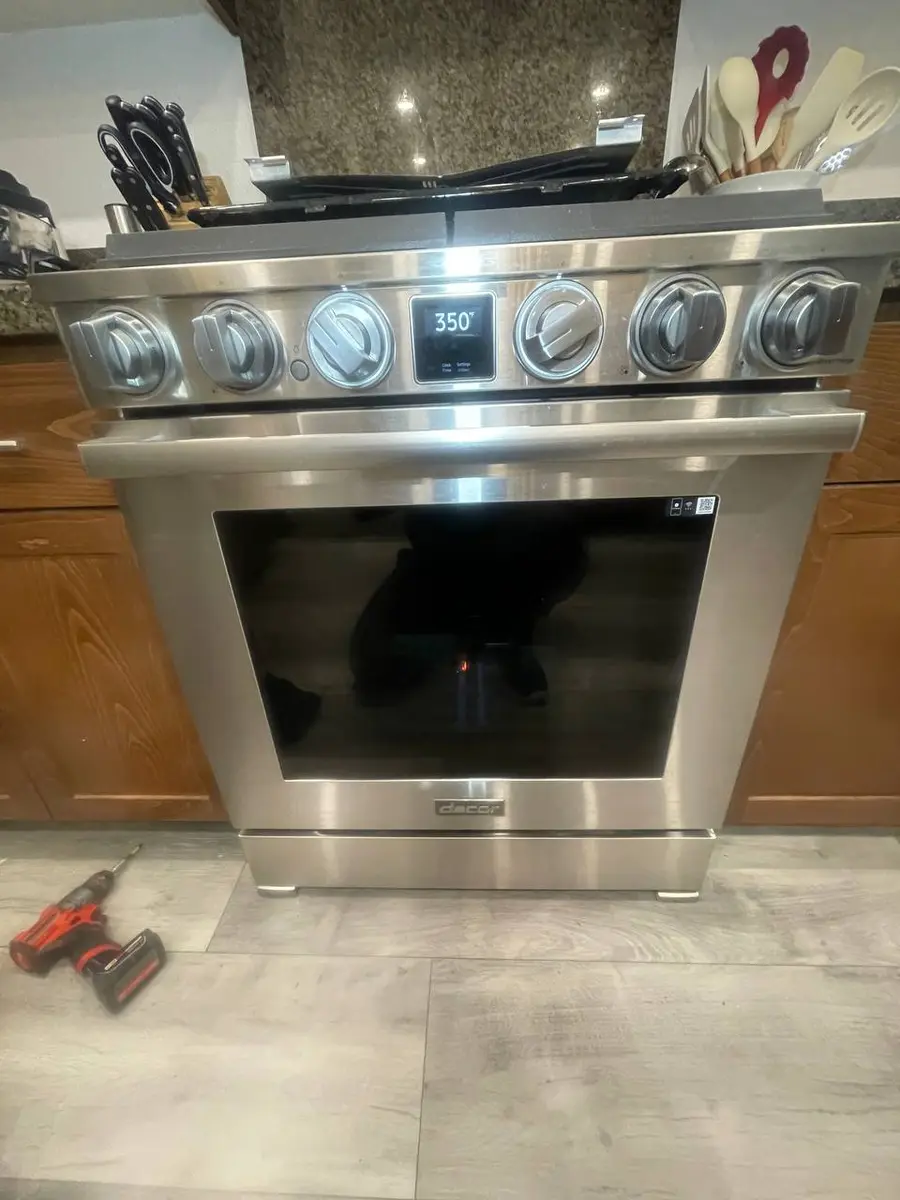
Viking Professional ranges and ovens represent the pinnacle of residential cooking equipment — commercial-grade construction, 15,000+ BTU burners, ProFlow convection, and VariSimmer settings that serious cooks demand. When the electronic control system detects a fault, it displays an F-prefix error code on the oven display. Understanding these codes is critical because Viking ovens can involve both high-voltage electrical and gas systems, making some faults potentially hazardous.
This guide covers every Viking oven error code across the Professional, 7 Series, and dual fuel range lineups. We explain what each code means, what causes it, and whether it requires immediate attention or can wait for a scheduled service call.
How Viking Oven Error Codes Work#
Viking ovens use an RTD (Resistance Temperature Detector) sensor system with a microprocessor-based control board. The board continuously monitors oven cavity temperature, door status, cooling fan operation, and safety interlocks. When a parameter exceeds safe thresholds, the board cuts power to heating elements (or gas igniters) and displays the corresponding F-code.
Critical safety note: On Viking dual fuel ranges (gas cooktop + electric oven), any error code that mentions temperature or heating should prompt you to shut off both the electrical breaker AND the gas supply valve behind the unit. Gas and electricity together create compounding hazards.
To access Viking oven diagnostic mode:
- Ensure the oven is OFF and cooled below 100°F.
- Press and hold Bake + Broil buttons simultaneously for 5 seconds.
- The display shows stored fault history (last 10 codes on Professional models).
- Press Bake to scroll forward, Broil to scroll backward through stored faults.
- Press Cancel to exit diagnostic mode.
Do You Have the Right Tools?
Combustion analyzer ($300), igniter tester ($120), temperature calibrator ($150), and gas pressure manometer. Our technician arrives with $3,000+ in professional tools — your diagnostic is free.
Licensed & Insured · 90-Day Warranty · Same-Day Service
F01 — Door Latch/Lock Circuit Fault#
The oven control board cannot confirm the door latch motor has completed its lock/unlock cycle. This code most commonly appears during or after self-clean cycles when the door lock mechanism is actively engaged.
Common causes:
- Door latch motor failure (the most common cause on Viking ovens over 8 years old)
- Lock switch out of alignment with latch position
- Wiring harness damage from heat exposure near the oven cavity
- TruGlide rack rail interference with latch mechanism
- Control board latch driver circuit failure
Troubleshooting steps:
- If the oven is hot from a self-clean cycle, wait until it cools below 550°F — the lock will not release until temperature drops.
- Once cool, try pressing Cancel to clear the code and unlock the door.
- If the door remains locked: disconnect power for 10 minutes. On some Viking models, the latch resets to unlocked position when power is removed.
- Inspect the latch assembly above the door opening for debris, grease buildup, or misalignment with the TruGlide rack system.
- Measure latch motor continuity — Viking spec is 1,100–1,400 ohms across the motor coil.
- Test both solenoid coils independently — Viking Professional ranges use a dual-solenoid latch design.
Parts: PA010073 door latch assembly (varies by model and region), PB010025 lock switch (varies by model and region). Professional labor: varies by model and region total.
Diagnostic tip: Viking pro ranges use a dual-solenoid latch — test both coils independently. A single open coil triggers F01 even if the other is functional. The most common failure is the lock coil burning out during extended self-clean cycles (4.5 hours at 900°F+).
F02 — RTD Temperature Sensor Fault#
The oven's RTD temperature sensor is reading open circuit, short circuit, or a resistance value outside the valid range. The oven will not heat until this is resolved.
Common causes:
- RTD sensor element failure (glass-encased platinum wire breaks after thermal cycling)
- Wiring break where harness passes near ProFlow convection fan area (heat damage)
- Connector corrosion at the control board from moisture/grease vapor
- Sensor probe physical damage from oven rack removal
Troubleshooting steps:
- Disconnect power and access the RTD sensor — it's located behind the rear oven panel, typically upper-left corner, held by a single mounting screw.
- Measure RTD resistance at room temperature: Viking spec is 1,080–1,090 ohms at 72°F. This is a platinum RTD, not a thermistor.
- If room-temp reading is correct but F02 fires during preheat, test at elevated temperature: resistance should be approximately 1,400 ohms at 200°F.
- Inspect the wire routing — the harness passes near the ProFlow convection fan where temperatures exceed 500°F. Look for melted insulation or bare wire contact.
- Check the control board connector for carbon deposits or green corrosion on pins.
Parts: PA010042 RTD temperature sensor (varies by model and region), PB040019 sensor harness (varies by model and region). Professional labor: varies by model and region total.
Diagnostic tip: Viking RTD sensors drift with age. If the reading is within spec at room temp but F02 fires during preheat, the sensor has developed a temperature-dependent intermittent open circuit. Replace rather than intermittently troubleshoot — the sensor cost varies by model and region but the diagnostic labor to catch an intermittent can exceed $300.
Safety First — Know the Risks
Gas ovens involve live gas lines — a loose connection creates explosion and carbon monoxide risk. Electric ovens run on 240V circuits. Our techs are licensed and insured — let them handle the risk.
Licensed & Insured · 90-Day Warranty · Same-Day Service
F03 — Cooling Fan Feedback Fault#
The oven cooling fan (which protects control electronics and adjacent cabinetry from heat) is not providing a speed feedback signal to the control board. The oven will not operate without confirmed cooling fan operation.
Common causes:
- Cooling fan motor bearing seizure
- Fan blade warped or contacting shroud
- Hall-effect speed sensor failure (motor spins but board doesn't see feedback)
- Wiring issue between fan and control board
- Control board fan driver circuit failure
Troubleshooting steps:
- Disconnect power and locate the cooling fan — it's behind the top rear panel of the oven, blowing air across the control electronics area.
- Spin the fan blade by hand. It should rotate freely with minimal resistance. If seized or grinding, the motor bearings have failed.
- Measure fan motor windings: expect 15–25 ohms across the two power leads.
- If the motor spins freely and winding resistance is correct, test the Hall-effect feedback sensor — it's a third wire that provides a tachometer signal.
- Power the motor directly with 120V AC — if it runs, the issue is upstream in the board or wiring.
Parts: PA010058 cooling fan motor (varies by model and region), PB010031 fan blade assembly (varies by model and region). Professional labor: varies by model and region total.
Diagnostic tip: Listen carefully when F03 appears — a humming sound from behind the panel (motor energized but not spinning) indicates seized bearings. Silence indicates no power reaching the motor (wiring/board fault). This distinction saves diagnostic time.
F04 — Meat Probe Shorted#
The oven's meat probe jack detects a short circuit, either from the probe itself or from internal contamination of the jack receptacle.
Common causes:
- Moisture intrusion into the probe connector (from steam during cooking)
- Damaged probe cable (internal wire break causing intermittent short)
- Grease splatter entering the probe jack receptacle
- Probe tip damage from dishwasher cleaning (they're hand-wash only)
Troubleshooting steps:
- Unplug the meat probe from the oven jack. Clear the error by pressing Cancel.
- If the error clears with the probe removed, the probe itself is faulty. Test probe resistance — it should read open circuit at room temperature, with decreasing resistance as temperature increases.
- If F04 fires with NO probe inserted, the jack receptacle has internal contamination. Clean with compressed air directed into the jack. Use a cotton swab with isopropyl alcohol if grease is visible inside.
- Inspect the probe cable for cuts, kinks, or heat damage near the connector end.
Parts: PA010036 meat probe assembly (varies by model and region). Professional labor: varies by model and region total.
Quick fix: Most F04 errors resolve by removing the probe, cleaning the jack with compressed air, and allowing it to dry completely before reinserting. If F04 fires without a probe inserted, the jack itself needs replacement — a relatively simple repair.
The Real Cost of DIY
Average DIY attempt: $150-400 in tools you may use once, plus the risk of further damage. Our diagnostic visit costs $0 — we find the problem and give you an honest quote.
Licensed & Insured · 90-Day Warranty · Same-Day Service
F06 — Control Board Configuration Mismatch#
The main control board's EEPROM data doesn't match the expected oven configuration. This typically occurs after a board replacement if the technician doesn't transfer the EEPROM chip or program the board for the specific model.
Common causes:
- Incorrect replacement board installed (wrong part number for model/serial range)
- EEPROM chip not transferred from old board to new board
- EEPROM data corruption from power surge
- Firmware version mismatch after factory update
Troubleshooting steps:
- Verify the replacement board part number matches the Viking model AND serial number range exactly. Viking uses different firmware variants for the same physical board across serial number ranges.
- Power-cycle the unit: disconnect power for 5 full minutes, then reconnect.
- If the board was recently replaced, check whether the original EEPROM chip was transferred. Some Viking models require removing a small IC chip from the old board and soldering it to the new one.
- Contact Viking technical support (800-845-4641) for board re-initialization procedures if the EEPROM is integrated and cannot be transferred.
Parts: PA020085 main control board (varies by model and region), PB060012 EEPROM chip (varies by model and region). Professional labor: varies by model and region total.
Diagnostic tip: Viking pro-style ranges use model-specific EEPROM profiles. A board that physically fits and electrically works may still throw F06 if the firmware variant doesn't match the oven cavity configuration (single vs. double, convection type, gas vs. electric ignition mapping).
F07 — Door Switch/Interlock Fault#
The oven door switch (interlock) is sending a signal inconsistent with expected door state. This can prevent broil operation, trigger incorrect door-open indicators, or block self-clean initiation.
Common causes:
- Door switch contact failure (carbon buildup from arc-over)
- TruGlide hinge sag causing door misalignment with switch plunger
- Switch plunger physically broken
- Wiring issue between switch and board
- Door strike plate wear allowing incomplete closure
Troubleshooting steps:
- Open and close the oven door firmly. Listen and feel for positive latching contact.
- Inspect the door switch (located in the oven frame, actuated by a plunger when the door closes). Check for visible damage or misalignment.
- Check door hinge springs — Viking TruGlide hinges can slip, causing the door to sit lower than designed. Even 2mm of sag defeats the interlock.
- Test switch continuity in both open and closed positions with a multimeter.
- Inspect the strike plate on the door for wear grooves that allow the door to appear closed without fully depressing the switch plunger.
Parts: PA010029 door interlock switch (varies by model and region), PB010044 TruGlide hinge set (varies by model and region). Professional labor: varies by model and region total.
Diagnostic tip: Viking door switches are positioned higher than most brands. The strike plate must align precisely with the switch plunger. If you can push the door in further by hand after it "closes," the hinges need adjustment or replacement.
Don't Void Your Warranty
Opening your appliance yourself may void the manufacturer warranty. Our repair comes with a 90-day guarantee, and we document everything for warranty compliance.
Licensed & Insured · 90-Day Warranty · Same-Day Service
F10 — Runaway Temperature Detected#
F10 is the most critical Viking oven error code — it means the oven cavity temperature has exceeded the setpoint by 50°F or more, indicating an uncontrolled heating condition. This is a potential fire hazard.
Common causes:
- Relay on control board welded closed (most dangerous — element stays energized continuously)
- RTD sensor failure reporting falsely low temperature (board thinks oven is cold, keeps heating)
- Control board processor malfunction
- Bake or broil element energized without command signal
Immediate actions:
- Turn off the oven immediately. If the oven is still hot and you smell burning, disconnect power at the breaker.
- On dual-fuel Viking ranges, ALSO shut off the gas supply valve behind the unit.
- Do NOT use the oven until professionally diagnosed and repaired.
Troubleshooting steps (for qualified technicians only):
- After cooling completely, power on the oven WITHOUT selecting any cycle. Monitor the bake and broil elements — if either energizes without being commanded, a relay is welded closed on the board.
- Verify RTD sensor reading at room temperature (1,080–1,090 ohms at 72°F). A drifted sensor could have caused the board to over-heat.
- If the relay is welded, the entire control board must be replaced — the relay is not separately serviceable.
- Test by disconnecting the element leads from the board relay outputs and verifying no voltage is present without a cycle selected.
Parts: PA020085 main control board (varies by model and region), PA010042 RTD sensor (varies by model and region). Professional labor: varies by model and region total.
Warning: F10 indicates a potential fire hazard. Do NOT attempt to bypass, reset, or ignore this code. A welded relay means the heating element receives power continuously regardless of temperature. On Viking dual-fuel ranges, shut off gas supply at the shutoff valve behind the unit. Keep the oven disconnected from power until a certified technician diagnoses the root cause.
F30/F31 — Secondary Sensor Issues#
F30 and F31 indicate sensor failures similar to F02 but targeting specific oven cavities on double-wall-oven models. F30 = primary/lower oven sensor. F31 = secondary/upper oven sensor. On single-oven Viking ranges, only F30 appears.
Common causes:
- Same failure modes as F02 (sensor element failure, wiring, connector corrosion)
- On double ovens: separate sensors and harnesses for each cavity
Troubleshooting steps:
- Identify which cavity is affected: F30 = primary (lower on double ovens, only cavity on single ovens). F31 = upper/secondary cavity.
- Follow the same diagnostic procedure as F02 — measure RTD resistance at room temp (1,080–1,090 ohms at 72°F).
- On double-wall-oven models, each sensor has its own dedicated harness running to the control board. Trace the correct harness for the affected cavity.
Parts: PA010042 RTD sensor (varies by model and region per sensor). Professional labor: varies by model and region total.
Is It Worth Your Time?
Oven temperature issues require systematic testing of the igniter, gas valve, thermostat, and calibration. Average DIY: 4-6 hours. Our technician diagnoses the issue in about 30 minutes — same-day appointments available.
Licensed & Insured · 90-Day Warranty · Same-Day Service
Viking Oven Error Code Quick Reference#
| Code | Description | Severity | Can Wait? |
|---|---|---|---|
| F01 | Door latch fault | Medium | Yes, if door opens normally |
| F02 | RTD sensor fault | High | No — oven won't heat |
| F03 | Cooling fan fault | Medium | No — protects electronics |
| F04 | Meat probe shorted | Low | Yes — remove probe to clear |
| F06 | Board config mismatch | High | No — oven non-functional |
| F07 | Door interlock fault | Medium | Partial function may work |
| F10 | Runaway temperature | Critical | NEVER — fire hazard |
| F30/F31 | Sensor issues | High | No — oven won't heat |
Frequently Asked Questions#
Q: How do I reset my Viking oven after an error code? A: Press Cancel/Off to clear the display, then disconnect power at the breaker for 5 minutes. Reconnect and test. If the code returns, the fault is persistent and requires repair. Never repeatedly reset F10 — each reset cycle with a welded relay risks fire.
Q: Why does my Viking range show F02 only during preheating? A: The RTD sensor has developed a temperature-dependent intermittent failure. It reads correctly at room temperature but develops a micro-crack in the platinum element that opens under thermal expansion during heating. Replace the sensor — it will fail completely soon.
Q: Can I use the stovetop burners if the oven shows an error code? A: On Viking dual-fuel and all-gas models, the stovetop burners are independent of the oven control board. You can safely use the burners with an oven error displayed — EXCEPT for F10 (runaway temperature), where you should shut off gas as a precaution until the oven side is repaired.
Q: How much does a Viking oven control board replacement cost? A: Viking control boards range from varies by model and region for the part alone. With professional installation, calibration, and verification, total cost is typically varies by model and region. Always use OEM Viking boards — aftermarket alternatives often lack the correct EEPROM programming.
Q: My Viking oven is stuck locked after self-clean. How do I open it? A: Wait at least 1 hour for the oven to cool below 550°F — the lock will not release at high temperatures. Then disconnect power for 10 minutes. On most Viking models, the latch motor resets to the unlocked position when power is removed. If still locked, the latch motor (F01) has failed and requires professional repair.
The Risk of Getting It Wrong
A wrong diagnosis often turns a simple fix into a costly replacement. Without proper diagnostic tools, you might replace the wrong part — or cause additional damage. Our free diagnostic eliminates the guesswork.
Licensed & Insured · 90-Day Warranty · Same-Day Service
When to Call a Professional#
Viking ovens combine gas systems, high-voltage electricity, and commercial-grade components. Professional repair is essential for:
- F10 (runaway temperature) — immediate fire hazard, requires board replacement
- F02/F30/F31 with gas models — sensor failures on gas ovens can lead to uncontrolled heating
- F06 (board configuration) — requires Viking-specific programming knowledge
- Any code during self-clean — 900°F+ temperatures create unique failure modes
- Dual-fuel models — combining gas and electric diagnostics safely requires specialized training
EasyBear's Viking-certified technicians work on Professional ranges daily. We carry common Viking oven parts — RTD sensors, latch assemblies, and control boards. Our free diagnostic visit identifies the exact failure using Viking's diagnostic mode, and we explain your options before any repair begins. Every repair is backed by our 90-day parts and labor warranty. Schedule your free diagnosis today.
Lead Appliance Repair Technician · 12 years experience
Experienced technician with 12 years specializing in washing machine and dryer repairs across all major brands.