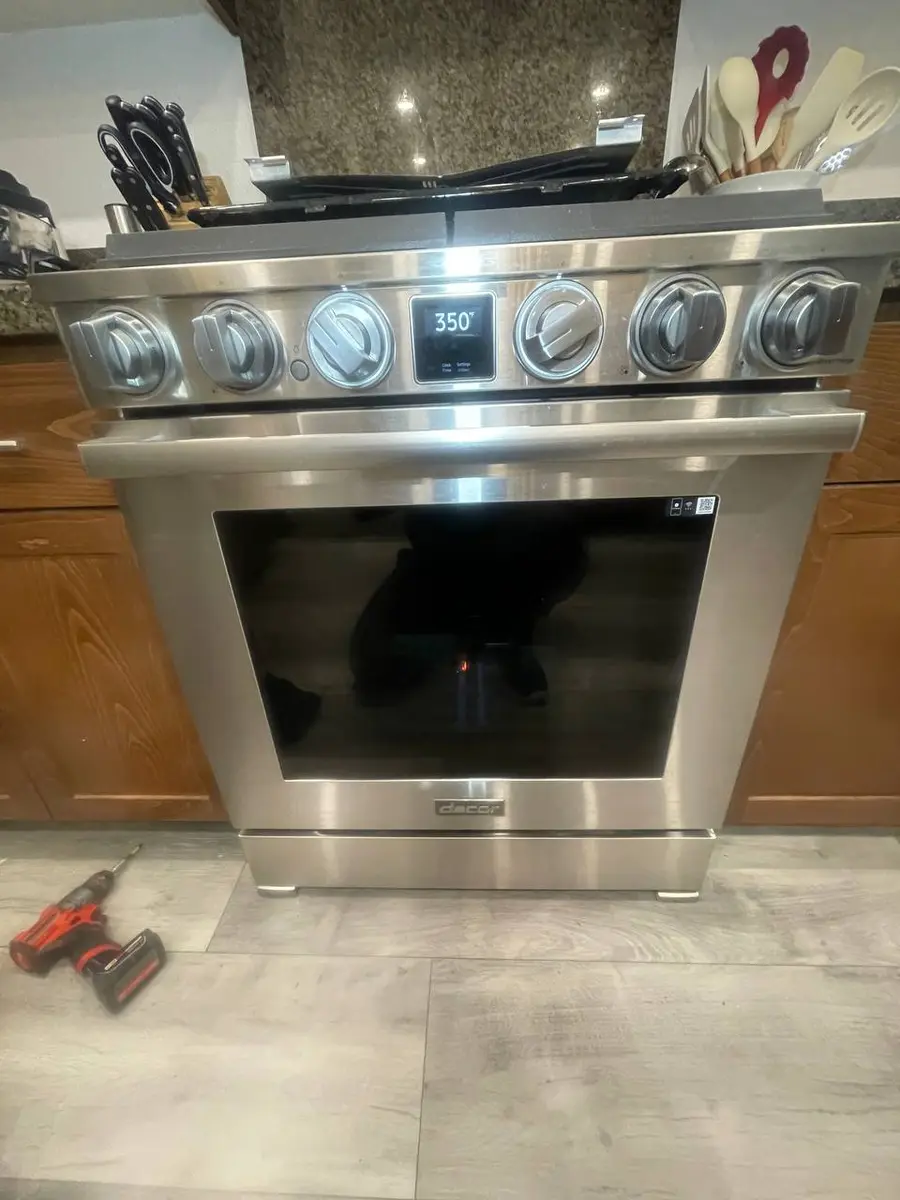
A Dacor range that won't heat has a break somewhere in the ignition or heating chain — on gas models usually the igniter or the safety valve, on the electronics side a control-board relay or a temperature sensor. Since the Modernist series shares Samsung-derived electronics, some parts are more available than they used to be. This guide ranks the causes.
The likely culprit#
Most likely: igniter failure on gas models. The oven igniter must draw enough current — typically in the 3.2-3.6 amp range — to open the gas valve's safety solenoid, and a weak igniter may glow visibly yet never reach that threshold, so gas never flows and the oven stays cold. Measure the igniter's current draw with a clamp meter; below about 3.0A it's too weak and needs replacing. If the igniter is strong, look at the control board and the temperature sensor.
Do You Have the Right Tools?
Combustion analyzer ($300), igniter tester ($120), temperature calibrator ($150), and gas pressure manometer. Our technician arrives with $3,000+ in professional tools — your diagnostic is free.
Licensed & Insured · 90-Day Warranty · Same-Day Service
Safety first#
Disconnect power at the breaker and shut off the gas supply before inspecting the igniter, safety valve, or control board. Dacor ranges mix high-voltage components and gas connections.
Do not attempt repairs beyond basic inspection unless you have professional training.
Ranked causes at a glance#
| Likely cause | How common | What you'll notice / what to check |
|---|---|---|
| Igniter failure (gas models) | Most common | The igniter glows but gas never lights; current draw below about 3.0A. |
| Control board relay failure | Common | No response, erratic temperature, or persistent error codes after a power cycle. |
| Gas safety valve not opening | Occasional | Gas shuts off seconds after the flame lights, from a fatigued bimetal or solenoid. |
| RTD temperature sensor open | Occasional | The board can't read oven temperature; sensor resistance far out of range. |
| Convection element burnout | Occasional | No convection heat on dual-fuel models; the element reads open. |
Safety First — Know the Risks
Gas ovens involve live gas lines — a loose connection creates explosion and carbon monoxide risk. Electric ovens run on 240V circuits. Our techs are licensed and insured — let them handle the risk.
Licensed & Insured · 90-Day Warranty · Same-Day Service
Working through each cause#
1. Igniter failure — gas models (most common)#
Gas oven igniters are silicon-carbide or silicon-nitride elements that must draw enough current to open the gas valve's safety solenoid, and a weakened igniter may glow but not reach the amperage threshold, so the valve never opens and gas doesn't flow. Measure the current draw with a clamp meter — typically it should sit in the 3.2-3.6 amp range, and below about 3.0A the igniter is too weak. A glow without a flame is the classic sign. The igniter is a common, replaceable part.
2. Control board relay failure (common)#
The electronic control board manages heating cycles, temperature regulation, and safety interlocks, and a board fault shows up as no response to the controls, erratic temperature swings, or persistent error codes that survive a power cycle. Inspect the board for bulging capacitors, darkened solder joints, or burnt relay contacts. Power-cycle the range — breaker off for about ten minutes — before condemning the board. On Modernist models the Samsung-derived boards are more readily available.
3. Gas safety valve not opening (occasional)#
Some gas Dacor ovens use a bimetal strip for flame sensing that bends when heated to hold the gas valve open, and over time the bimetal fatigues and can no longer hold the valve, so gas shuts off within seconds of releasing the knob even with a strong flame. If the burner lights then dies repeatedly, suspect the safety valve. The valve is replaced as a unit when the bimetal or solenoid no longer holds it open.
4. RTD temperature sensor open (occasional)#
The oven temperature sensor is a resistance probe (RTD) in the cavity that the board reads to regulate heat, and an open or shorted sensor leaves the board unable to read temperature, so it won't drive the heat. Measure it at the connector with the oven cold — near 72F room temperature it should read roughly 1080-1100 ohms — and an open circuit, a near-zero reading, or a value far off that means the sensor has failed. Replace the RTD probe if it reads out of range.
5. Convection element burnout (occasional)#
On dual-fuel Dacor models a circular convection element behind the rear oven wall provides supplemental heat during convection cooking, and when it burns out you lose convection heat specifically. Test the element's resistance — roughly 15-35 ohms is normal, and an infinite reading confirms an open element. A partially failed element may heat intermittently or show visible hot spots or damage.
The short version#
- Igniter (gas) — most common; glows but no flame, draw below about 3.0A.
- Control board relay — common; no response or error codes after a reset.
- Gas safety valve — occasional; gas dies seconds after lighting.
- RTD sensor — occasional; about 1080-1100 ohms at 72F when good.
- Convection element — occasional; an open element, no convection heat.
The Real Cost of DIY
Average DIY attempt: $150-400 in tools you may use once, plus the risk of further damage. Our diagnostic visit costs $0 — we find the problem and give you an honest quote.
Licensed & Insured · 90-Day Warranty · Same-Day Service
What the repair usually involves#
A Dacor no-heat repair confirms the igniter's current draw first on gas models, then checks the safety valve, the RTD sensor, and the control board, with the convection element tested if only convection is affected. The igniter is the most common replacement; Modernist boards benefit from Samsung parts availability, while Heritage-era parts can have longer lead times. Because gas and high-voltage are involved, most of this is professional work.
When to call a professional#
Call a technician for a weak igniter, a fatigued safety valve, a failed RTD sensor, or a control-board fault — these involve gas connections and high-voltage components. Have your model handy (for example DOP36M96D, ER48D, ER36D, or DYRP36D) so the right parts come on the truck. The cost depends on the part plus labor, and a tech can confirm before starting.
Oven won't heat? Book an EasyBear technician — we service Dacor Modernist and Heritage ranges and diagnose gas and electronic heating faults safely.
Appliance Repair Technician & Diagnostics Specialist · 10 years experience
Electronics and diagnostics specialist with 10 years of experience in modern smart appliance repair, specializing in LG and Samsung.