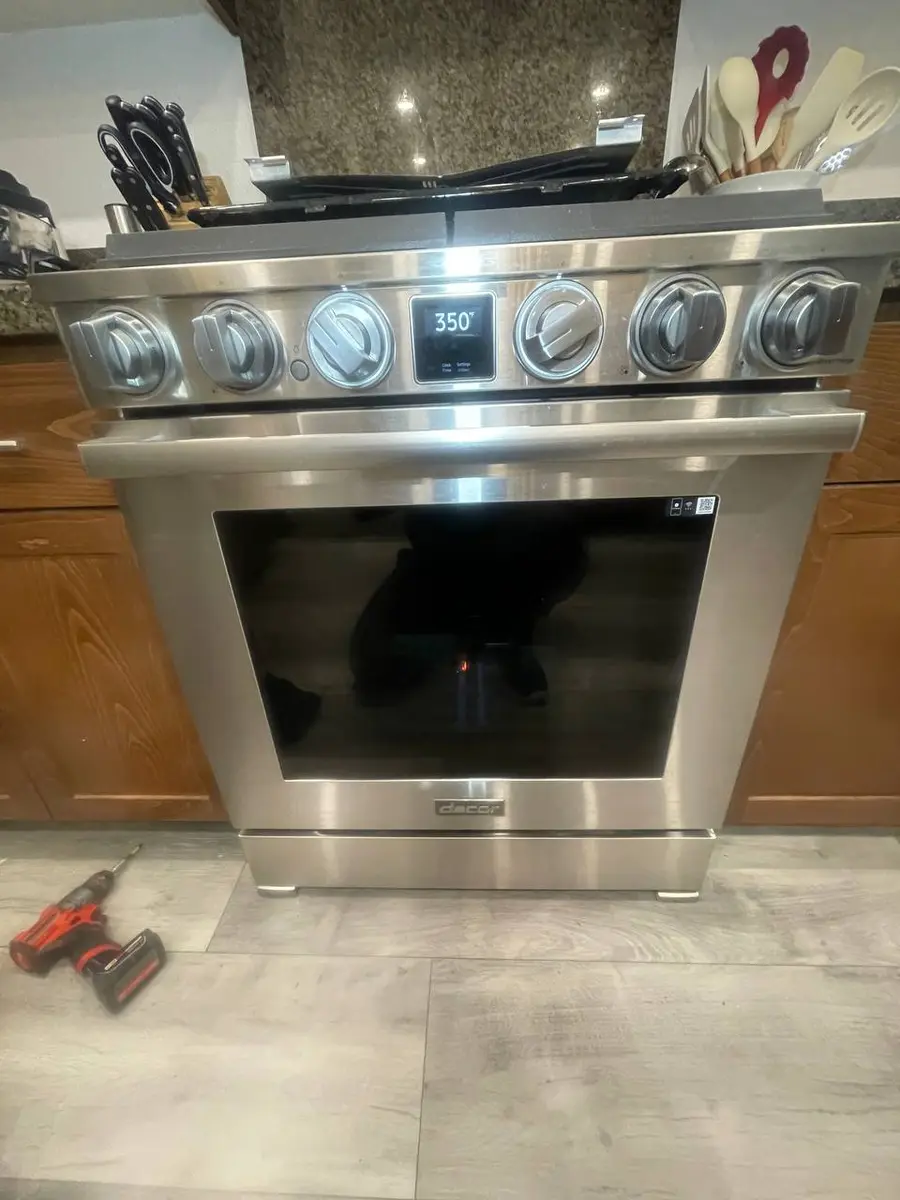
Before assuming the worst, it helps to know that on a Thermador oven this problem usually traces to a short list of brand-specific parts. Below is what actually fails on Thermador, how to check it safely, and what the repair tends to cost.
The short answer: Thermador Oven not heating#
Nine times out of ten on Thermador, not heating comes down to speed convection third heating element failure rather than the one-size-fits-all list the generic guides push. If that comes back clean, the next thing I look at is home Connect Wi-Fi module firmware desynchronization. It is a design quirk, so the usual suspects are only worth chasing once this one is ruled out. A repair here normally lands inside the $150–$400 range in the table below, set by which part has actually failed.
The failure modes below are specific to Thermador ovens — they are what set Thermador apart from the generic not heating checklist.
| Likely Thermador-specific cause | How often we see it | Typical repair |
|---|---|---|
| Speed convection third heating element failure in Masterpiece series causing prolonged preheat and uneven roasting | Most likely | $150–400 |
| Home Connect Wi-Fi module firmware desynchronization preventing remote preheat and recipe temperature profile activation | Common | $150–400 |
| SoftClose door hinge dampener failure causing the oven to register a door-open condition and block heating | Common | $150–400 |
| Steam-and-convection combination mode water pump cavitation disrupting moisture injection timing on Professional series steam ovens | Possible | $150–400 |
| Rotisserie motor drive gear stripping under heavy roast loads in Professional Grand series ovens | Possible | $150–400 |
Do You Have the Right Tools?
Combustion analyzer ($300), igniter tester ($120), temperature calibrator ($150), and gas pressure manometer. Our technician arrives with $3,000+ in professional tools — your diagnostic is free.
Licensed & Insured · 90-Day Warranty · Same-Day Service
What you can safely check first#
Run these quick checks before spending on a call-out. Safety first — unplug the oven — then take each item in turn.
- Speed convection third heating element failure. It is easy to spot once you know it is a weak point here; a worn part usually shows visible wear or play.
- Home Connect Wi-Fi module firmware desynchronization. On Thermador it is the first thing I confirm before ordering a part, since it is quick to rule in or out.
- SoftClose door hinge dampener failure. Owners miss it because the generic guides never mention it, yet it is one of the more common thermador culprits.
- Steam-and-convection combination mode water pump cavitation. If this comes back clean you have narrowed the field a lot, and the remaining suspects get easier to isolate.
- Rotisserie motor drive gear stripping under. It is the cheapest thing to check and surprisingly often the answer, so start here rather than at the control board.
- Find the model number first; across the POD301W, POD302W, MED301LWS, PRD486WDHU range the correct part varies, and ordering the wrong one is the most common home-repair mistake.
- Read the panel. A E011 or E012 or E025 or E031 code narrows things fast; note it before you clear it and hand it to your technician, as it points straight at the circuit.
Repair cost and when to call an EasyBear technician#
That $150–$400 range covers two very different jobs. At the low end sits a straightforward fix such as rotisserie motor drive gear stripping under; the high end is a deeper job that adds the part plus the labor to reach it. A confirmed diagnosis is worth more than it sounds, because it stops you paying twice for the same symptom. When the home checks come up empty, an EasyBear visit settles it fast — you pay for the right part, not three wrong ones.
Appliance Repair Technician & Diagnostics Specialist · 10 years experience
Electronics and diagnostics specialist with 10 years of experience in modern smart appliance repair, specializing in LG and Samsung.