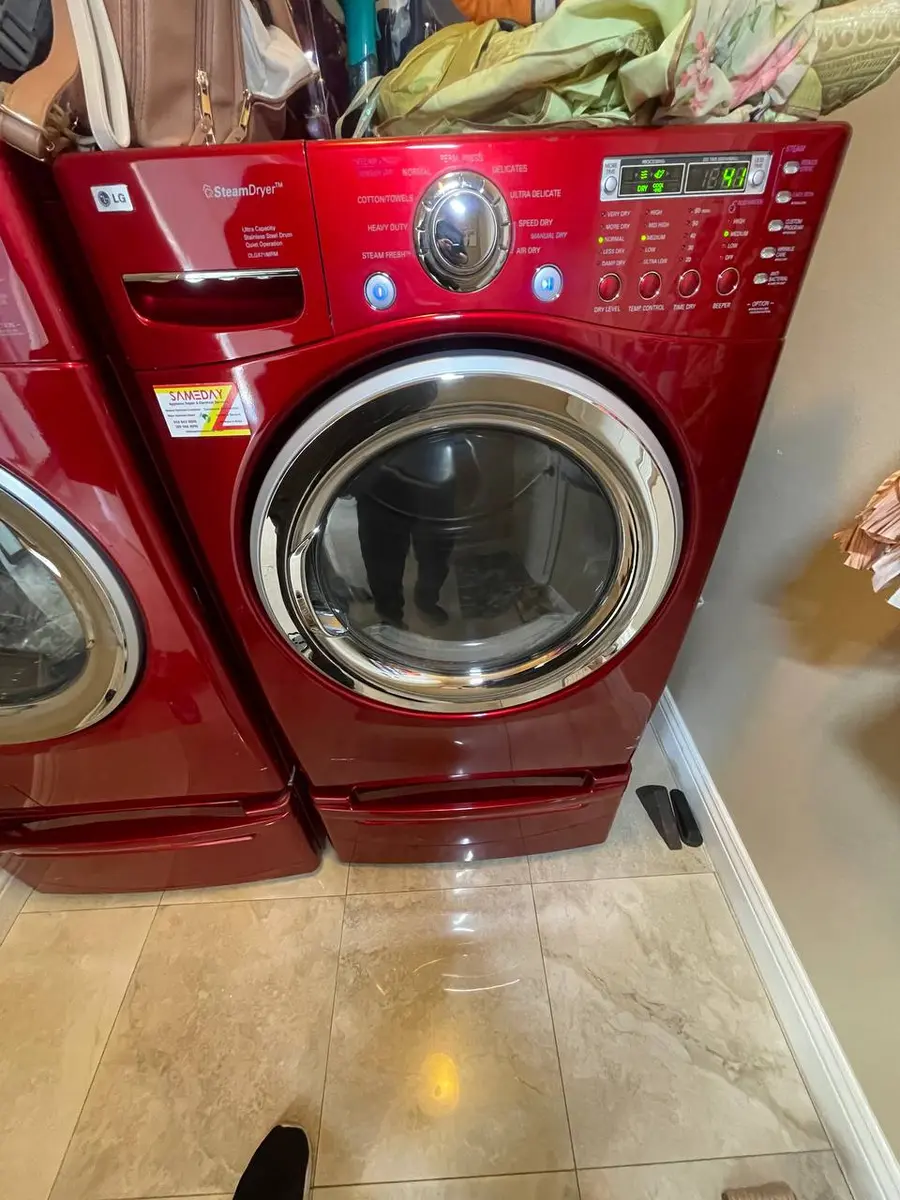
What do the LG Dryer error codes mean?
All LG dryer error codes explained with step-by-step fixes. Covers gas and electric models including d80, d90, tE1, dE, PS, nP, and more.
- d80 — 80% Exhaust Restriction
- d90 — 90% Exhaust Restriction
- d95 — 95% Exhaust Restriction
- tE1 — Thermistor Error
- dE — Door Error
- PS — Power Supply Error
LG Dryer Error Codes — Quick Reference#
| Code | Meaning | Severity | DIY? |
|---|---|---|---|
| d80 | 80% Exhaust Restriction | medium | DIY OK |
| d90 | 90% Exhaust Restriction | high | DIY OK |
| d95 | 95% Exhaust Restriction | critical | DIY OK |
| tE1(tE2, tE3) | Thermistor Error | high | Pro Only |
| dE(dE4) | Door Error | low | DIY OK |
| PS | Power Supply Error | medium | Pro Only |
| nP(nE, nP1) | No Power to Gas Valve (Gas Dryers) | high | Pro Only |
| HS | Humidity Sensor Error | medium | Pro Only |
| PF | Power Failure | low | DIY OK |
| CL | Child Lock Active | low | DIY OK |
| F1 | Exhaust Thermistor Open | high | Pro Only |
| E13 | Main Board Communication Error | high | Pro Only |
| AE | Automatic Restart Error | medium | DIY OK |
| tE4 | Drum Thermistor Error | high | Pro Only |
| FO | Filter Obstruction | medium | DIY OK |
| E6 | Inverter Motor Error | high | Pro Only |
LG Dryer Broken? Same-Day Diagnostic Available
Our certified technicians serve the Bay Area and Sacramento. Free diagnostic visit — we identify the problem, quote the repair, and fix it on the spot in most cases. No hidden fees.
Licensed & Insured · 90-Day Warranty · Same-Day Service
d80 — 80% Exhaust Restriction#
Common Causes
- Lint buildup in vent duct(common) — Over months, lint accumulates in the dryer vent duct, blocking 80% of airflow.
- Crushed flexible duct(occasional) — The foil duct behind the dryer is pushed against the wall, partially collapsing.
- Long vent run(occasional) — Vent runs over 25 feet or with multiple elbows create inherent restriction.
DIY Fix
Warning
Fire hazard: the NFPA reports dryer vent fires cause an average of $238 million in property damage annually. Clean vents at least once per year.
- Unplug the dryer (or turn off gas for gas models).
- Disconnect the vent duct from the back of the dryer.
- Use a vent brush kit to clean the entire duct run to the exterior.
- Check the exterior vent flap for blockage.
- Reconnect and run a timed dry cycle to test.
Professional Repair
Estimated Cost
$100-200
Repair Time
30-60 minutes
Professional vent cleaning is recommended for runs through walls, ceilings, or over 15 feet where DIY brush kits cannot reach effectively.
d90 — 90% Exhaust Restriction#
Common Causes
- Severely clogged vent duct(common) — Years of lint accumulation have blocked 90% of exhaust airflow, creating a serious fire hazard.
- Bird nest or debris in exterior vent(occasional) — Animals or debris have blocked the exterior vent opening.
DIY Fix
Warning
At 90% restriction, the dryer is a fire hazard. Do not use until resolved.
- Immediately stop using the dryer until the vent is cleaned.
- Disconnect the vent duct and clean the entire run with a brush kit.
- Check the exterior vent flap and remove any nests or debris.
- Consider replacing flexible foil duct with rigid metal for improved airflow.
- Run a test cycle to verify the code clears.
Professional Repair
Estimated Cost
$100-250
Repair Time
30-60 minutes
At 90% restriction, professional cleaning with commercial equipment is recommended to ensure complete clearing.
d95 — 95% Exhaust Restriction#
Common Causes
- Near-total vent blockage(common) — The vent is almost completely blocked, creating an extreme fire risk and preventing the dryer from operating safely.
DIY Fix
Warning
CRITICAL: 95% restriction is a fire emergency. The dryer must not be used until the vent is fully cleared and tested.
- DO NOT use the dryer. This is a fire emergency.
- Disconnect the vent duct and clean thoroughly.
- Inspect the entire run for crushed sections or blockages.
- Replace the duct if damaged.
- Have the exterior vent inspected for blockage.
Professional Repair
Estimated Cost
$150-300
Repair Time
60-90 minutes
At 95% restriction, professional vent replacement is strongly recommended. The existing duct may be damaged, crushed, or have multiple blockage points that require professional-grade equipment.
LG Repair Tools Required
DIY tool investment: $0+ just for basics. Our technician arrives with $15,000+ in professional tools — your diagnostic is free.
tE1 — Thermistor Error#
Common Causes
- Thermistor failure(common) — The NTC thermistor on the exhaust duct or blower housing reads open or shorted.
- Wiring issue(occasional) — The thermistor wire connector loosens from dryer vibration.
Professional Repair
Estimated Cost
$120-200
Repair Time
30-45 minutes
LG dryers typically have two thermistors. tE1 is the outlet thermistor, tE2 is the inlet, tE3 is the drum thermistor. A multimeter test confirms which one failed (should read approximately 10k ohms at room temperature).
dE — Door Error#
Common Causes
- Door not latched(common) — The dryer door is not fully closed or the latch is not engaged.
- Door switch failure(occasional) — The mechanical door switch wears out and does not register the closed position.
DIY Fix
- Open the door and check for lint or debris around the latch.
- Close the door firmly until you hear a click.
- Press Start to resume.
Professional Repair
Estimated Cost
$100-180
Repair Time
20-30 minutes
Door switch replacement requires removing the top panel of the dryer.
PS — Power Supply Error#
Common Causes
- Power board issue(common) — The internal power supply board on the dryer fails to regulate voltage correctly.
- Voltage irregularity(occasional) — Household voltage fluctuations damage the power regulation circuitry.
Professional Repair
Estimated Cost
$150-280
Repair Time
30-45 minutes
The PS error requires testing the internal power board with specialized equipment. The board must be replaced, not repaired.
Licensed & insured technicians, a free in-home diagnostic, and a 90-day repair guarantee — with our no-fix, no-fee promise, you only pay if we fix it.
nP — No Power to Gas Valve (Gas Dryers)#
Common Causes
- Gas valve coil failure(common) — One or both gas valve solenoid coils fail, preventing gas flow to the burner.
- Igniter failure(occasional) — The glow-bar igniter cracks or weakens, unable to reach ignition temperature.
- Gas supply issue(occasional) — The gas supply valve is partially closed or gas pressure is insufficient.
Professional Repair
Estimated Cost
$150-280
Repair Time
45-60 minutes
Gas dryer repairs require shutting off gas and testing components with a multimeter. The igniter should glow bright orange. If it glows but gas does not ignite, the valve coils need replacement. In our Bay Area repair data, valve coils are the most common LG gas dryer repair.
HS — Humidity Sensor Error#
Common Causes
- Humidity sensor failure(common) — The exhaust humidity sensor fails, preventing auto-dry from determining when clothes are done.
- Sensor wiring loose(occasional) — The connector to the humidity sensor vibrates loose.
Professional Repair
Estimated Cost
$120-200
Repair Time
30-45 minutes
The humidity sensor is in the exhaust path and requires panel removal to access.
PF — Power Failure#
Common Causes
- Power interruption(common) — The dryer lost power during a cycle due to a power outage or loose plug.
DIY Fix
- Press Start/Pause to resume the cycle.
- If PF appears without an actual outage, check that the plug is firmly in the outlet.
- Ensure the dryer is on a dedicated circuit.
Professional Repair
Estimated Cost
$89
Repair Time
10 minutes
PF is almost never a repair issue. If it happens frequently without power outages, have an electrician check the outlet.
DIY Risk: Wrong Diagnosis = Bigger Bill
Replacing the wrong part on your Dryer wastes money and time. A wrong diagnosis often turns a $150 repair into a $600+ problem. Our free diagnostic eliminates the guesswork.
CL — Child Lock Active#
Common Causes
- Child lock accidentally activated(common) — Someone pressed the Child Lock button combination, disabling all other buttons.
DIY Fix
- Press and hold the Child Lock button (or Dry Level + Time on some models) for 3-5 seconds.
- The CL indicator should disappear and buttons will function normally.
Professional Repair
Estimated Cost
$0
Repair Time
0 minutes
This is not an error. No repair needed.
F1 — Exhaust Thermistor Open#
Common Causes
- Exhaust thermistor burnt out(common) — The thermistor monitoring exhaust temperature has failed in the open-circuit state.
- Wiring disconnected(occasional) — The thermistor wire has come loose from the connector.
Professional Repair
Estimated Cost
$120-200
Repair Time
30-45 minutes
The exhaust thermistor is on the blower housing. A failed thermistor reads infinite resistance instead of the expected 10k ohms at room temperature.
E13 — Main Board Communication Error#
Common Causes
- Main control board failure(common) — The main PCB has a component failure affecting internal communication.
- Wiring harness issue(occasional) — The harness between the main board and UI board is damaged.
Professional Repair
Estimated Cost
$200-350
Repair Time
45-60 minutes
Both boards and the interconnect must be tested. In our Sacramento service calls, the main board is the culprit about 60% of the time.
Repair vs Replace: The Math
Most Dryer issues are fixable at a fraction of replacement cost. Our free diagnostic tells you exactly what is wrong and gives you an honest quote — no obligation.
AE — Automatic Restart Error#
Common Causes
- Power fluctuation during cycle(common) — A brief power dip caused the dryer to restart automatically.
- Loose power connection(occasional) — The dryer plug is not fully seated in the outlet.
DIY Fix
- Press Start/Pause to resume or restart the cycle.
- Check that the dryer plug is firmly seated in the outlet.
- Ensure the dryer is on a dedicated 240V/30A circuit (electric) or 120V/15A circuit (gas).
Professional Repair
Estimated Cost
$100-200
Repair Time
30 minutes
If AE occurs frequently, the power cord or terminal block may have a failing connection.
tE4 — Drum Thermistor Error#
Common Causes
- Drum thermistor failure(common) — The sensor monitoring drum temperature fails, preventing proper heat regulation.
Professional Repair
Estimated Cost
$120-200
Repair Time
30-45 minutes
The drum thermistor is inside the drum housing. Accessing it requires removing the front or rear panel of the dryer.
FO — Filter Obstruction#
Common Causes
- Lint filter clogged(common) — The lint screen is heavily clogged, restricting airflow into the drum.
- Lint filter housing blocked(occasional) — Lint has accumulated in the filter housing slot, not just on the screen itself.
DIY Fix
Warning
A clogged lint filter reduces efficiency and is a fire risk.
- Remove the lint filter and clean it thoroughly.
- Use a vacuum with a narrow attachment to clean the filter housing slot.
- Wash the filter with warm soapy water monthly to remove dryer sheet residue.
- Allow to dry completely before reinserting.
Professional Repair
Estimated Cost
$89
Repair Time
10 minutes
This is user maintenance. No professional repair needed.
LG Dryer Broken? Same-Day Diagnostic Available
Our certified technicians serve the Bay Area and Sacramento. Free diagnostic visit — we identify the problem, quote the repair, and fix it on the spot in most cases. No hidden fees.
Licensed & Insured · 90-Day Warranty · Same-Day Service
E6 — Inverter Motor Error#
Common Causes
- Inverter board failure(common) — The inverter board that controls the variable-speed motor fails, preventing the drum from spinning.
- Motor winding fault(occasional) — The inverter motor itself has a winding short or open.
Professional Repair
Estimated Cost
$200-350
Repair Time
45-60 minutes
Inverter dryers use a variable-speed motor controlled by an inverter board. Diagnosis requires testing both components. In our Bay Area repair data, the inverter board is the culprit about 70% of the time.
How to Enter LG Dryer Diagnostic Mode#
- Power on the dryer with an empty drum.
- Press and hold Temperature + Dry Level simultaneously for 3 seconds.
- The display shows test codes as the dryer enters diagnostic mode.
- The unit cycles through heater, motor, sensor, and vent tests.
- Use the LG ThinQ app for Smart Diagnosis on Wi-Fi-enabled models.
LG Smart Diagnosis (phone): call 1-800-243-0000, hold the Temp button, place phone speaker near the Power button area. The dryer sends an audio signal for remote diagnosis.
LG Repair Tools Required
DIY tool investment: $0+ just for basics. Our technician arrives with $15,000+ in professional tools — your diagnostic is free.
LG Dryer Repair Cost Guide#
| Repair | Parts | Labor | Total |
|---|---|---|---|
| Heating element replacement | $35-60 | $100-150 | $135-210 |
| Drum belt + roller replacement | $25-50 | $100-150 | $125-200 |
| Control board replacement | $100-200 | $100-150 | $200-350 |
| Gas valve coils + igniter replacement | $40-70 | $100-150 | $140-220 |
| Thermistor replacement | $10-25 | $80-120 | $90-145 |
| Door switch replacement | $10-20 | $80-120 | $90-140 |
| Professional vent cleaning | $0 | $100-200 | $100-200 |
Frequently Asked Questions#
What do LG dryer d80, d90, d95 codes mean?
These are exhaust restriction warnings unique to LG dryers. d80 = 80% blocked, d90 = 90% blocked, d95 = 95% blocked (critical fire hazard). Clean the entire dryer vent duct from the dryer to the exterior wall. In our Sacramento service calls, vent cleaning resolves these codes 95% of the time. At d95, stop using the dryer immediately.
How do I clean my LG dryer vent?
Unplug the dryer, disconnect the vent duct from the back, and use a dryer vent brush kit ($20-35) to clean the entire run to the exterior. Check the exterior flap for blockage. Replace flexible foil duct with rigid metal if possible. Based on our Bay Area repair data, annual vent cleaning prevents 85% of overheating issues and reduces drying time by 30-50%.
Why does my LG dryer take so long to dry clothes?
Long dry times are almost always caused by a partially clogged exhaust vent, even before the d80 code appears. Other causes include a dirty lint screen, overloading, and dirty moisture sensor bars. Clean the full vent run, wash the lint screen monthly with soap and water, and wipe the moisture sensor bars with rubbing alcohol.
Is LG dryer error code nP dangerous?
The nP code on gas dryers means no power to the gas valve. While the dryer will not operate, there is no active gas leak danger. The most common cause is failed gas valve coils ($140-220 total repair). Do not attempt gas dryer repairs yourself. Always have a qualified technician service gas appliances.
How do I use LG Smart Diagnosis on my dryer?
App method: open LG ThinQ app, select your dryer, tap Smart Diagnosis. Phone method: call 1-800-243-0000, hold the Temp button while placing your phone speaker near the dryer Power button. The dryer sends an audio signal that LG decodes. Smart Diagnosis identifies the error and provides a recommended fix.
Can I replace an LG dryer belt myself?
Yes, an LG dryer belt replacement is a moderate DIY project. Remove the top panel (2 screws at rear), then the front panel (4-6 screws). Thread the new belt around the drum with the ribbed side touching the drum. Loop it around the idler pulley and motor shaft. The belt and idler pulley together cost $20-40. Professional repair runs $125-200 total.
What does LG dryer CL mean?
CL means Child Lock is active. It is not an error code. Press and hold the Child Lock button (or Dry Level + Time on some models) for 3-5 seconds to deactivate. The CL indicator will disappear and all buttons will function normally.
How long do LG dryers typically last?
Based on our repair data, LG dryers average 10-14 years with proper maintenance. The most common failure points are the drum belt (5-8 years), gas valve coils (5-8 years on gas models), and heating element (6-9 years on electric). Annual vent cleaning is the single most important maintenance task for longevity.
Why is my LG dryer making squeaking noises?
Squeaking typically indicates worn drum rollers ($125-200 to replace set of 4), a worn belt ($125-200 with idler pulley), or dry drum glides ($100-150). A grinding noise may mean a foreign object is caught in the blower housing. In our experience, drum rollers are the most common noise-related LG dryer repair.
Does LG dryer PS code mean a power outage?
Not exactly. PS indicates the internal power supply board has failed, not an external outage (that would be PF). PS requires professional diagnosis and typically means the power board needs replacement ($150-280). Try unplugging for 10 minutes first, but persistent PS codes require a technician.
Licensed & insured technicians, a free in-home diagnostic, and a 90-day repair guarantee — with our no-fix, no-fee promise, you only pay if we fix it.
Lead Appliance Repair Technician · 12 years experience
Experienced technician with 12 years specializing in washing machine and dryer repairs across all major brands.