<strong>Quick answer:</strong> Induction vs Gas Cooktop: each has distinct strengths in reliability, repair cost, and longevity. See the detailed comparison below for repair data and our technician recommendation.
Induction and gas cooktops represent opposite engineering philosophies. Gas is mechanical: valves, burners, igniters, flame. Induction is electronic: coils, inverters, sensors, glass. This fundamental difference creates two completely different repair profiles. Gas breaks more often but fixes cheaply. Induction breaks rarely but costs significantly more when it does.
The Numbers#
| Factor | Gas Cooktop | Induction Cooktop |
|---|---|---|
| Service call rate (10 years) | 30-40% | 15-22% |
| Average repair cost | Varies | Varies |
| Most common repair | Igniter/spark module: Varies | Induction coil/generator: Varies |
| Lifespan | 15-20 years | 12-18 years |
| Parts availability | Excellent (universal igniters) | Limited (brand-specific modules) |
| DIY repairability | Moderate (igniter, burner cap) | Very low (electronic, sealed) |
| Glass top replacement | N/A (grates are metal) | Varies |
Do You Have the Right Tools?
Multimeter ($85), vacuum pump ($250), diagnostic software, and specialized hand tools. Our technician arrives with $15K+ in professional tools — your diagnostic is free.
Licensed & Insured · 90-Day Warranty · Same-Day Service
Gas Cooktop: Simple Mechanics, Frequent Small Repairs#
Spark Igniter System#
Every gas cooktop burner has a spark igniter — a ceramic electrode that creates an arc to light the gas. The spark module (a single unit powering all igniters) sends high-voltage pulses when any burner knob is turned. Common failures:
Click but no spark on one burner: The igniter electrode is cracked, the gap is too wide (corrosion), or the wire from the spark module to that igniter has failed. Fix: replace the individual igniter electrode (varies by model part, varies by model). Every technician carries these.
Continuous clicking (won't stop sparking): Moisture in the igniter switch or a shorted spark module. This often happens after a boil-over or cleaning with too much water. Fix: dry out the switches (24-48 hours with burners off) or replace the spark module (varies by model part, varies by model).
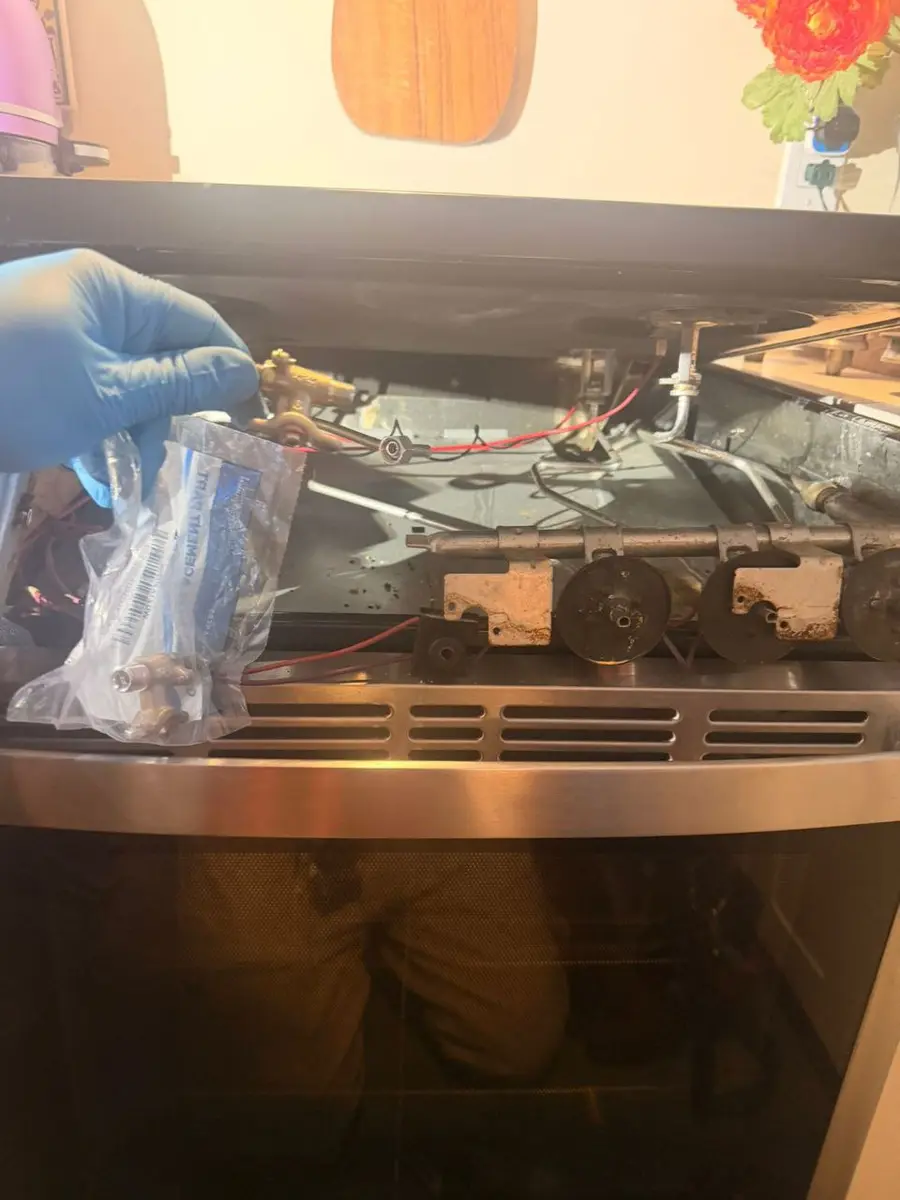
No click on any burner: Spark module failure. The module is usually accessible under the cooktop surface (lift the top on freestanding ranges, or access from below on built-in cooktops). Fix: replace spark module, varies by model.
Burner Valve Issues#
Gas cooktop valves control gas flow to each burner. They rarely fail completely but can develop:
- Sticking: The valve shaft seizes from grease/food intrusion. Lubrication may fix temporarily; replacement varies by model and condition per valve.
- Flame irregularity: Burner ports clog from food spills. Cleaning with a pin or needle brush restores proper flame. Not a true "repair" but a common service call (varies by model diagnostic/cleaning).
- <a href="https://www.cpsc.gov/Safety-Education/Safety-Guides/General-Information/Carbon-Monoxide-Information-Center" rel="nofollow noopener" target="_blank">Gas leak</a> at valve stem: The valve packing (O-ring or graphite seal) wears, allowing gas to seep around the knob shaft. Detectable by gas odor when the burner is off but the knob is in the "off" position. This is a safety issue requiring immediate valve replacement.
Thermocouple (Standing Pilot Models)#
Older and some commercial-style gas cooktops use standing pilot lights instead of electronic igniters. The thermocouple keeps the gas valve open by sensing pilot heat. Thermocouple replacement: varies by model, universal parts available.
Induction Cooktop: Rare Failures, Expensive Parts#
How Induction Works (Repair Implications)#
An induction cooktop does not produce heat directly. Each cooking zone contains a copper coil (the induction generator) that creates an alternating magnetic field. This field induces electrical currents in ferromagnetic cookware, which heats the pan. The glass surface never gets hot from the cooktop itself — only from contact with the heated pan.
Repair implications:
- No combustion = no igniters, valves, or gas lines to service
- No exposed elements = nothing to clean, no moving parts in the cooking zones
- All failures are electronic = specialized diagnostic equipment and brand-specific replacement modules
- Glass surface is structural and functional = a crack ends the cooking zone's life
Induction Coil (Generator) Failure#
Each cooking zone has its own induction generator module — a coil assembly with an integrated power board. When a zone stops working:
- Zone shows an error code (typically E1, E3, or Er on the display)
- Zone does not detect cookware (even known-compatible ferromagnetic pots)
- Zone heats inconsistently or shuts off mid-cooking
The generator module is a sealed electronic assembly. It cannot be repaired in the field — it is replaced as a unit. Cost: varies by model for the part, varies by model with labor. Each module is specific to the brand and zone size (a 6-inch zone module is not interchangeable with a 9-inch zone module on the same cooktop).
Parts availability is the bottleneck. Unlike gas igniters (which are universal across brands), induction modules are brand-specific. A Bosch NITP068UC induction generator must come from BSH parts distribution. Lead time: 3-10 business days. Samsung and LG induction modules have similar lead times. During the wait, that cooking zone is unusable.
Control Board Failure#
The main control board manages power distribution, touch controls, timer functions, and safety lockout. Control board failures present as:
- Touch controls unresponsive
- All zones dead simultaneously
- Random error codes on multiple zones
- Child lock engages and cannot be disengaged
Control board replacement: varies by model. Like generator modules, boards are brand and model-specific. Some Bosch induction cooktops share boards across model years, improving parts availability. Samsung and LG do not.
Glass Top Damage#
The glass-ceramic surface (Schott Ceran or equivalent) is remarkably heat-resistant but vulnerable to impact and point pressure. A cast-iron pan dropped corner-first from 6 inches can crack the surface. Common damage scenarios:
- Dropped cookware (most common)
- Sliding heavy cast-iron pans (scratches that can propagate to cracks)
- Thermal shock from placing frozen items on a hot zone (rare, but we have seen it)
- Expansion stress if the cooktop frame is overtightened during installation
A cracked glass is non-negotiable — the cooktop must be taken out of service. Moisture penetrating the crack reaches the high-voltage induction coils below, creating a shock and short-circuit risk. Glass replacement cost: varies by model including labor. The glass assembly includes the coils, sensors, and adhesive backing — it is not just a piece of glass.
Power Supply Issues#
Induction cooktops draw significant power — a 36-inch four-zone model can pull 40+ amps at full power. Voltage fluctuations, brownouts, or inadequate wiring can cause:
- Random shutoffs under heavy load (multiple zones at max power)
- Error codes related to overcurrent protection
- Blown internal fuses
These are not cooktop failures per se, but they generate service calls. The technician must test the electrical supply before diagnosing the cooktop. If the home circuit is undersized (a 30-amp circuit feeding a 40-amp cooktop), no component replacement will solve the problem — the electrical panel needs upgrading (varies by model for an electrician to add a proper circuit).
Same-Day Appliance Repair
Fixed or It's Free
Free Service Call & Diagnosis — no hidden fees, offer ends Jun 10
Safety First — Know the Risks
Appliances involve high voltage (120-240V), pressurized water, gas lines, and chemical refrigerants. Over 400 DIY repair injuries are reported yearly. Our techs are licensed and insured — let them handle the risk.
Licensed & Insured · 90-Day Warranty · Same-Day Service
The DIY Factor#
Gas cooktop repairs are among the most DIY-accessible appliance repairs:
- Igniter electrodes: accessible, inexpensive, universal
- Burner caps and grates: remove, clean, replace
- Spark module: accessible, plug-and-play
- Flame adjustment: knob removal and air shutter adjustment
Induction cooktop repairs are among the least DIY-accessible:
- All components are under the sealed glass surface
- Electronic modules require brand-specific diagnostic codes to identify the failed zone
- High voltage (up to 240V, high-frequency AC) inside the unit
- Replacing the glass surface requires precise positioning and adhesive application
- A misdiagnosed zone replacement (varies+ wasted) is an expensive mistake
What Is the Total Cost of Ownership Comparison (15 Years)?#
| Category | Gas | Induction |
|---|---|---|
| Purchase price | Varies | Varies |
| Expected repairs | 2-4 repairs, Varies total | 1-2 repairs, Varies total |
| <a href="https://www.energy.gov/energysaver/appliances-and-electronics" rel="nofollow noopener" target="_blank">Energy cost</a> (annual) | Varies | Varies |
| Total 15-year cost | Varies | Varies |
The gas cooktop has a lower total cost of ownership in most scenarios. The induction cooktop's energy efficiency partially offsets its higher purchase and repair costs, but not enough to close the gap at current energy prices.
<p>Our technicians' field observations align with this conclusion — induction and gas cooktops represent opposite engineering philosophies..</p>Not sure which type you have or need help with a repair? EasyBear technicians service every cooktop configuration. Book your diagnostic appointment today and we will handle the rest.
Appliance Repair Technician · 11 years experience
Experienced technician with 11 years specializing in Frigidaire and Electrolux refrigerator and dryer repair with a focus on safety.