How to Replace LG Range Oven Temperature Sensor
An LG oven that will not heat (often an F9 code), overheats, or bakes at the wrong temperature usually has a failed temperature sensor. It is one of the simplest oven repairs — one screw and one connector. Cut power, meter the sensor at room temperature (a healthy one reads about 1080-1100 ohms at 70F), unscrew the…
The sensor is a thin metal RTD probe about 5-7 inches long that protrudes into the oven cavity from the upper rear wall, and when it fails you see the oven not heating (F9 or similar code), overheating (it reads low, so the board keeps heating), or significant temperature inaccuracy. LG ovens, including ProBake Convection models, use a single sensor, and it involves only one mounting screw and one wire connector.
Tools, Parts, and Safety First#
- Tools needed: Phillips #2 screwdriver, multimeter (for testing), work gloves
- Parts needed: LG oven temperature sensor for your model (varies by model)
- Time required: 10-15 minutes
- Difficulty: Beginner
- Safety warning: Turn off the oven and allow it to cool completely. Disconnect power by unplugging or turning off the breaker. The sensor itself carries no dangerous voltage, but the wire harness connects to the control board which is powered by 120V.
Do You Have the Right Tools?
Combustion analyzer ($300), igniter tester ($120), temperature calibrator ($150), and gas pressure manometer. Our technician arrives with $3,000+ in professional tools — your diagnostic is free.
Licensed & Insured · 90-Day Warranty · Same-Day Service
Step-by-Step Instructions#
Step 1 — Test the existing sensor#
Confirm the sensor is the problem before replacing it. With power off, reach the sensor's wire connector either inside the oven (follow the probe to where it exits the rear wall) or from behind the range (rear panel to the wire junction). Set the meter to resistance: at room temperature (70F), a healthy LG oven sensor reads about 1080-1100 ohms, and a reading well off that — OL, 0 ohms, or far from 1090 — confirms failure.
Step 2 — Locate the sensor inside the oven#
Open the oven door. The probe extends from the upper rear wall, usually upper-left or upper-center — a thin metal tube about 1/4 inch in diameter, mounted with a single screw at its base bracket where it enters the wall. On LG ProBake models, do not confuse it with the meat-probe receptacle (if fitted), which sits elsewhere.
Step 3 — Remove the mounting screw#
Remove the single Phillips screw holding the sensor bracket to the inside of the oven rear wall; the probe is now free to pull through. On some LG models there is also a small retaining clip to squeeze before the sensor slides out.
Step 4 — Pull the sensor through the wall#
Gently pull the probe forward and out of the rear wall, and the wire follows it through a rubber grommet. From outside (rear of the range), disconnect the wire connector — on most LG models a 2-pin plug near where the wire exits the cavity — by pressing the locking tab and pulling apart.
Step 5 — Connect the new sensor wire#
Plug the new sensor's connector into the same junction point; it is keyed and only fits one way, so push until the locking tab clicks.
Step 6 — Feed the new sensor through the wall#
From outside the oven, feed the new probe through the grommet hole into the cavity, then from inside pull it through until the mounting bracket sits flush against the wall.
Step 7 — Secure with the mounting screw#
Reinstall the Phillips screw through the bracket into the oven wall. The probe should extend horizontally into the cavity without touching the racks, walls, or food, and sit away from direct element radiation (not directly in front of or above an element) for an accurate ambient reading.
Step 8 — Test and calibrate#
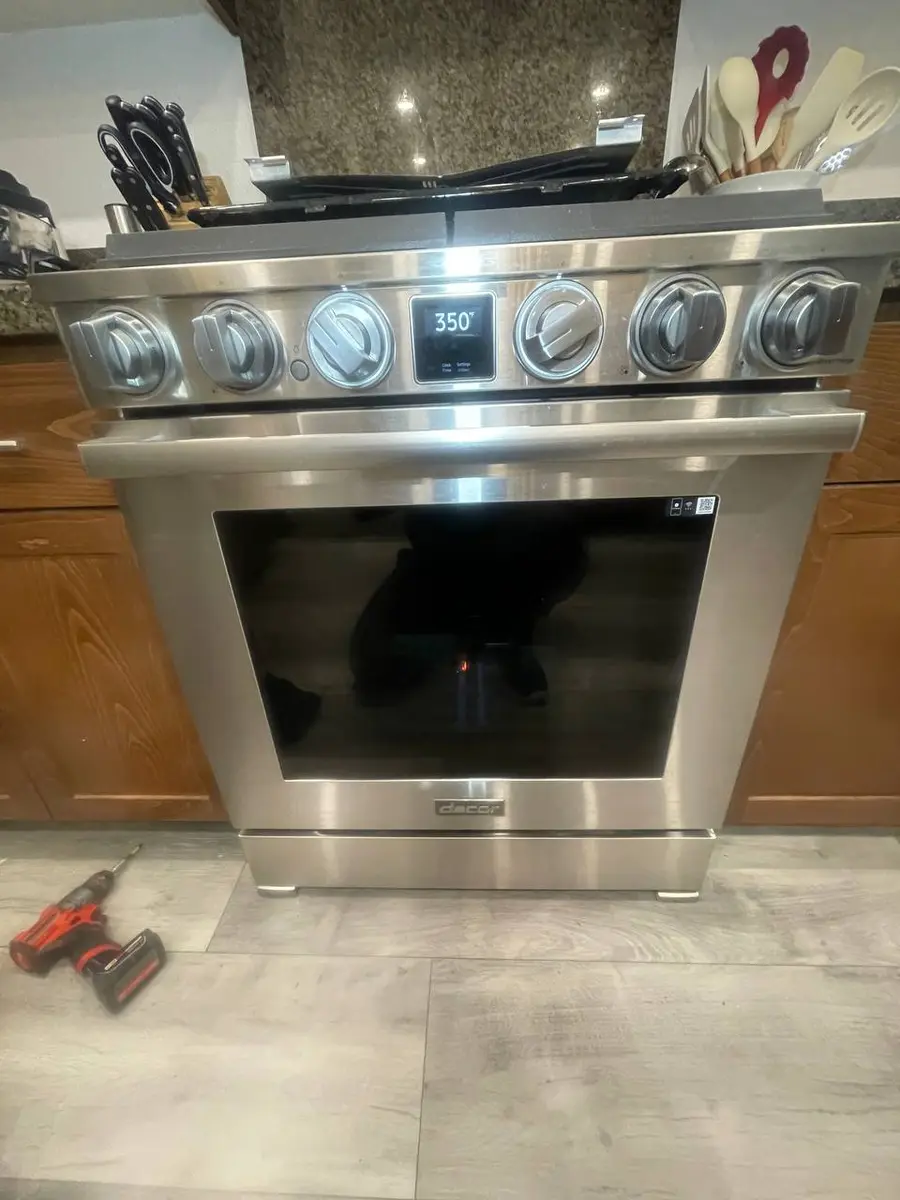
Restore power and set the oven to 350 degrees F, then use an independent oven thermometer on the center of the middle rack to check accuracy. LG ovens allow a calibration offset through the control panel (typically by holding the Bake button or via the settings menu), so adjust in plus-or-minus 5-degree increments until the thermometer matches the setting, allowing 20-30 minutes of stable operation before each adjustment.
Troubleshooting Common Issues#
- Error code persists after replacement: perform a hard reset (unplug 5 minutes) so the board clears the stored error; if it stays, the board's sensor-reading circuit may be at fault.
- Oven overheats after replacement: verify the new sensor read 1080-1100 ohms at 70F before installation, since an incorrect sensor value makes the board misread temperature.
- Consistently off by the same amount: use the built-in calibration offset rather than replacing the sensor again, since sensor-to-sensor manufacturing variation can account for 5-15 degree differences.
- New sensor wire too short to reach the connector: do not splice — order the correct model-specific sensor with the proper wire length.
- On ProBake models: verify EasyClean and self-clean modes reach their target temperatures after replacement, since they rely on accurate sensor feedback for cycle duration and door-lock timing.
- New sensor reads fine but baking is still off: the sensor position matters as much as the part — if the probe is touching a rack or sitting too close to an element, it reads a false local temperature, so reposition it to sit freely in the cavity air.
Safety First — Know the Risks
Gas ovens involve live gas lines — a loose connection creates explosion and carbon monoxide risk. Electric ovens run on 240V circuits. Our techs are licensed and insured — let them handle the risk.
Licensed & Insured · 90-Day Warranty · Same-Day Service
When Should You Call a Professional?#
EasyBear technicians serving Sacramento and the Bay Area carry LG-specific diagnostic tools and replacement parts on every service call. Call one if error codes persist after replacement and a reset (the board's sensor-input circuit may need diagnosis), if the oven consistently reads wrong temperatures and the calibration offset cannot compensate (a second problem like a failing element, insulation, or board), or if the wire grommet in the rear wall is damaged or missing (which lets oven heat escape to the wiring area and needs proper thermal isolation).
Need Professional Help?#
Need help with this repair? Schedule a free diagnostic — same-day LG stove service across the Bay Area.
Appliance Repair Technician & Diagnostics Specialist · 10 years experience
Electronics and diagnostics specialist with 10 years of experience in modern smart appliance repair, specializing in LG and Samsung.