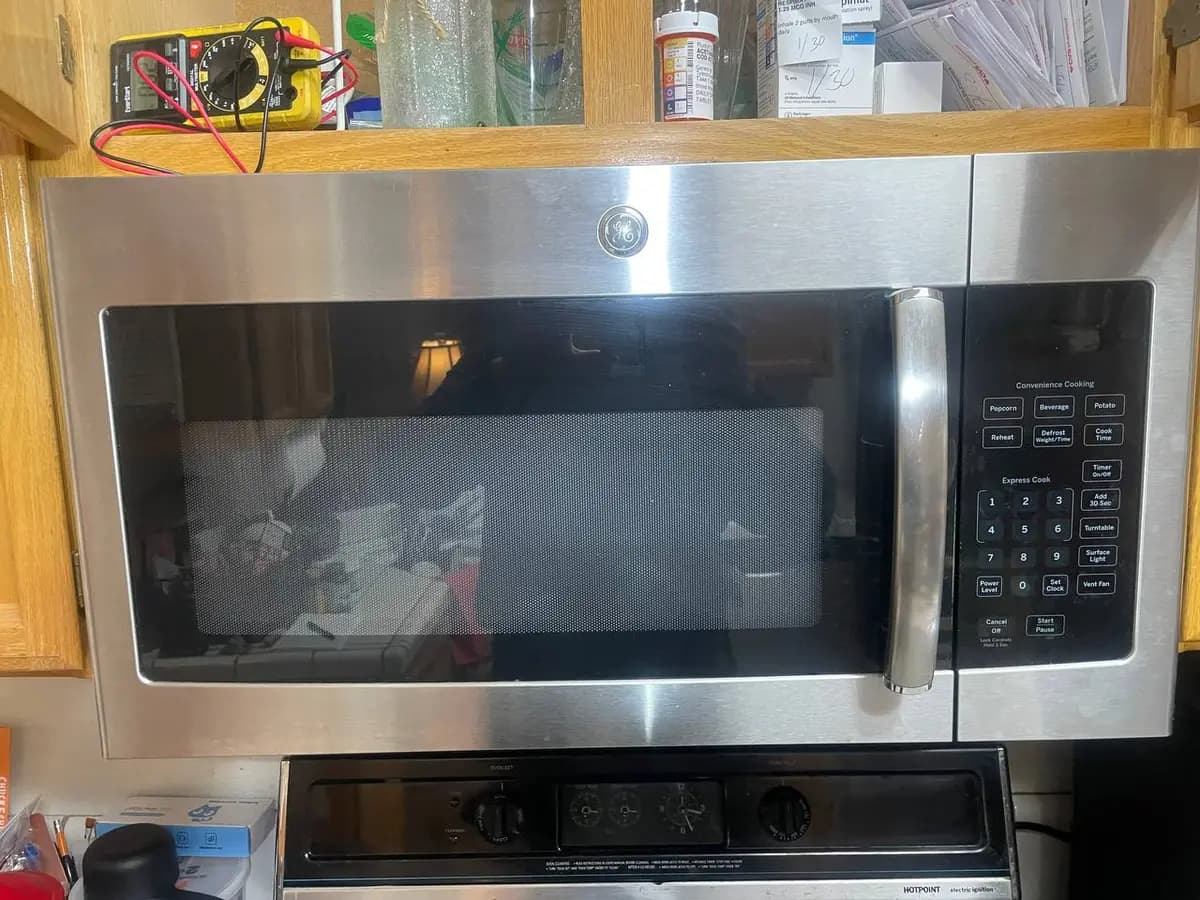
How to Replace a GE Microwave Capacitor
A GE microwave that buzzes loudly with no heat, or drops dead the moment it starts because the fuse let go, is usually telling you the high-voltage capacitor has failed. Swapping it takes about 30 to 45 minutes, but it is an advanced repair for one reason: the capacitor can store a fatal charge long after the cord is…
Reading the symptoms first#
GE builds its over-the-range and countertop ovens around the same voltage-doubling circuit, where the capacitor pairs with the high-voltage diode to lift the transformer output high enough to run the magnetron. Two failure modes cover almost every case. An open capacitor kills the doubling, so you get a hard transformer buzz and cold food. A shorted capacitor dumps current straight through the line fuse, so the oven trips instantly and stays dark. Before you commit to the swap, rule out a simply blown fuse and a shorted magnetron, because both mimic these signs.
Safety warning: Unplug the microwave. CRITICAL: The high-voltage capacitor inside can hold a LETHAL charge. Discharge it and prove zero volts on a meter before any tool touches a terminal, keep one hand clear, and never bridge both terminals with your fingers.
What you need#
| Category | Detail |
|---|---|
| Tools | Phillips #2 and Torx T20 drivers, multimeter, insulated capacitor-discharge tool, insulated pliers, safety glasses |
| Part | Microwave-duty capacitor sized to your GE model, around 0.95 microfarads and rated for the high-voltage circuit near 2,100 volts |
| Time and level | 30 to 45 minutes, Advanced (lethal stored charge) |
GE prints the exact figure on the cavity tech sheet; match it rather than guessing, because the value sets the doubling ratio.
Do You Have the Right Tools?
High-voltage capacitor discharge tool ($90), magnetron tester ($200), microwave leakage detector ($150). Our technician arrives with $3,000+ in professional tools — your diagnostic is free.
Licensed & Insured · 90-Day Warranty · Same-Day Service
Doing the swap#
1 - Open the cabinet and find the parts. With the oven unplugged, remove the rear screws (GE uses Phillips or Torx T20) and slide the wrap back. Identify the transformer, the big cylindrical capacitor, the diode and the magnetron before you reach in.
2 - Kill the stored charge. This is the step that keeps you alive. Lay an insulated discharge tool across both capacitor terminals, holding only the insulated grip; expect a crack as it dumps. Then set a meter to DC volts across the terminals and watch for a true zero. Nothing else happens until that reads zero.
3 - Confirm the capacitor, not the magnetron. Lift one lead. On a capacitance meter the part should read near its label; on an analog ohmmeter the needle should swing up and fall back toward infinity. A needle that never moves is open, one that sits low is shorted — both mean replace.
4 - Unhook and pull it. Photograph the wiring, slip the spade terminals off with insulated pliers, release the retaining strap, and lift the old capacitor out.
5 - Drop in the new one. Set it the same way round, press the spades fully onto the terminals, and make sure no lead is pinched between the can and the chassis.
6 - Reassemble and prove heat. Refit the cabinet, put a cup of water inside and run it 60 seconds on high. A solid temperature rise confirms the doubler is healthy again. If the fuse blows the instant you test, stop and check the magnetron for a short instead of feeding it another fuse.
If the oven still will not cook#
- Fuse blows again on the first run: the magnetron is likely shorted to ground — test it before fitting another capacitor.
- Weak heat only: the fresh capacitor is delivering, but an aging magnetron is running out of output.
- Dead panel after the repair: check the ceramic line fuse, a 20 amp part near the power-cord entry, which GE drops when a door switch fails or a surge hits.
- Arcing noises on restart: a lead is riding too close to the chassis or a spade is loose — unplug immediately.
Safety First — Know the Risks
Microwave capacitors store lethal voltage (4,000V+) even when unplugged. This is the single most dangerous DIY appliance repair. Our techs are licensed and insured — let them handle the risk.
Licensed & Insured · 90-Day Warranty · Same-Day Service
When to hand it over#
Call a technician if the fuse keeps failing after a new capacitor (a shorted magnetron or transformer), if the control board shows scorch marks, if you cannot confirm zero volts after discharging, or if you are simply not comfortable within reach of a part that stores a lethal charge. GE Profile ovens with speed-cook systems add a further wrinkle that is best left to a pro.
Senior Gas Appliance Specialist · 18 years experience
AGA-certified gas appliance specialist with 18 years of experience in residential and commercial oven, range, and cooktop repairs.