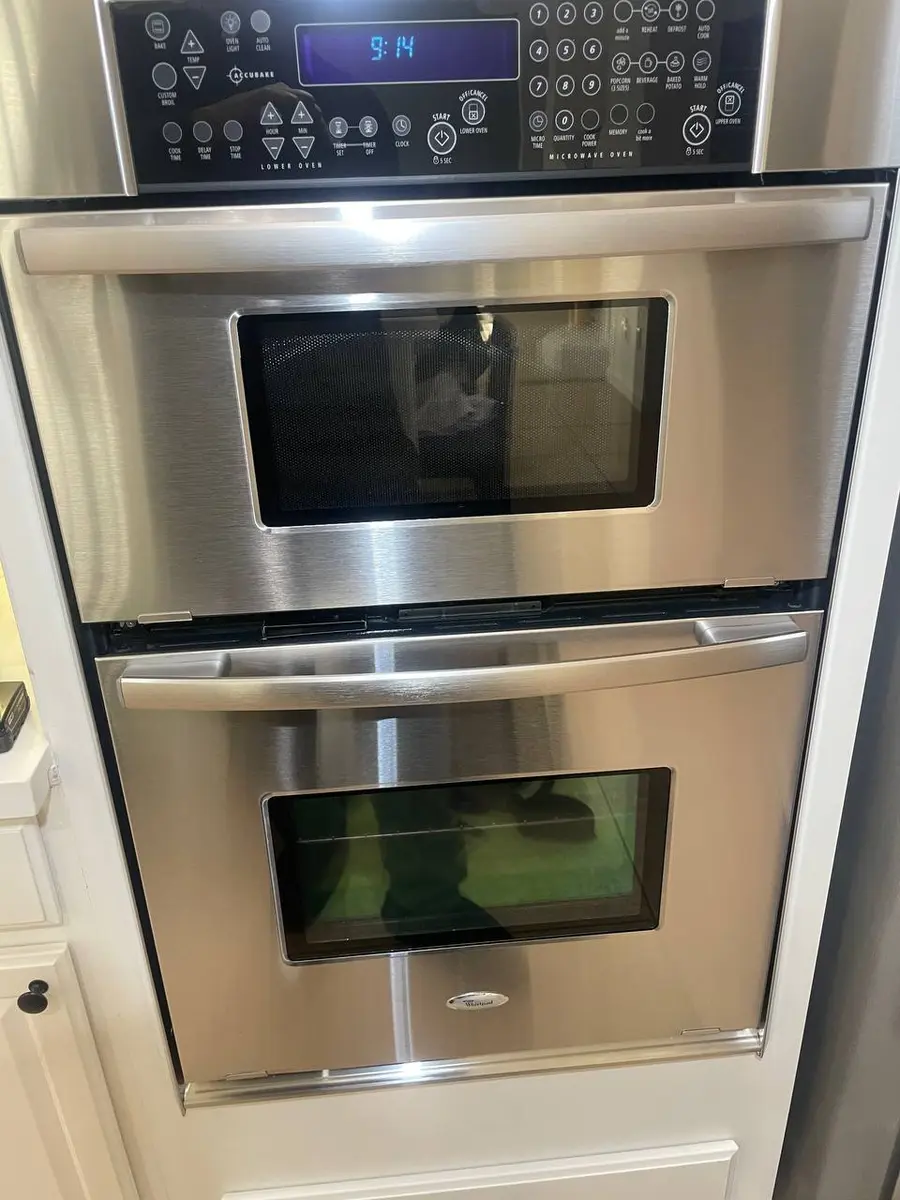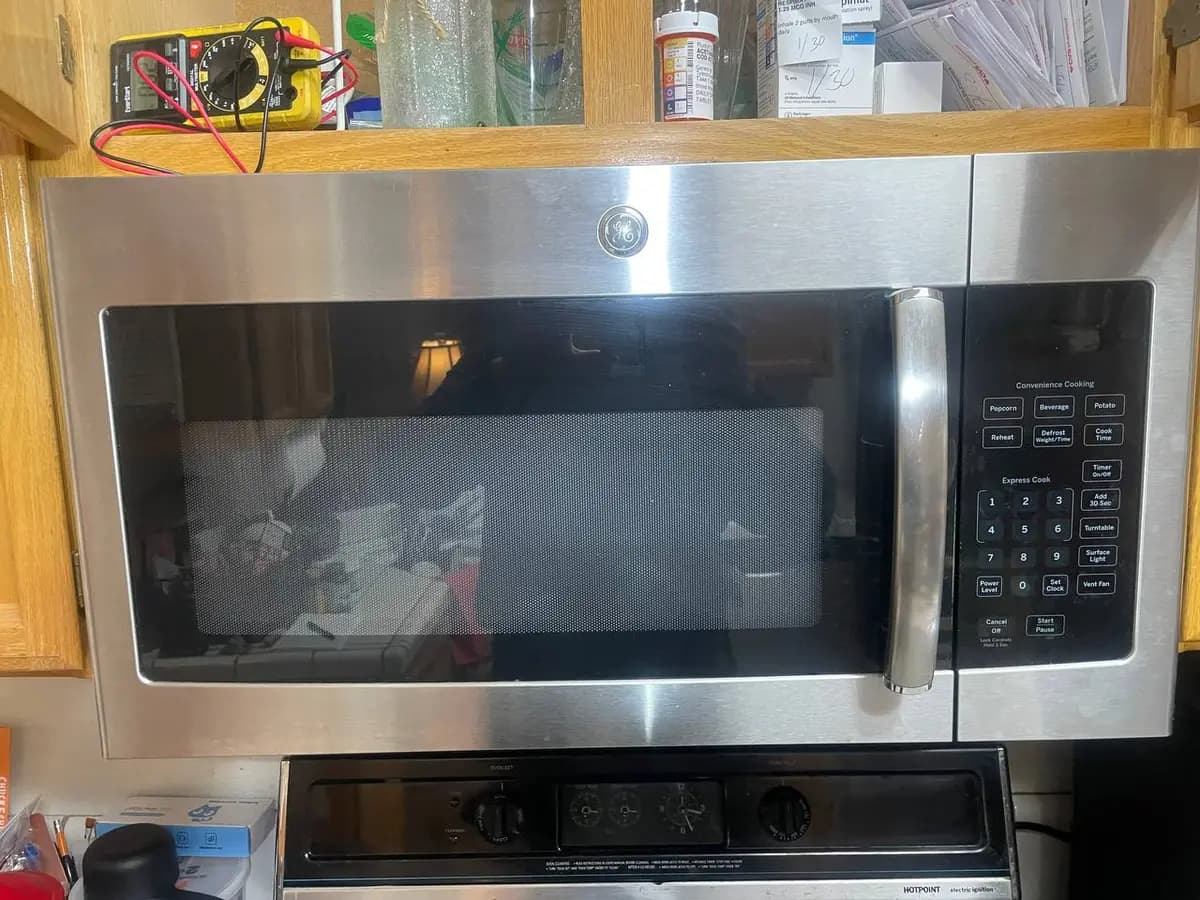
GE microwaves — Over-the-Range (OTR), countertop, and built-in models — use an electronic control board to manage magnetron power, turntable operation, ventilation fan speed, and cooking programs. When the control board detects a component failure or safety fault, it stops operation and displays an error code. This guide covers every GE microwave error code with real part numbers, diagnostic steps, and repair costs.
The sensor is behind most of it, and manual still works#
F3 is the most common GE microwave error code, and it is a sensor reading rather than a broken oven. That distinction matters: it decides whether you are cooking tonight while a part is on order.
| What it is doing | What that means | What to do now |
|---|---|---|
| F3 on the display | the humidity sensor or the temperature thermistor is reading outside its expected range — the most common GE microwave code there is | clean the sensor first. It is the small disc on the ceiling or upper wall of the cavity, and a grease film is enough to stop it reading moisture change. Damp cloth, mild dish soap, the surrounding area too. |
| It keeps prompting for food, or auto-cook will not run | the auto-cook and auto-defrost programs are what use those sensors to decide when food is done | the same clean. This is the sensor doing exactly what a saturated or coated sensor does, and it has nothing to do with the magnetron. |
| F3 appeared right after boiling water or steaming vegetables | the sensor is temporarily saturated rather than failed | open the door and let it air out for 15 minutes, then close and retry. Cooking uncovered puts far more steam past the sensor than cooking covered does. |
| Auto-cook fails but timed cooking works perfectly | the sensor is at fault and nothing else is | keep using manual timed mode while the replacement part comes. This is the row that saves you a week of takeaway, and it is the most common real-world F3 outcome. |
| F3 survives a clean and an airing | the thermistor itself | measure it from outside — behind the control panel on over-the-range models, or a small access panel. Around 50,000 ohms at room temperature is healthy for the NTC thermistors GE uses; open or near-zero means it has failed. |
| F1 on the display | the control board cannot talk to the touchpad, or failed its own self-test | unplug for 60 seconds first, since a transient glitch often clears there. Then check whether specific buttons feel mushy or need excessive pressure, which is a degraded membrane, and reseat the ribbon cable between touchpad and board. |
| You want the codes the microwave has already stored | GE keeps them, and there are two ways in | hold 0 for 5 seconds on most models to enter Service Mode, press 1 to scroll through stored faults, Stop/Cancel to exit. On WiFi Connect models, SmartHQ reports the same thing under Appliance Health. |
| You are about to open the case | stop | the high-voltage capacitor stores a lethal charge up to 4,000 volts even when the microwave is unplugged. Every diagnostic above is external or low-voltage on purpose — the high-voltage compartment is not a homeowner job at any skill level. |
| F5 on the display | the door switches disagree with each other, or the board cannot confirm the door is closed | GE uses three door switches as redundant safety interlocks, so F5 means one is contradicting the others. This is a safety system reporting correctly and it is not a code to work around. |
| F2 on the display | the magnetron or the cavity has exceeded its safe temperature and the unit shut itself down | a thermal cutoff, not a nuisance code — it fires to prevent component damage and fire. Check that nothing is blocking ventilation before assuming a part, and do not keep restarting it. |
| F9 on an over-the-range model | the exhaust fan is not reaching speed, or not running when the board calls for it | this one is exclusive to over-the-range units because they carry the range ventilation. Grease-laden filters are worth ruling out before the motor. |
| F4 on the display | the humidity sensor is reading infinite resistance — an open circuit | this is F3 next of kin with a sharper meaning: F3 is out of range, F4 is disconnected. Check the sensor connection before buying the sensor, because a dislodged connector produces exactly this. |
| The microwave will not start at all while a code is showing | that is deliberate on this platform | most GE microwave codes lock the unit out until the fault clears — you cannot begin a cooking cycle with an active code. So a microwave that refuses to start is often reporting rather than broken, and the code is the thing to read first. |
| You are trying to clear a code on an over-the-range or built-in unit | there is no plug to pull | Stop/Cancel first. If the code returns, cut the breaker for 60 seconds rather than hunting for a cord — a mounted unit is wired in, and that is the equivalent of the 60-second unplug a countertop model gets. |
| You need to reach the thermistor and cannot find it | where it lives depends on the format | on over-the-range models it is typically behind the control panel; on other formats it is behind a small access panel. Either way it is reachable from outside the high-voltage compartment, which is why it is one of the few components on this page you may measure yourself. |
| The code returns the instant power comes back | the component has failed rather than glitched | a transient fault clears on the 60-second cut. One that reappears immediately on restore is the board reporting a real, present failure — stop cycling the power and read the code section for that fault. |
| You are wondering why three switches watch one door | they are independent, and all three must agree | triple door interlocks are the reason F5 exists as a code at all: if any one switch fails, the magnetron cannot energise and the microwave will not start. That is the safety design working, not a fault to bypass. |
| F2 cleared, then came back | look for the thermal cutoff fuses | fuses sit near the magnetron and the high-voltage transformer and permanently break the circuit past safe temperature. Once blown they do not reset — they are replaced, and a repeat F2 is the reason to find out why the temperature got there. |
| You are weighing whether to call at all | this appliance answers that differently from the rest of the kitchen | the capacitor holds a lethal charge for hours after the plug is out, so almost every internal GE microwave repair is a professional one. The external and low-voltage checks above are deliberately the whole of what this page asks you to do yourself. |
Nineteen rows, five of them F3 in different disguises, because the humidity sensor is genuinely behind most GE microwave complaints and it presents as at least four distinguishable symptoms — the code itself, the food prompt, post-steam saturation, and auto-cook failing while manual works. Two rows are the diagnostic entry points GE provides, and the last is the line no row crosses. The 50,000 ohm figure is GE own NTC thermistor value and the 4,000 volt figure is the capacitor charge this guide warns about, not a category estimate.
Do You Have the Right Tools?
High-voltage capacitor discharge tool ($90), magnetron tester ($200), microwave leakage detector ($150). Our technician arrives with $3,000+ in professional tools — your diagnostic is free.
Licensed & Insured · 90-Day Warranty · Same-Day Service
How GE Microwave Error Codes Work#
GE microwaves display error codes as alphanumeric combinations on the LED/LCD panel. The control board monitors the magnetron, high-voltage capacitor circuit, humidity sensor, temperature thermistor, door switches, and turntable motor. Most GE microwave error codes lock out the unit until the fault is cleared — you cannot start a cooking cycle with an active error code.
Critical safety warning: Microwaves contain a high-voltage capacitor that stores a lethal charge (up to 4,000 volts) even when unplugged. Never attempt to service internal high-voltage components unless you are a trained technician with proper discharge tools. The troubleshooting steps in this guide focus on safe, external diagnostics and low-voltage components that do not require opening the high-voltage compartment.
SmartHQ diagnostics (WiFi models): Newer GE OTR and built-in microwaves with WiFi Connect can report error codes and usage data to the SmartHQ app. Open the app, select your microwave, and tap "Appliance Health."
Service Mode entry: Press and hold the 0 button for 5 seconds on most GE models. The display enters diagnostic mode showing stored fault codes. Press 1 to scroll through codes. Press Stop/Cancel to exit.
Basic reset procedure:
- Press Stop/Cancel to clear the current error.
- If the error returns, unplug the microwave (or flip the breaker for OTR/built-in models) for 60 seconds.
- Restore power. If the code returns immediately, the component has failed.
F3 — Humidity Sensor / Temperature Sensor Error#
The F3 code is the most common GE microwave error code. It indicates the humidity sensor or temperature thermistor is reading outside the expected range. GE microwaves use these sensors for auto-cook and auto-defrost programs to determine when food is done.
Common causes:
- Humidity sensor contamination from grease and food splatter (the sensor is inside the cooking cavity)
- Thermistor failure — open or shorted element
- Wiring harness between sensor and control board damaged
- Excessive steam from cooking without a cover (the sensor gets saturated)
- Sensor board failure (on models with a separate sensor board)
How to fix:
- Clean the sensor: The humidity sensor is a small disc mounted on the ceiling or upper wall of the microwave cavity. Use a damp cloth with mild dish soap to clean the sensor surface and surrounding area. Grease film blocks the sensor's ability to detect moisture changes accurately.
- Ventilate and retry: If F3 appeared during a high-steam cooking cycle (boiling water, steaming vegetables), open the microwave door and let it air out for 15 minutes. The sensor may be temporarily saturated. Close the door and try again.
- Test the thermistor: Access the thermistor from the outside (typically behind the control panel on OTR models, or behind a small access panel). Measure resistance: expect approximately 50,000 ohms (50k) at room temperature for NTC thermistors used in GE microwaves. Open (infinite) or near-zero readings mean the thermistor has failed.
- Bypass test for auto-cook: If F3 appears only during auto-cook or auto-defrost cycles but the microwave works fine in manual (timed) mode, the sensor is at fault. You can continue using manual cooking modes while waiting for the sensor replacement part.
Part cost: Humidity sensor varies by model and repair complexity. Thermistor varies by model and repair complexity. Professional repair varies by model and repair complexity.
Safety First — Know the Risks
Microwave capacitors store lethal voltage (4,000V+) even when unplugged. This is the single most dangerous DIY appliance repair. Our techs are licensed and insured — let them handle the risk.
Licensed & Insured · 90-Day Warranty · Same-Day Service
F1 — Control Board / Touchpad Error#
The F1 code indicates the control board has detected a communication fault with the touchpad panel or an internal self-test failure.
Common causes:
- Touchpad membrane failure from age, moisture, or heat exposure
- Control board internal fault (microcontroller error)
- Ribbon cable between touchpad and control board damaged or loose
- Power surge damage to the control board components
How to fix:
- Power cycle: Unplug the microwave for 60 seconds. F1 from a transient glitch often clears with a full power cycle.
- Inspect the touchpad: If specific buttons feel different (mushy, non-responsive, or require excessive pressure), the touchpad membrane has degraded. On OTR models, the touchpad is part of the front panel assembly; on countertop models, it is often a separate overlay.
- Check the ribbon cable: On OTR and built-in models, remove the outer casing (screws along the top and sides). Locate the ribbon cable between the touchpad and the control board. Reseat the connector. Check for heat damage or corrosion.
- Isolate the fault: Disconnect the touchpad ribbon cable and restore power. If F1 clears, the touchpad has failed. If F1 persists with the touchpad disconnected, the control board itself has an internal fault.
Part cost: Touchpad membrane varies by model and repair complexity. Control board varies by model and repair complexity. Professional repair varies by model and repair complexity.
F5 — Door Switch Error / Door Sensing Failure#
The F5 code means the control board cannot confirm the door is properly closed, or the door switch signals are contradictory (one switch says open, another says closed). GE microwaves use multiple door switches (typically 3) as redundant safety interlocks.
Common causes:
- Door not fully latched — food debris or warped door preventing full closure
- Faulty door switch (part varies by model — typically WB24X10047 or equivalent)
- Misaligned door latch hook — the metal hook that engages the door switches
- Wiring issue between door switches and control board
- Door hinge worn or bent, preventing proper alignment
How to fix:
- Clean the door latch area: Wipe food debris from the door edges, latch hooks, and switch contact points. Even small amounts of dried food can prevent the latch from fully engaging.
- Check door alignment: Close the door slowly and watch the latch hooks engage the switch mechanisms. The hooks should insert smoothly and the door should sit flush with the frame. If the door is misaligned, check the hinges for wear or bending.
- Test door switches: This requires removing the outer casing — proceed only if you are comfortable working with microwave components (with the unit unplugged and the high-voltage capacitor discharged). GE microwaves typically have three door switches: a primary (monitor) switch, a secondary switch, and an interlock switch. Each should have definitive continuity when the door is closed and open when the door is open. A switch that reads open in both positions has failed.
- Check the door latch hooks: The metal hooks that engage the switches can bend or wear down. If the hooks do not fully depress the switch plungers, the switches report "door open" even when closed.
Part cost: Door switch (WB24X10047) varies by model and repair complexity each. Door latch hook varies by model and repair complexity. Professional repair varies by model and repair complexity.
Warning: GE microwaves will not operate if any door switch is malfunctioning — this is an intentional safety design to prevent microwave radiation leakage. Do not bypass or tape door switches under any circumstances.
The Real Cost of DIY
Average DIY attempt: $150-400 in tools you may use once, plus the risk of further damage. Our diagnostic visit costs $0 — we find the problem and give you an honest quote.
Licensed & Insured · 90-Day Warranty · Same-Day Service
F2 — Over-Temperature / Magnetron Thermal Cutoff#
The F2 code indicates the magnetron or cavity temperature has exceeded the safe threshold. The microwave shuts down to prevent component damage and potential fire.
Common causes:
- Blocked ventilation — OTR microwaves need clear ventilation paths above and behind the unit
- Running the microwave empty (no food or liquid to absorb microwave energy — this reflects energy back into the magnetron, overheating it)
- Ventilation fan failure (part varies by model)
- Magnetron cooling duct blocked by grease buildup
- Extended high-power operation without pause (heating heavy items for 15+ minutes continuously)
How to fix:
- Let it cool down: After F2 appears, the microwave needs 15–30 minutes to cool before it will allow restarting. This is a thermal lockout.
- Check ventilation: For OTR microwaves, verify the ventilation duct is not blocked. Check the charcoal or aluminum mesh grease filters on the bottom of the unit — clogged filters restrict airflow. Clean the aluminum filters in hot soapy water; replace charcoal filters (they cannot be cleaned).
- Test the ventilation fan: Start the microwave and select the exhaust fan. Listen for the fan motor. If the fan does not spin, check for obstructions. If clear but the motor does not run, it has failed.
- Never run empty: Microwave energy with no food to absorb it reflects back to the magnetron, causing rapid overheating. Always have food or at least a cup of water inside when running.
- Check the magnetron cooling duct: On OTR models, a metal duct channels cooling air from the fan across the magnetron. Grease buildup inside this duct restricts airflow. Clean during annual maintenance.
Part cost: Grease filter (WB06X10309) varies by model and repair complexity. Charcoal filter (WB02X11544) varies by model and repair complexity. Ventilation fan motor varies by model and repair complexity. Professional repair varies by model and repair complexity.
F9 — Exhaust Fan Error (OTR Models)#
The F9 code appears on GE Over-the-Range microwaves when the exhaust fan fails to reach the expected speed or does not run when called for by the control board.
Common causes:
- Fan motor failure — the motor has seized or the winding has failed
- Fan blade obstructed by grease accumulation or foreign object
- Fan motor capacitor failure (on capacitor-start motors)
- Control board relay failure — the fan relay does not energize
How to fix:
- Check the fan manually: With the microwave on, press the exhaust fan button. Listen for the motor starting and feel for air movement at the top vent. If no sound and no air movement, the motor or its power supply has failed.
- Clean the fan blade: Unplug the microwave. For OTR models, remove the unit from the wall bracket to access the fan housing on top. Remove the fan housing cover and check for grease buildup on the fan blades and housing. Heavy grease can cause the motor to seize.
- Test the fan motor: With the housing open, try spinning the fan blade by hand. It should turn freely. If seized, the motor bearings have failed. Measure motor winding resistance — expect 50–200 ohms depending on the motor type. Open reading means the winding has failed.
- Check the capacitor: Some GE OTR exhaust fans use a start/run capacitor. A failed capacitor causes the motor to hum but not spin. Test the capacitor or replace it (varies by model and region).
Part cost: Fan motor varies by model and repair complexity. Fan blade varies by model and repair complexity. Motor capacitor varies by model and repair complexity. Professional repair varies by model and repair complexity.
Don't Void Your Warranty
Opening your appliance yourself may void the manufacturer warranty. Our repair comes with a 90-day guarantee, and we document everything for warranty compliance.
Licensed & Insured · 90-Day Warranty · Same-Day Service
Additional GE Microwave Error Codes Quick Reference#
- F4 — Humidity sensor open circuit. The humidity sensor reads infinite resistance. Check sensor connection first; replace sensor if disconnected. Part cost varies by model and region. Related to F3 but specifically indicates an open circuit rather than out-of-range reading.
- F6 — Relay board error. The high-voltage relay that controls magnetron power is not functioning. Professional repair required — do not attempt to access the high-voltage section.
- F7 — Touchpad key stuck. Similar to F1 but the control board has identified a specific stuck key. Clean the touchpad surface and check for moisture behind the membrane. Replace the touchpad if the stuck key persists.
- PF — Power failure. The microwave lost power during cooking. Press Stop/Cancel to clear, then restart your cooking program.
- LOC / LOCK — Control lock active. Not an error. Press and hold the Clear/Off button for 3 seconds (or the Lock button if equipped) to deactivate.
- SHO / SHRT — Shorted key or sensor. The control board detected a short circuit in a sensor or input circuit. Power cycle first; if persistent, professional diagnosis is required.
Microwave Safety Basics#
GE microwaves are designed with multiple safety systems:
- Triple door interlock switches — Three independent switches must all confirm the door is closed before the magnetron can energize. If any switch fails, the microwave will not start (F5 code).
- Thermal cutoff fuses — Fuses near the magnetron and high-voltage transformer that permanently break the circuit if temperatures exceed safe limits. Once blown, they must be replaced (they do not reset).
- High-voltage capacitor — Stores energy for the magnetron. This capacitor retains a lethal charge for hours after the microwave is unplugged. Only qualified technicians should access the high-voltage compartment.
Is It Worth Your Time?
Microwave repair requires specialized testing of the magnetron, capacitor, diode, and transformer — each requiring specific safety procedures. Our technician diagnoses the issue in about 30 minutes — same-day appointments available.
Licensed & Insured · 90-Day Warranty · Same-Day Service
Frequently Asked Questions#
Q: How do I reset my GE microwave after an error code? A: Press Stop/Cancel to clear the display. If the code returns, unplug the microwave (or flip the breaker for OTR/built-in models) for 60 seconds and restore power. For thermal codes (F2), wait an additional 15–30 minutes for cool-down before the unit will allow restarting. If the code returns immediately after a full power cycle, the component has failed.
Q: Why does my GE OTR microwave show F3 when I boil water? A: Boiling water generates intense steam that saturates the humidity sensor. This is the most common trigger for the F3 code. Cover liquids with a microwave-safe lid or plate to reduce steam exposure to the sensor. After the F3 event, open the door and let the microwave cavity air out for 15 minutes before retrying. If F3 appears consistently even with covered food, the humidity sensor lens needs cleaning or the sensor has degraded.
Q: My GE microwave runs but does not heat food. Is there an error code for this? A: A microwave that runs (turntable spins, lights on, timer counts) but does not heat usually indicates a magnetron failure, high-voltage diode failure, or high-voltage capacitor failure. These failures may not generate an error code on all models. This is not a DIY repair — the high-voltage components carry lethal voltage. Call a professional technician for diagnosis.
Q: Are GE microwave parts covered by warranty? A: GE provides a 1-year full parts and labor warranty. The magnetron has a 5-year limited warranty (parts only, labor not included after year 1) on most GE models. The cavity interior (rust-through) has a 5-year limited warranty on select models. No extended warranty applies to the control board, touchpad, or door switches beyond year 1 without a GE Protection Plan.
Q: Is it worth repairing an old GE microwave, or should I replace it? A: For countertop microwaves a certain threshold most repairs a certain threshold make replacement more economical. For OTR and built-in models ($300–significant cost for the unit plus installation), repair is usually worthwhile unless the magnetron has failed on a unit over 8 years old. The magnetron repair alone runs varies by model and region and at that age other components are also near end-of-life.
When to Call a Professional#
Most GE microwave repairs should be performed by a professional. Unlike other appliances, microwaves contain high-voltage components that store lethal charges:
- Any code related to heating (F2, F6) — Involves the high-voltage section.
- Microwave runs but does not heat — Magnetron, diode, or capacitor failure. All high-voltage components.
- Burning smell from the microwave — Could indicate a transformer, capacitor, or wiring failure. Unplug immediately.
- Sparking inside the cavity — Usually caused by damaged waveguide cover, metallic residue, or arcing from a failing magnetron. Stop using immediately.
- F5 after door switch replacement — If new switches do not resolve F5, the interlock wiring or control board has failed. Improper interlock wiring can create a safety hazard.
- Any code on built-in or OTR models — These units require removal from the wall or cabinet for most repairs, adding complexity and weight (OTR models weigh 50–80 lbs).
The only safe DIY troubleshooting for microwaves involves external components: cleaning the humidity sensor, replacing grease/charcoal filters, cleaning the door latch area, and testing door closure. All internal work should be performed by a qualified technician.
Tired of dealing with GE microwave error codes? EasyBear's certified technicians specialize in GE microwave repair — Over-the-Range, countertop, and built-in models. We offer free diagnostic visits — our tech will identify the exact cause, explain your options (repair vs. replace), and complete the repair on the spot in most cases. Every repair is backed by our 90-day parts and labor warranty. Schedule your free diagnosis today.
Q: Why does my GE microwave keep saying Food? A: The humidity sensor cannot read the moisture change it needs to. That sensor is a small disc on the ceiling or upper wall of the cavity, and a grease film from splatter is usually enough to blind it — clean it with a damp cloth and mild dish soap. If the prompt appeared right after boiling water or steaming, the sensor may just be saturated: air the cavity out for 15 minutes and retry.
Q: Can I keep using the microwave while F3 is showing? A: In most cases yes, on manual timed cooking. F3 is a sensor reading, and the sensors are what auto-cook and auto-defrost use to decide when food is done — so if timed cooking works normally and only the automatic programs fail, the sensor is the sole fault and the rest of the oven is fine. Use manual mode while the part is on order.
Appliance Repair Technician & Diagnostics Specialist · 10 years experience
Electronics and diagnostics specialist with 10 years of experience in modern smart appliance repair, specializing in LG and Samsung.