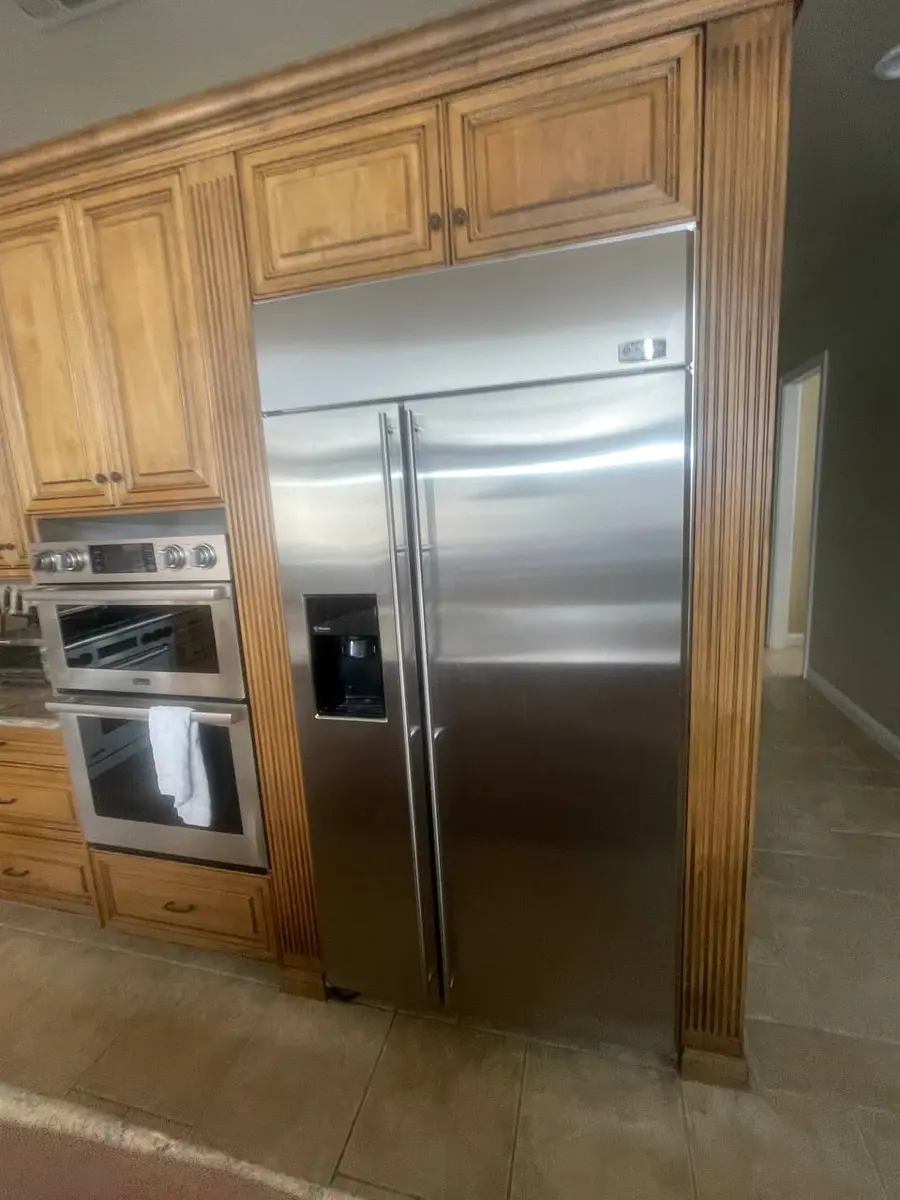
Maytag Refrigerator Door Sweating? Causes & Fix
Most likely high indoor humidity is condensing on the cool door surface — but a failed anti-sweat heater, an Energy Saver setting that disabled those heaters, or a leaking door gasket can each leave the door damp, so rule out humidity and the Energy Saver switch before opening anything up.
Normal condensation versus a fault#
A little sweat on humid days or right after long door-open time is normal. It becomes a fault when the door stays wet in ordinary conditions. Maytag counters everyday condensation with low-wattage anti-sweat heaters in the door frame and center mullion; when humidity spikes, those heaters fail, or a setting shuts them off, moisture wins and beads on the surface.
Causes at a glance#
| Likely cause | What you'll notice | Share of cases | First move |
|---|---|---|---|
| High indoor humidity | Sweat only on damp days | 35% | Run a kitchen exhaust fan |
| Failed anti-sweat heater | Persistent frame condensation | 25% | Test the anti-sweat heater |
| Energy Saver disabling heaters | Sweat after enabling the setting | 15% | Turn Energy Saver off |
| Door gasket air leak | Damp plus frost near a bad seal | 15% | Inspect and reseat the gasket |
| Interior condensation | Moisture inside on shelves | 10% | Check cooling and door seals |
Do You Have the Right Tools?
Refrigerant gauges ($200+), vacuum pump ($250), leak detector ($150), and EPA-certified recovery equipment. Our technician arrives with $3,000+ in professional tools — your diagnostic is free.
Licensed & Insured · 90-Day Warranty · Same-Day Service
Working through the causes#
High indoor humidity (35%). Seasonal humidity, common through Sacramento's winter rains, raises the moisture indoors and it condenses on the cool door. Running the kitchen exhaust fan while cooking and running the dishwasher pulls that humidity out at the source and often settles light sweating on its own. Failed anti-sweat heater (25%). Maytag models with anti-sweat heaters use low-wattage resistance elements, typically 5 to 15 watts each, embedded in the door frame and mullion to keep those surfaces just above the dew point. When a heater fails open, its stretch of the frame sweats persistently and the heater is tested and replaced. Energy Saver disabling heaters (15%). Some Maytag models have an Energy Saver switch that turns the anti-sweat heaters off to save power. With it on in a humid kitchen, the door sweats. Switch Energy Saver off during damp weather and the heaters resume. Door gasket air leak (15%). A gasket that no longer seals lets humid room air stream past the cold frame on its way into the cabinet, condensing as it goes and often frosting near the leak. Clean the gasket, reseat it, and replace it if it is torn or deformed. Interior condensation (10%). Moisture forming inside on walls or shelves points to warm air entering faster than the system can handle it — usually a seal or a cooling issue rather than the door heaters. Check the seals and cooling if the sweat is on the inside.
How to sort it out#
- Note whether the sweat tracks with humid weather or is constant regardless.
- Check whether an Energy Saver switch or setting is on, and turn it off during damp spells.
- Run the kitchen exhaust fan while cooking to cut the moisture load.
- Feel the door frame — a cold, wet stretch that should be slightly warm points to a dead anti-sweat heater.
- Do the dollar-bill test on the gasket to find a spot that no longer grips.
Safety First — Know the Risks
Refrigerant (R-134a/R-600a) requires EPA certification to handle. Improper discharge is a federal violation and health hazard. Our techs are licensed and insured — let them handle the risk.
Licensed & Insured · 90-Day Warranty · Same-Day Service
Preventing a repeat#
- Run the kitchen exhaust fan while cooking and running the dishwasher to remove humidity at the source.
- Leave the Energy Saver switch off whenever the room is humid so the anti-sweat heaters stay active.
- Wipe and inspect the door gaskets regularly so a small leak does not grow.
- Do not leave the doors open longer than needed on humid days.
Door still sweating? Our technicians service Maytag refrigerators same-day across Sacramento and the Bay Area. Book your repair.
Lead Appliance Repair Technician · 12 years experience
Experienced technician with 12 years specializing in washing machine and dryer repairs across all major brands.