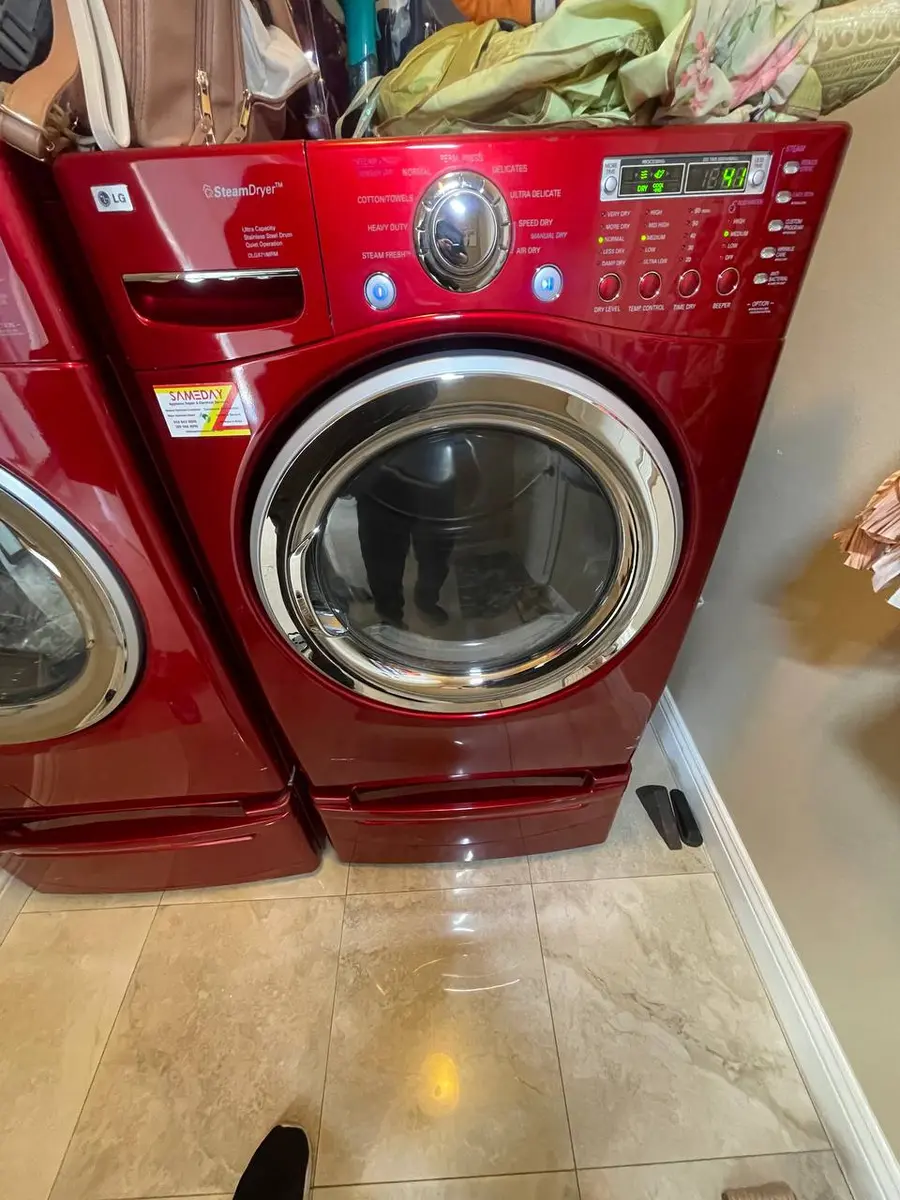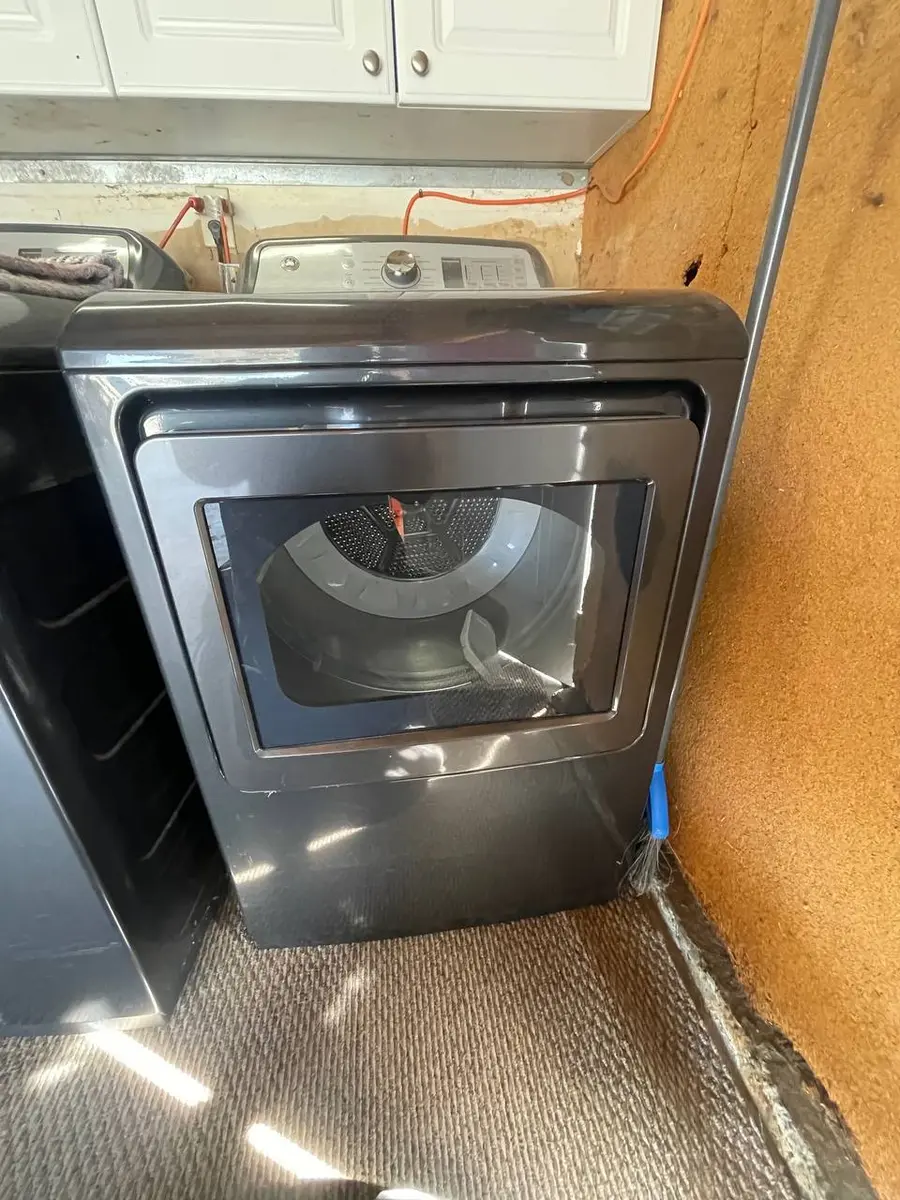
"Not draining" means two different things on an LG dryer depending on which kind you own. A heat-pump model collects the water it pulls from your clothes and can fail to drain it — usually a full tank, a blocked hose, a clogged condenser filter, or a dead condensate pump. A vented model has no drain at all, so water inside it points to condensation or over-wet loads instead.
First: Heat-Pump or Vented?#
This split decides your entire diagnosis. LG's heat-pump dryers, the DLHX series, are ventless — they condense the moisture out of your laundry into liquid water and route it to a removable tank or a plumbed drain, so they genuinely have a drainage system that can clog or fail. LG's vented dryers, the DLEX, DLE, and DLGX lines, blow that moisture outside as warm air and never collect water on purpose. So if you have a vented LG and you're seeing water, you are not looking at a failed drain — you are looking at condensation or a load that arrived soaked. Identify your model before you chase a part that your dryer may not even have.
Do You Have the Right Tools?
Gas leak detector ($130), thermal fuse tester ($95), belt tension gauge, and vent inspection camera ($180). Our technician arrives with $3,000+ in professional tools — your diagnostic is free.
Licensed & Insured · 90-Day Warranty · Same-Day Service
How a Heat-Pump LG Handles Its Water#
Before diagnosing a DLHX, it helps to picture where the water goes. Warm, humid air off your clothes passes through a condenser that cools it below its dew point, and the liquid that drips out collects in a sump at the base. From there a small pump lifts it up into the removable tank you empty by hand, or pushes it out through a hose to a plumbed drain. That's four points where the flow can stall — the tank, the hose, the condenser filter that keeps lint out of the works, and the pump — and every heat-pump drainage complaint is a blockage or failure at one of them. Knowing the path turns a vague "not draining" into a short checklist you can walk from the tank outward.
Heat-Pump Models: Why the Water Won't Leave#
Drain tank full (about 40%)#
The most common and simplest cause. On a DLHX using the removable tank rather than a plumbed drain, a tank that fills and isn't emptied leaves nowhere for new condensate to go, and the dryer stops. Empty the tank, and if you'd rather stop thinking about it, connect the unit to a direct drain so it empties itself. Make emptying the tank the first thing you check.
Blocked drain hose (about 30%)#
On a plumbed install, the condensate hose from the dryer to the drain can kink behind the machine or clog with lint and scale, so the water backs up. Pull the dryer out enough to check the hose for a pinch, disconnect it, and flush it clear; replace it if the inside is crusted. Like the tank, this is often a no-parts fix — just clear the path.
Condenser lint filter clogged (about 20%)#
Heat-pump dryers have an extra filter guarding the condenser, and when it packs with lint the airflow and water handling both suffer, leaving moisture that doesn't reach the drain path cleanly. Rinse the condenser filter on the schedule your model specifies — this filter is easy to overlook because vented dryers don't have one, and a neglected one is a frequent hidden cause.
Condensate pump failure (about 10%)#
The small pump that lifts water from the sump to the tank or drain can fail, and then the water simply sits with nowhere to go. Listen for the pump during a cycle; silence when it should run points at a dead pump motor, which gets replaced rather than cleaned. This is the least common of the four but the one most likely to need a part.
Safety First — Know the Risks
Gas dryers carry carbon monoxide and explosion risk. Even electric dryers involve 240V circuits that can deliver a fatal shock. Our techs are licensed and insured — let them handle the risk.
Licensed & Insured · 90-Day Warranty · Same-Day Service
Vented Models: Water Where There Shouldn't Be Any#
Because a DLEX, DLE, or DLGX vents moisture outdoors, water inside or beneath it is not a drainage failure — it's condensation or excess load water. A long or cold vent run lets humid exhaust condense on the duct walls and drip back toward the dryer, and a blocked or sagging vent makes it worse by trapping moisture instead of expelling it. Clothes that arrive dripping because the washer's spin was weak also read as unexplained water once they warm. So on a vented LG, inspect the vent duct for blockage, sags that pool condensate, and a cold uninsulated run, and check that the washer is spinning clothes to merely damp — not the dryer's drain, because it doesn't have one.
Keep It Draining Freely#
- Empty the heat-pump tank on a regular cadence, or plumb it to a direct drain so it never backs up.
- Rinse the condenser filter on schedule — it's the filter vented-dryer owners never had to think about.
- Leave slack in the drain hose and check it for kinks whenever you move the machine.
- On a vented dryer, keep the exhaust duct short, sloped, and clear so moisture leaves instead of condensing back.
Related reading: an LG dryer with weak heat and an LG dryer that takes too long.
LG [dryer repair](/bay-area/services/dryer-repair) across [Sacramento](/sacramento/sacramento) and the Bay Area — tank, pump, and vent diagnostics in one visit. Book a technician.
Senior Appliance Repair Technician · 15 years experience
EPA-certified technician with 15 years of experience specializing in refrigerator and cooling system repairs.