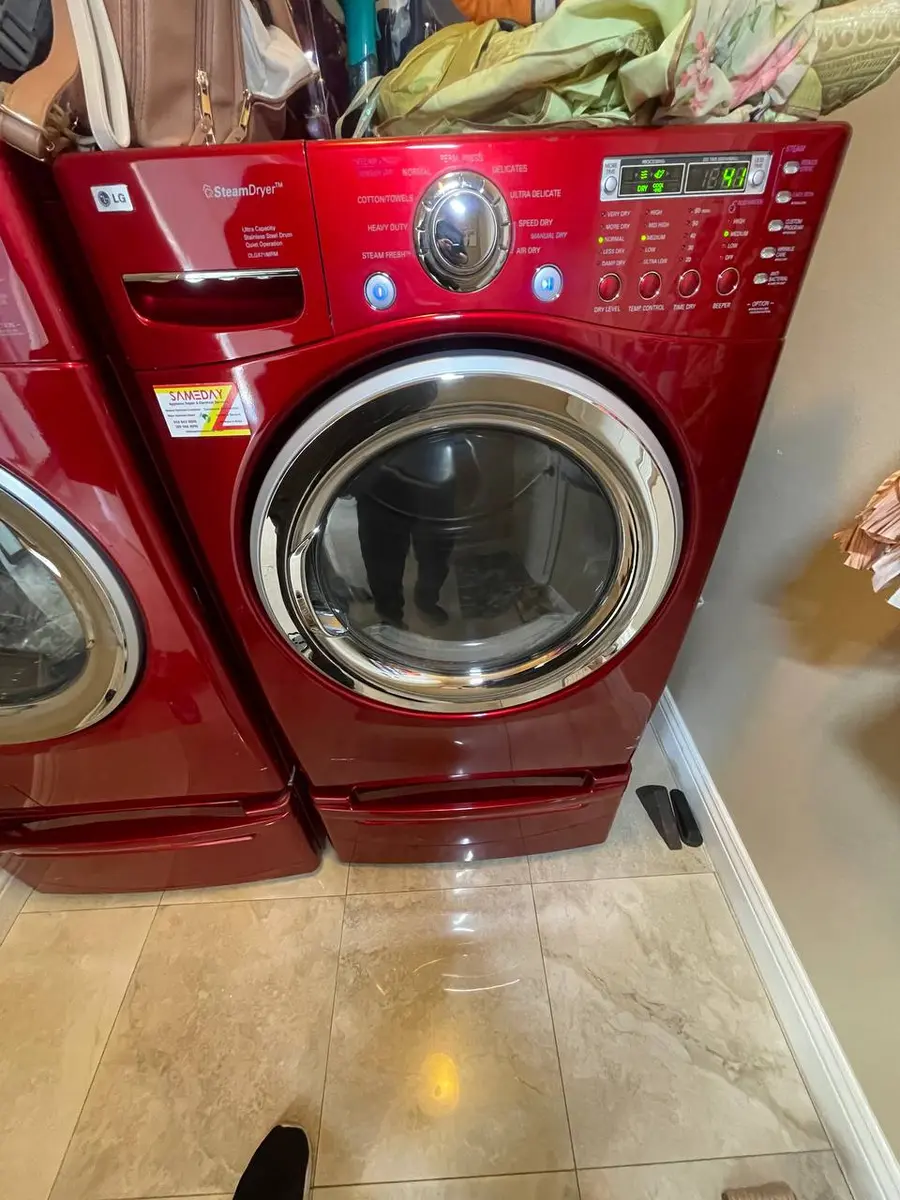
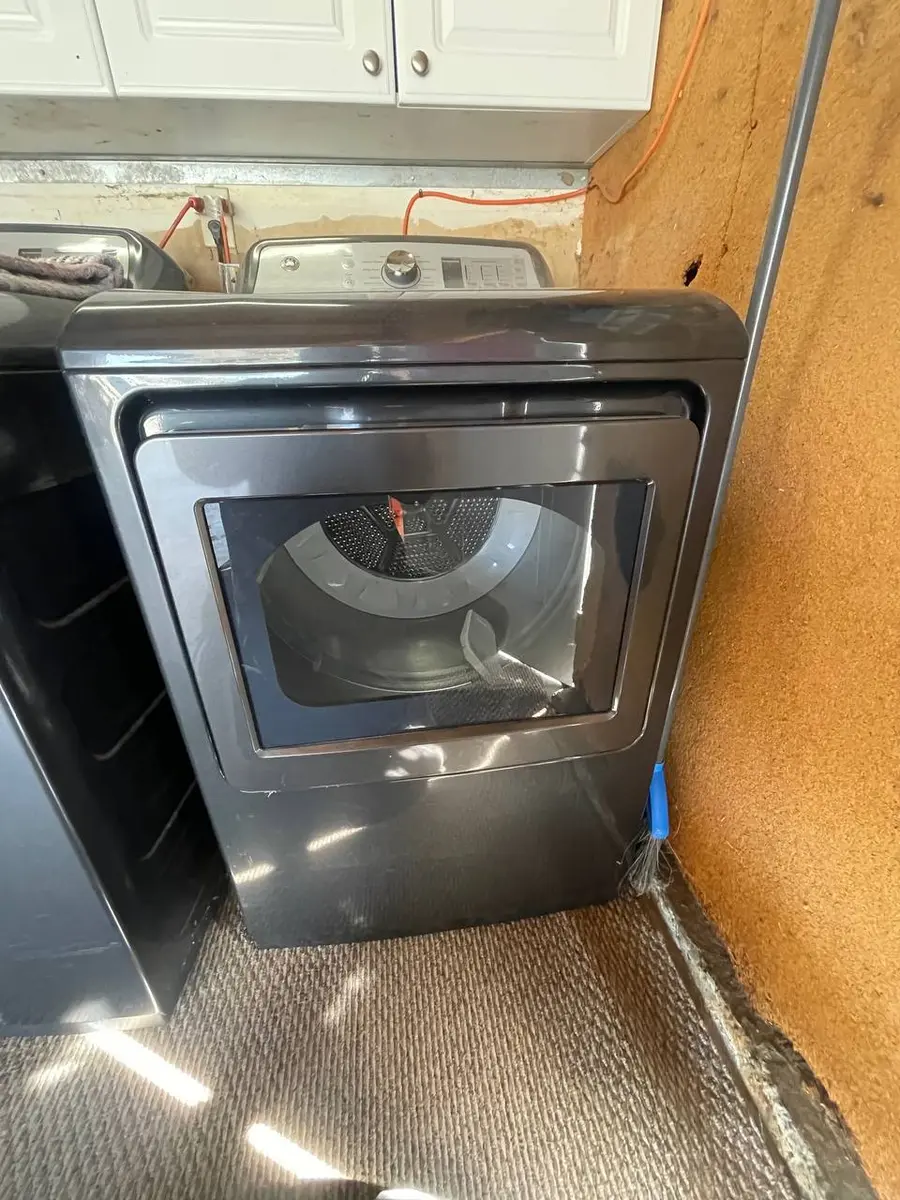
GE Dryer Not Heating — Complete Diagnosis for GFD Electric and GTD Gas Models
A GE dryer that tumbles but produces no heat is the most common dryer complaint we encounter. GE makes both electric (GFD series) and gas (GTD gas variants) dryers, and the no-heat diagnosis differs significantly between them. Electric models have a simple heating element circuit; gas models have an ignition system with multiple failure points. Both share the Sensor Dry moisture-detection system that relies on proper heat to function.
GE Dryer Heating Systems Explained
GFD Electric Dryers: A 240V heating element (GE WE11M10001) mounts in a housing behind the rear panel. The element draws approximately 22-24 amps through a 5400-watt coil. Two safety devices protect the circuit: a high-limit thermostat and a thermal fuse (GE WE04X10120) on the blower housing.
GTD Gas Dryers: A gas burner assembly with igniter, flame sensor, and gas valve solenoids (GE WE14X215 coil set) produces heat. The igniter glows to light the gas, then the flame sensor verifies ignition. If any component in this sequence fails, gas never flows and no heat is produced.
Both Types: Share the Sensor Dry system — two parallel metal bars inside the drum detect clothing moisture by measuring conductivity between them. If coated with fabric softener residue, they misread dry clothes as wet (cycle runs too long) or vice versa.
Do You Have the Right Tools?
Gas leak detector ($130), thermal fuse tester ($95), belt tension gauge, and vent inspection camera ($180). Our technician arrives with $15K+ in professional tools — your diagnostic is free.
Licensed & Insured · 90-Day Warranty · Same-Day Service
Safety First
- Electric (GFD): Unplug the dryer — the 240V element circuit is lethal. Verify no voltage with a multimeter before touching any component behind the rear panel.
- Gas (GTD): Turn off the gas supply valve AND unplug before inspection. If you smell gas at any point, leave the area and call your gas company.
- Both: Clear the exhaust vent system before any repair — a blocked vent is the most common cause of thermal fuse failure, and a new fuse will blow again immediately if the vent is not cleared.
GE Dryer Diagnostic Mode
Your GE dryer Service Mode:
- Dryer in standby (plugged in, powered off, door closed).
- Press and hold Delay Start + My Cycle for 3 seconds.
- Display shows "88" then "t1" — diagnostic mode.
- Press Start to advance: heating element, thermistor, motor, moisture sensor, drum rotation.
- Error codes: E1 (thermistor open), E2 (short), E3 (door switch), E5 (exhaust high temp).
GE SmartHQ App: WiFi dryers (2017+) provide remote diagnostics and vent blockage alerts.
For no-heat diagnosis, the heating element continuity test (t2) and thermistor reading test (t3) are most relevant. On gas models, the igniter test (t5) activates the ignition sequence.
Safety First — Know the Risks
Gas dryers carry carbon monoxide and explosion risk. Even electric dryers involve 240V circuits that can deliver a fatal shock. Our techs are licensed and insured — let them handle the risk.
Licensed & Insured · 90-Day Warranty · Same-Day Service
Most Common Causes (Electric GFD Models)
1. Heating Element Burned Out — 35% of Electric Cases
The heating element (GE WE11M10001) is a resistance coil that eventually burns through, creating an open circuit. This is wear-and-tear failure — the element has a typical lifespan of 8-12 years depending on usage frequency.
GE-Specific Access: On GFD models, the element mounts in a bracket behind the rear panel. Remove approximately 12-15 Phillips screws from the rear panel to access. The element housing pulls straight out after disconnecting 2 wire terminals.
Test: With the dryer unplugged, disconnect one wire from the element terminals and measure resistance. Good = 8-15 ohms. Open circuit (infinite resistance) = burned out. Also inspect visually — look for a visible break in the coil.
DIY Difficulty: Moderate Parts Cost: $35-75 (GE WE11M10001) Professional Repair Cost: $145-295
Repair Steps:
- Unplug the dryer (240V — critical).
- Remove the rear panel (12-15 Phillips screws around the perimeter).
- Photograph the wire connections to the element housing before disconnecting.
- Remove the 2-3 screws holding the element housing bracket to the dryer frame.
- Slide the housing out.
- Transfer any reusable components (mounting brackets, insulation) to the new element if not included.
- Install new WE11M10001 and reconnect wires per your photo.
- Reassemble rear panel.
2. Thermal Fuse Blown — 25% of Electric Cases
The thermal fuse (GE WE04X10120) is a one-shot safety device on the blower housing. When exhaust temperature exceeds safe limits — almost always caused by a blocked vent — the fuse permanently opens, cutting power to the heating element.
Critical Point: Replacing the thermal fuse without clearing the vent blockage means the new fuse blows within days. Always check and clear the entire vent run from the dryer to the exterior exit.
Sacramento Vent Issue: Many Sacramento homes have dryers in interior laundry closets with long vent runs (15-30 feet) through walls and attics. GE recommends a maximum 60-foot equivalent vent run, but even 25 feet with multiple elbows can restrict enough to trip the fuse during Sacramento's 100F+ summer days when the attic temperature pre-heats the vent air.
Test: Continuity check with multimeter. Good fuse = continuity (closed circuit). Blown fuse = no continuity (open circuit).
DIY Difficulty: Easy to Moderate Parts Cost: $8-20 (GE WE04X10120) plus vent cleaning cost Professional Repair Cost: $95-185 (fuse replacement + vent inspection)
3. High-Limit Thermostat — 12% of Electric Cases
The high-limit thermostat (cycling thermostat) regulates operating temperature by cycling the element on and off. If it fails open, the element receives no power. If it fails closed (stuck on), the element overheats and blows the thermal fuse.
Test: Continuity at room temperature should be closed (continuity present). If open at room temperature, the thermostat has failed.
DIY Difficulty: Moderate Parts Cost: $15-35 Professional Repair Cost: $95-185
Most Common Causes (Gas GTD Models)
4. Gas Valve Solenoid Coils — 30% of Gas Cases
Gas dryers have 2-3 solenoid coils (GE WE14X215) on the gas valve that open sequentially to allow gas flow. These coils are a known wear item — they weaken over time and cannot pull the valve open against spring pressure when hot.
GE-Specific Intermittent Pattern: Coils often work fine when cold (first cycle of the day) but fail after heating up during the cycle. The dryer starts with heat, loses heat 10-20 minutes in, then may recover briefly. This hot-failure pattern is classic gas valve coil degradation.
DIY Difficulty: Moderate Parts Cost: $20-40 (GE WE14X215 coil set — always replace all coils together) Professional Repair Cost: $125-235
5. Igniter Failure — 20% of Gas Cases
The igniter (a flat silicon carbide bar) glows orange-hot to ignite the gas stream. When it cracks or loses conductivity, it cannot reach ignition temperature.
Test: Watch through the lower front panel opening during startup. The igniter should glow bright orange for 30-90 seconds before gas flows. If it glows dimly and gas never ignites, it has weakened. If it does not glow at all, it is open-circuit.
DIY Difficulty: Moderate Parts Cost: $25-55 Professional Repair Cost: $125-225
6. Flame Sensor (Gas) — 15% of Gas Cases
After ignition, the flame sensor verifies continuous flame. If the sensor malfunctions, it signals "no flame" and the board shuts off gas flow as a safety measure.
Parts Cost: $15-35 Professional Repair Cost: $95-185
The Real Cost of DIY
Average DIY attempt: $150-400 in tools you may use once, plus the risk of further damage. Our diagnostic visit costs $0 — we find the problem and give you an honest quote.
Licensed & Insured · 90-Day Warranty · Same-Day Service
Shared Causes (Both Electric and Gas)
7. Blocked Exhaust Vent — Present in 40% of All No-Heat Calls
A partially blocked vent reduces airflow, causing heat to build up inside the dryer housing. This triggers the high-limit thermostat to cycle the heat off prematurely. Clothes dry much slower — the dryer technically heats but cannot maintain temperature.
Sacramento-Specific: Homes with dryers in interior laundry rooms often have 15-30 foot vent runs with 3-4 elbows. Each 90-degree elbow adds the equivalent of 5 feet. A 25-foot run with 4 elbows = 45-foot equivalent — getting close to GE's 60-foot maximum. Lint accumulation in these long runs is inevitable without annual cleaning.
GE Vent Recommendation: Maximum 60-foot equivalent total run. Use rigid metal duct (not flexible foil) for best airflow. Annual professional vent cleaning for runs over 15 feet.
8. Thermistor (Temperature Sensor) Fault
The thermistor (GE WE04X25929) measures exhaust air temperature for the Sensor Dry system. If it reads incorrectly high, the board may reduce or cut heat prematurely.
Error Code: E1 (thermistor open), E2 (thermistor short) Parts Cost: $20-40 (GE WE04X25929) Professional Repair Cost: $95-185
Same-Day Appliance Repair
Fixed or It's Free
$89 → $0 Service Call & Diagnosis — offer ends May 25
Diagnosis Flowchart
- Does the dryer tumble? No → separate issue (motor/belt/door switch). Yes → continue.
- Electric or Gas model? Check the plug — 240V 4-prong (electric) or standard 120V plug + gas line (gas).
- Electric: Check thermal fuse (WE04X10120) for continuity first — cheapest and fastest test.
- Electric: Check element (WE11M10001) resistance — 8-15 ohms = good, infinite = burned out.
- Gas: Watch igniter during startup — does it glow? Bright glow + no gas = valve solenoids. No glow = igniter.
- Both: Check vent airflow at exterior exit — feel for strong airflow during operation.
Don't Void Your Warranty
Opening your appliance yourself may void the manufacturer warranty. Our repair comes with a 90-day guarantee, and we document everything for warranty compliance.
Licensed & Insured · 90-Day Warranty · Same-Day Service
DIY vs Professional
| Component | GE Part | DIY Cost | Professional |
|---|---|---|---|
| Heating element | WE11M10001 | $35-75 | $145-295 |
| Thermal fuse | WE04X10120 | $8-20 | $95-185 |
| Gas valve coils | WE14X215 | $20-40 | $125-235 |
| Igniter | — | $25-55 | $125-225 |
| Thermistor | WE04X25929 | $20-40 | $95-185 |
| Vent cleaning | — | $20-50 (DIY kit) | $100-175 |
Prevention
- Clean the lint screen before every load — GE's Sensor Dry bars also need cleaning monthly with fine sandpaper and alcohol.
- Have vents professionally cleaned annually — critical for Sacramento homes with long runs.
- Check exterior vent flap — birds nest in vent exits, blocking airflow completely.
- Do not overload — restricted airflow around clothes prevents proper drying and strains the heating system.
- Use GE SmartHQ vent monitoring on WiFi models — it warns when vent restriction reaches problematic levels.
Is It Worth Your Time?
A dryer not heating could be the element, thermal fuse, gas valve, igniter, or timer. Average DIY diagnosis: 3-4 hours with no guarantee of finding the issue. Our technician diagnoses the issue in about 30 minutes — same-day appointments available.
Licensed & Insured · 90-Day Warranty · Same-Day Service
FAQ
Q: My GE dryer heats for 10 minutes then loses heat and comes back. What is this?
Classic gas valve solenoid degradation (GE WE14X215). The coils work when cold but cannot hold the valve open after heating up during the cycle. Replace the entire solenoid coil set — individual coil replacement is unreliable.
Q: I replaced the thermal fuse on my GE dryer and it blew again immediately. Why?
The vent is still blocked. The thermal fuse is a symptom indicator — it blows because exhaust temperature exceeded safe limits due to restricted airflow. Clear the entire vent run from the dryer to the exterior exit before installing another fuse.
Q: How do I know if my GE dryer is electric or gas?
Check the power plug: electric GE dryers (GFD) use a large 240V 4-prong plug. Gas dryers (GTD) use a standard 120V 3-prong plug PLUS have a gas supply line connecting to the back. Also check the model number — GFD prefix = electric, certain GTD configurations = gas.
Q: Are the Sensor Dry bars related to no-heat issues?
Not directly — the Sensor Dry bars detect moisture, not temperature. However, if bars are coated with fabric softener residue, the dryer may seem like it is not heating because cycles end prematurely (bars falsely detect dryness). Clean with fine sandpaper and rubbing alcohol.
GE dryer not heating in Sacramento? Our technicians carry elements (WE11M10001), thermal fuses (WE04X10120), and gas valve coils (WE14X215) for same-day GFD and GTD repair. Schedule a repair →