Most Likely Cause#
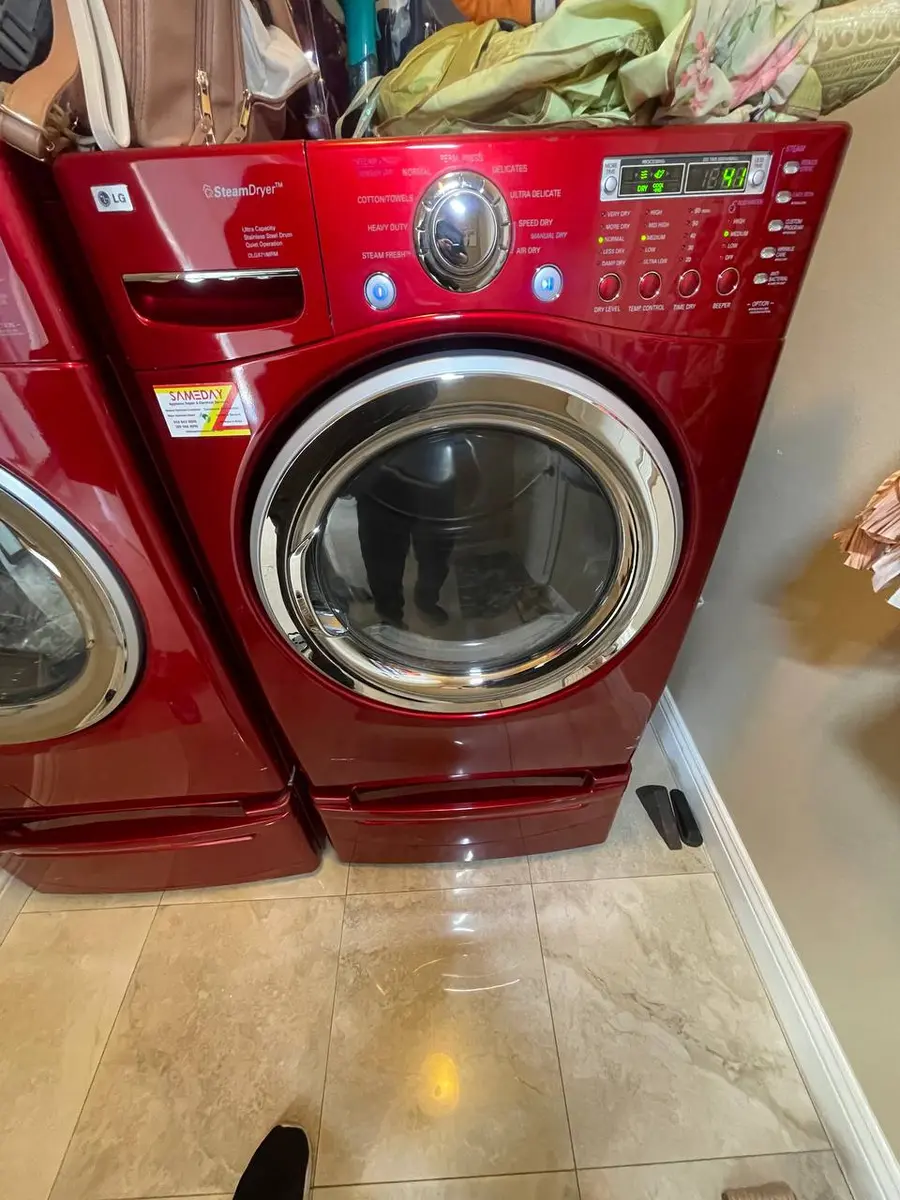
An LG dryer door problem is really two problems wearing one name. The most common by far is a worn plastic catch-and-strike — the mechanical latch that holds the door shut — which accounts for about 35% of cases. Close behind is the electrical door switch that tells the control board the door is closed; when that fails the door can latch physically yet the dryer still won't run and throws code dE. Because the switch is a completely separate part from the latch, the first thing to establish is whether the door won't stay shut (mechanical) or stays shut but won't start (electrical).
Fault Map: Cause by What You See#
| What you observe | Most likely cause | How often | Part |
|---|---|---|---|
| Door won't stay shut; catch looks rounded off | Worn door catch/strike | ~35% | catch/strike assembly |
| Door latches but [dryer won't start](/bay-area/services/dryer-wont-start), code dE | Failed door switch | ~30% | 6601ER1004C |
| Door sags; catch and strike no longer meet squarely | Hinge wear / misalignment | ~20% | hinge assembly |
| Door won't close fully; gasket bunched | Door gasket interference | ~15% | door gasket |
Do You Have the Right Tools?
Gas leak detector ($130), thermal fuse tester ($95), belt tension gauge, and vent inspection camera ($180). Our technician arrives with $3,000+ in professional tools — your diagnostic is free.
Licensed & Insured · 90-Day Warranty · Same-Day Service
Check Diagnostics First#
Before you take anything apart, let the dryer tell you what's wrong. Note any error code on the display: dE is a door error, tE a thermistor fault, HE a heater fault, LE a motor fault. On Wi-Fi models, LG ThinQ Smart Diagnosis reads the fault directly; on any model, the FlowSense indicator — d80, d90, d95 — flags exhaust-vent restriction, which is the number-one cause of LG dryer performance complaints and worth ruling out while you're in there. A dE code with a door that physically latches points you straight at the switch, not the catch.
The Worn Catch and Strike#
LG front-loaders latch with a hook-shaped plastic catch on the door that grabs a strike on the body. That catch is injection-molded plastic, and on a dryer run three to five times a day it can round off in 4-6 years until it no longer holds. Inspect the catch for rounding, chips, or cracks, and the strike for wear marks, deformation, or a broken spring. On DLEX models the catch is replaceable on its own — two or three screws on the inner door panel reach it. After replacing the catch or strike, the door should click firmly shut and resist a gentle pull.
Safety First — Know the Risks
Gas dryers carry carbon monoxide and explosion risk. Even electric dryers involve 240V circuits that can deliver a fatal shock. Our techs are licensed and insured — let them handle the risk.
Licensed & Insured · 90-Day Warranty · Same-Day Service
The Door Switch (Code dE)#
The electrical switch confirms closure to the board, and a dead switch stops the dryer even when the door latches perfectly — the tell is a dE code with a door that clearly clicks shut. Close the door and listen for the switch click; no click means the switch failed. Confirm with a meter: continuity when the door is closed, open when it's open. Reaching it means pulling the top and front panels to get behind the door opening, and the common LG part is 6601ER1004C or a model-specific equivalent.
Hinge Wear and Gasket Interference#
Hinge wear. Hinges develop play over time and the door sags, so the catch no longer lines up with the strike and the door won't close fully or won't stay closed while running. Check for vertical play by lifting the door's far edge — any drop means worn hinge bushings. Tighten the hinge screws first, since vibration loosens them; if the door still wobbles with tight screws, the hinge assembly needs replacing. On reversible-door models, confirm the door was reassembled correctly if it was recently reversed.
Gasket interference. The rubber gasket around the drum opening can shift out of its channel or swell, physically holding the door open just far enough that the catch never reaches the strike. Inspect the whole gasket, reseat any bunched section into its channel, and check for coins or small items lodged in it — they migrate there. A swollen or hardened gasket needs replacing.
The Real Cost of DIY
Average DIY attempt: $150-400 in tools you may use once, plus the risk of further damage. Our diagnostic visit costs $0 — we find the problem and give you an honest quote.
Licensed & Insured · 90-Day Warranty · Same-Day Service
Replacing the Catch or Strike#
When the mechanical latch is worn, the catch and strike are a front-of-door job on DLEX models:
- Unplug the dryer.
- Open the door and remove the two or three screws on the inner door panel to reach the plastic catch.
- Unclip or unscrew the rounded catch and fit the new one; if the body-side strike is deformed or its spring is broken, replace that too.
- Close the door and confirm it clicks firmly and resists a gentle pull before reassembling the panel.
Replacing the Door Switch#
When a dE code shows on a door that physically latches, the electrical switch is the fix:
- Unplug the dryer and pull it out for access.
- Remove the top panel, then the front panel, to reach behind the door opening where the switch mounts.
- Unplug the switch harness and meter the switch — continuity closed, open when open — to confirm before swapping.
- Fit the replacement (6601ER1004C or the model-specific equivalent), reconnect, and reassemble.
- Close the door and listen for the switch click, then start a cycle to confirm the dE code is gone.
Don't Void Your Warranty
Opening your appliance yourself may void the manufacturer warranty. Our repair comes with a 90-day guarantee, and we document everything for warranty compliance.
Licensed & Insured · 90-Day Warranty · Same-Day Service
Prevention#
- Clean the lint filter before every load — LG's slot filter pulls straight up from the door opening.
- Clean the exhaust duct at least yearly (every six months for long or multi-bend runs) and act on d80 before it becomes d90 or d95.
- Wipe the moisture-sensor bars inside the drum monthly with isopropyl alcohol — softener residue coats them.
- Don't overload; clothes need to tumble freely for the door to close cleanly and for the moisture sensors to read correctly.
- Close the door with a firm push rather than a slam — slamming is what rounds off the plastic catch years before its time.
Cost and Repair-or-Replace#
Door-latch repairs on an LG dryer are cheap and mostly DIY. A catch or strike is a low-cost part and an easy job, the door switch is inexpensive though it takes panel removal, and a hinge or gasket is modest. None of these approaches the cost of a new dryer, so on any machine worth keeping the repair wins easily, and even stacking a catch, a switch, and a hinge on one visit still lands well under a replacement. If you'd rather not pull the top and front panels to reach the switch, schedule service and we'll bring the LG catch, switch, hinge, and gasket parts and diagnose the door in one trip.
Reading the share column, and the third factor behind both#
The figures in the fault map order these causes against one another on an LG dryer door complaint. They are a ranking rather than a measured incidence — this guide names no sample of jobs or period they were drawn from — and their job is to say which row to check first, not to be quoted.There is also a relationship between the top two rows that the ordering hides. A door that has begun to drop on its hinge stops presenting the catch squarely to the strike, so the catch wears on one edge rather than evenly and reaches the end of its life early. The same misalignment leaves the switch being closed at the edge of its travel, where the smallest further movement drops the signal. So a hinge that nobody has looked at can be behind a worn catch, an intermittent switch, or both — and replacing either part while the geometry is still wrong buys months rather than years.
That is the argument for checking the hinge and the door's fit before ordering anything, even when the symptom points cleanly at one of the two named parts.
Senior Appliance Repair Technician · 15 years experience
EPA-certified technician with 15 years of experience specializing in refrigerator and cooling system repairs.