How to Troubleshoot a Whirlpool Refrigerator Not Cooling: Systematic Diagnosis
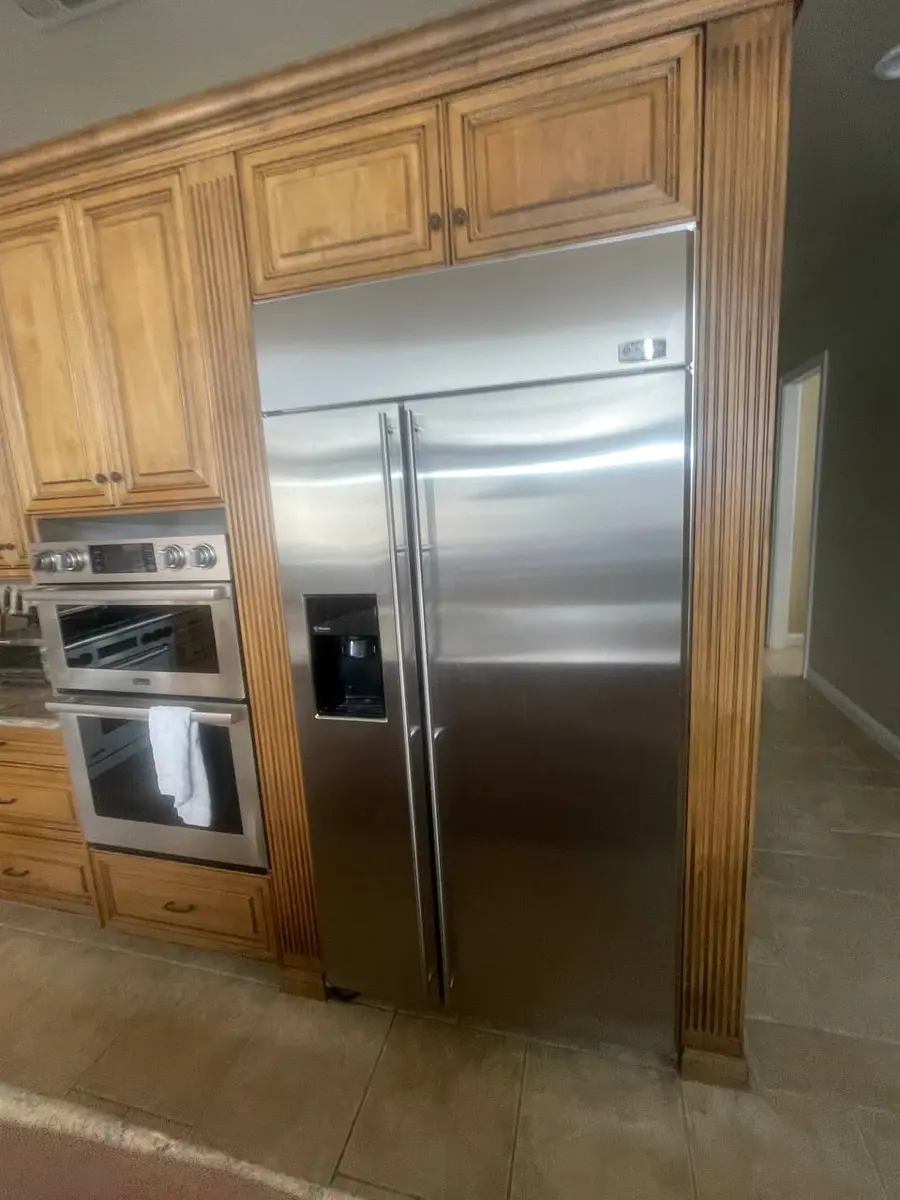
When your Whirlpool refrigerator requires component replacement, understanding the brand's specific design philosophy and access patterns makes the repair straightforward. Whirlpool's WRF (French door), WRS (side-by-side), and WRT (top-mount) refrigerator lines share common diagnostic architecture and fastener systems, meaning skills learned on one model transfer directly to others.
Whirlpool refrigerators (WRF French door, WRS side-by-side, WRT top-mount series) feature Adaptive Defrost technology that adjusts defrost frequency based on door openings and compressor runtime rather than a fixed timer. The Accu-Chill temperature management system provides rapid cooling after door closures using variable fan speeds. Models with In-Door-Ice store ice in the freezer door rather than the cabinet, freeing shelf space. EveryDrop water filters provide NSF-certified filtration at the base grille or inside the fresh food section. The Measured Fill dispenser accurately fills containers to a user-selected volume using a timed solenoid.
Before You Start
- Tools needed: Torx T20 screwdriver (Whirlpool's primary fastener), 1/4" hex nut driver, Phillips #2, digital multimeter
- Parts needed: Replacement component specific to repair type (verify part number using your Whirlpool model number from the rating plate inside the door frame or on the serial tag)
- Time required: 30-60 minutes depending on access complexity
- Difficulty: Intermediate
- Safety warning: Unplug the refrigerator before any repair work. The compressor start relay may hold a small charge — discharge by shorting terminals with an insulated screwdriver. The sealed system contains pressurized refrigerant — never puncture or heat sealed system components.
Do You Have the Right Tools?
Refrigerant gauges ($200+), vacuum pump ($250), leak detector ($150), and EPA-certified recovery equipment. Our technician arrives with $15K+ in professional tools — your diagnostic is free.
Licensed & Insured · 90-Day Warranty · Same-Day Service
Understanding the Problem
Whirlpool refrigerators are sophisticated systems with multiple interconnected components. The Adaptive Defrost system, Accu-Chill temperature management, evaporator fans, condenser fans, thermistors, dampers, ice maker modules, and water valves all communicate through the main control board. When one component fails, the diagnostic system logs an F#E# code and may adjust other system parameters to compensate. Understanding this interconnection helps you diagnose accurately — sometimes the apparent symptom (like warm fresh food) is caused by a component failure elsewhere (like a stuck damper) rather than a cooling system problem.
Step-by-Step Instructions
Step 1: Prepare the appliance and gather information
Unplug the refrigerator before any repair work. The compressor start relay may hold a small charge — discharge by shorting terminals with an insulated screwdriver. The sealed system contains pressurized refrigerant — never puncture or heat sealed system components. Before beginning disassembly, locate your model number (printed on the rating plate — Whirlpool refrigerators: inside the fresh food section left wall; ranges: behind the lower drawer or under the cooktop; freezers: inside the cabinet left wall; vacuums: on the serial plate on the body). Record this number for ordering correct replacement parts. Also locate the tech sheet (refrigerators: behind base grille; ranges: under cooktop or behind lower drawer panel; freezers: behind base grille). The tech sheet contains your model-specific wiring diagram and diagnostic entry sequence.
Step 2: Enter diagnostic mode and record codes
Enter Whirlpool diagnostic mode using the 3-button sequence from your tech sheet (located behind the base grille or inside the fresh food compartment ceiling). Whirlpool uses F#E# error codes where F indicates the functional system (F0=sealed system, F1=board communication, F3=sensors, F4=fans, F5=door, F7=motor/actuator, F8=water system, F9=defrost) and E indicates the specific error. The diagnostic system stores up to 10 recent fault events with occurrence counters.
Record all stored codes before beginning the repair. This establishes baseline knowledge of what the control system has detected. Multiple codes from the same system (e.g., F3E1 and F3E2) suggest a common cause like a wiring issue rather than multiple independent failures.
Step 3: Disconnect power and access the component
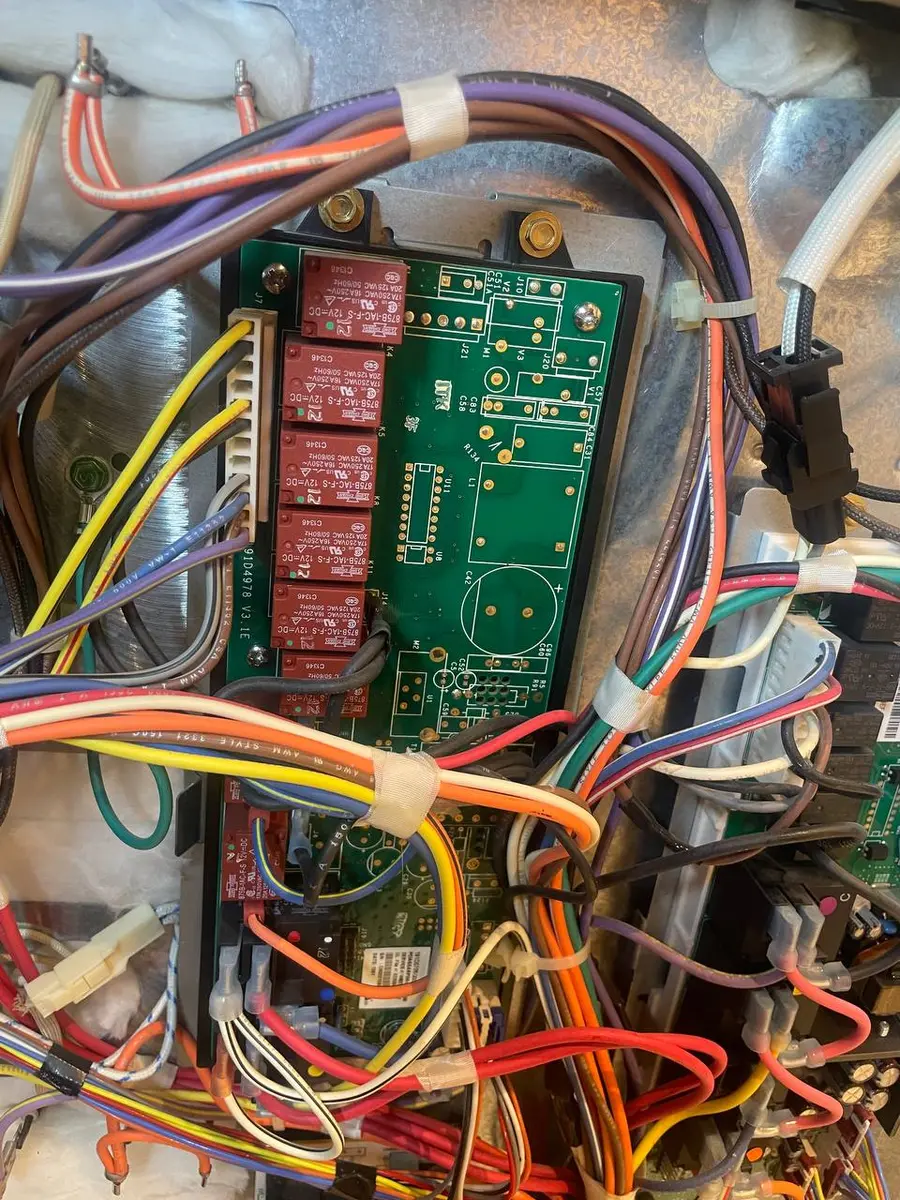
Whirlpool refrigerator internal components are accessed differently depending on the component location. Evaporator and defrost components: remove freezer shelves and rear freezer panel (6-8 Torx T20 screws). Control board: remove rear panel in fresh food section (Phillips or Torx screws). Compressor and condenser: remove rear lower panel at the exterior bottom. Ice maker: single mounting screw inside freezer. Water inlet valve: rear lower panel exterior. Door gaskets: no panel removal needed — gaskets are retained by door liner screws accessible from inside.
Step 4: Remove the failed component
With access achieved, identify the failed component. Take a photograph of all wire connections before disconnecting anything — this serves as your reassembly reference. Disconnect wire harnesses by pressing the locking tab and pulling the connector body (never pull on wires themselves). Remove mounting screws or brackets holding the component. On Whirlpool appliances, most internal fasteners are Torx T20 with some 1/4" hex in access panel locations.
Step 5: Verify failure with testing
Before installing the new part, confirm the old one is actually failed. Use your multimeter to test resistance (heating elements: 20-50 ohms normal, infinity = open/burned out), continuity (switches and sensors: should show closed/open at appropriate conditions), or voltage at the connector (verifies the supply circuit is providing power to the component location). This prevents installing a new part only to find the issue is upstream in the wiring or control board.
Step 6: Install the replacement component
Mount the new component in the exact position and orientation as the original. Reconnect all wire harnesses, verifying each connector seats fully with an audible click or tactile lock. Tighten mounting screws snug but not excessively — Whirlpool uses plastic mounting tabs on many components that crack if overtightened.
Step 7: Reassemble and verify
Reinstall all panels and covers in reverse order of removal. Restore power. Enter diagnostic mode and clear any stored error codes related to the repair. Run the component through a test cycle — either using the diagnostic mode forced-test function or by operating the appliance normally and monitoring for correct behavior.
Step 8: Post-repair monitoring
Monitor the appliance for 24-48 hours after repair. Check that temperature returns to the Accu-Chill setpoint (37°F fresh food, 0°F freezer) within 24 hours. Verify the Adaptive Defrost cycle runs without triggering a new code. On ice maker repairs, expect first ice batch in 2-4 hours. If the original error code returns within 48 hours, the repair may be incomplete or a secondary failure exists. Re-enter diagnostic mode and check for new or recurring codes.
Safety First — Know the Risks
Refrigerant (R-134a/R-600a) requires EPA certification to handle. Improper discharge is a federal violation and health hazard. Our techs are licensed and insured — let them handle the risk.
Licensed & Insured · 90-Day Warranty · Same-Day Service
Whirlpool-Specific Repair Notes
Whirlpool appliances across all product lines share several repair characteristics that streamline the process:
- Torx T20 dominance: Whirlpool uses Torx T20 for approximately 80% of internal fasteners. Having this single driver handles most disassembly.
- Tech sheet location: Every Whirlpool appliance has a tech sheet with wiring diagram and diagnostic procedures taped inside the unit. Finding this sheet before starting saves significant troubleshooting time.
- F#E# universal codes: All Whirlpool Corporation brands (Whirlpool, Maytag, KitchenAid, Amana) use the same F-number/E-number error code format. Repair knowledge transfers across brands.
- Cross-brand parts compatibility: Many components (especially start relays, door switches, heating elements, motors) are shared between Whirlpool Corporation brands. A part for a Maytag often fits the equivalent Whirlpool model.
- 3-button diagnostic entry: The diagnostic mode entry uses a brand-wide 3-button sequence pattern pressed within a 4-second window. The specific buttons vary by appliance type but the timing protocol is consistent.
- Parts availability: Whirlpool has the widest parts network of any appliance brand with decades of backwards compatibility. Parts for models 15-20 years old are commonly available.
Troubleshooting Common Issues
If the repair does not resolve the problem with your Whirlpool refrigerator:
- If the same error code returns after replacing the component, check the wiring harness between the component and the control board. A damaged wire or corroded connector creates the same symptom as a failed component and will repeatedly kill new parts
- If a different error code appears after repair, you may have partially-seated a connector during reassembly. Open the area back up and verify every connection is fully clicked into place
- If no error codes exist but the system does not function correctly, the issue may be mechanical rather than electrical. On refrigerators check the damper and air flow; on ranges check element positioning; on vacuums check belt tension and seal integrity
- If the control board shows no response after reassembly, verify power is reaching the board — check for a blown fuse or tripped breaker that may have occurred during the repair (possible if a connector was momentarily shorted during reconnection)
- Consult your Whirlpool tech sheet wiring diagram to trace the circuit path from the control board output to the component. Test voltage at each junction point to isolate where signal is lost
The Real Cost of DIY
Average DIY attempt: $150-400 in tools you may use once, plus the risk of further damage. Our diagnostic visit costs $0 — we find the problem and give you an honest quote.
Licensed & Insured · 90-Day Warranty · Same-Day Service
When This Fix Will Not Work
Call a professional appliance technician if:
- The issue involves the sealed refrigeration system (compressor, refrigerant lines, evaporator, condenser on refrigerators/freezers) — these require EPA certification and specialized equipment
- Multiple unrelated systems have failed simultaneously — this typically indicates main control board failure affecting multiple outputs rather than individual component failures
- You find burn marks, melted connectors, or a burning smell in the wiring — this indicates an arc-over event that may have damaged multiple components and requires systematic professional diagnosis
- Gas range repairs require disconnecting or reconnecting gas supply lines — improper connections create explosion risk. Only certified technicians should perform gas line work
- The repair requires accessing components behind sealed panels that contain warnings about trained technician access only
Same-Day Appliance Repair
Fixed or It's Free
$89 → $0 Service Call & Diagnosis — offer ends May 25
Cost Comparison: DIY vs Professional
| DIY | Professional | |
|---|---|---|
| Parts | $15-$150 (component dependent) | $15-$150 (same parts) |
| Labor | $0 | $120-$280 |
| Time | 30-60min | 30-45min |
| Risk | Low with proper preparation | Warranty included |
Don't Void Your Warranty
Opening your appliance yourself may void the manufacturer warranty. Our repair comes with a 90-day guarantee, and we document everything for warranty compliance.
Licensed & Insured · 90-Day Warranty · Same-Day Service
Need Professional Help?
FAQ
Q: Where do I find the tech sheet on my Whirlpool refrigerator? A: Check behind the base grille at the front bottom (remove grille by pulling forward), taped to the ceiling of the fresh food section near the rear, or inside the compressor access panel at the rear. The tech sheet contains your wiring diagram, diagnostic entry sequence, and component location guide.
Q: What tools do I need for most Whirlpool refrigerator repairs? A: A Torx T20 screwdriver handles most internal fasteners. Add a 1/4" hex nut driver for access panels, a Phillips #2 as backup, and a digital multimeter for electrical diagnosis. These four tools cover 90% of Whirlpool repair needs.
Q: Are Whirlpool refrigerator parts interchangeable with other brands? A: Many components are shared across Whirlpool Corporation brands (Whirlpool, Maytag, KitchenAid, Amana). Parts with W or WP prefix numbers are current production. Cross-reference your specific part number — the same physical component often has different catalog numbers for different brand labels.
Q: How do I know if a repair is worth doing vs replacing the refrigerator? A: If the repair cost (parts + your time value) exceeds 50% of a comparable new unit price AND the refrigerator is over 8 years old, replacement is typically more economical. For simple component failures ($15-$80 in parts) on units under 10 years old, repair is almost always worthwhile.