GE Stove: Replace the 470uF Control Capacitor
Most GE range heating faults come down to four parts — a gas igniter, the bake element, the convection fan, or the oven temperature sensor — and each has a quick test. Identifying which heating system your model uses points you straight at the culprit, an intermediate job of about 30 to 45 minutes.
Know your GE heating layout#
Gas GE ranges use one igniter per sealed burner, so a single dead burner is that burner's igniter. Electric ovens split into a bottom bake element and a top broil element, and Profile and Cafe models add a True European Convection ring around the rear fan for even heat. Matching the symptom to the layout narrows the diagnosis before you touch a tool.
Safety warning: Turn off circuit breaker for electric models. For gas: turn off gas supply valve behind stove and verify with soapy water bubble test.
What you need#
| Category | Detail |
|---|---|
| Tools | Phillips #2 screwdriver, quarter-inch and five-sixteenths nut drivers, multimeter, igniter wrench |
| Common parts | Bake element WB44T10011, gas igniter WB13K21, convection fan motor WB26X10210, oven sensor WB21X5301 — all model-specific |
| Time and level | 30 to 45 minutes, Intermediate |
Do You Have the Right Tools?
Combustion analyzer ($300), igniter tester ($120), temperature calibrator ($150), and gas pressure manometer. Our technician arrives with $3,000+ in professional tools — your diagnostic is free.
Licensed & Insured · 90-Day Warranty · Same-Day Service
Step by step#
1 - Pin down the symptom. Decide gas or electric, then whether the fault is stovetop, oven, or both, and whether the oven fails to reach temperature or just cooks unevenly. One dead gas burner is an igniter; an oven that burns the top and leaves the bottom raw is a bake element; poor results only in convection mode point at the fan.
2 - Test a gas burner igniter. Turn the burner on and watch: a good igniter glows bright within about 40 seconds and lights the gas. GE's safety valve only opens when the igniter draws enough current, roughly 3.2 to 3.6 amps, so an igniter that glows dim for over a minute without lighting has weakened. Each sealed burner has its own igniter, commonly WB13K21, since lead lengths differ by position.
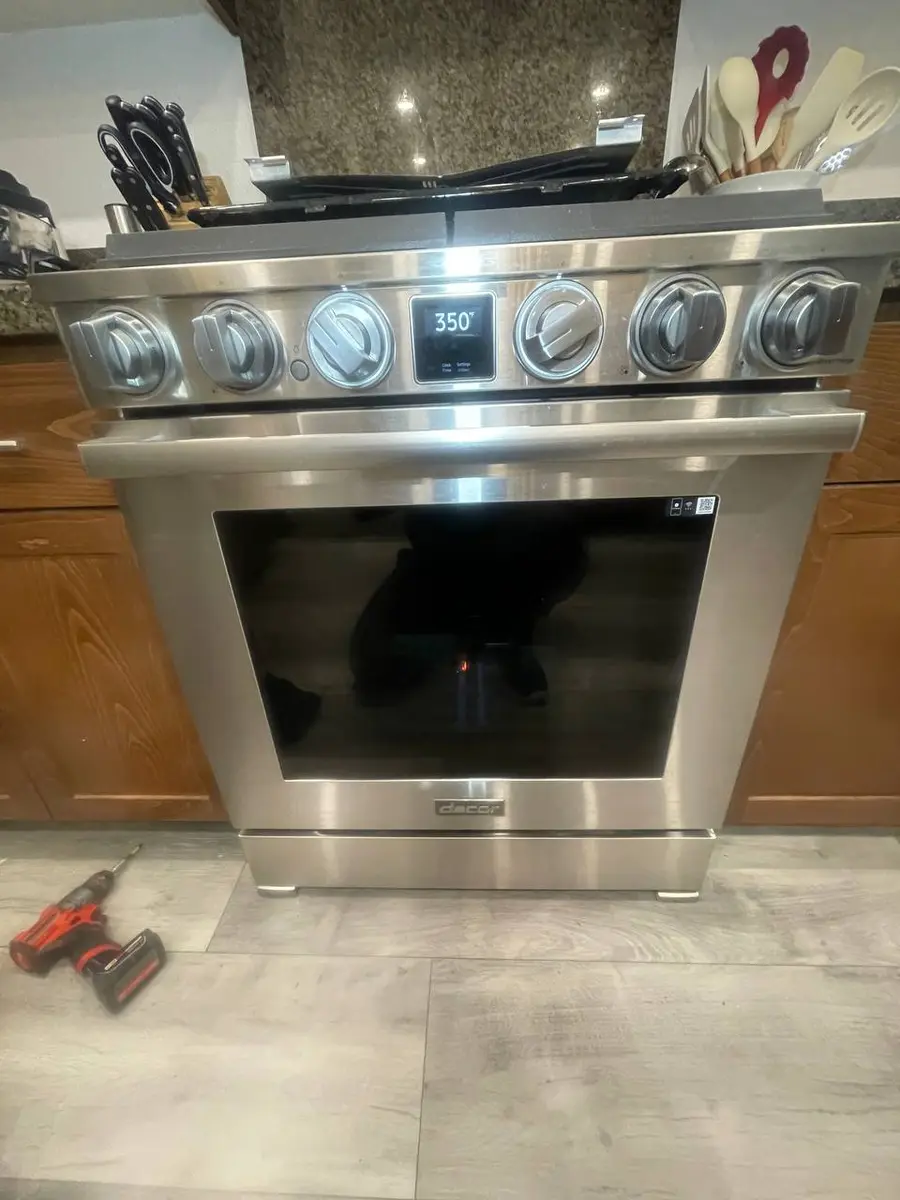
3 - Inspect the bake element. Pull the racks and set bake to 350°F. A healthy element glows evenly red-orange along its whole length within a couple of minutes; dark spots, uneven glow, or blistering mean it has failed. Kill power at once and check the element, part WB44T10011, held by two rear screws and a wire connector behind the wall.
4 - Test the convection fan. Select convection and, after preheat, open the door briefly to see the rear fan spinning behind its cover. A still fan means a failed motor, WB26X10210. On True European Convection the ring element heats the air the fan moves, so if the fan spins but heat stays uneven, the ring element is the suspect.
5 - Check the oven temperature sensor. If the oven overshoots, undershoots, or bakes unevenly, test the sensor, WB21X5301, a resistance probe on the rear wall. Cold at room temperature it should read about 1080 to 1090 ohms; a reading far off that means the sensor has drifted. Two screws inside the cavity hold it, with no rear-panel removal needed.
6 - Rule out the extras. GE Air Fry mode just runs the same convection fan faster, so uneven Air Fry with good normal bake hints at a failing fan bearing — and dark pans hurt Air Fry browning. If your model has a wired meat probe, a frayed or bent probe feeds the controller bad readings, so inspect and test it too.
If heating stays off#
- Slow preheat: both bake and broil run during preheat, so test the broil element as well.
- Igniter clicks nonstop but no flame: the spark works but gas is not arriving — check the supply valve behind the range.
- Browning uneven on one side: a door gasket leaking on one side lets heat escape — run the dollar-bill test around the door.
- An F3 or F4 code: a temperature-sensor circuit fault, so replace the sensor before the pricier control board.
Safety First — Know the Risks
Gas ovens involve live gas lines — a loose connection creates explosion and carbon monoxide risk. Electric ovens run on 240V circuits. Our techs are licensed and insured — let them handle the risk.
Licensed & Insured · 90-Day Warranty · Same-Day Service
When to call a professional#
Stop and get help immediately if you smell gas with the burner off — open windows, do not touch switches, and leave if it is strong. Call a technician for a bake element that has burned through and is arcing, for control-board codes a power-cycle will not clear, or for any gas safety-valve replacement, which needs proper leak testing.
Appliance Repair Technician & Diagnostics Specialist · 10 years experience
Electronics and diagnostics specialist with 10 years of experience in modern smart appliance repair, specializing in LG and Samsung.