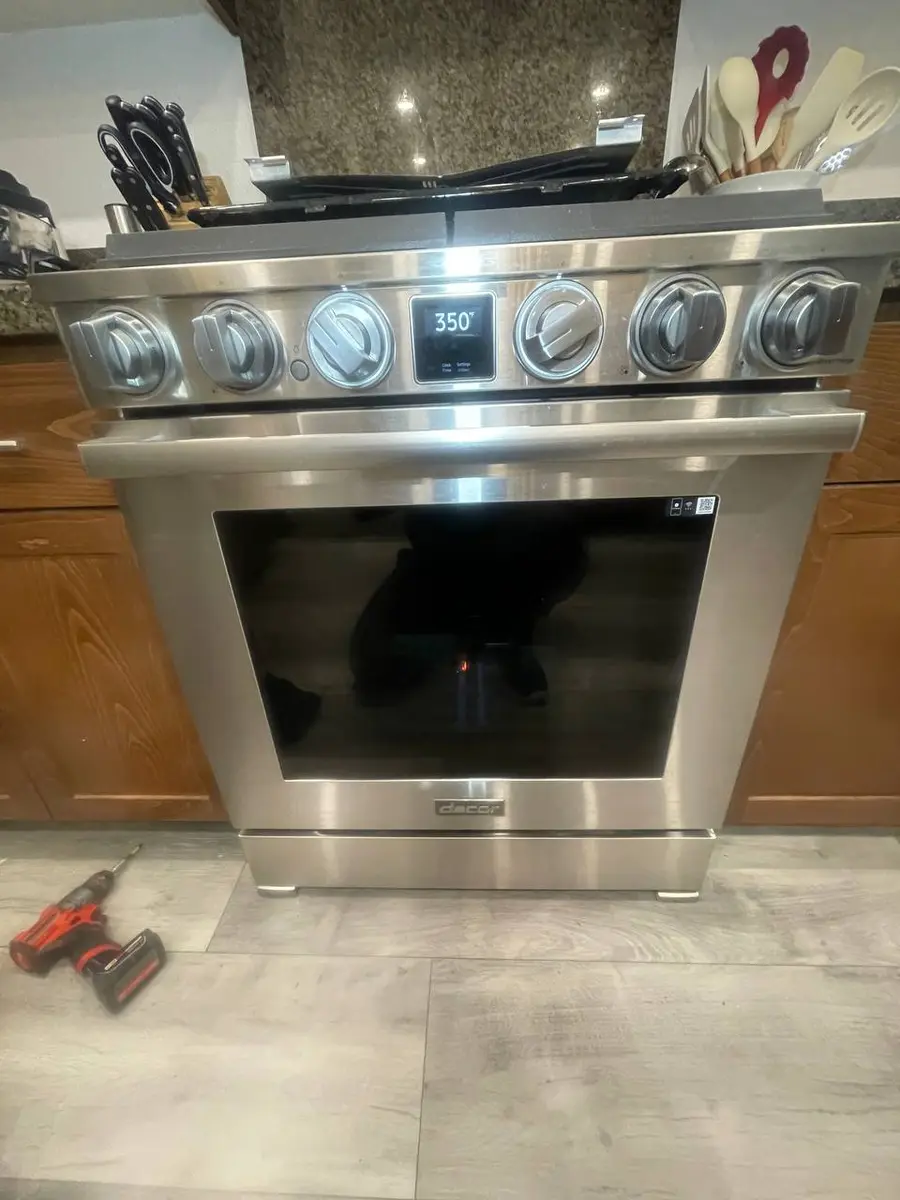
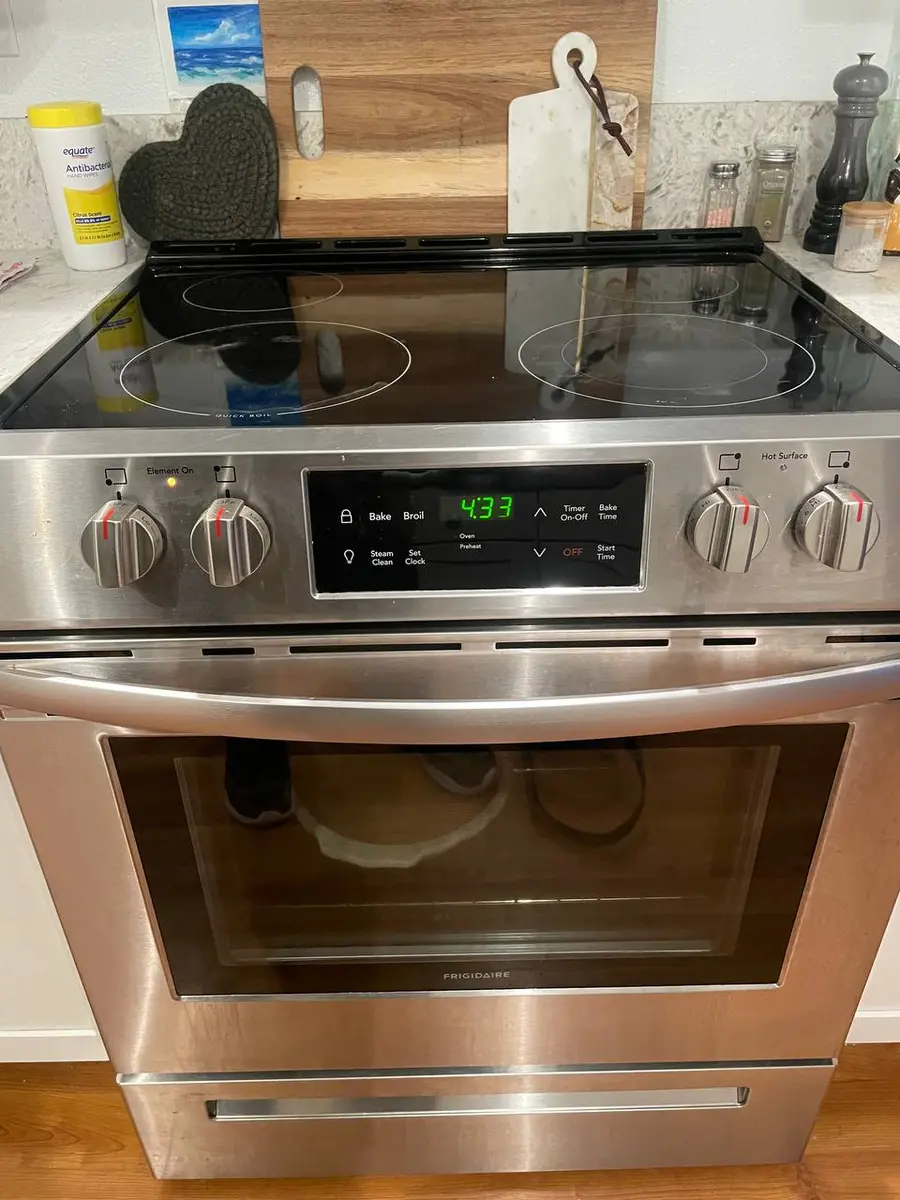
GE Cafe ranges and wall ovens — including the CGB500, CGS700, CHS900, and CTD90 series — are the design-forward choice in the GE lineup. With customizable hardware in six finishes (matte white, matte black, brushed bronze, brushed copper, brushed stainless, brushed brass), glass-touch control panels, true European convection, and SmartHQ Wi-Fi connectivity, these units varies and deliver features typically found only in professional-grade appliances at a more accessible price point.
Cafe ovens share the GE F-code error platform but add glass-touch panel considerations, connected diagnostics, and premium-component complexities that differentiate their troubleshooting from standard GE ranges. This guide covers every error code with Cafe-specific context that matters for diagnosis and repair decisions.
How Cafe Oven Error Codes Work#
Cafe ranges and wall ovens display error codes on the glass-touch LCD panel. The F-prefix codes indicate control and sensor faults — these are consistent across the GE platform. On dual-oven models (CHS900 double oven series), the code specifies which cavity is affected (upper or lower). The ERC (Electronic Range Control) board manages temperature regulation, heating element switching, door lock operation, and self-clean cycle coordination.
To reset most error codes: Touch the Cancel zone on the glass panel, then power off at the breaker for 60 seconds. Restore power and test. If the code reappears, the underlying fault persists and requires diagnosis.
SmartHQ note: Connected Cafe ovens push error notifications to the SmartHQ app immediately. Error history persists in the app even after you clear codes on the physical unit.
Do You Have the Right Tools?
Combustion analyzer ($300), igniter tester ($120), temperature calibrator ($150), and gas pressure manometer. Our technician arrives with $3,000+ in professional tools — your diagnostic is free.
Licensed & Insured · 90-Day Warranty · Same-Day Service
F0 — Stuck Key / Touch Panel Error#
F0 indicates a continuously activated touch zone on the glass control panel — the control board detects a capacitive input held for longer than the timeout threshold. This is one of the most common codes specifically on Cafe ranges because the glass-touch panels are inherently more sensitive to environmental factors than traditional membrane keypads used on standard GE models.
Common causes:
- Grease or liquid film on the glass touch surface (cooking splatter creates a conductive path that mimics a finger touch)
- Moisture from steam cooking migrating behind the glass panel seal during extended stovetop use
- Hairline crack in the glass panel creating a permanent phantom capacitive input
- Glass-touch panel controller IC malfunction from power surges
How to fix:
- Clean the entire glass touch panel with a non-abrasive glass cleaner and a lint-free microfiber cloth. Remove all grease film — even a thin, invisible-to-the-eye residue can trigger phantom inputs on capacitive touch surfaces.
- If F0 persists after thorough cleaning, power off at the breaker. Let the panel cool to room temperature and dry completely for at least 30 minutes (steam from stovetop cooking often condenses behind the panel seal during extended boiling or steaming).
- A proven moisture-clearing technique: run the oven at 200 degrees F for 30 minutes with the door cracked slightly open. This gently evaporates any moisture that has migrated behind the glass panel seal. Many F0 events on Cafe ranges resolve with this procedure alone.
- If F0 recurs after cleaning and drying, the glass-touch panel assembly needs replacement. Cafe glass-touch panels cost varies by model and region depending on the specific model and panel size.
Cafe-specific note: Cafe glass-touch panels are significantly more susceptible to moisture-induced F0 than standard GE membrane keypads. The design places the touch panel directly above the cooking surface on freestanding and slide-in ranges. Heavy stovetop boiling, steaming vegetables, pressure cooking, or canning directs steam upward directly into the touch panel area. A properly functioning range hood that vents to the outside (not a recirculating hood) dramatically reduces F0 recurrence. If your kitchen uses a recirculating range hood, consider upgrading to an external-venting model.
Part cost: Glass-touch panel varies by part. Professional repair: varies by part.
F1 — ERC / Control Board Fault#
F1 signals that the ERC board has detected an internal malfunction it cannot resolve through a standard power cycle reset. This is a board-level hardware or firmware failure.
Common causes:
- ERC board component failure (power relay, filter capacitor, microprocessor, or voltage regulator)
- Power surge damage from lightning, utility switching, or generator transfer
- Wiring fault or corrosion at one of the ERC multi-pin connectors
- Corrupted firmware (rare, but documented on SmartHQ-connected models after interrupted over-the-air updates)
How to fix:
- Power off at the breaker for a full 2 minutes (the ERC has capacitors that hold charge). Restore power. If F1 returns immediately on the display, the board has a persistent internal fault.
- Inspect the ERC board for visible damage: remove the back panel on freestanding ranges, or the upper access panel on wall ovens. Look for burn marks (typically near relays), swollen electrolytic capacitors (bulging or leaking tops), darkened PCB areas, or hairline solder cracks at heavy-component leads.
- Check all wiring connectors to the ERC for corrosion (green deposits on pins) or bent/pushed-back pins that prevent full connection. Reseat each connector firmly.
- If no visible damage is found and F1 persists after reseating all connectors, the ERC board requires replacement.
Cafe-specific note: Cafe ERC boards include the integrated Wi-Fi module for SmartHQ connectivity. When ordering a replacement board, you must match the connected/non-connected designation of your specific model. Installing a non-connected board in a connected model permanently disables SmartHQ (the app will not detect the unit after board replacement). Cafe ERC boards also differ functionally from both standard GE and Monogram boards — cross-referencing the complete model number (not just series name) is critical for correct part ordering.
Part cost: ERC board varies by part. Professional repair: varies by part.
Safety First — Know the Risks
Gas ovens involve live gas lines — a loose connection creates explosion and carbon monoxide risk. Electric ovens run on 240V circuits. Our techs are licensed and insured — let them handle the risk.
Licensed & Insured · 90-Day Warranty · Same-Day Service
F2 — Oven Over-Temperature#
F2 is a safety-critical code indicating the oven cavity temperature has exceeded the programmed set point by a dangerous margin (typically 50+ degrees F above set temperature). This represents a potential fire safety concern and must be addressed before the oven is used again.
Common causes:
- Oven temperature sensor failure (reading falsely low, causing the ERC to continue applying heat past the actual safe temperature)
- Bake or broil relay stuck in the closed position on the ERC board (power flows continuously to the heating element regardless of temperature reading)
- Convection fan malfunction creating concentrated hot spots near the sensor location
- Sensor wiring partial short to the metal oven frame, causing a false low-resistance reading that the ERC interprets as a low temperature
How to fix:
- Press Cancel immediately on the glass-touch panel and open the oven door to ventilate heat. Power off at the breaker — do not continue using the oven.
- After the oven cools to room temperature, test the temperature sensor resistance at the sensor connector: approximately 1,080 ohms at 70 degrees F. If the reading is significantly low (below 800 ohms at room temperature), the sensor or its wiring is partially shorted, causing the ERC to under-read the actual cavity temperature and continue powering the heating elements.
- Inspect the sensor wire where it passes through the oven cavity wall — thermal insulation damage at this penetration point is common and creates a partial short to the metal oven frame.
- If the sensor tests correctly (1,080 ohms at room temp), the bake or broil relay on the ERC board may be stuck in the closed (conducting) position. This requires ERC board replacement — a stuck relay cannot be repaired individually on modern ERC boards.
Cafe-specific note: Cafe true convection ovens circulate air more aggressively than standard GE ovens using a rear-mounted fan and a dedicated third heating element. This powerful airflow can occasionally create localized hot spots near the temperature sensor location, especially if the convection fan motor has developed bearing wear that causes wobble and uneven air distribution. If F2 appears during convection baking but never during standard (non-convection) baking, inspect the convection fan for smooth, balanced operation.
Warning: F2 is a fire safety code. Do not use the oven for any purpose until repaired and verified. Keep the breaker off until a qualified technician diagnoses and resolves the root cause.
Part cost: Temperature sensor varies by part. ERC board varies by part. Convection fan motor varies by part. Professional repair: varies by part.
F3 — Open Oven Sensor Circuit#
F3 means the oven temperature sensor circuit is electrically open — the sensor wire is broken somewhere between the sensor element and the ERC board, or the sensor element itself has failed in an open-circuit state.
Common causes:
- Sensor element thermal fatigue failure (common after 5+ years of service or after frequent self-clean cycles at 900+ degrees F)
- Broken sensor wire where it passes through the oven cavity wall (thermal expansion cycles cause metal fatigue at this stress point)
- Disconnected sensor plug at the back of the range or behind the wall oven upper access panel
- Corroded connector pins creating high resistance that reads as an open circuit
How to fix:
- Power off at the breaker. Locate the sensor plug — on Cafe freestanding ranges, it is at the back of the unit near the top behind the rear panel. On wall ovens, it is behind the upper access panel.
- Disconnect the sensor plug and measure resistance at the sensor leads with a multimeter: approximately 1,080 ohms at 70 degrees F room temperature. An infinite (OL) reading confirms the sensor element or wire is broken.
- If the connector reads open, disconnect the sensor from inside the oven cavity (the sensor mounts at the top-rear of the oven with 1–2 screws) and test directly at the sensor body terminals. If the body reads the correct resistance, the wiring between the sensor and the back connector is broken — trace the harness and repair or replace.
- If the sensor body reads open circuit, the sensor element has failed and needs replacement.
Cafe-specific note: Cafe self-clean cycles reach 900+ degrees F, which puts extreme thermal stress on the sensor element and its wiring. If F3 appeared during or immediately after a self-clean cycle, thermal fatigue is almost certainly the cause. Cafe models offer a Steam Clean alternative that operates at a much lower temperature (approximately 250 degrees F with steam) — using Steam Clean instead of traditional self-clean extends sensor life significantly. The trade-off is that Steam Clean does not handle heavy baked-on soil as effectively.
Part cost: Temperature sensor varies by part. Wiring harness varies by part. Professional repair: varies by part.
The Real Cost of DIY
Average DIY attempt: $150-400 in tools you may use once, plus the risk of further damage. Our diagnostic visit costs $0 — we find the problem and give you an honest quote.
Licensed & Insured · 90-Day Warranty · Same-Day Service
F4 — Shorted Oven Sensor Circuit#
F4 is the complement to F3 — the sensor circuit has an abnormally low resistance (short), reading well below the expected 1,080 ohms at room temperature.
Common causes:
- Sensor wire insulation damage causing the conductor to short against the metal oven frame (ground short)
- Sensor element internally shorted (resistance approaches zero)
- Moisture in the sensor connector creating a low-resistance path between pins
How to fix:
- Power off at the breaker. Disconnect the sensor plug at the back of the range.
- Measure resistance at the sensor leads: a shorted sensor reads near 0 ohms or very low (below 200 ohms at room temperature). Normal is approximately 1,080 ohms.
- Disconnect the sensor from both ends (at the back connector AND at the sensor element inside the oven). Measure resistance at the sensor element body alone. If it reads normal, the wiring has a short to ground — the wire insulation is damaged and contacting the metal oven frame somewhere along its path.
- If the sensor element itself reads shorted (near 0 ohms), the element has failed and needs replacement.
Cafe-specific note: On Cafe slide-in ranges (CHS900, CGS700), the sensor wire routes through a tight sheet-metal channel between the oven cavity liner and the outer cabinet shell. Thermal expansion during self-clean cycles can gradually press the wire against sharp sheet metal edges, wearing through the insulation over multiple self-clean events. When replacing the sensor, inspect the wire routing path and add heat-resistant wire loom or insulation tape at any contact points to prevent recurrence.
Part cost: Temperature sensor varies by part. Professional repair: varies by part.
F5 — ERC Board Failure (Self-Diagnosed)#
F5 is an ERC self-diagnostic code indicating the board has identified an internal hardware failure in its own circuitry. The board is functional enough to detect and report the problem but cannot operate the oven safely. No amount of sensor or panel troubleshooting will resolve F5.
Common causes:
- Internal relay failure (a relay coil has opened or contacts have welded)
- Power component degradation from age, thermal cycling, or power quality issues
- Solder joint cracking from years of thermal expansion at relay and transformer pads
How to fix:
- Power off at the breaker for 5 full minutes. Restore power. If F5 returns immediately, the board has a confirmed, non-transient internal fault.
- Visual inspection of the board is optional but can confirm the specific failure — look for darkened areas around relays, cracked solder at large component leads, or discolored relay housings.
- Replace the ERC board. Match the exact part number for your specific Cafe model and connectivity configuration.
Cafe-specific note: Cafe ERC boards with SmartHQ functionality occasionally receive over-the-air firmware updates that address certain transient F5 conditions caused by software timing issues rather than hardware failure. If your unit is connected to SmartHQ and the F5 code appeared only once (not recurring), check for available firmware updates in the SmartHQ app before ordering a board. In rare documented cases, a firmware update has resolved F5 without hardware replacement. However, if F5 recurs or persists through multiple power cycles, hardware failure is confirmed.
Part cost: ERC board varies by part. Professional repair: varies by part.
Don't Void Your Warranty
Opening your appliance yourself may void the manufacturer warranty. Our repair comes with a 90-day guarantee, and we document everything for warranty compliance.
Licensed & Insured · 90-Day Warranty · Same-Day Service
F7 — Stuck Function Key#
F7 differs from F0 in specificity — F7 indicates a particular function key (Bake, Broil, Convection, Self-Clean, etc.) is registering as continuously pressed, while F0 is a general stuck-key detection. F7 helps narrow the fault to a specific physical section of the glass-touch panel.
Common causes:
- Single touch zone delaminated or cracked
- Grease accumulation specifically under one section of the panel (near a specific button)
- Ribbon cable trace failure affecting the capacitive circuit for one particular zone
How to fix:
- Clean the specific area of the panel corresponding to the stuck function indicated in the error.
- If F7 persists after cleaning, the glass-touch panel section for that particular function has permanently failed. Full panel replacement is required — Cafe glass-touch panels cannot be partially repaired or zone-patched.
- Note which function triggers F7 and report this to the technician — it speeds diagnosis and confirms the panel (not the board) is the fault source.
Part cost: Glass-touch panel varies by part. Professional repair: varies by part.
F9 — Door Lock Circuit Error#
F9 indicates the oven door lock mechanism is not responding properly to commands from the ERC. This typically surfaces during or after self-clean cycles, which require the door to be locked for safety.
Common causes:
- Door lock motor failure (the small motor that drives the lock bar has burned out)
- Lock position switch not registering the locked or unlocked state
- Wiring fault between the lock assembly and the ERC board
- Door latch mechanism physically jammed (food debris, warped latch)
How to fix:
- If the oven is hot (during or after self-clean), wait for complete cool-down — this can take 1–2 hours. Do not attempt to force the door open.
- Power cycle at the breaker for 2 minutes. The lock motor should attempt to reset to the unlocked position.
- If the door remains locked after cool-down and power cycle, access the lock mechanism from the top of the unit (remove the back panel on freestanding models or the top access panel on slide-ins) and manually release the lock lever.
- Test the lock motor and position switch for continuity and proper mechanical operation. Replace the complete door lock assembly if the motor does not engage or the switch contacts are worn.
Cafe-specific note: Cafe slide-in ranges (CHS900, CGS700) have a door lock mechanism accessed from the top of the unit after removing the glass cooktop surface (electric) or the burner grate/drip pan assembly (gas). This is significantly more involved than freestanding ranges where the lock is accessible from the rear panel. Professional service is recommended for lock replacement on slide-in models to avoid damaging the glass top or gas connections during access.
Part cost: Door lock assembly varies by part. Professional repair: varies by part.
Is It Worth Your Time?
Oven temperature issues require systematic testing of the igniter, gas valve, thermostat, and calibration. Average DIY: 4-6 hours. Our technician diagnoses the issue in about 30 minutes — same-day appointments available.
Licensed & Insured · 90-Day Warranty · Same-Day Service
FD — Meat Probe Circuit Error#
FD appears when the control board detects a short in the meat probe circuit — either the probe itself is damaged or the jack inside the oven is contaminated.
How to fix:
- Remove the meat probe from the oven jack completely.
- Clean the probe jack inside the oven cavity with a dry cotton swab. Grease and food splatter from cooking is the number one cause of FD — conductive residue across the jack pins creates a false short reading.
- Inspect the probe cable for visible damage — cuts, kinks, melted insulation near the connector end.
- Test probe resistance at room temperature with a multimeter: approximately 50,000 ohms. A reading near 0 ohms indicates the probe is internally shorted and needs replacement.
- If FD persists with no probe inserted and the jack cleaned, the jack receptacle itself has internal contamination or a short — replace the jack assembly.
Part cost: Meat probe varies by part. Probe jack receptacle varies by part.
Additional Cafe Oven Codes#
- F8 — ERC internal fault (similar to F5 but a different internal failure mode). Board replacement required. Same part and cost as F5.
- LOC — Control lock active. Press and hold the Lock touch zone for 3–5 seconds until LOC disappears. This is a feature, not a fault.
- SAB — Sabbath mode active (all lights, sounds, and displays suppressed during Sabbath observance). Deactivate through the settings menu or SmartHQ app.
- PF — Power failure acknowledged. Press any button to clear. Check breaker and power supply stability.
The Risk of Getting It Wrong
A wrong diagnosis often turns a simple fix into a costly replacement. Without proper diagnostic tools, you might replace the wrong part — or cause additional damage. Our free diagnostic eliminates the guesswork.
Licensed & Insured · 90-Day Warranty · Same-Day Service
SmartHQ Diagnostics for Cafe Ovens#
Connected Cafe ovens provide remote diagnostic capabilities through the SmartHQ app:
- Error notifications: Receive immediate alerts when an error occurs, including the specific code and contextual troubleshooting suggestions.
- Real-time sensor data: View live oven temperature, current sensor resistance readings, and heating element activation status.
- Error history log: The last 20 error codes with precise timestamps, preserved even after manual code clearing on the unit.
- Remote preheat: Start oven preheating remotely to test functionality after a repair without standing in the kitchen waiting.
Frequently Asked Questions#
Q: Are GE Cafe oven error codes the same as standard GE range codes? A: The F-code system (F0–F9, FD) is shared across all GE oven and range products — the codes mean the same thing regardless of sub-brand. However, Cafe models use glass-touch panels instead of traditional membrane keypads, which makes F0 and F7 significantly more common on Cafe units due to the panel's sensitivity to moisture and grease. ERC control boards are physically different and not interchangeable between Cafe and standard GE. SmartHQ remote diagnostics are Cafe-specific.
Q: Why does my Cafe range show F0 after boiling water on the stovetop? A: Steam from stovetop cooking rises directly into the glass-touch control panel area on freestanding and slide-in Cafe ranges. This moisture condenses on or behind the glass surface, creating phantom capacitive inputs that trigger F0. Use your range hood on high while doing any steam-producing stovetop cooking (boiling pasta, steaming vegetables, canning, pressure cooking). Dry the control panel surface afterward. If F0 recurs frequently, your range hood ventilation may be inadequate — external-venting hoods are far more effective than recirculating types for this issue.
Q: My Cafe oven temperature seems inaccurate but no error code appears. What should I do? A: Temperature drift without an error code means the sensor is drifting gradually but still reads within the range the ERC considers acceptable (roughly plus or minus 50 degrees F from actual). You can compensate using the oven temperature calibration feature in settings (typically adjustable up to plus or minus 35 degrees F). If the inaccuracy exceeds what calibration can correct, or if an F2/F3/F4 code eventually appears, the sensor needs physical replacement.
Q: How do I identify the correct ERC board part number for my Cafe model? A: The full model number is printed on a label inside the oven door frame (open the door and look at the left or right frame edge). Cafe part numbers are strictly model-specific — even two Cafe ranges that look nearly identical can use different ERC boards depending on feature set (gas vs electric, single vs double oven, slide-in vs freestanding, SmartHQ-connected vs non-connected). Always cross-reference using the complete model number.
Q: Can Sacramento power surges damage my Cafe oven electronics? A: Yes. GE Cafe glass-touch panels and ERC boards contain sensitive digital electronics that are vulnerable to voltage spikes. Sacramento summer brownouts (voltage drops during peak afternoon AC demand) followed by voltage restoration surges are documented triggers for F1, F5, and F8 codes. A dedicated appliance surge protector (not a standard power strip) provides protection for plug-in ranges. For hardwired wall ovens and slide-in ranges, a whole-house surge protector installed at the main breaker panel is the appropriate protection strategy.
Free Diagnostic Visit — Zero Risk
Our certified technician comes to your home, diagnoses the problem with professional tools, and gives you an honest quote — all at zero cost. No parts markup, no hidden fees. If you decide not to proceed, you pay nothing.
Licensed & Insured · 90-Day Warranty · Same-Day Service
Professional Cafe Oven and Range Service#
GE Cafe ranges combine premium aesthetics with advanced cooking technology — and the glass-touch panels, true convection systems, and SmartHQ connectivity require technicians who understand Cafe-specific engineering. EasyBear is trained on the full Cafe product line and carries common Cafe parts including temperature sensors, door lock assemblies, and control components. We provide free diagnostic visits — our technician identifies the exact error code cause, explains your options clearly, and completes the repair on-site in most cases. Every repair is backed by our 90-day parts and labor warranty. Schedule your free diagnosis today.
Senior Gas Appliance Specialist · 18 years experience
AGA-certified gas appliance specialist with 18 years of experience in residential and commercial oven, range, and cooktop repairs.