Standard Refrigerator Dimensions: Which Style?
Standard refrigerators run 28 to 36 inches wide and 61 to 71 inches tall, but the case size is not what decides the purchase — your alcove is. Take 1 inch off each side and 1 to 2 inches off the back for clearance, and read what is left against the fit table below.
How big is a standard refrigerator?#
The width on the spec sheet and the width you can actually use are two different numbers. A standard refrigerator needs 1 inch of air on each side and 1 to 2 inches behind it for the condenser coils and the water line, so an alcove that measures 33 inches takes a case around 31 inches, not 33. The table below gives the case sizes for the four common styles; the fit table under it turns the opening you measured into the styles that survive those clearances.
Standard refrigerator dimensions by configuration#
| Configuration | Width (in) | Height (in) | Depth (in) | Best for |
|---|---|---|---|---|
| Standard-depth top-freezer | 28–33 | 61–69 | 30–34 | budget kitchens with a deep cabinet run |
| Bottom-freezer | 29–33 | 67–70 | 33–36 | easy fresh-food access at eye level |
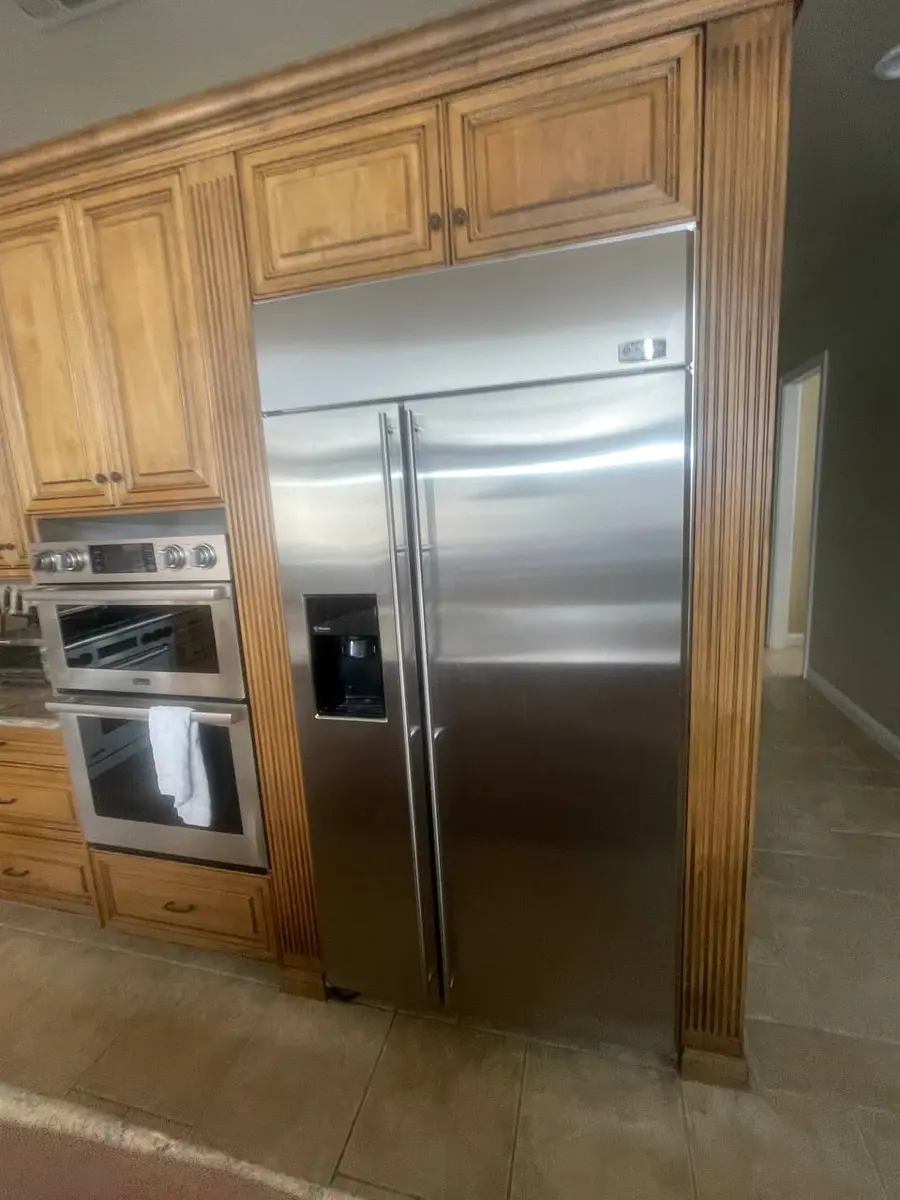
| Standard-depth side-by-side | 32–36 | 66–71 | 33–35 | narrow kitchens needing tall storage |
| Standard-depth French door | 29–36 | 68–70 | 33–36 | wide produce drawers and a roomy fridge |
Do You Have the Right Tools?
Refrigerant gauges ($200+), vacuum pump ($250), leak detector ($150), and EPA-certified recovery equipment. Our technician arrives with $3,000+ in professional tools — your diagnostic is free.
Licensed & Insured · 90-Day Warranty · Same-Day Service
Match the opening you measured to a refrigerator style#
Measure the alcove at its narrowest point — cabinet face to cabinet face, and floor to the underside of the upper cabinet — then find your number in the left column.
| Opening you measured (width) | Largest case it takes | Styles in that range | What still has to check out |
|---|---|---|---|
| 30 in | 28 in | Standard-depth top-freezer only, at the bottom of its 28–33 in range | Depth: a top-freezer is 30–34 in deep and still needs 1–2 in behind it, so the alcove has to be deeper than the case by that much |
| 33 in | 31 in | Top-freezer (28–33 in), bottom-freezer (29–33 in), French door at its narrow end (29–36 in) | Height: bottom-freezer and French door run 67–70 in — measure to the underside of the upper cabinet, not to the ceiling |
| 36 in | 34 in | All four, side-by-side included (32–36 in) | Door swing: 30 in of clear floor in front, or the crisper drawers never pull all the way out |
| 38 in or more | 36 in | All four at the top of their ranges | Rough opening: frame it about 1 in wider than the case so the unit slides in without scraping the cabinet sides |
Four styles are counted above — top-freezer, bottom-freezer, side-by-side and French door — and each span is the case-size range published for that style on manufacturer installation sheets, not a tally of the models on any one shop floor. A given model sits somewhere inside its span, so frame the alcove to that model’s sheet rather than to the widest number here.
Installation clearances for a standard refrigerator#
- Rear clearance: 1–2 in in behind a standard refrigerator for the condenser coils and water line.
- Side clearance: 1 in in on each side so a standard refrigerator can shed heat and the doors clear the cabinet.
- Top clearance: 1 in in above a standard refrigerator for airflow across the top vent.
- Door swing: 30 in in of front space for a standard refrigerator door to open fully and pull the drawers out.
- Rough opening: 1 in in wider than the refrigerator case when framing the alcove so it slides in without scraping.
Safety First — Know the Risks
Refrigerant (R-134a/R-600a) requires EPA certification to handle. Improper discharge is a federal violation and health hazard. Our techs are licensed and insured — let them handle the risk.
Licensed & Insured · 90-Day Warranty · Same-Day Service
Will your standard refrigerator fit? Clearances and door swing#
Start by measuring the cabinet or wall opening in all three directions, then compare it against the case dimensions in the table rather than the door-front numbers. A standard refrigerator needs 1 to 2 inches of rear clearance for the condenser coils and water line, about 1 inch on each side so it can shed heat and the doors clear the cabinet, and roughly 1 inch above the top vent. Frame the rough opening about 1 inch wider than the case so the unit slides in without scraping. Finally, leave around 30 inches of unobstructed space in front so the door can swing fully open and the crisper drawers pull all the way out; in a galley kitchen, check that an open door will not block the opposite counter or a walkway.
Standard refrigerator sizes by type: standard-depth top-freezer, bottom-freezer, standard-depth side-by-side, standard-depth french door#
The four configurations in the table trade footprint for access in different ways. A standard-depth top-freezer, at 28 to 33 inches wide and 61 to 69 inches tall, is the most compact and budget-friendly, ideal for a deep cabinet run or a rental. A bottom-freezer, 29 to 33 inches wide but taller at 67 to 70 inches, keeps fresh food at eye level. A standard-depth side-by-side spans 32 to 36 inches wide and 66 to 71 inches tall, splitting the box vertically so narrow doors need less swing room in a tight kitchen. A standard-depth French door, 29 to 36 inches wide and 68 to 70 inches tall, gives the widest produce drawers and the roomiest fridge section, but at 33 to 36 inches deep it projects well past the counter.
Senior Appliance Repair Technician · 15 years experience
EPA-certified technician with 15 years of experience specializing in refrigerator and cooling system repairs.