Side-by-Side Refrigerator Dimensions: Alcove Fit
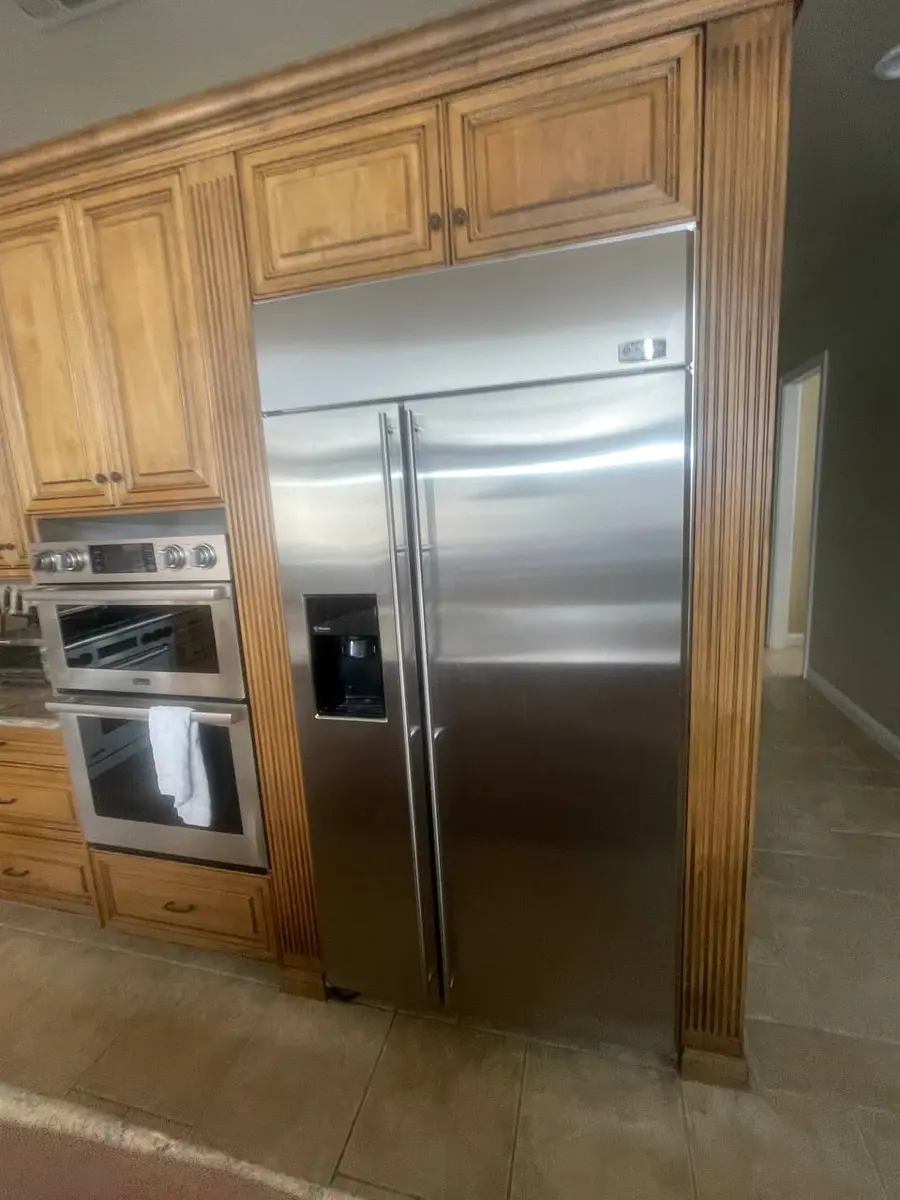
Side-by-side cases run 30 to 39 inches wide and 66 to 71 inches tall. The style’s real advantage is the narrow doors: 24 inches of front clearance opens either one, so a galley too tight for a single wide door can still take a side-by-side.
How big is a side-by-side refrigerator?#
A side-by-side refrigerator is 30 to 39 inches wide, 66 to 71 inches tall and 28 to 35 inches deep across the three classes below. What the width alone hides is the reason people choose this style in the first place: each door is half the box, so 24 inches of front clearance opens either one — a galley that cannot take a single wide door often takes a side-by-side comfortably. The table under the specifications reads your alcove and your aisle back as a verdict.
Side-by-side refrigerator dimensions by configuration#
| Configuration | Width (in) | Height (in) | Depth (in) | Best for |
|---|---|---|---|---|
| Standard-depth side-by-side | 32–39 | 66–71 | 29–35 | tall frozen and fresh storage side by side |
| Counter-depth side-by-side | 32–36 | 69–71 | 28–31 | a flush look in a narrow kitchen |
| Compact side-by-side | 30–33 | 66–69 | 29–33 | smaller kitchens that still want two doors |
Do You Have the Right Tools?
Refrigerant gauges ($200+), vacuum pump ($250), leak detector ($150), and EPA-certified recovery equipment. Our technician arrives with $3,000+ in professional tools — your diagnostic is free.
Licensed & Insured · 90-Day Warranty · Same-Day Service
The alcove and the aisle you measured, read back#
Measure the alcove at its narrowest point and to the underside of the upper cabinet, then the aisle in front of the door face. Your tightest number decides.
| What you measured | Class it takes | What still has to check out |
|---|---|---|
| An opening 32 in wide | Compact (30–33 in) at its wide end, or counter-depth (32–36 in) at its narrow end | The 1 in of side clearance comes off first, so a 32 in opening takes a case near 30 in — not a 32 in one |
| An opening 36–40 in wide | Any class, standard-depth included (32–39 in) | Frame the rough opening about 1 in wider than the case, or it scrapes going in |
| Alcove depth 28–31 in | Counter-depth only (28–31 in deep) | Add the 1 to 2 in behind for the coils, the water line and the heat exhaust — a counter-depth case still needs it |
| An aisle of 24 in from the door face | Any class — this is the style’s advantage | Each narrow door opens independently on 24 in; leave the dispenser side the clearer of the two |
| An opening height under 69 in | Compact (66–69 in), or standard-depth at its short end (66–71 in) | Counter-depth starts at 69 in, so it is the class that loses to the upper cabinet first |
Three configurations are counted above, and their widths overlap by design: the classes are defined by depth and door arrangement, not by width. That is why an opening measurement alone rarely picks a class, and why the depth row is doing most of the work in the table.
Installation clearances for a side-by-side refrigerator#
- Door swing: 24 in in of front clearance a side-by-side refrigerator needs — less than a French door because each narrow door opens independently.
- Rear clearance: 1–2 in in behind a side-by-side refrigerator for the coils, water line, and heat exhaust.
- Side clearance: 1 in in beside a side-by-side refrigerator so both doors and the dispenser clear the cabinet.
- Rough opening: 1 in in wider than the side-by-side case so it slides into the alcove cleanly.
Safety First — Know the Risks
Refrigerant (R-134a/R-600a) requires EPA certification to handle. Improper discharge is a federal violation and health hazard. Our techs are licensed and insured — let them handle the risk.
Licensed & Insured · 90-Day Warranty · Same-Day Service
Will your side-by-side refrigerator fit? Clearances and door swing#
A side-by-side splits the box into two tall, narrow doors, so each one needs about 24 inches of swing — more than a French door but less than a single wide fridge door — which is why it works well in a galley layout. Measure the opening width, height, and depth, then match the case to the table; standard-depth models reach 29 to 35 inches deep while counter-depth ones stop at 28 to 31 inches. Leave 1 to 2 inches at the back for the coils and water line, about 1 inch on each side for heat, and frame the rough opening roughly 1 inch wider than the case. Because both doors are narrow, this style rarely blocks a walkway when open.
Side-by-side refrigerator sizes by type: standard-depth side-by-side, counter-depth side-by-side, compact side-by-side#
The three side-by-side options span a wide size range. A standard-depth side-by-side, 32 to 39 inches wide and 66 to 71 inches tall, offers the largest capacity and the widest choice of models. A counter-depth side-by-side, 32 to 36 inches wide and 69 to 71 inches tall, trims the depth to 28 to 31 inches for a flush, built-in look. A compact side-by-side, 30 to 33 inches wide and 66 to 69 inches tall, is the narrowest and shortest, made for apartments or a second kitchen. All three keep the same tall, twin-door design with its roughly 24-inch door swing.
Appliance Repair Technician & Diagnostics Specialist · 10 years experience
Electronics and diagnostics specialist with 10 years of experience in modern smart appliance repair, specializing in LG and Samsung.