Samsung vs Whirlpool Refrigerator
Want the smartest refrigerator on the market? Family Hub is unrivalled and nothing Whirlpool builds competes with it. Want the one that stays out of the shop and is cheap to put right when it does not? Whirlpool, comfortably. Both average 13-16 years, so this is a choice between features and serviceability, not…
The serviceability gap#
Whirlpool's advantage is unglamorous: the widest parts availability in the industry, a modular ice maker platform refined over decades, and Adaptive Defrost that keeps the cycle sensible. Individual components replace one at a time, aftermarket alternatives exist for most of them, and the average repair costs less as a result.
Samsung's advantage is the machine itself: the Family Hub touchscreen, a FlexZone compartment that converts between fridge and freezer, Twin Cooling Plus running the two compartments independently, and styling that makes a Whirlpool look like a Whirlpool.
| Samsung | Whirlpool | |
|---|---|---|
| Ice maker | Most-serviced component on the brand | Lowest failure rate of any mainstream maker |
| Parts | Some proprietary, some diagnostics need brand tools | Widest availability, aftermarket options common |
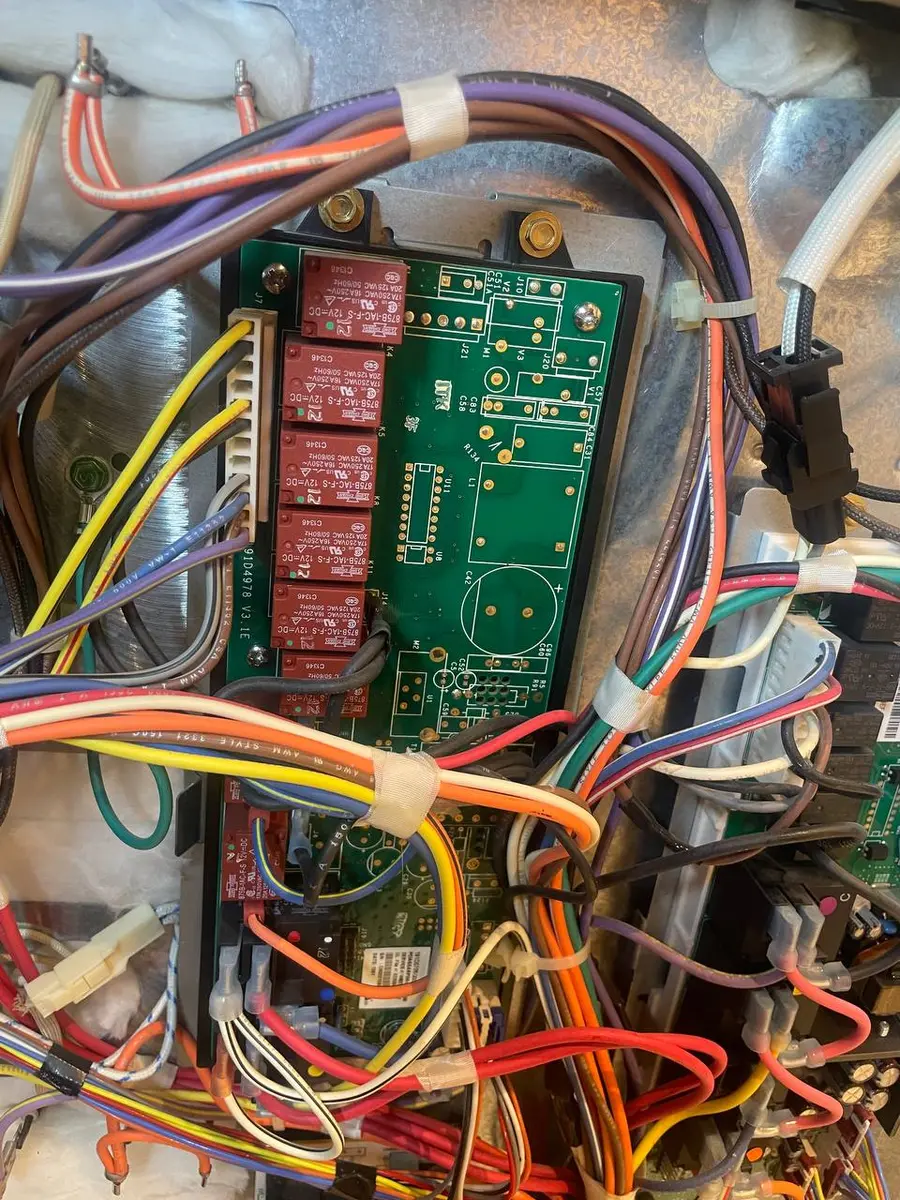
| Electronics | Boards fail around 5-7 years; Family Hub screen is one replaceable unit | Control lock quirks; LED light boards on newer models |
| Ages out via | Dispenser leaks, dust-choked condenser coils | Condenser fan motors at 7-10 years |
Where each brand actually costs you money#
On the Samsung side, ice makers dominate the call sheet, particularly on the RF28 and RF263 series where the design has been revised repeatedly. Water dispensers leak from an inlet valve, a cracked tank, worn actuator seals, or a line damaged inside the door. Control boards run compressor, defrost and dispenser duties, and on French door cabinets condensation collects on the board housing until the conformal coating gives up. The Family Hub screen bundles a display, a computing module and a camera into one part that replaces as a single unit — expensive, but it only reports temperature, so a dead screen never stops the cooling. Coils sit under the cabinet behind a removable grille and pack with dust, which forces long compressor cycles until someone cleans them.
On the Whirlpool side, the list is shorter and cheaper. Control locks activate on their own or refuse to release, usually because moisture from the gasket area is triggering the touch button. Condenser fan motors fail somewhere around 7-10 years, and then the compressor overheats and cycles on its thermal protector, giving you a fridge that cools intermittently. LED light boards burn out as a unit rather than as a single bulb, though aftermarket boards cost less than the factory part. Defrost heaters do fail, but they are standardised across many model years and available from several suppliers. Even Whirlpool ice makers show up occasionally — just far less often than Samsung's.
Do You Have the Right Tools?
Refrigerant gauges ($200+), vacuum pump ($250), leak detector ($150), and EPA-certified recovery equipment. Our technician arrives with $3,000+ in professional tools — your diagnostic is free.
Licensed & Insured · 90-Day Warranty · Same-Day Service
The verdict#
Buy Samsung for smart features, app control, the convertible drawer and modern looks. Buy Whirlpool if low repair costs, traditional controls and easy parts sourcing sit at the top of your list. Samsung typically costs more per average repair and carries the higher ice maker failure rate; Whirlpool gives up the screen and the styling in exchange.
Post-2021 Samsung models have narrowed the ice maker gap considerably, so if you want the features, buy a recent one rather than a leftover.
We service both brands daily and stock parts for each. Book a repair.
Appliance Repair Technician & Diagnostics Specialist · 10 years experience
Electronics and diagnostics specialist with 10 years of experience in modern smart appliance repair, specializing in LG and Samsung.