Refrigerator Amps, Watts & Breaker Size
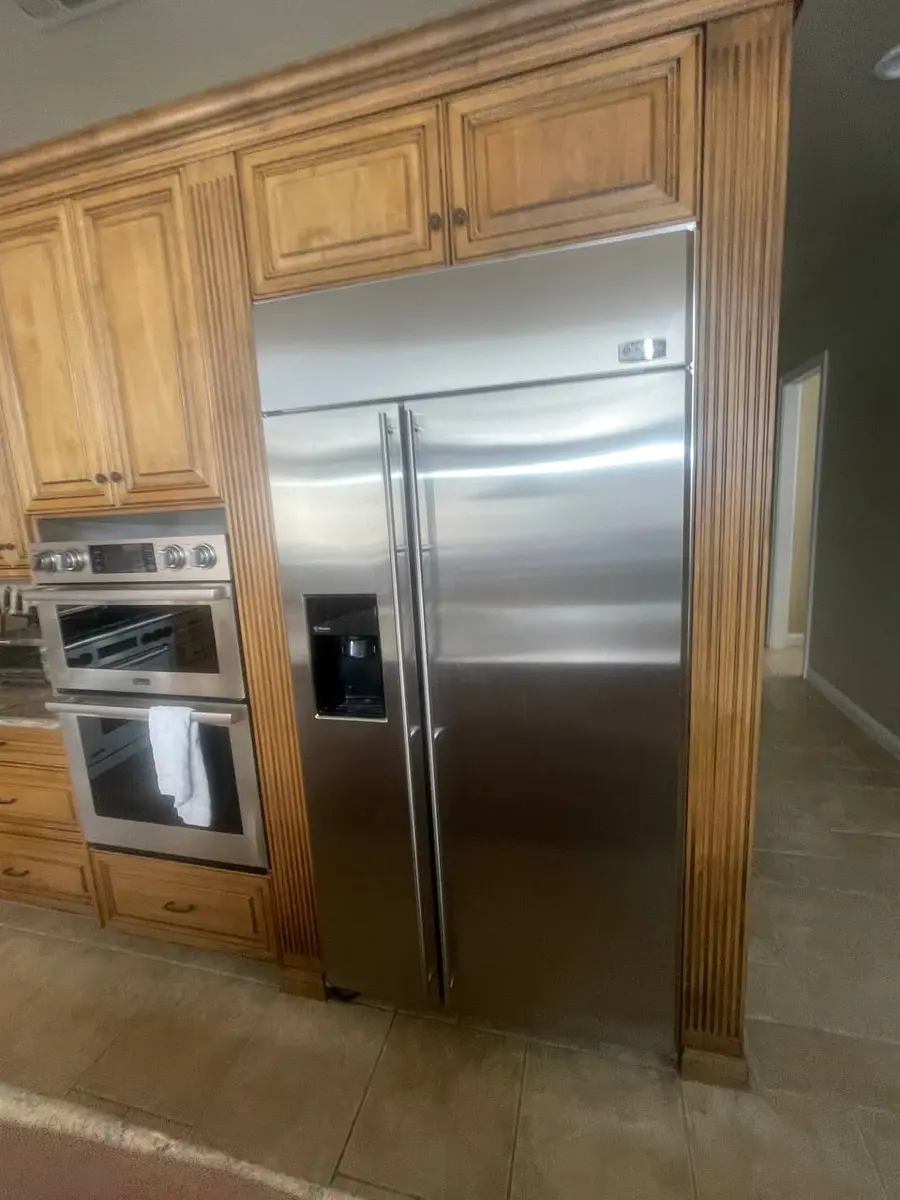
A refrigerator is a light load: 3 to 6 A and 250 to 700 W on a 15 A circuit, or about 6 A and 700 W on 20 A for a built-in or counter-depth model. The circuit rating is almost never the problem. What the outlet behind it is sharing, and whether anything sits between the plug and the wall, is.
Refrigerator Power Requirements at a Glance#
A kitchen refrigerator runs on a 120 V outlet and draws modestly — a standard top-freezer or side-by-side pulls about 3 to 6 A and 250 to 700 W on a 15 A circuit through a 5-15R receptacle, while a built-in or counter-depth model draws about 6 A and 700 W and is often specified for a 20 A circuit with a 5-20R outlet. Those numbers explain why a fridge almost never overloads a branch on its own, and why the failures that do happen are about company: what else is on that circuit, and what is between the plug and the wall.
Refrigerator Electrical Specifications#
| Configuration | Voltage | Amps | Watts (max load) | Breaker | Outlet (NEMA) |
|---|---|---|---|---|---|
| Standard top-freezer or side-by-side refrigerator | 120 V | 3–6 A | 250–700 W | 15 A | 5-15R |
| Built-in or counter-depth refrigerator | 120 V | 6 A | 700 W | 20 A | 5-15R / 5-20R |
A refrigerator sips power most of the time but jolts the circuit with a brief starting surge every time the compressor kicks in, which is exactly why sharing its outlet with a microwave or toaster invites nuisance trips. A dedicated branch keeps that momentary surge to itself and out of the kitchen counter run.
Do You Have the Right Tools?
Refrigerant gauges ($200+), vacuum pump ($250), leak detector ($150), and EPA-certified recovery equipment. Our technician arrives with $3,000+ in professional tools — your diagnostic is free.
Licensed & Insured · 90-Day Warranty · Same-Day Service
The outlet behind your refrigerator, and what it may share#
Pull the fridge out far enough to see the receptacle and whatever is plugged into it, then find the breaker that feeds it.
| What you find | What it is | Verdict |
|---|---|---|
| A 5-15R receptacle on its own 15 A breaker | The dedicated circuit manufacturers recommend | Runs a standard top-freezer or side-by-side at 3 to 6 A with the branch left free for the compressor to restart against |
| A 5-20R receptacle on a 20 A breaker | The heavier kitchen branch | Runs everything on this page, a built-in or counter-depth model at about 6 A and 700 W included |
| A receptacle shared with the counter appliances | A general-purpose kitchen branch | The fridge’s own 250 to 700 W is small, but a kettle or toaster on the same branch is what trips it — and a trip nobody notices is a warm fridge for a day |
| A GFCI receptacle that trips every few weeks | A modern kitchen requirement meeting an older compressor | Worth diagnosing rather than defeating; a refrigerator on a bypassed GFCI is not an acceptable trade for fewer trips |
| An extension cord or power strip between the plug and the wall | Not the specified connection | Manufacturers specify a grounded wall outlet — a compressor starts against far more than its 3 to 6 A running draw, and the cord is where that shows up as heat |
Two configurations are counted here — a standard kitchen refrigerator and a built-in or counter-depth model — and neither is a heavy load. Everything on this page that can actually go wrong is about what shares the branch and what sits between the plug and the wall, neither of which appears in an amperage figure.
Circuit and Breaker Sizing for the Refrigerator#
A refrigerator's running current — 3 to 6 A for a standard model — is a small slice of a 15 A circuit, so capacity is never the issue; a larger built-in unit at about 6 A is commonly placed on a 20 A circuit per the manufacturer's spec. The reason a fridge wants a dedicated circuit is the compressor's startup surge, which momentarily draws several times the running current. On a shared branch, that repeated inrush stacked with another appliance can trip the breaker and silently spoil the food. A dedicated circuit with a single receptacle isolates the refrigerator from that risk, whether it is a 15 A circuit for a standard unit or a 20 A circuit for a built-in.
Safety First — Know the Risks
Refrigerant (R-134a/R-600a) requires EPA certification to handle. Improper discharge is a federal violation and health hazard. Our techs are licensed and insured — let them handle the risk.
Licensed & Insured · 90-Day Warranty · Same-Day Service
Installation and Safety Notes for Refrigerator Wiring#
A refrigerator needs a grounded receptacle — a 5-15R for a standard unit, a 5-20R where a built-in is specified for a 20 A circuit — ideally on a circuit that serves the fridge alone. In a kitchen, GFCI protection for the receptacle is increasingly required, and modern refrigerators are built to tolerate it. Plugging in is a homeowner step, but adding a new dedicated circuit, or converting a shared outlet the fridge keeps tripping into its own feed, is a licensed electrician’s job — and the reliable fix for a refrigerator that loses power whenever a nearby appliance surges.
Refrigerator Electrical FAQ#
Does a refrigerator really need its own dedicated circuit?#
It is the standard recommendation. The running draw of 3 to 6 A is small, but the compressor’s startup surge on a shared circuit can trip the breaker and spoil the food, so a dedicated circuit is worth it.
What breaker should the kitchen fridge sit on?#
A standard refrigerator sits on a 15 A circuit through a 5-15R outlet. A larger built-in or counter-depth model drawing about 6 A is often specified for a 20 A circuit with a 5-20R outlet.
Can it share one outlet with a countertop microwave?#
Better not to. Both are surge-prone: the fridge compressor and the microwave together can trip a shared circuit. Each is happiest on its own dedicated feed.
Is a 15-amp branch enough for a full-size unit?#
Yes for a standard full-size refrigerator, which draws only 3 to 6 A. A large built-in model, however, may be specified for a 20 A circuit — check the nameplate.
Why do the amps spike the instant the compressor starts?#
A refrigerator’s compressor motor draws a large inrush surge for a fraction of a second at startup, several times its 3 to 6 A running current. That surge is why a dedicated circuit is recommended.
Should the cold-food outlet be GFCI-protected?#
In a kitchen, the refrigerator receptacle increasingly must be GFCI-protected under current code, and modern units are designed to work on it. Follow local requirements when adding or updating the outlet.
Appliance Repair Technician & Diagnostics Specialist · 10 years experience
Electronics and diagnostics specialist with 10 years of experience in modern smart appliance repair, specializing in LG and Samsung.