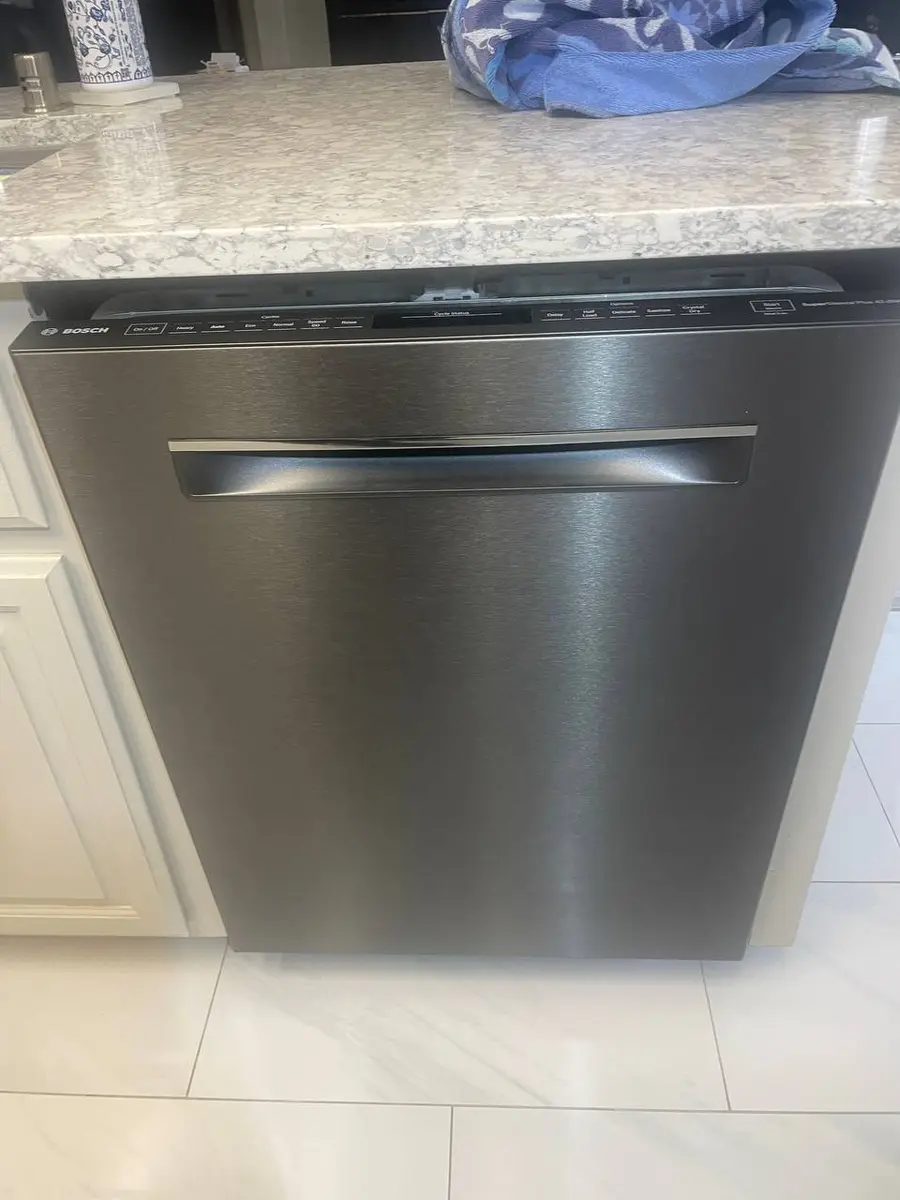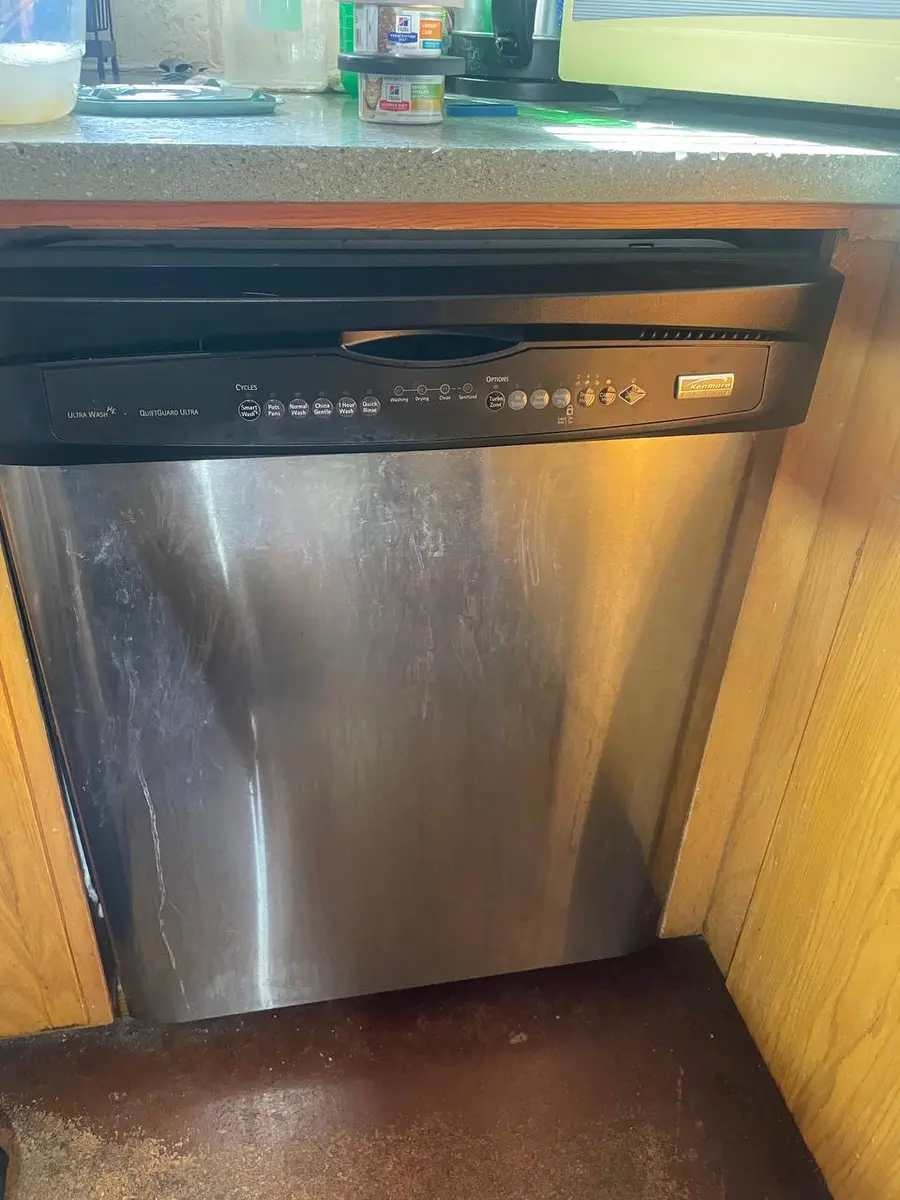
Midea has rapidly expanded its dishwasher lineup in the US, offering both compact countertop models popular in apartments and full-size built-in units that compete at the budget price point. Whether you own a Midea-branded dishwasher or a Comfee model (same machine, different badge), the error code system is identical. Midea dishwashers use a simplified E-code system (E1 through E7) that is straightforward to diagnose once you understand what each code means.
This guide covers every error code across Midea's dishwasher range — from the popular countertop units (MDC24020W, MDF18A1) to their full-size built-in models. Many issues have simple DIY fixes that do not require a service call.
How Midea Dishwasher Error Codes Work#
Midea dishwashers display error codes in two ways depending on the model:
LED display models: Alphanumeric codes (E1, E2, E3, etc.) appear directly on the digital display.
LED indicator models (countertop): The indicator lights blink in a pattern — count the number of blinks in each group. One blink = E1, two blinks = E2, and so on.
To reset a Midea dishwasher error code:
- Press and hold Power for 3 seconds to turn off the unit.
- Wait 60 seconds.
- Power on and start a new cycle.
- If the code returns within the first 5 minutes, the fault needs repair.
For stubborn codes, unplug the unit (or flip the breaker for built-in models) for 5 minutes before restarting.
Do You Have the Right Tools?
Water pressure gauge ($60), spray arm tester, float switch multimeter ($85), and drain inspection camera. Our technician arrives with $3,000+ in professional tools — your diagnostic is free.
Licensed & Insured · 90-Day Warranty · Same-Day Service
E1 — Water Fill Error#
The dishwasher did not detect water reaching the proper level within the fill timeout period. This is the most common Midea dishwasher error code.
Common causes:
- Water supply valve not open (most common on new installations)
- Kinked supply hose
- Clogged inlet screen (mesh filter at the water valve connection)
- Failed water inlet valve (solenoid does not open)
- Low water pressure (Midea requires minimum 14.5 PSI, maximum 145 PSI)
- Float switch stuck in the "full" position from a previous overflow event
How to fix:
- Countertop models: These connect to the kitchen faucet via an adapter. Check that the adapter is properly attached, the faucet is turned on, and the adapter connection is not leaking (a leak reduces pressure to the dishwasher).
- Built-in models: Check the water supply valve under the sink — it must be fully open. These connect to the hot water line.
- Disconnect the water supply line and inspect the inlet screen for mineral deposits. Sacramento hard water causes significant buildup. Clean with vinegar.
- If water flow is strong but E1 persists, the inlet valve solenoid may have failed. Test with a multimeter: expect 500–1500 ohms across the coil. If open (infinite resistance), replace the valve.
- Check the float switch inside the tub — it is a small plastic float at the bottom of the tub. If stuck in the raised position (from a previous overflow), it tells the control board the tub is already full. Push it down manually to free it.
Part cost: Inlet valve varies by model and repair complexity. Float switch varies by model and repair complexity. Professional repair varies by model and repair complexity.
E2 — Drain Error#
The dishwasher cannot drain water from the tub within the expected time. Water remains standing in the bottom after the cycle.
Common causes:
- Clogged filter/food trap at the bottom of the tub (most common — especially on countertop models)
- Kinked drain hose
- Drain hose connected incorrectly (countertop models draining into sink)
- Failed drain pump
- Garbage disposal knockout plug not removed (new built-in installations)
- Blocked air gap or missing high loop in drain hose
How to fix:
- Remove and clean the filter assembly at the bottom of the tub. Midea dishwashers have a coarse filter (large trap) and fine filter (mesh). Food debris, glass shards, and grease accumulate here — clean after every 5–10 cycles for best performance.
- Countertop models: The drain hose hooks over the sink edge. Check that it is not kinked where it bends over the edge, and that the sink drain is not clogged (the dishwasher drains into the sink).
- Built-in models: Check the drain hose connection at the garbage disposal or drain fitting. If recently installed, verify the knockout plug inside the disposal has been removed. This is the number one cause of E2 on new installations.
- Ensure the drain hose has a high loop (rises to countertop height before descending to the drain) or connects through an air gap. Without this, dirty water backflows into the dishwasher.
- If the filter is clean and the hose is clear, start a drain cycle and listen for the pump. A humming pump that does not drain means the impeller is jammed. Silence means the pump motor has failed.
Part cost: Drain pump varies by model and repair complexity. Professional repair varies by model and repair complexity.
Safety First — Know the Risks
Live 120V wiring in a wet environment is one of the most dangerous DIY scenarios. Water + electricity = serious shock risk. Our techs are licensed and insured — let them handle the risk.
Licensed & Insured · 90-Day Warranty · Same-Day Service
E3 — Heating Error / Water Temperature Timeout#
The dishwasher water did not reach the target temperature within the expected time. The heating element or thermistor has a fault.
Common causes:
- Failed heating element (most common)
- Cold incoming water (especially on countertop models connected to cold water only)
- Failed thermistor (temperature sensor gives incorrect reading)
- Control board not sending power to the heating element
- Heavily scaled heating element reducing efficiency (hard water mineral coating)
How to fix:
- Countertop models connected to cold water: These units must heat water from ambient (~60 degrees) to wash temperature (~130 degrees), which takes significantly longer than units connected to hot water. If E3 only appears on the hottest wash cycles, try connecting to hot water instead or running a lighter cycle.
- Built-in models: Run hot water at the kitchen sink faucet until it runs hot before starting the dishwasher. This ensures hot water reaches the unit immediately rather than the dishwasher receiving cold water from the long pipe run.
- Test the heating element: unplug the unit and measure resistance across the element terminals (access from below on built-in models, from the back on countertop). Expected: 10–30 ohms. If infinite, the element is broken.
- Hard water scaling on the element reduces heating efficiency. Run a cycle with citric acid or a commercial dishwasher descaler. If the element is heavily scaled (visible white mineral coating), it may never recover full output — replacement is more effective.
- Test the thermistor: at room temperature expect 10,000–15,000 ohms (NTC type).
Part cost: Heating element varies by model and repair complexity. Thermistor varies by model and repair complexity. Professional repair varies by model and repair complexity.
E4 — Overflow / Flood Protection#
The dishwasher detected water in the base pan (below the tub), triggering the flood protection system. The unit immediately drains and stops.
Common causes:
- Leaking door gasket allowing water to drip into the base
- Loose or cracked internal hose connection (between pump, tub, and inlet)
- Cracked tub or sump (rare but possible from thermal stress)
- Spray arm seal leaking
- Overfilling due to stuck inlet valve
- Leak from the hose clamp connections after a recent repair
How to fix:
- If E4 appears, the dishwasher will attempt to drain. Let the drain cycle complete, then power off and unplug.
- Tilt the dishwasher back carefully (countertop models) or remove the kickplate/bottom panel (built-in models) to inspect the base for standing water. Mop up any water.
- The flood protection float switch is in the base pan — if water has accumulated, the float rises and triggers E4. Dry the base pan completely to reset the float.
- Identify the leak source: start a short cycle and watch for water dripping into the base. Common leak points: door gasket (check for food debris in the gasket), spray arm seals, hose clamps, and the inlet valve connection.
- On countertop models, the most common E4 cause is the door gasket not sealing properly. Food particles caught in the gasket create gaps. Clean the gasket and door sealing surface thoroughly.
Part cost: Door gasket varies by model and repair complexity. Hose clamps varies by model and repair complexity. Professional repair varies by model and repair complexity.
The Real Cost of DIY
Average DIY attempt: $150-400 in tools you may use once, plus the risk of further damage. Our diagnostic visit costs $0 — we find the problem and give you an honest quote.
Licensed & Insured · 90-Day Warranty · Same-Day Service
E5 — Motor / Wash Pump Error#
The control board detects that the wash pump motor is not operating correctly — either it is not starting, not reaching proper speed, or drawing abnormal current.
Common causes:
- Pump impeller jammed by glass shard or food debris
- Failed wash pump motor
- Wiring fault between control board and pump motor
- Pump capacitor failure (on models with AC induction pump motors)
- Control board relay failure
How to fix:
- Remove the bottom spray arm, filter assembly, and inspect the pump area. Look for glass shards, bones, toothpicks, or other debris that could jam the impeller.
- Attempt to rotate the pump impeller by hand (if accessible through the filter opening). It should spin freely. If jammed, carefully remove the obstruction.
- Start a wash cycle and listen for the pump motor. A humming sound without water spraying indicates a jammed or seized pump. Complete silence indicates no power to the pump.
- If the pump is clear and has power but does not run, the motor has likely failed. Test motor winding resistance: expect 5–20 ohms. If open or significantly low (shorted), the motor needs replacement.
- On Midea countertop models, the wash pump and drain pump are separate units. On some compact built-in models, they share a single motor with a reversing function. Identify your configuration before ordering parts.
Part cost: Wash pump motor varies by model and repair complexity. Professional repair varies by model and repair complexity.
E6 — Turbidity Sensor Error#
The water turbidity (clarity) sensor is malfunctioning or reading values outside the expected range. This sensor determines how dirty the water is and adjusts cycle length and water changes accordingly.
Common causes:
- Mineral deposits coating the sensor lens (hard water areas)
- Failed sensor element
- Wiring issue to the sensor
- Food residue on the sensor surface
How to fix:
- Run an empty cycle with 2 cups of white vinegar or a commercial dishwasher cleaner to dissolve mineral deposits on the sensor.
- Locate the turbidity sensor — a small optical sensor in the sump area, typically near the filter housing. Access by removing the spray arms and filter.
- Clean the sensor lens with a soft cloth dampened with vinegar. Hard water deposits create an opaque coating that blocks the optical sensor.
- If cleaning does not resolve E6, check the sensor wiring connector for corrosion. Green or white buildup on pins indicates moisture damage.
- Note: not all Midea models have a turbidity sensor. Some budget models skip this feature and use time-based wash cycles instead. If your model does not have this sensor, E6 may indicate a different sensor fault — consult your specific model's tech sheet.
Part cost: Turbidity sensor varies by model and repair complexity. Professional repair varies by model and repair complexity.
Don't Void Your Warranty
Opening your appliance yourself may void the manufacturer warranty. Our repair comes with a 90-day guarantee, and we document everything for warranty compliance.
Licensed & Insured · 90-Day Warranty · Same-Day Service
E7 — Rinse Aid Dispenser Error#
The rinse aid dispensing mechanism is not operating correctly. This is a minor error that does not stop the wash cycle but may result in water spots on dishes.
Common causes:
- Rinse aid dispenser motor/solenoid failure
- Dispenser clogged with dried rinse aid
- Wiring fault to the dispenser mechanism
- Control board not sending the dispense signal
How to fix:
- Open the rinse aid dispenser cap and inspect. If the rinse aid has dried into a thick gel, the dispenser mechanism may be clogged. Clean out the dispenser reservoir with warm water.
- Fill with fresh rinse aid and verify the dispenser cap closes properly.
- Start a cycle and listen for the dispenser click during the rinse phase. If no click, the solenoid may have failed.
- This error is non-critical — the dishwasher will still wash and rinse effectively. The only impact is potentially more water spots on glassware. You can manually add vinegar to the rinse aid dispenser as a workaround until the mechanism is repaired.
Part cost: Dispenser assembly varies by model and repair complexity. Professional repair varies by model and repair complexity.
Countertop vs. Built-In: Special Considerations#
Countertop models (MDF18A1, MDT24020, Comfee CDD series):
- Connect to the faucet via adapter — water pressure varies with faucet type and household pressure. Low-flow faucets may not provide enough pressure, triggering E1.
- Drain into the sink — the drain hose must hook over the sink edge or connect to a Y-adapter. If the drain hose falls into the sink water, backflow occurs.
- Smaller pump motors — more susceptible to jamming from food debris. Pre-rinse dishes to prevent pump issues.
- No permanent water line — each use requires connecting and disconnecting the water supply.
Built-in models (MDT24H2AST, Comfee CFD series):
- Permanent hot water connection — better wash performance but requires proper installation.
- Garbage disposal knockout must be removed.
- Full-size filters and pump systems — more robust but still need regular cleaning.
- Flood protection activates the same (E4) but water goes into the subfloor area, potentially causing hidden water damage.
Is It Worth Your Time?
Dishwasher issues overlap between drain pump, wash motor, inlet valve, and control board. DIY diagnosis averages 3-5 hours. Our technician diagnoses the issue in about 30 minutes — same-day appointments available.
Licensed & Insured · 90-Day Warranty · Same-Day Service
Frequently Asked Questions#
Q: Why does my Midea countertop dishwasher keep showing E1? A: E1 on countertop models is almost always a water supply issue. The faucet adapter must be fully tightened, the faucet must be turned on to full flow, and the faucet must have a standard aerator thread that the adapter can grip. Some modern faucets (pull-out spray heads, non-standard fittings) are not compatible with the standard adapter — Midea sells adapter kits for these faucets.
Q: How do I clean the filter on my Midea dishwasher? A: Remove the lower spray arm (twist and lift), then twist and lift out the cylindrical coarse filter, then lift out the fine mesh filter plate underneath. Rinse both under running water, using a soft brush to remove stuck food particles. Do this every 1–2 weeks for best performance. A clogged filter is the leading cause of E2 drain errors and poor wash results.
Q: My Midea dishwasher leaves dishes wet. Is there an error code for that? A: No. Wet dishes after a cycle usually indicate the rinse aid is empty (refill it), the heating element is failing (dishes dry by residual heat from the final hot rinse), or you are opening the door immediately after the cycle (wait 15–30 minutes with the door cracked for steam to escape). Midea budget models do not have a dedicated drying fan — they rely on residual heat drying, which is less effective than brands with fan-assisted drying.
Q: Can I use pods/tablets in my Midea countertop dishwasher? A: Midea recommends liquid or powder detergent for countertop models. Pods/tablets are designed for full-size cycles with more water — in a countertop unit, they may not dissolve completely during the shorter, lower-water cycles. If you use pods, choose a mini/compact pod designed for countertop dishwashers, and place it in the detergent dispenser (not loose in the tub).
Q: Is it normal for my Midea dishwasher to make a humming noise during drain? A: Yes. The drain pump produces a humming or buzzing noise during drain cycles. This is normal operation. What is NOT normal: grinding (debris in pump), high-pitched whining (pump bearing wear), or complete silence during drain (pump motor failure — potential E2 trigger).
When to Call a Professional#
Most Midea dishwasher issues are DIY-friendly, but some warrant professional help:
- E4 with recurring leaks — If you cannot identify the leak source, a technician can run the unit while inspecting all seal points simultaneously. Hidden leaks (into subfloor from built-in models) can cause expensive water damage.
- E5 with seized pump — Pump motor replacement on built-in models requires disconnecting water and electrical connections underneath the unit.
- E3 with element replacement — On built-in models, the heating element is accessed from below and involves working with 120V connections.
- Built-in installation issues — If E1 or E2 errors appear on a newly installed unit, installation problems (knockout plug, drain loop, water supply) are best diagnosed by a professional who can verify the entire installation.
- Flood damage from E4 — If water leaked into cabinetry or subflooring before you noticed E4, professional water damage assessment may be needed alongside the dishwasher repair.
Dealing with a Midea dishwasher error code? EasyBear technicians have experience with Midea's expanding product line and understand the nuances of both countertop and built-in models. Free diagnostic visit — we identify the problem, explain your options, and repair on the spot when parts are available. Every repair includes our 90-day parts and labor warranty. Schedule your free diagnosis today.
Lead Appliance Repair Technician · 12 years experience
Experienced technician with 12 years specializing in washing machine and dryer repairs across all major brands.