An LG refrigerator that won't start splits into two very different problems. Completely dead — no display, no lights — is a power issue upstream of the controls, and simply checking the breaker and outlet resolves most of them. Powered but not cooling — display on, compressor silent — points into LG's two-board Linear Compressor architecture: the start relay, the inverter board, or the compressor itself.
Dead or Just Not Cooling?#
Settle this first, because it decides everything. A truly dead LG — no display, no interior light, nothing — means power isn't reaching the controls, so you're looking at the supply, the cord, or a catastrophically failed main board. A refrigerator whose panel and lights work but whose compressor never runs and whose temperature is climbing has power but a fault in the control or compressor circuit. These are fundamentally different failure points in LG's electrical layout, so knowing which you have keeps you from opening the wrong end of the machine.
Do You Have the Right Tools?
Refrigerant gauges ($200+), vacuum pump ($250), leak detector ($150), and EPA-certified recovery equipment. Our technician arrives with $3,000+ in professional tools — your diagnostic is free.
Licensed & Insured · 90-Day Warranty · Same-Day Service
Completely Dead — Power Upstream#
Electrical supply (about 40% of no-start cases)#
The most common cause, and the one to rule out before suspecting any part. LG refrigerators want a dedicated 120V, 15A circuit — 20A is recommended for French-door models with Craft Ice — and a tripped breaker, blown fuse, GFCI trip, or dead outlet all present exactly like a dead refrigerator. Check the breaker and reset it, press the reset on a GFCI outlet (LG doesn't recommend GFCI for refrigerators because nuisance trips cost you food, but many kitchens have them per code), test the outlet with a lamp, and confirm it isn't a switched outlet someone turned off. One caution: if the breaker trips again the instant you plug the refrigerator in, there's a short in its wiring or compressor — stop resetting and diagnose.
Power cord or internal wiring (about 15%)#
LG cords land at a junction box behind the rear-bottom panel, and that connection can loosen over time — the Linear Compressor's slight vibration works at it — or corrode in humidity. Unplug, pull the rear-bottom panel, and inspect the cord connection for burned, melted, or discolored terminals that signal arcing, check the cord for damage, and meter continuity from the plug prongs through to the junction-box terminals.
Main control board total failure (about 10%)#
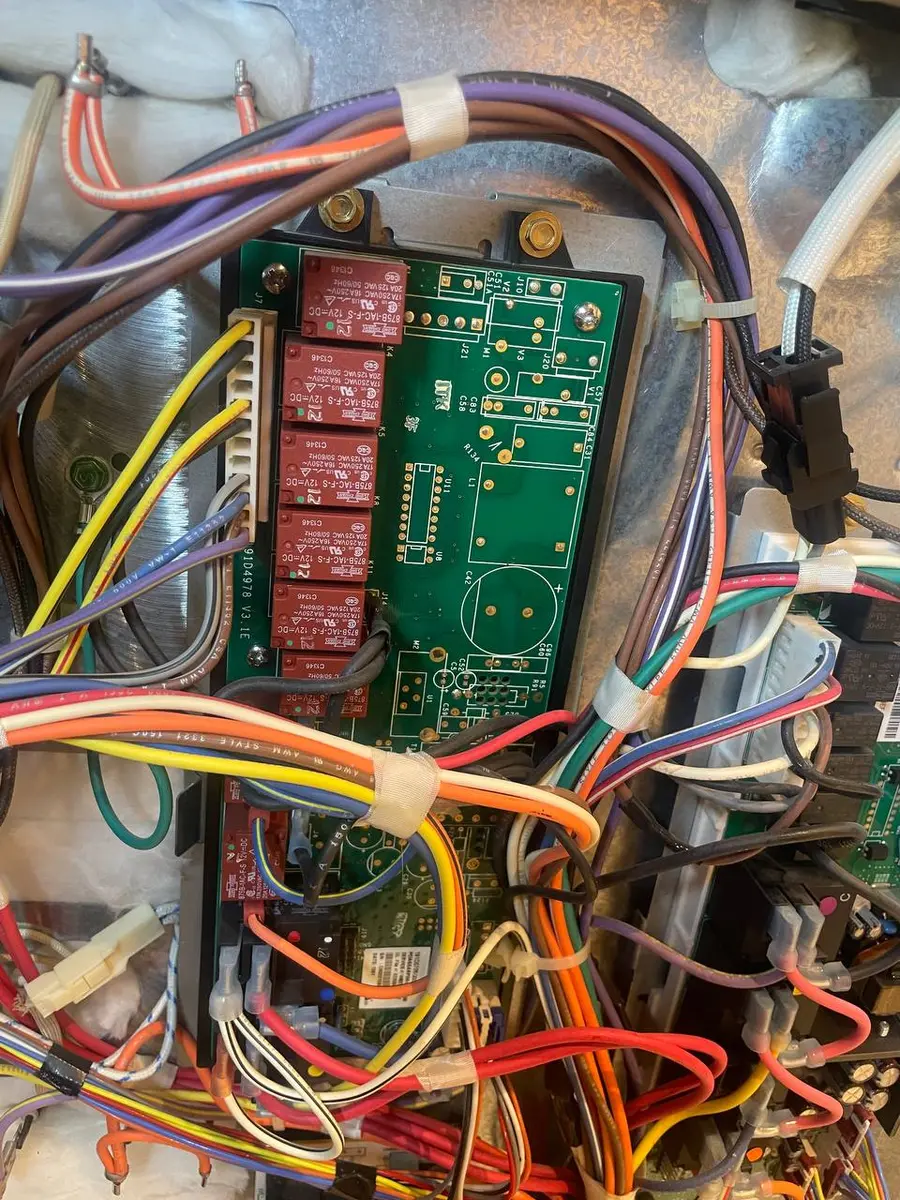
The main board is the system's brain, and a catastrophic failure — a burned relay or shorted supply section, usually from a power surge — takes the whole refrigerator dark. Confirm power is reaching the board by testing for 120VAC at its input connector, then inspect for burned components, bulging capacitors, or a scorched area, and smell for an electrical burning odor near the rear-top panel. Power in but nothing out means the board has died and needs replacing.
Powered But Not Running — the Compressor Circuit#
Compressor start relay or overload protector (about 20%)#
The most common cause on the powered-but-silent side. LG's Linear Compressor uses a start (inverter) relay to deliver power to the compressor coil, and when it fails the board keeps issuing the run command but the compressor can't energize — you'll hear a click from the relay area every couple to few minutes as the board retries, followed by the overload protector tripping. The panel works, the lights work, but the compressor never sustains and the box warms. Pull the relay off the compressor pins and shake it; a rattle means broken internals. Test the overload protector for continuity at room temperature, where it should read closed.
Inverter board failure (about 10%)#
LG's Linear Compressor needs a dedicated inverter board — separate from the main board, down near the compressor — to convert household AC into the variable-frequency drive the compressor requires. When it fails, the main board sends start commands but the compressor physically can't run, and the display shows the communication error Er CO. The compressor is completely silent — no click, no hum, no vibration. Inspect the inverter board for burned components and check the harness between it and the main board.
Linear Compressor seizure (about 5%)#
Rarely, the compressor's internal piston seizes from refrigerant contamination, oil breakdown, or wear, and the inverter board detects the locked-rotor over-current and refuses to even attempt a start — so the compressor is dead silent, often with Er CO after the inverter fails to start it. Crucially, this is covered by LG's ten-year Linear Compressor warranty, and units from the 2014-2019 era tied to the class-action compressor issue may qualify for free replacement, so check warranty status before authorizing any paid repair.
Safety First — Know the Risks
Refrigerant (R-134a/R-600a) requires EPA certification to handle. Improper discharge is a federal violation and health hazard. Our techs are licensed and insured — let them handle the risk.
Licensed & Insured · 90-Day Warranty · Same-Day Service
Keep Food Safe While You Diagnose#
A no-start refrigerator is also a food-safety clock, so manage that alongside the repair. With the doors kept closed, the refrigerator compartment stays safe for about four hours, a full freezer holds safe temperatures far longer than an empty one, and a half-full freezer somewhere in between. The single most important thing is to resist opening the doors to check on things, since every opening dumps the cold air you're trying to preserve. If the diagnosis or repair will run beyond that first few-hour window, move the most perishable items — raw meat, dairy, leftovers — into a cooler with ice, and let the freezer ride as long as it holds. That way a relay or board repair that takes an afternoon doesn't cost you the contents of the fridge on top of the part.
Surge Protection Pays for Itself#
Two of the most expensive failure modes here — the main control board and the inverter board — are also the two most often killed by power surges, and the Linear Compressor's large startup inrush makes the moment of compressor start especially vulnerable to a voltage spike. That makes a dedicated surge protector genuinely worthwhile on an LG refrigerator, since the combined cost of replacing both boards far exceeds the protector. Look for a unit rated at least 15A, with metal-oxide-varistor protection carrying a solid joule rating, and importantly no GFCI function, since a GFCI on a refrigerator invites the nuisance trips that spoil food. A protector with a status light matters too, because the varistors degrade over time and a dark indicator tells you the protection has worn out and needs replacing before the next storm season.
The Real Cost of DIY
Average DIY attempt: $150-400 in tools you may use once, plus the risk of further damage. Our diagnostic visit costs $0 — we find the problem and give you an honest quote.
Licensed & Insured · 90-Day Warranty · Same-Day Service
What to Do Right Now#
Work it in order: check the breaker and outlet first, since that clears the largest share of cases; if the display is dark, verify power delivery before suspecting parts; if the display works but the compressor is silent, listen for that click-silence-click relay pattern and check for the Er CO code; and run LG Smart Diagnosis through the ThinQ app to pull stored codes even with the compressor down. Keep the doors shut to protect food — a closed refrigerator holds safe for about four hours and a full freezer far longer — and move critical items to a cooler if the repair will run long. Finally, given how vulnerable both the control and inverter boards are to surges, protect the refrigerator with a surge protector rated at least 15A, with MOV protection above a solid joule rating and no GFCI function, since the combined board-replacement cost dwarfs the modest price of the protector.
Related reading: LG refrigerator error codes and an LG refrigerator that runs constantly.
LG [refrigerator repair](/bay-area/services/refrigerator-repair) across [Sacramento](/sacramento/sacramento) and the Bay Area — relay, inverter, and compressor diagnostics in one visit. Book a technician.
Senior Appliance Repair Technician · 15 years experience
EPA-certified technician with 15 years of experience specializing in refrigerator and cooling system repairs.