LG Refrigerator and Freezer Both Too Warm — Complete Cooling System Failure
When both the refrigerator and freezer compartments of an LG unit are warming simultaneously, the problem lies in the shared cooling infrastructure rather than the compartment-specific distribution system. A warm fridge with a cold freezer indicates a damper or fan issue (compartment distribution), but BOTH compartments warming points to the compressor, condenser system, refrigerant charge, or main board — the components that generate and manage cooling for the entire unit.
This is a food safety emergency. The USDA recommends discarding all perishable food that has been above 40°F for more than 4 hours. Act quickly to minimize food loss.
Why Both Compartments Warm Simultaneously
LG refrigerators use a single evaporator located in the freezer compartment that cools both sections. Cold air is generated at the evaporator and distributed to both compartments by the evaporator fan. If the cooling source itself fails (compressor stops, refrigerant leaks, condenser cannot reject heat), both compartments lose their cold-air source simultaneously.
Do You Have the Right Tools?
Refrigerant gauges ($200+), vacuum pump ($250), leak detector ($150), and EPA-certified recovery equipment. Our technician arrives with $15K+ in professional tools — your diagnostic is free.
Licensed & Insured · 90-Day Warranty · Same-Day Service
Primary Causes
1. Linear Compressor Failure (30% of cases)
LG's Linear Compressor is the sole mechanical heart of the cooling system. When it fails, all cooling stops. The compressor may fail electrically (motor winding open/short), mechanically (piston seized), or through its start system (relay/inverter board failure preventing startup).
LG's well-documented class-action settlement (2014-2019 models) addressed widespread Linear Compressor failures. The 10-year warranty covers parts and labor for compressor replacement. Before paying for any compressor-related repair, verify warranty status with LG at 1-800-243-0000.
Diagnosis:
- Complete silence from the rear-bottom of the unit (where the compressor sits) — no humming, clicking, or vibration.
- Or: repeated click-pause-click pattern every 2-5 minutes (relay attempting to start a seized compressor).
- Error code Er CO (communication between main board and inverter board failed).
- The compressor housing is either cold (not running at all) or extremely hot (attempting to run but failing).
Important: LG's Linear Compressor produces a clicking sound during normal operation (reciprocating piston). The ABNORMAL pattern is click-silence-click with no sustained operation between attempts.
DIY Difficulty: Professional only — EPA-certified refrigerant handling required Parts Cost: $300-600 (compressor + refrigerant) Professional Repair Cost: $500-900 (or $0 under warranty)
2. Condenser System Failure (25% of cases)
The condenser system (condenser coils + condenser fan) rejects heat from the refrigerant cycle. If this heat cannot be expelled, the entire system overheats and the compressor's thermal overload trips, stopping all cooling. Sacramento's summer temperatures make this the most seasonally-dependent cause — a system that works marginally in spring can fail completely when ambient temperatures reach 100°F+.
Two failure modes:
- Clogged condenser coils: Dust, pet hair, and kitchen grease coating the coils insulates them from ambient air. The Linear Compressor runs but cannot achieve cooling because heat stays trapped in the system. Eventually thermal overload shuts it down.
- Condenser fan motor failure: The fan forces air across the condenser coils. Without it, natural convection cannot provide adequate heat dissipation (especially during hot weather). The compressor overheats and cycles on thermal protection.
Diagnosis:
- Compressor runs but both compartments stay warm — suggests condenser cannot reject heat.
- Pull unit from wall, remove rear bottom panel. Inspect coils for debris coating.
- With power on, verify the condenser fan rotates when the compressor runs. If silent/stationary, the fan motor has failed.
- Compressor housing very hot to touch (above 150°F indicates thermal stress).
DIY Difficulty: Easy (cleaning) or Moderate (fan motor replacement) Parts Cost: $0-30 (cleaning) or $30-70 (fan motor) Professional Repair Cost: $100-280
3. Sealed System Refrigerant Leak (20% of cases)
A refrigerant leak depletes the working fluid that carries heat from inside the unit to the condenser. As charge drops, cooling capacity decreases proportionally. Both compartments warm gradually over days to weeks as the leak progresses. This is distinguishable from sudden compressor failure by its gradual onset.
Leaks most commonly occur at brazed joints in the evaporator (stress cracks from thermal cycling), at compressor connection points, or in the condenser tubing (vibration fatigue).
Diagnosis:
- Both compartments warming gradually over 1-4 weeks (not sudden).
- The compressor runs continuously but with diminishing effect.
- Partial frost pattern on evaporator (visible after removing freezer rear panel): frost on one section, bare on the other indicates insufficient refrigerant to fill the entire evaporator.
- Oily residue visible on tubing connections at the rear of the unit (refrigerant oil seeps with the gas).
DIY Difficulty: Professional only — EPA certification and leak detection equipment required Parts Cost: $200-700 (leak repair + recharge, varies by location) Professional Repair Cost: $450-1000
4. Main Control Board Failure (15% of cases)
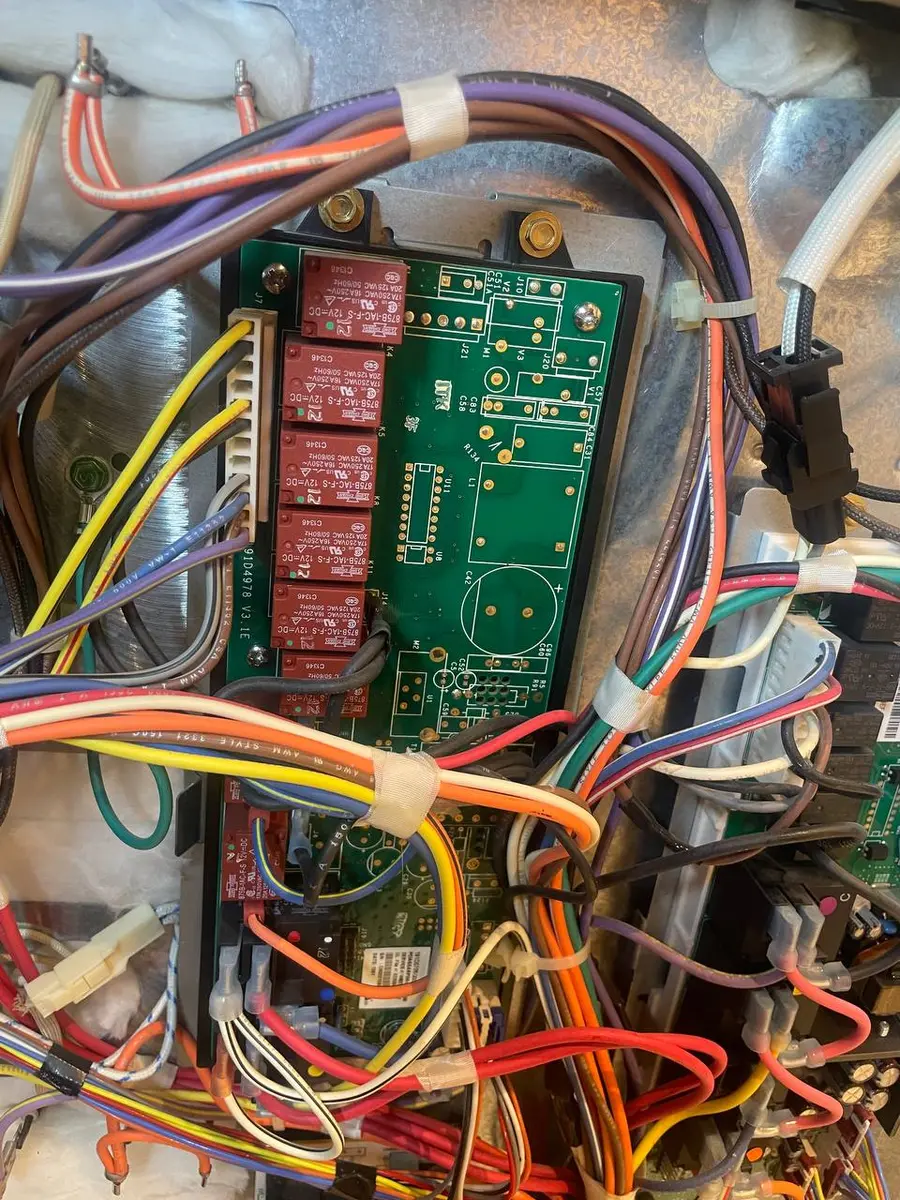
The main PCB commands the compressor (via inverter board), evaporator fan, condenser fan, and defrost system. A complete board failure can stop all cooling components simultaneously. Partial failures may disable only the compressor relay while fans continue running — you hear fan sounds but no compressor operation, and both compartments warm.
Power surges (Sacramento thunderstorms, PG&E grid events) are the primary cause of board death. The board may visually appear normal or show obvious burn marks depending on the failure severity.
Diagnosis:
- Display operational (the board's low-power section works) but compressor and/or fans do not engage.
- No error codes may appear if the board's diagnostic section is the part that failed.
- Visual inspection of the board (behind rear-top access panel) reveals burned components, bulging capacitors, or discolored traces.
- Power cycling does not restore operation.
DIY Difficulty: Moderate — board is accessible and plug-in replacement Parts Cost: $150-350 Professional Repair Cost: $280-550
5. Power Interruption / Undervoltage (10% of cases)
Not a refrigerator fault but a common Sacramento occurrence. During peak summer demand, PG&E voltage can sag below the minimum needed for the Linear Compressor's inverter to operate (typically below 105V). The refrigerator display may illuminate (lower power requirement) but the compressor cannot start under low voltage conditions.
Brownouts during late afternoon peak demand (4-7 PM) are particularly common during heat waves when AC load across the grid peaks.
Diagnosis:
- The issue occurs during specific times (afternoon/evening during heat waves).
- Other high-draw appliances also underperform (dim lights, slow AC).
- Measure outlet voltage with a multimeter during the event — below 110V is problematic for the compressor.
- The refrigerator recovers normal operation when voltage returns to normal.
Fix: Dedicated circuit for the refrigerator, voltage monitoring, or UPS/voltage regulator for the refrigerator outlet. Contact PG&E about persistent undervoltage.
Immediate Food Safety Steps
- Keep doors CLOSED — every opening accelerates warming. A closed LG French Door retains safe temperatures approximately 4 hours (fridge) and 24-48 hours (freezer) depending on fullness.
- If repair will take more than 4 hours, transfer perishables to a cooler with ice.
- Monitor with a thermometer if available — discard items once above 40°F for 2+ hours.
- Full freezers maintain safe temperature nearly twice as long as half-full ones.
Safety First — Know the Risks
Refrigerant (R-134a/R-600a) requires EPA certification to handle. Improper discharge is a federal violation and health hazard. Our techs are licensed and insured — let them handle the risk.
Licensed & Insured · 90-Day Warranty · Same-Day Service
Diagnostic Decision Tree
| Compressor Sound | Condenser Fan | Most Likely Cause |
|---|---|---|
| Silent | Silent | Board failure or power issue |
| Click-pause-click | Running | Compressor relay/mechanical failure |
| Running steady | Silent | Condenser fan failure |
| Running steady | Running | Clogged coils or refrigerant leak |
| Running hard | Running | Refrigerant leak (compressor compensating) |
Same-Day Appliance Repair
Fixed or It's Free
$89 → $0 Service Call & Diagnosis — offer ends May 25
LG Warranty Coverage
For both-compartments-warm issues, these warranty coverages apply:
- 10-year Linear Compressor warranty — covers compressor failure, parts and labor
- 1-year full warranty — covers all other components (board, fan, relay)
- Class-action extended coverage (2014-2019 models) — may extend beyond standard warranty period for compressor
Always verify warranty status before authorizing paid repair. Provide model number, serial number, and purchase date to LG support (1-800-243-0000).
The Real Cost of DIY
Average DIY attempt: $150-400 in tools you may use once, plus the risk of further damage. Our diagnostic visit costs $0 — we find the problem and give you an honest quote.
Licensed & Insured · 90-Day Warranty · Same-Day Service
Prevention
- Clean condenser coils every 6 months (every 3 months with pets or in Sacramento's dusty summer conditions).
- Install surge protection on the refrigerator's dedicated circuit.
- Maintain adequate clearance (4 inches rear, 2 inches sides) for condenser airflow.
- Do not install in garages or spaces that exceed 110°F ambient.
- Keep the unit level — improper leveling can stress refrigerant lines over time.
Frequently Asked Questions
Q: Both compartments warm — should I keep it plugged in or unplug it?
Keep it plugged in unless you smell burning or see sparks. The compressor's thermal overload is a safety device designed to prevent damage. If the unit is attempting to run (clicking), the relay/overload is protecting the compressor from further damage. Unplugging removes all protection including the board's error monitoring.
Q: My LG refrigerator is warm after a power outage — is it broken?
Not necessarily. After a power outage, LG's Linear Compressor requires 5-8 minutes of stabilization before restarting (built-in delay to prevent compressor damage from restart pressure). Wait 30 minutes after power restoration before concluding the unit is malfunctioning. If still not cooling after 30 minutes, check for tripped GFCI or breaker.
Q: Is it worth repairing a 10-year-old LG refrigerator that has lost all cooling?
It depends on the cause. A $70 condenser fan or $30 start relay is clearly worth repairing. A sealed-system leak repair ($600-1000) on a 10-year-old unit approaches the economic replacement threshold ($2,000-4,000 for equivalent LG French Door). Check warranty coverage first — the compressor may still be covered under the 10-year warranty even near end-of-life.
Both sides of your LG refrigerator losing temperature? Our technicians arrive with compressor relays, fan motors, and diagnostic equipment for LG French Door models. Same-day emergency service available. Schedule emergency repair →