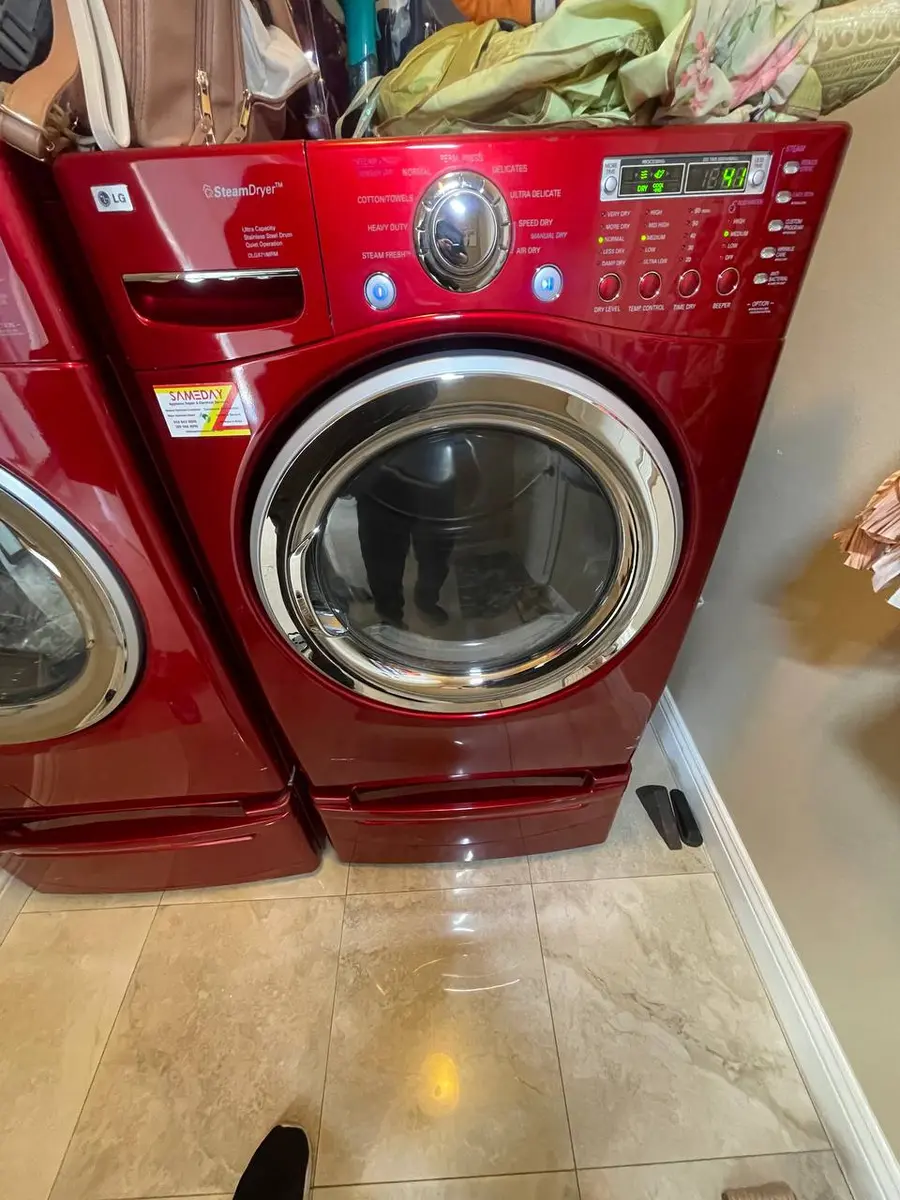
When an LG dryer shows drum not turning, it is telling you something specific. Below are the causes we see most, ranked, with what each looks like and how to check it.
The likely culprit#
Most likely: broken drum belt. In practice, lG dryers use a thin, multi-rib drum belt that wraps entirely around the drum circumference, then routes through a spring-loaded idler pulley and around the motor pulley. After 5-10 years of use, this belt dries out, cracks, and eventually snaps. If that checks out, look next at idler pulley failure.
Do You Have the Right Tools?
Gas leak detector ($130), thermal fuse tester ($95), belt tension gauge, and vent inspection camera ($180). Our technician arrives with $3,000+ in professional tools — your diagnostic is free.
Licensed & Insured · 90-Day Warranty · Same-Day Service
Ranked causes and what to look for#
Match your symptom to the rows below, starting at the top:
| Likely cause | How common | What you'll notice / what to check |
|---|---|---|
| Broken Drum Belt | 40% of cases | LG dryers use a thin, multi-rib drum belt that wraps entirely around the drum circumference, then routes through… |
| Idler Pulley Failure | 25% of cases | The idler pulley provides spring tension to keep the belt tight against the drum and motor pulley. |
| Drum Roller/Bearing Failure | 20% of cases | LG DLEX dryers have support rollers (typically 2 in rear, sometimes 2 in front) that the drum rides… |
| Motor Failure | 15% of cases | The LG dryer drive motor turns both the drum (via belt) and the blower wheel. |
Sorting it out, step by step#
Here is what each cause looks like up close and how to confirm it.
1. Broken Drum Belt (40% of cases)#
After 5-10 years of use, this belt dries out, cracks, and eventually snaps. Once broken, the motor rotates freely (you can hear it) but the drum is stationary. LG dryers use a thin, multi-rib drum belt that wraps entirely around the drum circumference, then routes through a spring-loaded idler pulley and around the motor pulley. Turn the drum by hand — free-spinning or rough rotation points straight at the drive parts.
2. Idler Pulley Failure (25% of cases)#
What happens: the idler pulley provides spring tension to keep the belt tight against the drum and motor pulley. On LG dryers, it consists of a wheel on a pivot arm with a spring. When the pulley bearing seizes or the spring breaks, the belt loses tension and slips off, effectively breaking the drive connection. Open the cabinet and check the belt and pulleys for wear, cracks, or a flat spot that causes the noise.
3. Drum Roller/Bearing Failure (20% of cases)#
LG DLEX dryers have support rollers (typically 2 in rear, sometimes 2 in front) that the drum rides on. When roller bearings seize, the drum cannot rotate even with a good belt — the motor stalls or the belt breaks from the excess load. Locked up rollers commonly produce loud squealing or thumping before complete failure. Turn the drum by hand — free-spinning or rough rotation points straight at the drive parts.
4. Motor Failure (15% of cases)#
Mechanically, the LG dryer drive motor turns both the drum (via belt) and the blower wheel. When the motor gives out electrically (open winding) or mechanically (locked up bearing), nothing operates. Some LG dryers have a motor reset button (thermal overload protector) that trips if the motor overheats from a jammed condition. Spin the affected part by hand with power off — grinding, drag, or a burnt smell points to the motor.
Safety First — Know the Risks
Gas dryers carry carbon monoxide and explosion risk. Even electric dryers involve 240V circuits that can deliver a fatal shock. Our techs are licensed and insured — let them handle the risk.
Licensed & Insured · 90-Day Warranty · Same-Day Service
In a nutshell#
The fast version, top to bottom:
- Broken Drum Belt — 40% of the time; open the cabinet and check the belt and pulleys for wear, cracks, or a flat spot that causes the noise.
- Idler Pulley Failure — 25% of the time; turn the drum by hand — free-spinning or rough rotation points straight at the drive parts.
- Drum Roller/Bearing Failure — 20% of the time; open the cabinet and check the belt and pulleys for wear, cracks, or a flat spot that causes the noise.
- Motor Failure — 15% of the time; listen for a hum without movement, which usually means the motor or its start components have failed.
What fixing it usually involves#
A typical repair follows the same arc: confirm the cause with a quick test, unplug and open the relevant panel, swap the failed part, then reassemble and run a full cycle to verify. On this symptom the broken drum belt is where most visits start.
The Real Cost of DIY
Average DIY attempt: $150-400 in tools you may use once, plus the risk of further damage. Our diagnostic visit costs $0 — we find the problem and give you an honest quote.
Licensed & Insured · 90-Day Warranty · Same-Day Service
Keeping it from coming back#
A little routine care goes a long way: keep the dryer clean, level, and free of buildup, and this symptom is far less likely to return.
When to stop and call for help#
Call a technician if the symptom persists after the checks above, if the repair means reaching power, gas, or sealed components, or if your LG dryer is still under warranty — DIY work can void it. The bill scales with the part involved and your model, and a technician can confirm the exact figure before starting.
When in doubt, book a same-day diagnosis. A tech who knows LG dryers can confirm the cause and quote the repair on the spot.
Senior Appliance Repair Technician · 15 years experience
EPA-certified technician with 15 years of experience specializing in refrigerator and cooling system repairs.