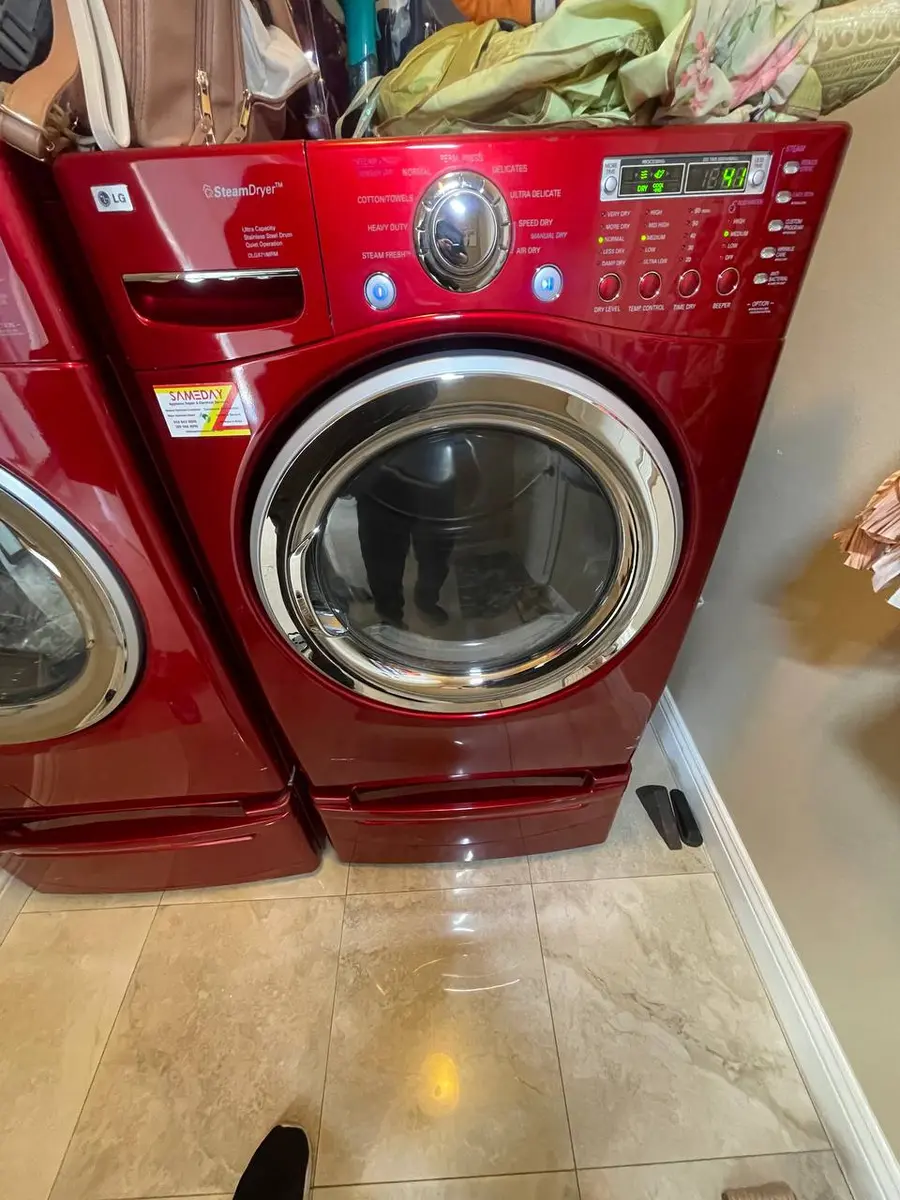
Quick Answer: Identify the Smell, Then Stop the Dryer#
Most likely: lint has built up in the exhaust duct and is scorching against the hot exhaust — the leading cause of an LG dryer burning smell at about 38% of cases, and because dryer lint is highly flammable this is a real fire risk. The kind of smell narrows it fast: a lint or fabric smell is overheated lint at the vent or element (most dangerous); a rubber smell is a slipping or dragging drum belt; an electrical smell is the motor, wiring, or board; and a gas or sulfur smell on a DLGX or DLG model is a leak — leave and call the gas company. Stop the dryer first, and if you see smoke, do not open the door.
Immediate Safety Steps#
Stop the dryer immediately — press Power Off. Do NOT open the door if you see smoke, because adding oxygen can intensify smoldering. Unplug the dryer (electric), or turn off the gas and unplug it (gas models). If smoke is visible or the smell is intense, evacuate and call 911. If the smell is mild with no smoke, proceed with the diagnosis below.
Do You Have the Right Tools?
Gas leak detector ($130), thermal fuse tester ($95), belt tension gauge, and vent inspection camera ($180). Our technician arrives with $3,000+ in professional tools — your diagnostic is free.
Licensed & Insured · 90-Day Warranty · Same-Day Service
Likely Causes at a Glance#
| Cause | Likelihood | Smell / what to check |
|---|---|---|
| Vent duct lint accumulation | 38% | Lint/fabric smell; clean the full exhaust run — LG FlowSense d80/d90/d95 codes warn of this |
| Lint on the heating element or burner | 22% | Strong fabric smell; lint that bypassed the screen scorching on the element (rear panel) or burner (front) |
| Drum belt friction | 15% | Rubber smell; spin the idler pulley by hand — grinding or a seized pulley drags the belt |
| Drum seal / felt strip worn | 10% | Metallic smell; bare-metal contact where the felt around the drum opening has worn through |
| Motor winding overheating | 8% | Acrid electrical smell from the base; a restricted vent or seizing bearings overwork the motor |
| Overloaded dryer | 5% | Load over 3/4 full restricts airflow and overheats stressed parts |
| Element contacting housing | 2% | Electric only; a broken ceramic insulator lets the coil sag onto the housing |
Walking Through the Diagnosis#
Once it is safe — dryer stopped and unplugged — work from the most common and most dangerous cause outward. Vent lint leads the list: lint that slips past the screen packs into the exhaust duct over months, airflow drops, exhaust temperature climbs, and the lint nearest the element or connection scorches. Clean the entire run from the dryer to the exterior cap, and if your LG showed FlowSense d80, d90, or d95 codes before the smell, the vent was already critically restricted. Next most common, and closely related, is lint that has reached the heating element (behind the rear panel on electric models) or the burner (behind the lower front panel on gas) and is smoldering there — a strong fabric smell. A rubber smell points to the drum belt: unplug, open the top or front, and spin the idler pulley by hand; it should turn freely, and grinding, stiffness, or flat spots mean the belt is dragging on a seized pulley.
The rest sort by smell and location. A metallic burning smell is the drum seal — when the felt strips around the front and rear drum openings wear through, the metal drum edge rubs the bulkhead, and you will see shiny contact marks. An acrid electrical smell from the base of the machine is the motor overheating, usually because a restricted vent makes it work harder or its bearings are seizing. Simple overloading (LG recommends no more than 3/4 full) restricts airflow enough to overheat stressed parts. And on electric models only, a broken ceramic insulator can let the heating coil sag against its metal housing, creating a hot spot that smells and can trip the thermal fuse — inspect the coil for even spacing with no contact. Heat-pump DLHX models run cooler (around 130 to 140°F versus 180°F on conventional dryers), so burning smells are rare; if one appears, check the separate condenser lint filter and the inverter board.
Safety First — Know the Risks
Gas dryers carry carbon monoxide and explosion risk. Even electric dryers involve 240V circuits that can deliver a fatal shock. Our techs are licensed and insured — let them handle the risk.
Licensed & Insured · 90-Day Warranty · Same-Day Service
Repair or Replace? The Short Version#
None of this justifies a new dryer — the top cause, vent lint, is free to clear, and a belt, idler, felt seal, or heating element are all inexpensive parts. What matters here is safety over economics: a burning smell is a fire warning, so stop and unplug the dryer, and never keep running it to "see if it clears." Clean the vent and element, replace a dragging belt or worn seal, and if the smell is electrical or you cannot find the source, have it diagnosed before using it again — book an EasyBear technician.
Frequently Asked Questions#
Can lint in my LG dryer actually cause a fire?#
Yes. Lint is highly flammable, and the heating element or gas burner easily reaches ignition temperature, which is why failing to clean the vent is the leading cause of residential dryer fires. A burning smell is your warning to act immediately — stop the dryer, unplug it, and clean the full exhaust run. If your LG showed FlowSense d80, d90, or d95 codes, the vent was already dangerously restricted.
My LG dryer only smells on high heat — is that normal?#
A faint warmth smell in the first minutes of a high-heat cycle can be normal, but an actual burning smell — acrid, smoky, or rubber-like — is never normal on any setting and needs investigation. High heat simply makes an existing problem, like vent lint or a dragging belt, show up sooner. Stop the dryer and check the vent and belt rather than continuing the cycle.
Is the LG FlowSense warning reliable?#
Generally yes — FlowSense measures exhaust airflow resistance with an internal pressure sensor, so d80 through d95 codes track a genuinely restricting vent. It can false-trigger if the exterior vent cap flap is stuck by wind, ice, or debris, so check the outdoor cap first when it activates. Either way, treat the codes as a signal to clean the duct, because a restricted vent is exactly what leads to a burning smell.
Senior Appliance Repair Technician · 15 years experience
EPA-certified technician with 15 years of experience specializing in refrigerator and cooling system repairs.