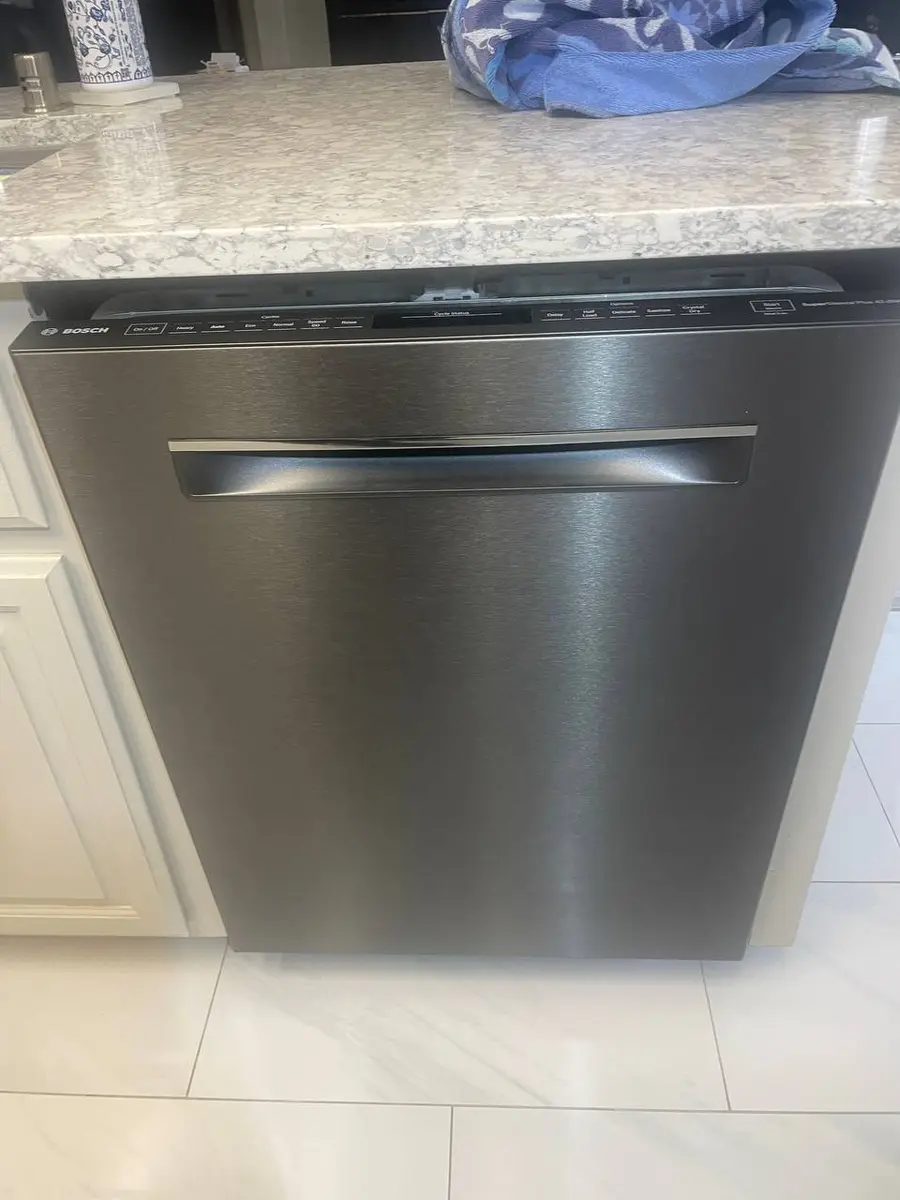
KitchenAid dishwashers are among the most popular premium dishwashers in American kitchens, known for features like the FreeFlex Third Rack, ProWash cycle, PrintShield stainless finish, and the Clean Water Wash system. As a Whirlpool Corporation brand, KitchenAid dishwashers use the standard F#E# error code format displayed on the control panel or as a flashing clean/normal light sequence on models without a digital display. This guide covers every error code across KitchenAid dishwasher models including KDTE (top-control), KDTM (FreeFlex), KDFE (front-control), and KDFM series.
How KitchenAid Dishwasher Error Codes Work#
KitchenAid dishwashers monitor water temperature, fill level, drain function, motor operation, and dispenser status through a network of sensors connected to the main control board. When a fault condition is detected, the dishwasher halts the cycle and displays an error code. On top-control models (KDTE, KDTM), error codes appear on the hidden top-edge display. On front-control models (KDFE), they appear on the front panel display. On older models without a digital readout, errors are indicated by a specific pattern of flashing LED lights — count the flashes between pauses to determine the code number.
To reset a KitchenAid dishwasher error code:
- Press the Cancel/Drain button (or Hi Temp Scrub + Energy Saver Dry simultaneously on older models).
- If the error persists, turn off the dishwasher at the circuit breaker for 5 minutes.
- Restore power and start a Normal cycle.
- If the code returns, proceed with the specific troubleshooting below.
Diagnostic mode entry: On KDTE and KDTM models, press any 3 buttons in the sequence 1-2-3, 1-2-3, 1-2-3 (for example, Hi Temp Scrub, Energy Saver Dry, Cancel — repeated three times within 6 seconds). The dishwasher enters diagnostic mode and runs through all component tests.
Do You Have the Right Tools?
Water pressure gauge ($60), spray arm tester, float switch multimeter ($85), and drain inspection camera. Our technician arrives with $3,000+ in professional tools — your diagnostic is free.
Licensed & Insured · 90-Day Warranty · Same-Day Service
F1E1 — Main Control Board Error#
The main electronic control board has detected an internal fault. This code indicates a hardware-level failure on the board itself.
Common causes:
- Power surge or voltage spike damaging the control board
- Steam intrusion from the drying vent corroding board components (part W11305309)
- Failed relay or capacitor on the board
- Loose wire harness connector at the board
How to fix:
- Turn off the dishwasher at the circuit breaker for 10 minutes — a longer reset can sometimes clear a transient board error.
- Open the dishwasher door and remove the inner door panel screws to access the control board mounted inside the door.
- Inspect the board for visible signs of damage: green corrosion on connector pins, brown/black burn marks on components, swollen capacitors, or water stains.
- On KDTE and KDTM models, check the door vent gasket — steam from the drying cycle migrates upward into the door panel and condenses on the control board. If you see moisture evidence, replace the vent gasket along with the board to prevent repeat failure.
- Reseat all wire harness connectors on the board firmly. If the board shows physical damage, replacement is necessary.
Part cost: Main control board (W11305309) varies by model and repair complexity. Door vent gasket (WPW10503549) varies by model and repair complexity. Professional repair varies by model and repair complexity.
F2E1 — Stuck Button / User Interface Error#
The control board detects that a button on the user interface panel is stuck in the pressed position, or the touch panel membrane is sending a continuous signal.
Common causes:
- Physical button stuck from food splatter or detergent residue
- Touch panel membrane delaminating from heat exposure
- Moisture infiltration behind the control panel
- Failed user interface board (part W11305311)
How to fix:
- Turn off the breaker for 2 minutes, then press each button on the control panel firmly several times to free any stuck key.
- Clean the control panel surface with a damp cloth. On top-control models (KDTE, KDTM), condensation from drying cycles drips down the door interior and can seep behind the button membrane.
- If the error persists, inspect the user interface assembly inside the door panel. Look for moisture between the membrane and the circuit board.
- Replace the UI assembly if cleaning does not resolve the issue. Apply a thin bead of clear silicone sealant along the top edge of the new membrane to prevent future moisture intrusion.
Part cost: User interface assembly (W11305311) varies by model and repair complexity. Professional repair varies by model and repair complexity.
Safety First — Know the Risks
Live 120V wiring in a wet environment is one of the most dangerous DIY scenarios. Water + electricity = serious shock risk. Our techs are licensed and insured — let them handle the risk.
Licensed & Insured · 90-Day Warranty · Same-Day Service
F2E2 — User Interface Board Communication Error#
The user interface board and the main control board are not communicating properly. This is different from F2E1 (stuck button) — F2E2 indicates a data link failure between the two boards.
Common causes:
- Loose ribbon cable between the UI board and the main control board
- Corroded connector pins on either board
- Failed UI board or main control board
- Wire harness damage from repeated door opening/closing
How to fix:
- Turn off the breaker and access both the UI board (behind the outer door panel) and the main control board (behind the inner door panel).
- Disconnect and reseat the ribbon cable or wire harness connecting the two boards. Look for bent, corroded, or damaged pins.
- If connectors look clean, swap the ribbon cable if a replacement is available — cable fatigue from door flexing is a common cause on KDTM FreeFlex models.
- If the cable is intact and seated, one of the two boards has failed and requires professional diagnosis.
Part cost: Ribbon cable (WPW10854429) varies by model and repair complexity. UI board (W11305311) varies by model and repair complexity. Main control board (W11305309) varies by model and repair complexity. Professional repair varies by model and repair complexity.
F3E1 — Thermistor / OWI Sensor Error#
The water temperature sensor (thermistor) or the Optical Water Indicator (OWI) turbidity sensor is reading outside the expected range. KitchenAid dishwashers with ProWash use the OWI sensor to measure how dirty the wash water is and automatically adjust the cycle.
Common causes:
- Failed thermistor/OWI sensor assembly (part WPW10467289)
- OWI lens coated with hard water deposits or food residue
- Disconnected sensor wire harness
- Control board not reading the sensor signal
How to fix:
- Locate the thermistor/OWI sensor in the sump area at the bottom of the tub, near the wash pump intake.
- Remove the sensor and clean the optical lens with white vinegar and a soft cloth. Hard water scale from Sacramento and Bay Area water supplies coats the lens over time, causing the dishwasher to think the water is always dirty, resulting in extremely long cycle times (3+ hours).
- Test the thermistor portion: resistance should be approximately 55,000 ohms at 77°F room temperature. Readings far above or below indicate a failed sensor.
- Check the wire harness for damage — the sump area is wet and connectors can corrode.
Part cost: Thermistor/OWI sensor assembly (WPW10467289) varies by model and repair complexity. Professional repair varies by model and repair complexity. Cleaning the OWI lens resolves about 60% of F3E1 codes without parts replacement.
The Real Cost of DIY
Average DIY attempt: $150-400 in tools you may use once, plus the risk of further damage. Our diagnostic visit costs $0 — we find the problem and give you an honest quote.
Licensed & Insured · 90-Day Warranty · Same-Day Service
F3E2 — Water Temperature Error#
The wash water is not reaching the expected temperature within the allotted time, or the temperature is reading abnormally high.
Common causes:
- Home water heater set below 120°F (KitchenAid recommends 120°F incoming water)
- Failed heating element (part WPW10518394)
- Thermistor reading inaccurately (see F3E1)
- Control board relay not activating the heating element
How to fix:
- Check your home water heater setting — incoming water should be at least 120°F. Run the kitchen faucet hot for 2 minutes before starting the dishwasher to flush cold water from the line.
- Test the heating element: disconnect it and measure resistance with a multimeter. Should read 10–15 ohms. Infinite reading means the element is broken.
- Check the heating element for ground fault — measure between a terminal and the metal tub. Any reading indicates a grounded element that must be replaced.
- If the element tests good, check for 120V AC at the element terminals during the heating phase of a cycle. No voltage points to a control board relay issue.
Part cost: Heating element (WPW10518394) varies by model and repair complexity. Professional repair varies by model and repair complexity.
F6E1 — Water Inlet Valve Error#
The dishwasher is not filling with water or is filling too slowly. The control board expects to reach the minimum water level within a specific time and triggers this code when it does not.
Common causes:
- Home water supply valve under the sink not fully open
- Clogged inlet valve screen from hard water mineral deposits (extremely common in Sacramento and Bay Area)
- Failed water inlet valve solenoid (part WPW10195049)
- Low household water pressure (below 20 PSI)
- Kinked or restricted water supply line
How to fix:
- Verify the water supply valve under the kitchen sink is fully open.
- Turn off the supply valve and disconnect the water supply line at the dishwasher inlet valve. Inspect the inlet screen for mineral deposits — white or tan crusty buildup. Sacramento hard water can calcify the screen within 2-3 years.
- Clean the screen with white vinegar, or replace the inlet valve if the internal passages are calcified (the screen on KitchenAid models is often molded into the valve body and cannot be effectively cleaned separately).
- Check household water pressure — minimum 20 PSI is required. Test at the kitchen faucet with a pressure gauge.
- Test the valve solenoid with a multimeter — coil should read 500–1500 ohms. Apply 120V AC to the solenoid and verify water flows through the valve.
Part cost: Water inlet valve (WPW10195049) varies by model and repair complexity. Professional repair varies by model and repair complexity. Installing an inline sediment filter on the supply line (varies by part) extends valve life significantly in hard water areas.
Don't Void Your Warranty
Opening your appliance yourself may void the manufacturer warranty. Our repair comes with a 90-day guarantee, and we document everything for warranty compliance.
Licensed & Insured · 90-Day Warranty · Same-Day Service
F6E4 — Flow Meter Sensor Error#
The electronic flow meter that measures incoming water volume is malfunctioning. This sensor replaced the older float switch on newer KitchenAid models for more precise water measurement.
Common causes:
- Hard water deposits on the internal turbine wheel of the flow meter
- Failed flow meter sensor (part WPW10467290)
- Debris blocking the turbine from spinning
- Corroded connector at the sensor
How to fix:
- Locate the flow meter sensor on the inlet side of the wash system inside the dishwasher base.
- Disconnect and inspect the sensor — hard water deposits on the internal turbine wheel are the primary failure mode. Clean with vinegar if accessible.
- Test the flow meter electrically: it produces a pulsing voltage signal when water flows through. Use a multimeter on AC voltage mode to verify output during a fill cycle.
- Check the connector for corrosion and ensure a firm connection.
Part cost: Flow meter sensor (WPW10467290) varies by model and repair complexity. Professional repair varies by model and repair complexity.
F8E1 — Slow Drain Error#
The dishwasher cannot drain water within the expected time. Water remains in the tub at the end of the cycle.
Common causes:
- Clogged dishwasher filter (the fine mesh filter at the bottom of the tub)
- Kinked drain hose under the sink
- Garbage disposal knockout plug not removed (most common cause on new installations)
- Clogged drain pump (part WPW10730972)
- Shared drain line with the kitchen sink is blocked
How to fix:
- Remove and clean the dishwasher filter at the bottom of the tub — twist counterclockwise to remove the cylindrical filter, then lift out the flat mesh screen beneath it. Food debris accumulates here rapidly, especially on models without a hard food disposer.
- Check the drain hose under the sink for kinks. The hose should loop up to the bottom of the countertop (high loop) or connect to an air gap fitting to prevent backflow.
- If the dishwasher drains into a garbage disposal, verify the knockout plug was punched out. This is the most overlooked cause of F8E1 after new disposal installation — the installer must physically punch out the dishwasher drain plug inside the disposal inlet.
- Run the garbage disposal for 30 seconds to clear the shared drain path.
- If the filter and hose are clear, the drain pump may have failed. Listen during a drain cycle — the pump should hum loudly. Silence means a dead pump motor.
Part cost: Drain pump (WPW10730972) varies by model and repair complexity. Professional repair varies by model and repair complexity.
Is It Worth Your Time?
Dishwasher issues overlap between drain pump, wash motor, inlet valve, and control board. DIY diagnosis averages 3-5 hours. Our technician diagnoses the issue in about 30 minutes — same-day appointments available.
Licensed & Insured · 90-Day Warranty · Same-Day Service
F8E4 — Water Supply Error / Fill Timeout#
Similar to F6E1 but specifically indicates the dishwasher did not detect any water flow at all during the fill phase, as opposed to slow filling.
Common causes:
- Water supply valve completely closed or failed
- Frozen water supply line (rare, but possible in exterior-wall installations during cold snaps)
- Complete inlet valve failure — no mechanical response
- Electrical failure — no signal from the control board to the inlet valve
How to fix:
- Check the supply valve under the sink — turn it fully off and then fully on again to verify it operates.
- Disconnect the supply line at the dishwasher and hold it over a bucket while opening the valve. If no water flows, the problem is in the supply line or house plumbing, not the dishwasher.
- If water flows from the supply line but the dishwasher does not fill, test for 120V AC at the inlet valve terminals during the fill phase. No voltage means a control board issue. Voltage present with no fill means the inlet valve solenoid has failed.
Part cost: Water inlet valve (WPW10195049) varies by model and repair complexity. Main control board (W11305309) varies by model and repair complexity.
F9E1 — Diverter Motor Error#
The diverter motor that alternates water pressure between the upper and lower spray arms has malfunctioned. This results in uneven cleaning — typically the top rack items remain dirty.
Common causes:
- Failed diverter motor assembly (part WPW10537869)
- Food particles jamming the diverter disc
- Seized motor from corrosion or mineral deposits
- Wiring issue between the motor and the main control board
How to fix:
- Enter diagnostic mode and run the diverter motor test. Listen for the motor running and observe water spray patterns — water should alternate between upper and lower spray arms.
- If the motor hums but does not move the diverter disc, food particles or mineral deposits may be jamming it. On KDTM FreeFlex models, the diverter assembly can be accessed by removing the lower spray arm and the sump cover.
- Clean the diverter disc and housing thoroughly. Sometimes disassembly and cleaning restores function without parts replacement.
- If the motor does not respond at all, test the wiring harness and replace the motor assembly if needed.
Part cost: Diverter motor assembly (WPW10537869) varies by model and repair complexity. Professional repair varies by model and repair complexity.
The Risk of Getting It Wrong
A wrong diagnosis often turns a simple fix into a costly replacement. Without proper diagnostic tools, you might replace the wrong part — or cause additional damage. Our free diagnostic eliminates the guesswork.
Licensed & Insured · 90-Day Warranty · Same-Day Service
FAE1 — Detergent Dispenser Error#
The detergent dispenser mechanism has failed — the dispenser door did not open during the wash cycle, so detergent was never released.
Common causes:
- Old caked-on detergent physically blocking the dispenser door from opening
- Failed dispenser wax motor actuator (part W10854428)
- Broken dispenser door spring or latch mechanism
- Failed dispenser assembly (part WPW10862260)
How to fix:
- Open the dispenser manually and inspect for detergent residue buildup around the door hinge and latch. Soak with hot water and scrub with an old toothbrush.
- Test the dispenser operation: close the dispenser with a detergent tablet inside, then enter diagnostic mode and activate the dispenser test. The door should pop open with an audible click.
- If the door does not open, check the wax motor actuator — this small motor uses heat to expand a wax element that pushes the latch open. They degrade over time (5-7 year lifespan is typical).
- Replace the dispenser assembly if the mechanism is physically damaged or the actuator has failed.
Part cost: Dispenser assembly (WPW10862260) varies by model and repair complexity. Dispenser actuator (W10854428) varies by model and repair complexity. Professional repair varies by model and repair complexity.
KitchenAid Dishwasher Diagnostic Mode#
Access the built-in diagnostic mode to systematically test each component:
- Entry sequence: Press any 3 buttons in the pattern 1-2-3, 1-2-3, 1-2-3 (example: Hi Temp, Energy Saver, Cancel — three complete cycles within 6 seconds). All indicator lights will illuminate to confirm entry.
- Automatic test cycle: The dishwasher automatically runs through fill, wash motor, drain, heating, and dispenser tests in sequence. Each test runs for a set duration.
- Component status: During each test phase, the corresponding indicator light illuminates. If a component fails its test, the associated error code is stored and displayed.
- Manual test advancement: Press the Start button to advance to the next test step if you want to skip a particular test.
- Exiting diagnostic mode: Press Cancel or open the door during a pause between tests.
Free Diagnostic Visit — Zero Risk
Our certified technician comes to your home, diagnoses the problem with professional tools, and gives you an honest quote — all at zero cost. No parts markup, no hidden fees. If you decide not to proceed, you pay nothing.
Licensed & Insured · 90-Day Warranty · Same-Day Service
Frequently Asked Questions#
Q: Why does my KitchenAid dishwasher cycle take over 3 hours? A: Extended cycle times on KitchenAid ProWash dishwashers are usually caused by a dirty OWI (Optical Water Indicator) sensor. The OWI measures water turbidity and extends the cycle until the water appears clean. Hard water scale on the sensor lens makes the dishwasher think the water is perpetually dirty. Clean the OWI lens with vinegar — this resolves most 3+ hour cycle complaints without any parts replacement.
Q: How do I reset my KitchenAid dishwasher when the clean light is flashing? A: A flashing clean light (7 flashes, pause, repeat) indicates an F7E1 heating error on models without a digital display. First, try pressing Cancel/Drain. If that does not clear it, turn off the breaker for 5 minutes. If the flashing returns, the heating element or thermistor needs diagnosis — enter diagnostic mode (button sequence 1-2-3 three times) to identify the specific failure.
Q: Can I use pods/tablets in my KitchenAid dishwasher? A: Yes, KitchenAid dishwashers are designed to work with detergent pods and tablets. Place them in the main wash detergent dispenser, not the pre-wash cup. However, if the dispenser mechanism fails (FAE1 error), the pod will not be released. Some users work around a broken dispenser by placing the pod in the bottom of the tub before starting — this works but the detergent dissolves during the pre-wash instead of the main wash, reducing cleaning effectiveness.
Q: Is it worth repairing a 10-year-old KitchenAid dishwasher? A: It depends on the failure. Simple repairs like a drain pump (varies by model and region total), inlet valve (varies by model and region), or OWI sensor cleaning (varies by model and region) are absolutely worth it on a KitchenAid — these units are built to last 12-15 years. However, if the main control board fails (varies by model and region total repair) on a 10+ year unit, you are approaching half the cost of a new unit, making replacement more sensible.
Q: Why does my KitchenAid dishwasher leave white film on glasses? A: White film is almost always hard water mineral deposits (calcium carbonate). Sacramento and the Bay Area have moderately hard to very hard water. Solutions: use a rinse aid (fill the rinse aid dispenser and set it to maximum), switch to a detergent with built-in water softener, or run a monthly vinegar cycle (place a cup of white vinegar on the top rack and run a hot cycle with no dishes). If film persists, a whole-house water softener is the permanent fix.
When to Call a Professional#
Some KitchenAid dishwasher problems require professional expertise:
- F1E1 with visible board damage — Control board replacement in the door panel requires careful handling to avoid damaging the door latch mechanism or the PrintShield finish on premium models.
- Persistent drain issues after filter cleaning — May indicate a drain pump impeller failure that requires removing the entire sump assembly.
- Water leaking from the door — Could be a door seal issue, a tub crack, or a spray arm hitting dishes and deflecting water out the door vent. Requires systematic diagnosis.
- Multiple error codes appearing in sequence — Often indicates a main control board failure rather than multiple independent component failures.
- Dishwasher trips the circuit breaker — Indicates a short circuit, grounded heating element, or wiring issue. Do not continue using until diagnosed.
A certified KitchenAid technician has access to advanced diagnostic modes, part cross-reference databases, and the experience to identify root causes efficiently.
Tired of dealing with KitchenAid dishwasher error codes? EasyBear's certified technicians specialize in KitchenAid and Whirlpool premium dishwasher repair across the Bay Area and Sacramento. We stock the most common KitchenAid dishwasher parts — inlet valves, drain pumps, OWI sensors, and control boards — so most repairs are completed in a single visit. We offer a free diagnostic visit where our technician identifies the exact problem, explains your options, and completes the repair on the spot. Every repair is backed by our 90-day parts and labor warranty. Schedule your free diagnosis today.
Lead Appliance Repair Technician · 12 years experience
Experienced technician with 12 years specializing in washing machine and dryer repairs across all major brands.